
Root Zone Treatment Systems: The Low-Energy Reed-Bed STP Explained
How subsurface-flow planted gravel beds use reed roots and microbes to treat sewage with almost no electricity — how they work, what they cost in land, and where a root zone treatment system actually fits in India.
Most sewage treatment in India runs on electricity. Blowers push air into tanks around the clock, pumps recirculate flows, and the power bill is often the single largest running cost of an STP. A root zone treatment system turns that model on its head. It does the same biological work — feeding the pollution in sewage to microbes until the water is clean — but it lets a bed of reeds and gravel do it, quietly, with little or no power. It is one of the few genuinely low-energy ways to treat sewage at building scale, and where the land and the loading suit it, it is hard to beat on running cost.
This guide explains what a root zone treatment system is, how the roots-and-gravel trick actually works, what it costs you in land and money, and — just as important — where it does not belong.
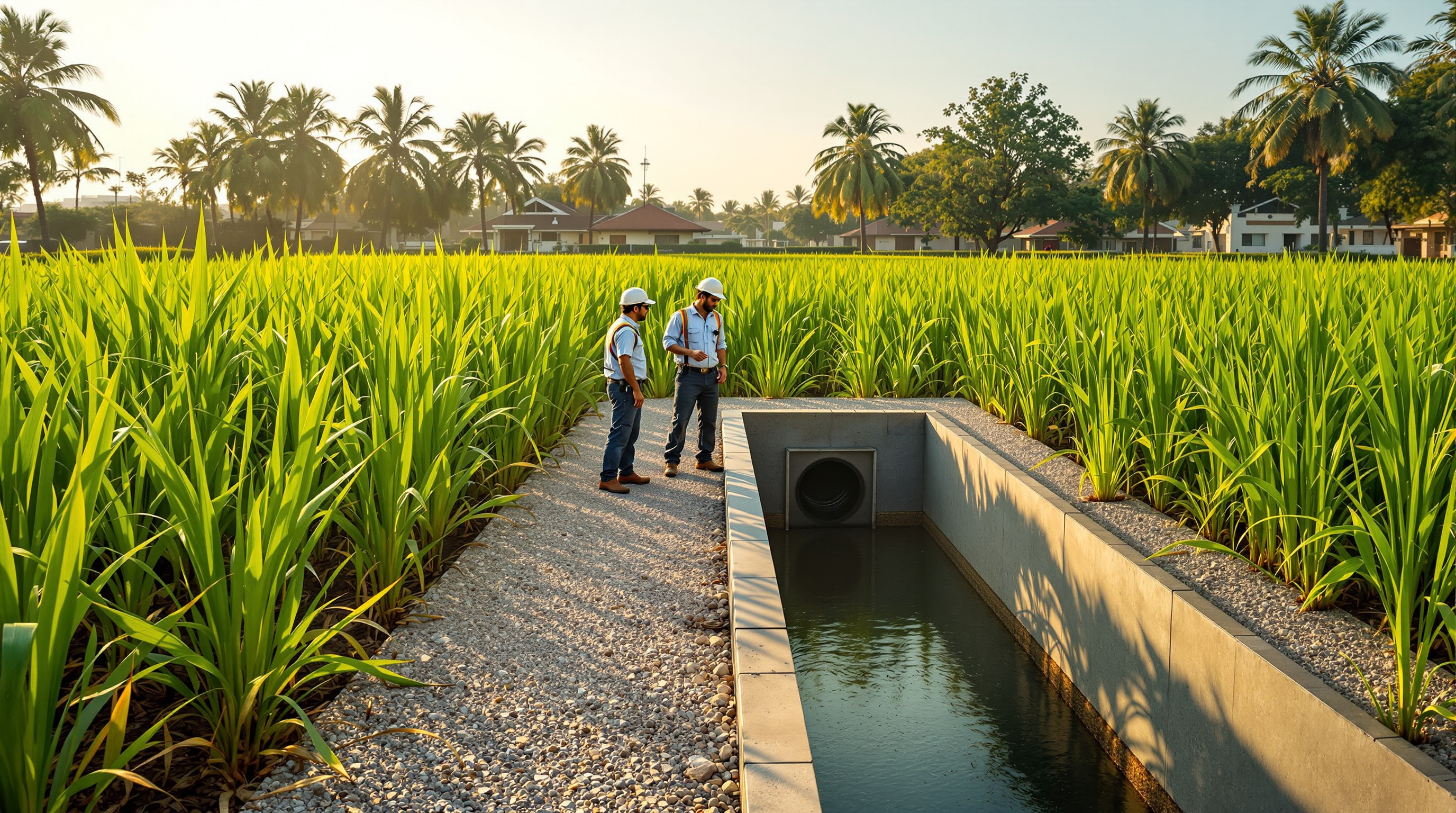
A root zone treatment system is a living filter: sewage flows sideways through a planted gravel bed, and the film of microbes clinging to the roots and stones eats the waste as the water passes. The reeds are not decoration — they are the engine's air supply and support structure.
What "root zone treatment" actually means
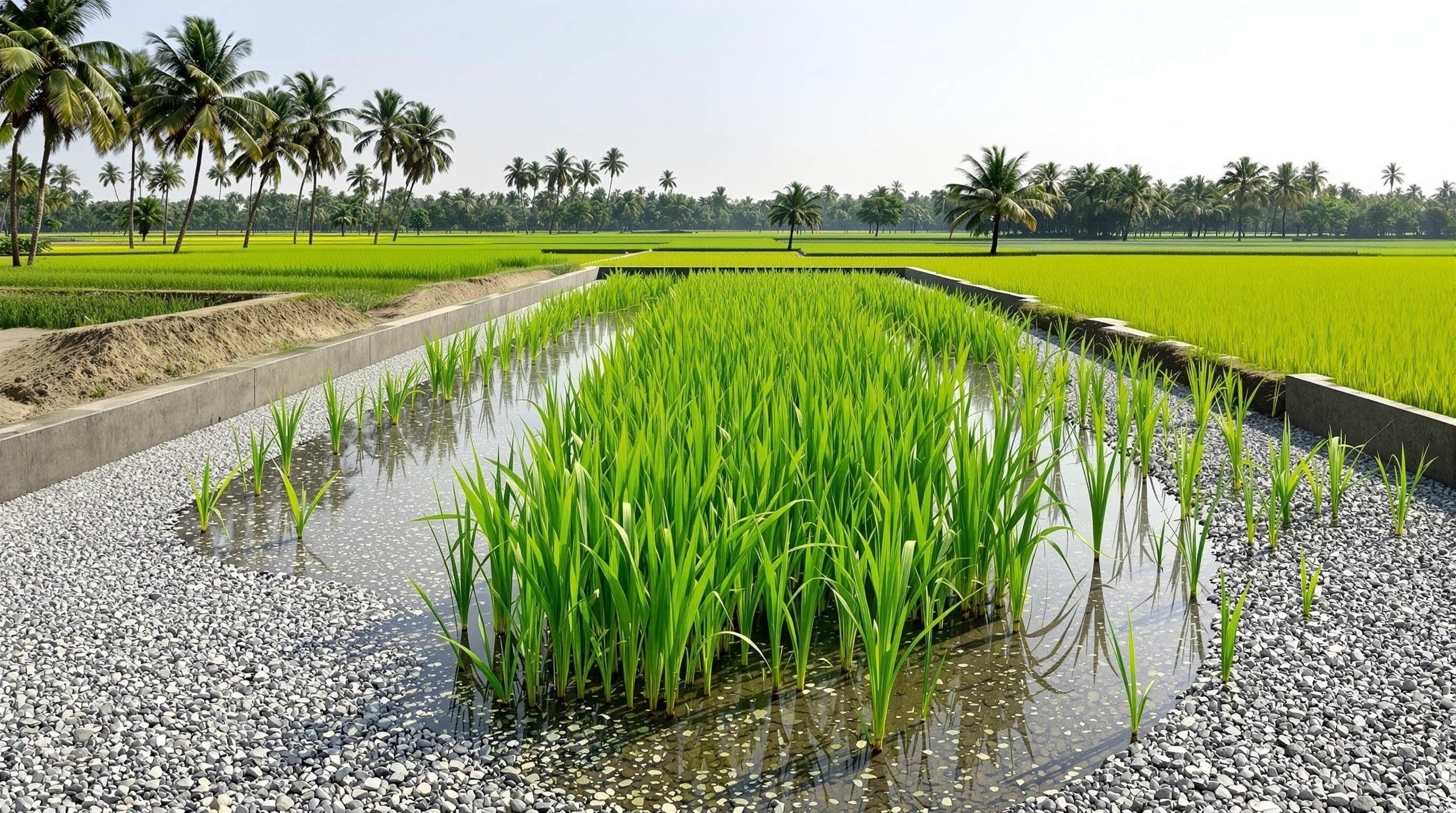
A root zone treatment system (RZTS), also called a reed bed or subsurface-flow constructed wetland, is a shallow lined basin filled with graded gravel or coarse sand and planted with wetland reeds — usually Phragmites, Typha (cattail) or Canna. Pre-settled sewage is fed in at one end and flows horizontally through the gravel, below the surface, to an outlet at the far end. You never see or smell the sewage; the top of the bed looks like an ordinary patch of tall green reeds.
It sits within the wider family of constructed wetlands, and specifically it is the horizontal subsurface-flow type — the water stays below the gravel surface the whole way across, which is what keeps odour and mosquito breeding down.
Two things separate it from a pond or a lagoon:
- The water flows through a solid medium, not open water. The gravel gives microbes an enormous surface to grow on, and keeps the effluent hidden and safe.
- The plants are functional, not ornamental. Reed roots pipe oxygen down into the gravel and give the treating microbes a home. Remove the reeds and the bed slowly clogs and fails.
How the bed cleans the water
The real treatment in a root zone system is done by bacteria, exactly as in a conventional activated sludge process — but instead of living suspended in an aerated tank, they live as a biofilm on the gravel and the reed roots. As sewage seeps past, this film does the work:
- The roots deliver oxygen. Reeds draw air down their hollow stems and leak it out of their fine root hairs into the gravel. This creates tiny oxygen-rich zones around the roots where aerobic microbes break down the organic load (BOD and COD).
- The gravel filters and hosts. Suspended solids are trapped physically in the pore spaces, while the vast wetted surface area of the stones carries most of the microbial population.
- Mixed aerobic and anaerobic zones remove nitrogen. Oxygen-rich pockets near the roots nitrify; the oxygen-starved bulk of the bed denitrifies. That alternation is what lets a well-built reed bed strip nitrogen without any of the tanks and recirculation an engineered plant needs.
- The plants take up a little. Reeds absorb some nitrogen and phosphorus as they grow, though this is a minor share of the total removal — the microbes do the heavy lifting.
A properly loaded and matured reed bed can bring domestic sewage from a raw BOD of 250–350 mg/l down towards single digits, comfortably inside CPCB discharge and reuse expectations for BOD and TSS. Its weak spot is faecal pathogens and, in some cases, phosphorus — which is why almost every reed bed is followed by a small disinfection step before reuse.
A realistic treatment train
A root zone system is almost never used alone. It needs the sewage de-gritted and settled first, or the gravel clogs. A typical Indian train looks like this:
1. Screen and grit removal — catch rags, plastics and sand.
2. Primary settling — a settler or anaerobic baffled reactor drops out the bulk of the solids so they never reach the bed. This step is non-negotiable; solids are what kill reed beds.
3. The root zone bed(s) — one or more subsurface-flow cells, often in series, doing the biological treatment.
4. Disinfection — a compact chlorination or UV unit before the water is stored for reuse.
The honest trade-offs
The reason every building is not on a reed bed comes down to two numbers: land and load. A root zone system trades cheap operation for a large footprint and a slow, forgiving personality that does not suit every site.
| Factor | Root zone treatment system | Conventional aerobic STP (ASP / MBBR / MBR) |
|---|---|---|
| Energy | Very low — often just a feed pump; the bed itself needs no power | High — continuous blowers and pumps dominate the bill |
| Land needed | Large — roughly 1–3 m² of bed per person served | Compact — fits in a basement or a corner of the plot |
| Operating cost | Very low; minimal skilled attention | Higher — power, spares, trained operator |
| Robustness to shock loads | High — absorbs surges and short overloads calmly | Lower — upsets can crash the biology |
| Sludge handling | Minimal; occasional de-silting of the settler | Regular sludge wasting and disposal |
| Startup time | Slow — reeds take a season to establish | Fast — commissioned in days |
| Best fit | Low-rise, land-rich, warm sites | Dense urban, land-scarce sites |
The land figure is the deciding one. At 1–3 m² per person, a 500-person community needs something in the order of 500–1,500 m² of bed — impossible on a tight urban plot, entirely reasonable for a resort, a school campus, a factory township or a peri-urban layout. Use the STP Capacity Calculator to fix your design flow in KLD first, then judge whether the footprint fits your land.
Where a root zone system fits — and where it does not

Good candidates:
- Resorts, farmhouses and eco-projects with land to spare and a preference for a natural, silent, near-invisible system.
- Rural schools, hospitals and institutions where reliable grid power and skilled operators are scarce and a low-maintenance system wins.
- Factory townships and campuses on the urban fringe with generous open land.
- Warm climates — the microbial and plant activity that drives treatment loves India's heat and slows in cold. Most of the country is ideal.
Poor candidates:
- Dense high-rise plots where every square metre is parking or built area — the footprint simply does not exist. A compact MBBR or MBR plant belongs here instead.
- Strong or industrial effluent — reed beds are built for domestic-strength sewage, not chemical loads.
- Sites needing instant commissioning — a bed needs a growing season to reach full performance.
If you are weighing this against a conventional plant, the STP Technology Selector walks the same land-versus-load logic, and the Energy Benchmark Calculator shows just how much the near-zero power draw saves over a plant's life.
Living with a reed bed
Low-energy does not mean no-maintenance. A root zone system stays healthy on a light but non-negotiable regime:
- Keep solids out. De-silt the primary settler on schedule — clogged gravel is the number-one failure mode.
- Manage the reeds. Harvest or cut back the reeds periodically and stop them spreading beyond the bed.
- Rest and rotate. Where two beds exist, alternating feed lets each recover and keeps the gravel from choking.
- Watch the outlet. A steady, clear, odourless discharge means the biofilm is healthy; ponding on the surface is the early warning of clogging.
Done right, the gravel and the reeds keep working for fifteen to twenty years with none of the blowers, spares and power bills that define a conventional STP.
The bottom line
A root zone treatment system is the answer when the site has land but not much appetite for power bills or plant operators. It treats domestic sewage to reuse-grade quality using nothing more exotic than gravel, reeds and the microbes they host — silently, robustly, and at a running cost that a mechanised plant cannot approach. It is not a universal STP; the footprint rules it out of dense city plots. But for the resort, the campus, the institution and the peri-urban layout, it is one of the most elegant and durable ways to turn sewage back into water.
To place it against every other option, browse the Sewage Treatment Plants guide library, and read the companion guide on constructed wetlands for the full wetland family it belongs to.
Export this guide
Related Guides — Deep-dive reading
Constructed Wetlands & Root Zone Systems: Natural STPs Explained
How engineered gravel beds planted with reeds and canna clean sewage using roots and microbes instead of blowers and motors — the low-energy, low-maintenance natural STP, and exactly where it fits in India.
Sewage Treatment PlantsAeration Tank: The Biological Heart of an STP
The tank where blowers push oxygen into billions of microbes that eat the sewage's organic load — how it works, what DO, MLSS, F/M and HRT mean, and why it quietly runs up the biggest electricity bill in the plant.
Sewage Treatment PlantsTrickling Filter Systems in Wastewater Treatment: How Attached-Growth STPs Work
The trickling filter treats sewage by dripping it over a bed of media coated in living biofilm — a low-power, low-maintenance workhorse. Here is how it works, where it fits in India, and how it stacks up against activated sludge.
Sewage Treatment PlantsRelated Tools — Try Free
STP Technology Selector
Weight your priorities — footprint, effluent quality, cost, power and simplicity — and get a scored recommendation between Extended Aeration, MBBR, SBR and MBR.
SelectorApartment STP Planner
Plan an apartment complex sewage treatment plant from flats and occupancy — get population load, sewage flow, recommended STP capacity in KLD, treatment technology and approximate space.
PlannerLift Running Cost Calculator
Monthly and yearly electricity cost of a home lift by type, trips per day and city.
Lift Calculator