
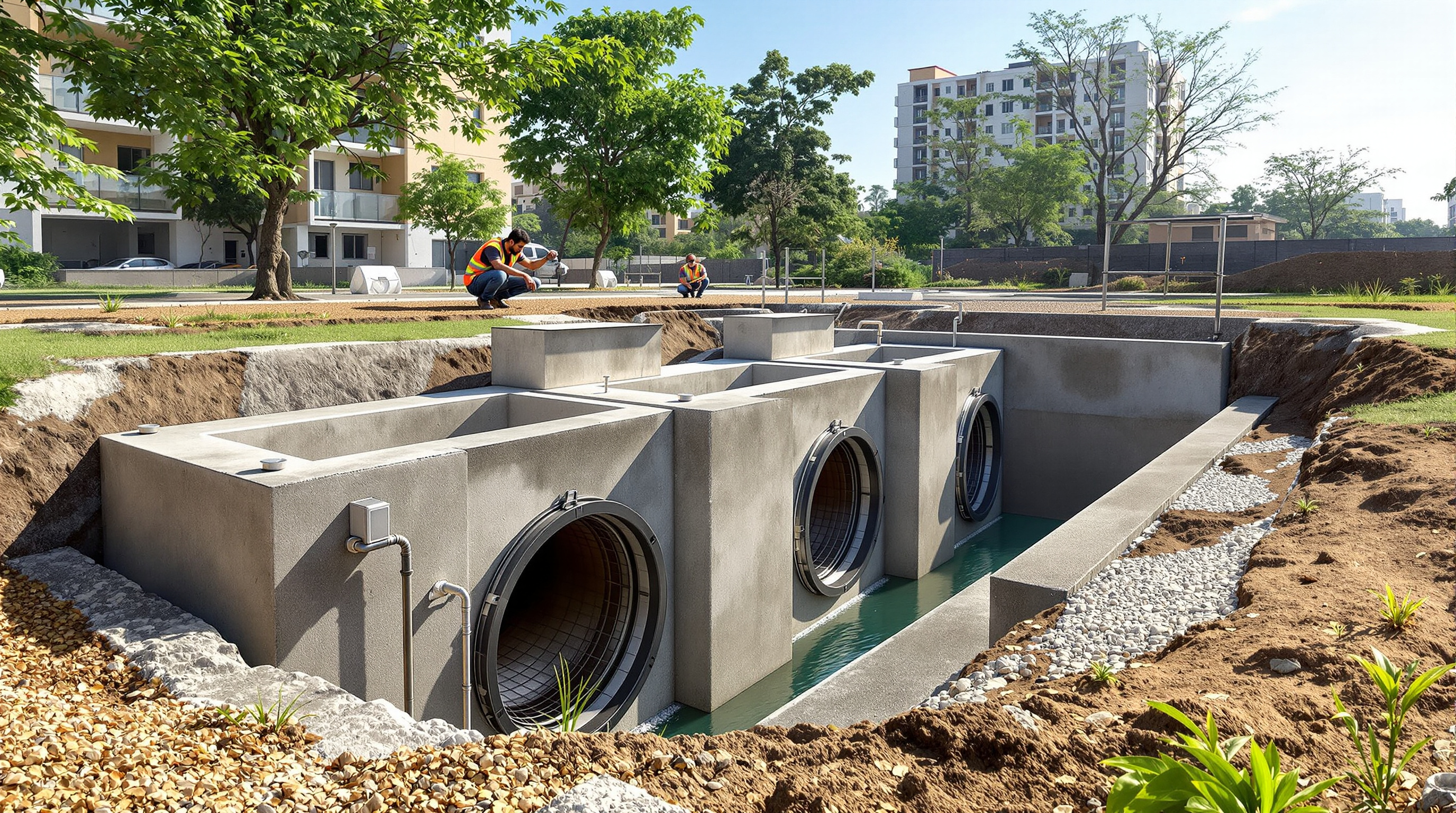
Anaerobic Baffled Reactor (ABR): The Low-Energy Heart of DEWATS Explained
A series of baffled compartments where sewage snakes up and down beneath a blanket of anaerobic sludge, destroying pollution with no power, no moving parts and almost no attention — how the baffles and sludge blanket work, why DEWATS schemes across India are built around it, and why it always needs a polishing step to finish the job.
Almost everything in a modern sewage treatment plant runs on a power supply. Blowers push air day and night, pumps lift water from stage to stage, and that electricity is, in most aerobic plants, the single largest running cost. The Anaerobic Baffled Reactor, or ABR, is a deliberate refusal of all that. It is little more than a long concrete tank divided by walls, buried in the ground, through which sewage flows by gravity alone — no air, no motors, no moving parts inside it — while a community of anaerobic microbes quietly eats the pollution.
Think of it as a septic tank that finally learned to work properly. This guide explains how an ABR actually treats sewage, why the baffles and the sludge blankets are the whole trick, why it has become the low-energy heart of decentralised wastewater treatment (DEWATS) across India, and — just as importantly — why it is never the last word and always hands its water to a polishing step.
An aerobic plant spends electricity to force pollution out of water. An ABR does the opposite: it lets pollution settle into a living blanket of sludge and asks the water to walk through it, slowly, on gravity's dime. What it saves in energy it gives back in patience — anaerobic microbes are slow, and the water they hand you is cleaner than a septic tank's but not yet fit to discharge.
New to the underlying ideas? It helps to first understand what a sewage treatment plant is and how an STP works stage by stage. This guide zooms into one specific, energy-defining technology within that world.
From septic tank to baffled reactor
A conventional septic tank has one fatal weakness: the sewage flows straight across the top while the useful biomass sits at the bottom. The two barely meet. Solids settle and partially digest, but the water leaves largely untreated — which is why a septic tank is a holding device, not a treatment plant.
The ABR fixes this with one idea: force the water to pass through the sludge, not over it. The tank is divided into a series of compartments — typically three to six — by hanging baffles. In each compartment the flow is pushed down a narrow "down-comer" and then made to travel upward through the settled sludge before it can spill over the next baffle and move on. Do this three, four, five times in a row and the sewage is repeatedly dragged through concentrated, active biomass. Each compartment behaves like a small upflow reactor in its own right, and the pollution is stripped out stage by stage.
How an anaerobic baffled reactor works
Picture a rectangular tank, usually buried so the ground surface above stays usable. Sewage enters at one end and leaves at the other, and everything in between is arranged around one motion: repeated upflow through a sludge blanket.
1. Settling first
Raw sewage almost always enters through a settler — a preliminary settling chamber (often the first compartment or a separate tank) that drops out the heavy, grit-like solids. This protects the reactor from clogging and takes the first bite out of the load, much like a primary clarifier in a conventional plant.
2. Up and over, again and again
The settled sewage then begins its snaking journey. In each compartment a baffle directs the flow downward, then the water rises up through a bed of anaerobic sludge that has accumulated on the floor. As it percolates up through this sludge blanket, the wastewater makes intimate contact with a dense population of bacteria that consume the dissolved and suspended organic matter — the BOD and COD. The upflow velocity is kept gentle, typically below 2 metres per hour, so the biomass is not washed out but stays put as a living filter the water must cross.
3. A staged digestion
Because the compartments are in series, the microbial community sorts itself out along the length of the tank. The early chambers, hit with the strongest load, are dominated by acid-forming bacteria; the later chambers, seeing weaker water, favour the slow methane-forming bacteria that finish the job. This natural staging is why an ABR treats dilute domestic sewage more reliably than a single-chamber anaerobic tank, and why it shrugs off shock loads — a surge is absorbed and spread across several compartments rather than hitting one.
4. Gas escapes, water leaves
Digestion releases biogas — mostly methane and carbon dioxide — which bubbles up in each compartment and helps stir the blanket without any mechanical mixer. In small decentralised units this gas is usually just vented and flared rather than collected, though larger installations can capture it. The treated (but still anaerobic) water overflows the final baffle and exits, typically after a hydraulic retention time of roughly 8 to 48 hours depending on strength and temperature.
The whole machine has no internal moving parts, needs no electricity to run, and asks the operator for little more than periodic desludging — often only once every couple of years.
Where the ABR fits: DEWATS

The ABR rarely stands alone. It is the workhorse core of DEWATS — Decentralised Wastewater Treatment Systems — the low-cost, low-energy, gravity-driven approach popularised in India by organisations such as BORDA and the CDD Society out of Bengaluru, and now used for housing layouts, schools, campuses, resorts and small communities across the country.
A classic DEWATS train reads like a relay of passive stages:
- Settler → drops the heavy solids.
- Anaerobic Baffled Reactor → the bulk biological removal, the subject of this guide.
- Anaerobic Filter → a packed-media chamber that catches the finer organic matter the ABR misses.
- Planted gravel filter → a constructed wetland or root-zone treatment bed that polishes the water aerobically and knocks down pathogens.
- Polishing pond → a final holding step before reuse or discharge.
The ABR does the cheap, heavy lifting; the wetland does the finishing. Together they can meet reuse-grade quality with essentially zero energy — the reason DEWATS is so attractive wherever land is available and grid power is unreliable or expensive.
Benefits and limits at a glance
| Advantages | Limitations | |
|---|---|---|
| Energy | Zero power to run — pure gravity flow, no blowers or mixers | No aeration means digestion is slow; biogas usually vented, not recovered |
| Water quality | Solid, cheap bulk removal of BOD/COD across staged chambers | Effluent still anaerobic — always needs an aerobic polishing step |
| Operation | No moving parts inside; very low O&M; long desludging interval | Slow to start up — building a healthy blanket can take weeks to months |
| Robustness | Absorbs hydraulic and organic shocks well | Sensitive to cold; performance drops below ~20 °C |
| Footprint | Buried tank; ground above stays usable | Total footprint grows once the wetland/pond is added |
| Cost | Simple RCC construction, low capital, minimal running cost | Little pathogen or nutrient removal on its own; H₂S odour must be managed |
The catch: it never finishes the job
If the ABR were a complete solution, DEWATS would stop there. It does not, for firm reasons:
- The water is not clean enough alone. An ABR reduces BOD substantially, but its effluent still typically carries a BOD of 50–150 mg/L — well above the discharge and reuse norms CPCB and state boards expect (directionally the 10–30 mg/L band). It removes little in the way of pathogens or nutrients.
- So it always needs post-treatment. In practice the ABR is followed by an aerobic polishing step — a constructed wetland, a sand filter, or an aerated unit — to bring BOD, TSS and pathogens down to standard.
- It is temperature-sensitive. Anaerobic microbes slow in the cold, so an ABR is happiest in India's warm climate and a weaker performer in northern winters.
- It is slow to commission. Growing a mature sludge blanket takes time, and a badly shocked reactor is slow to nurse back.
- Odour must be managed. The biogas carries corrosive, foul-smelling hydrogen sulphide, so venting and odour control are part of the design, not an afterthought.
Where it shines — and where it doesn't

The ABR is at its best treating dilute domestic sewage at small-to-medium decentralised scale in a warm climate, where land for a wetland is available and cutting the power bill to near zero matters. Housing layouts, campuses and resorts on the city edge are its natural home.
It is a poor fit where footprint is tight and there is no room for a polishing wetland — a compact commercial basement, a dense high-rise plot — where a packaged aerobic system like the Activated Sludge Process or a Moving Bed Biofilm Reactor (MBBR) is usually the better answer. Its larger anaerobic cousin, the Upflow Anaerobic Sludge Blanket (UASB), plays the same energy-saving role at full municipal scale.
The bottom line
The anaerobic baffled reactor is one of the quietest good ideas in sewage treatment: a buried, sealed tank divided into a series of baffled compartments that force sewage up and down through blankets of anaerobic sludge, staging the digestion so that each chamber does a little more of the work — all on gravity, with no power and almost no moving parts. It slashes energy and running costs and shrugs off shocks, which is exactly why it sits at the heart of DEWATS across India. The price of that thrift is patience: anaerobic microbes are slow and never quite finish, so an ABR is best understood not as a complete STP but as a superbly cheap first stage that hands its water to a wetland or filter to polish. Used that way, it is one of the smartest low-energy bargains in decentralised wastewater engineering. To place it among the other options, browse the full Sewage Treatment Plants guide library, or size the load first with the STP Capacity Calculator.
Export this guide
Related Guides — Deep-dive reading
Upflow Anaerobic Sludge Blanket (UASB): Anaerobic Sewage Treatment Explained
The no-oxygen reactor where sewage flows up through a blanket of granular sludge, destroying pollution while producing biogas and using almost no energy — how the sludge blanket and gas-solid separator work, why Indian municipal STPs favour it, and why it always needs an aerobic polishing step.
Sewage Treatment PlantsDecentralised Wastewater Treatment Systems (DEWATS): Treatment at Source
What it means to treat sewage where it is produced instead of piping it miles away — the modular, low-energy, gravity-and-anaerobic DEWATS approach, its building blocks, its honest limits, and how STPs fit this philosophy.
Sewage Treatment PlantsConstructed Wetlands & Root Zone Systems: Natural STPs Explained
How engineered gravel beds planted with reeds and canna clean sewage using roots and microbes instead of blowers and motors — the low-energy, low-maintenance natural STP, and exactly where it fits in India.
Sewage Treatment PlantsRelated Tools — Try Free
Cross-Ventilation Analyzer
Estimate airflow and air changes per hour (ACH) from room size, window areas, layout, and local wind — with NBC 2016 Part 8 compliance check.
Ventilation CalculatorHydraulic Retention Time (HRT) Calculator
Compute a reactor or tank's hydraulic retention time from its volume and daily flow, and benchmark it against recommended ASP, MBBR and SBR ranges.
STP CalculatorLift Running Cost Calculator
Monthly and yearly electricity cost of a home lift by type, trips per day and city.
Lift Calculator