
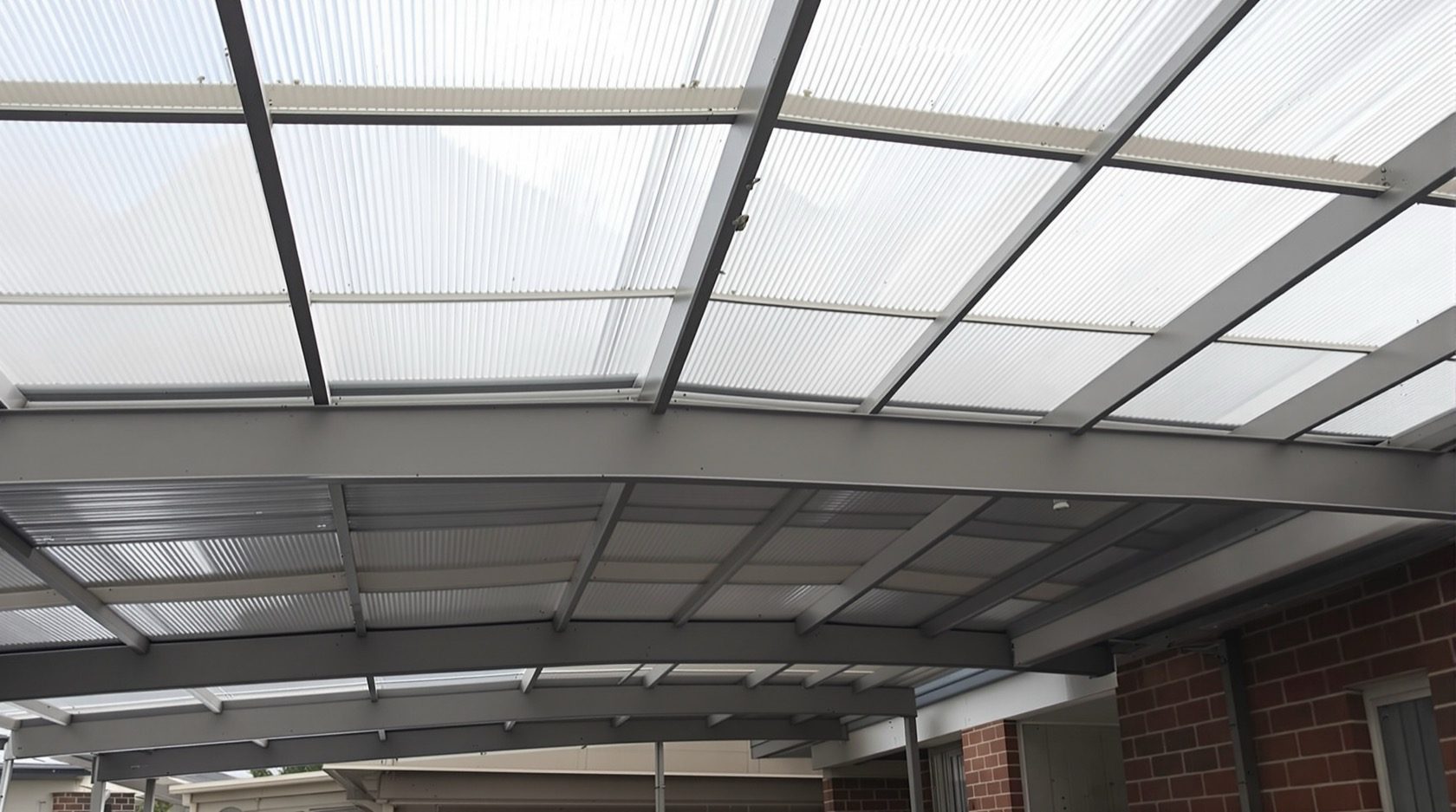
The Roofing Sheets Guide (Non-Metal)
The light, cheap, quick sheets that roof India's verandahs, car porches, sheds and utility spaces — fibre-cement (AC), polycarbonate, FRP, PVC and uPVC, bituminous and translucent daylighting sheets. What each is, how much light and heat it lets through, what it costs, how long it lasts, and the fragile-roof safety every one of them demands. Plain language, India-grounded.
Not every roof is a house roof. Over the car porch, the back verandah, the wash area, the cycle stand, the workshop and the little utility lean-to, most Indian homes carry a lightweight sheet roof — a thin skin of fibre-cement, polycarbonate, FRP or plastic fixed to a light steel or timber frame. These sheets are cheap, quick to fix and often let daylight through, which is exactly why they cover the secondary, semi-open parts of a home so well. What they are not is a substitute for a proper RCC, tiled or metal roof over your living rooms.
This is the non-metal sheet chapter of the Roofing Knowledge Hub and a companion to The Ultimate Guide to Roofing Systems. (For steel, Galvalume and colour-coated sheet, see the separate metal roofing guide.) It walks each family of non-metal sheet in turn — fibre-cement (the old "AC" sheet), solid and multiwall polycarbonate, FRP, PVC and uPVC, bituminous corrugated sheet, and the translucent daylighting sheets that let a verandah glow — and for each one gives you the plain facts: what it is, how it looks, how much light and heat it passes, what it costs, how long it lasts, where it shines and where it fails. It ends with the one warning that unites them all: many of these are fragile roofs you must never walk on.
Scope & safety. This guide helps you understand, plan, choose and judge a non-metal sheet roof. Designing the supporting structure, spacing the purlins, calculating wind-uplift on a light roof and specifying the tie-down fixings are qualified work for a structural engineer; erecting the frame, fixing the sheets and any work at height are for a licensed roofing contractor. Several of these sheets — fibre-cement and thin plastics especially — are fragile roofs that will not bear a person's weight; never walk on them, and let a professional using crawl boards and a harness do any access. Nothing here replaces a site-specific design or an on-site professional.
First, the honest framing: where sheets belong
Sheet roofs earn their place on the parts of a home that are secondary, semi-open or low-budget. They are light, so they need only a modest frame; they are large, so they go up in a day; and many are translucent, so they roof a space without making it a cave. But their thinness is also their limit — most are noisy in rain, poor insulators, and far shorter-lived than a masonry or tiled roof.
The rule of thumb is simple: sheets for the shed, tiles or RCC for the home.
| Good fit for sheets | Poor fit for sheets |
|---|---|
| Car porch, two-wheeler stand | Bedrooms, living room, kitchen |
| Back verandah, wash / utility yard | Any air-conditioned room |
| Cycle shed, storeroom, workshop | A roof you want to walk on or use |
| Staircase headroom cover, side passage | A room needing quiet and good insulation |
| Temporary, low-cost or industrial roofs | A 50-year, maintenance-free roof |
| Semi-open spaces wanting daylight | The primary roof of the house |
Read every material below through that lens. A sheet that is perfect over a porch would be a poor choice over a bedroom — and none of these is a walkable, usable roof.
The sheet families at a glance
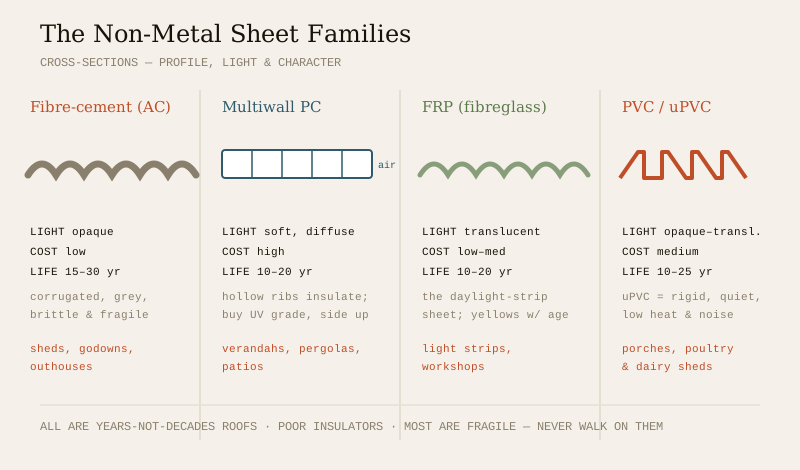
Six families cover almost every non-metal sheet roof in India. Here is the shape of the field before we take each in turn.
| Sheet | What it is | Light | Relative cost | Typical life* |
|---|---|---|---|---|
| Fibre-cement (AC) | Cement + cellulose/other fibre, corrugated | Opaque | Low | 15–30 yr |
| Polycarbonate (solid) | Tough clear/tinted plastic, glass-like | Translucent–clear | High | 10–20 yr |
| Polycarbonate (multiwall) | Hollow twin/triple-wall plastic panel | Translucent, diffused | High | 10–20 yr |
| FRP | Fibreglass-reinforced polyester | Translucent–opaque | Low–medium | 10–20 yr |
| PVC / uPVC | Plastic profiled sheet (uPVC often multi-layer) | Opaque to translucent | Medium | 10–25 yr |
| Bituminous | Bitumen-saturated fibre, corrugated | Opaque | Low–medium | 10–20 yr |
\Indicative service life with good detailing, the right grade and normal maintenance — real life depends on UV exposure, product quality and upkeep. All figures are far shorter than a tiled or RCC roof.*
Notice two patterns. First, the translucent sheets (polycarbonate, FRP, some PVC) are the ones you choose when you want daylight; the opaque ones (fibre-cement, bituminous) you choose for shade and economy. Second, every one of these lifespans is measured in years, not decades — sheets are a periodic-replacement roof, not a lifetime one.
Fibre-cement (AC) sheets — the workhorse
For generations the default cheap roof in India was the asbestos-cement (AC) sheet — the grey corrugated sheet on countless factories, sheds, godowns and outhouses. Because asbestos fibre is a serious health hazard (banned or restricted in many countries and being phased down here), today's product is increasingly non-asbestos fibre-cement, using cellulose or other fibres in the same cement matrix. The look and use are the same; the fibre is safer. When buying, insist on the non-asbestos grade.
Fibre-cement is opaque, so it gives full shade; it is non-combustible and does not corrode like bare metal; it stays cooler and quieter under sun and rain than a thin metal sheet; and it is genuinely cheap. Its weaknesses are that it is heavy and brittle — it cracks if walked on or struck, which makes it a classic fragile roof — it can grow moss and look tired, and old asbestos sheet must be handled and disposed of as hazardous waste, never broken up casually.
| Property | Fibre-cement (AC) sheet |
|---|---|
| Look | Grey, corrugated, utilitarian |
| Light | Opaque — full shade |
| Cost | Low |
| Life | 15–30 yr |
| Strengths | Cheap, non-combustible, cool & quiet-ish, no rust |
| Weaknesses | Brittle & fragile, heavy, moss, asbestos legacy |
| Best use | Sheds, godowns, factories, utility outhouses |
Fibre-cement corrugated sheets are made to IS 459; cellulose/non-asbestos fibre-cement sheets fall under IS 14862 / IS 15914 families, and the general workmanship of laying sheet roofs is covered by IS 3007. Confirm the exact grade and current edition with the manufacturer and the BIS catalogue.
Polycarbonate — solid and multiwall
Polycarbonate is the premium translucent sheet: a tough, glass-clear (or tinted) plastic that is famously near-unbreakable — it is the material of riot shields and greenhouse glazing. It comes in two forms. Solid polycarbonate is a single flat or corrugated sheet, glass-like and clear, used for skylights, pergola covers and stylish porch roofs. Multiwall (twin-wall, triple-wall) is a hollow panel with internal ribs — lighter, cheaper, better insulating and softly diffusing, so it spreads a gentle even light rather than a harsh glare.
Its strengths are real: high light transmission (you can have a bright, glowing verandah), extreme impact resistance, light weight, and easy cold-curving into arched porches and walkways. Its weaknesses are equally real: it is the most expensive of these sheets; cheap grades yellow and go brittle under UV within a few years unless they carry a proper UV-protective co-extruded layer (always specify UV-protected polycarbonate and fit it UV-side up); it expands and contracts a lot with heat, so it needs oversized fixing holes and correct spacing; and being clear, it lets solar heat straight through unless tinted or multiwall.
| Property | Solid PC | Multiwall PC |
|---|---|---|
| Look | Glass-like, clear | Ribbed panel, diffused |
| Light | Clear to tinted, high | Diffused, softer |
| Insulation | Poor (single skin) | Better (air cavity) |
| Cost | High | High (a bit less) |
| Life | 10–20 yr (UV grade) | 10–20 yr (UV grade) |
| Best use | Skylights, feature porches, curved walkways | Pergolas, verandahs, patios wanting soft light |
The single most important rule with polycarbonate: buy the UV-protected grade and lay it UV-side up. A no-name, non-UV sheet is cheaper for a reason — it will yellow, craze and crack within a couple of monsoons.
FRP, PVC and bituminous sheets
Three more families round out the field, each with a clear niche.
FRP (fibreglass-reinforced plastic) is a polyester resin reinforced with glass fibre, made as corrugated or profiled sheet that can be clear, translucent or opaque and coloured. Cheaper than polycarbonate, it is the traditional translucent light-strip sheet — a run of FRP among opaque sheets to let daylight into a shed — and it resists many chemicals, so it suits workshops. Its downsides: it yellows and loses light with age, its surface can degrade and "fibre-bloom" as the resin weathers, and it is less impact-resistant than polycarbonate.
PVC and uPVC sheets are all-plastic. Ordinary PVC is a cheap, flexible, often translucent corrugated sheet. Better uPVC (unplasticised PVC) roofing sheets are rigid, multi-layer profiled sheets engineered for roofing — low heat transmission, low noise, good corrosion and chemical resistance, and a longer life than plain PVC. uPVC has become popular for car porches, poultry and dairy sheds and factory canopies where its heat and sound insulation beat metal. The watch-outs: cheaper PVC can become brittle and discolour under strong UV, and plastics carry fire considerations, so check the product's fire rating for the use.
Bituminous sheets (corrugated bitumen, the best-known brand being one imported type) are made from cellulose or glass fibre saturated with bitumen. They are lightweight, flexible, quiet in rain and easy to cut and fix, and come in colours — useful for a light, curved or DIY-friendly porch or a re-roof over an old frame. They are opaque, mid-priced, and their life and colour-hold depend heavily on grade and sun exposure.
| Sheet | Light | Cost | Life* | Best use | Watch-out |
|---|---|---|---|---|---|
| FRP | Translucent–opaque | Low–med | 10–20 yr | Daylight strips, workshops | Yellows, fibre-bloom |
| PVC | Translucent | Low–med | 10–15 yr | Temporary, cheap covers | Brittle in UV, fire |
| uPVC | Opaque–translucent | Medium | 15–25 yr | Porches, poultry/dairy sheds | Cost vs plain PVC |
| Bituminous | Opaque | Low–med | 10–20 yr | Light, curved, DIY porches | Colour fade, softening in heat |
\Indicative — grade, UV exposure and fixing quality dominate.*
Reading the roof: light, heat and noise
Because these are thin single skins, three comfort factors decide how a sheet roof actually feels to sit under — and they trade off against each other.
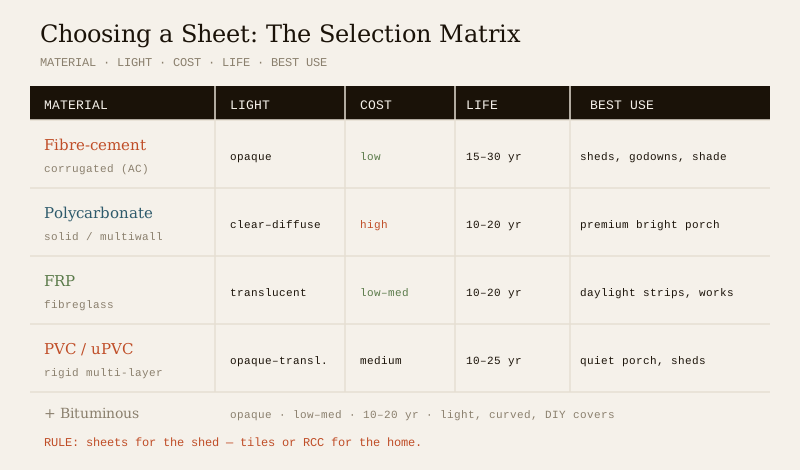
- Light. Translucent sheets (polycarbonate, FRP, clear PVC) turn a porch into a bright, usable space without electric light by day — wonderful for a plant verandah or a workshop. But light and heat travel together: a clear sheet that floods a space with daylight also lets solar heat pour in. Multiwall polycarbonate and tinted or opal sheets are the compromise — good diffused light, less heat.
- Heat. A single thin sheet is a poor insulator; a clear one is a small greenhouse. If the space matters, choose an opaque or tinted sheet, a multiwall panel with its insulating air cavity, or add an air gap and a reflective under-layer. This is why you never sheet-roof an air-conditioned room — see the roof insulation guide.
- Noise. Rain on a thin sheet is loud. Fibre-cement and uPVC are among the quieter options; bare metal and thin PVC the loudest. For anything but a shed, quietness is worth paying for.
| Want | Choose | Avoid |
|---|---|---|
| Maximum daylight | Clear solid polycarbonate, clear FRP | Fibre-cement, bituminous |
| Soft light + less heat | Multiwall PC, opal / tinted sheet | Clear single-skin sheet |
| Coolest shade | Fibre-cement, tinted uPVC | Clear polycarbonate / PVC |
| Quietest in rain | Fibre-cement, uPVC | Thin PVC, single-skin plastic |
The design move on a real verandah is often a mix: mostly opaque or tinted sheet for shade, with a strip or two of translucent sheet placed to bring in daylight where you want it.
Fixing, frame and the fragile-roof warning
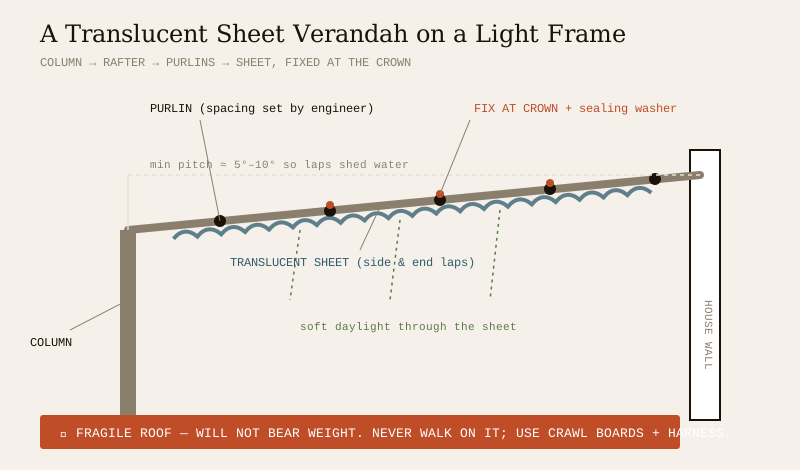
A sheet roof is only as good as the frame under it and the fixings through it. Because sheets are light, their great structural enemy is not weight but wind uplift — a gust getting under a shallow sheet roof can peel it off. The details that matter:
- The frame and purlin spacing. Sheets span between purlins (light steel tubes, angles or timber). Each sheet has a maximum allowed purlin spacing — exceed it and the sheet sags, cracks or flexes in the wind. The engineer sets the spacing and, critically, the tie-down fixings for your wind zone.
- Laps and slope. Sheets overlap at the sides (side lap) and ends (end lap), and need a minimum pitch — typically around 5°–10° — so water runs off the laps and does not creep back under them. Too shallow and a sheet roof leaks at every lap.
- Fix at the crown, with washers. Screws or hook-bolts go through the top of the corrugation (the crown), not the valley where water runs, and always with a sealing washer. Fixing through the valley invites a leak at every screw.
- Room to move. Plastics expand and contract a lot with heat, so fixing holes are drilled oversize and screws are not overtightened — pin a plastic sheet rigidly and it will crack or buckle.
And the warning that governs all of them: most of these are fragile roofs. Fibre-cement and thin plastic sheets will not carry a person's weight — every year people fall through corroded or brittle sheet roofs. Never walk on a sheet roof to clean, repair or access it; a professional must use crawl boards spanning the purlins and a safety harness. Treat a sheet roof as something you look at from below, never stand on.
The one-line answer
Non-metal roofing sheets — fibre-cement (AC), solid and multiwall polycarbonate, FRP, PVC/uPVC and bituminous — are the light, cheap, quick-to-fix skins that roof India's porches, verandahs, sheds and utility spaces, and several of them let daylight through, which no tiled or RCC roof does. Choose opaque fibre-cement for cool cheap shade, UV-protected polycarbonate (multiwall for soft light and less heat) for a premium glowing verandah, FRP for cheap daylight strips, uPVC for a quiet insulated porch, and bituminous for a light DIY-friendly cover — remembering that every one is a years-not-decades roof, poor at insulation and noisy in rain, that most are fragile roofs you must never walk on, and that they belong over the secondary parts of a home, not over the rooms you live in. Give the frame, purlin spacing, wind tie-downs and any work at height to a structural engineer and a licensed roofing contractor.
Where to go next
- The whole subject in one map: The Ultimate Guide to Roofing Systems.
- The metal cousins of these sheets: Metal Roofing Guide.
- The roofs these sheets are not a substitute for: RCC Roof Guide · Clay Roof Tiles Guide.
- The shape most sheet roofs take: Sloping Roof Design Guide.
- Keep a sheeted space cool and quiet: Roof Insulation Guide.
- The whole library: Roofing Knowledge Hub.
References
- National Building Code of India (SP 7), Bureau of Indian Standards — Part 6 (Structural Design) and Part 3 (General Building Requirements), for the supporting structure and wind loads on light roofs; verify the current edition via the BIS catalogue.
- IS 459: Corrugated and Semi-corrugated Asbestos-Cement Sheets — Specification (fibre-cement roofing sheets), Bureau of Indian Standards.
- IS 14862 / IS 15914: Fibre-Cement (Cellulose / non-asbestos) Flat and Corrugated Sheets — Specification, Bureau of Indian Standards.
- IS 3007 (Part 1 corrugated, Part 2 semi-corrugated): Code of Practice for Laying of Asbestos-Cement Sheets — the workmanship of sheet roofing, Bureau of Indian Standards.
- IS 12093: Corrugated Bitumen Roofing Sheets — Specification (bituminous sheets); IS 875 (Part 3): Wind Loads — for uplift on light sheet roofs. Verify current status via the BIS catalogue: https://www.services.bis.gov.in/
This is an educational overview. Structural design of the frame, purlin spacing, wind-uplift calculation, fixing and tie-down specification, sheet fixing and any work at height are qualified professional work — and most non-metal sheets are fragile roofs that will not bear a person's weight. Engage a structural engineer and a licensed roofing contractor for your project, and verify any standard's current status via the BIS catalogue before relying on it.
Export this guide
Related Guides — Deep-dive reading
Industrial Shed & Warehouse Roofs: Big Spans, Metal Decks & Daylight (India)
The factory, warehouse and godown roof is a different animal — huge column-free spans on steel portal frames, clad in profiled metal, fighting heat and harvesting daylight, rain and solar. How to specify, run and safely look after it in India.
RoofingThe Metal Roofing Guide
The fast, light, long-spanning roof — GI, Galvalume and colour-coated steel, aluminium, standing-seam, stone-coated and insulated panels; the profiles and coatings; and the four things that make or break metal in India — coastal corrosion, condensation, rain noise and heat. Plain language, India-grounded.
RoofingRoof Access & Walkways
Someone will need to get onto your roof several times a year — to clear a drain, service the tank, wash the solar panels, check the waterproofing. Access designed into the house is far safer and cheaper than a ladder propped against a wall. This guide covers the ways up (mumty stairs, fixed ladders, hatches, loft ladders), the ways around (walkways and duckboards over fragile or waterproofed surfaces), and the guardrails and anchor points that make maintenance safe.
RoofingRelated Tools — Try Free
Full-Room BOQ — Living, Bedroom, Kitchen, Bath
Room-wise BOQ across living, bedrooms, kitchen, utility, and bathrooms with line-item pricing.
Full-Room BOQMonsoon-Readiness Checklist
Pre-rain home audit across 9 categories — terrace, drains, waterproofing, electrical, HVAC, pest, vehicles, documents.
Seasonal AuditFalse Ceiling Cost Estimator
Live ₹/sqft across 8 ceiling types — POP, gypsum, designer, metal, PVC, wooden — with cove and spot lighting for 20 Indian cities.
Cost Calculator