
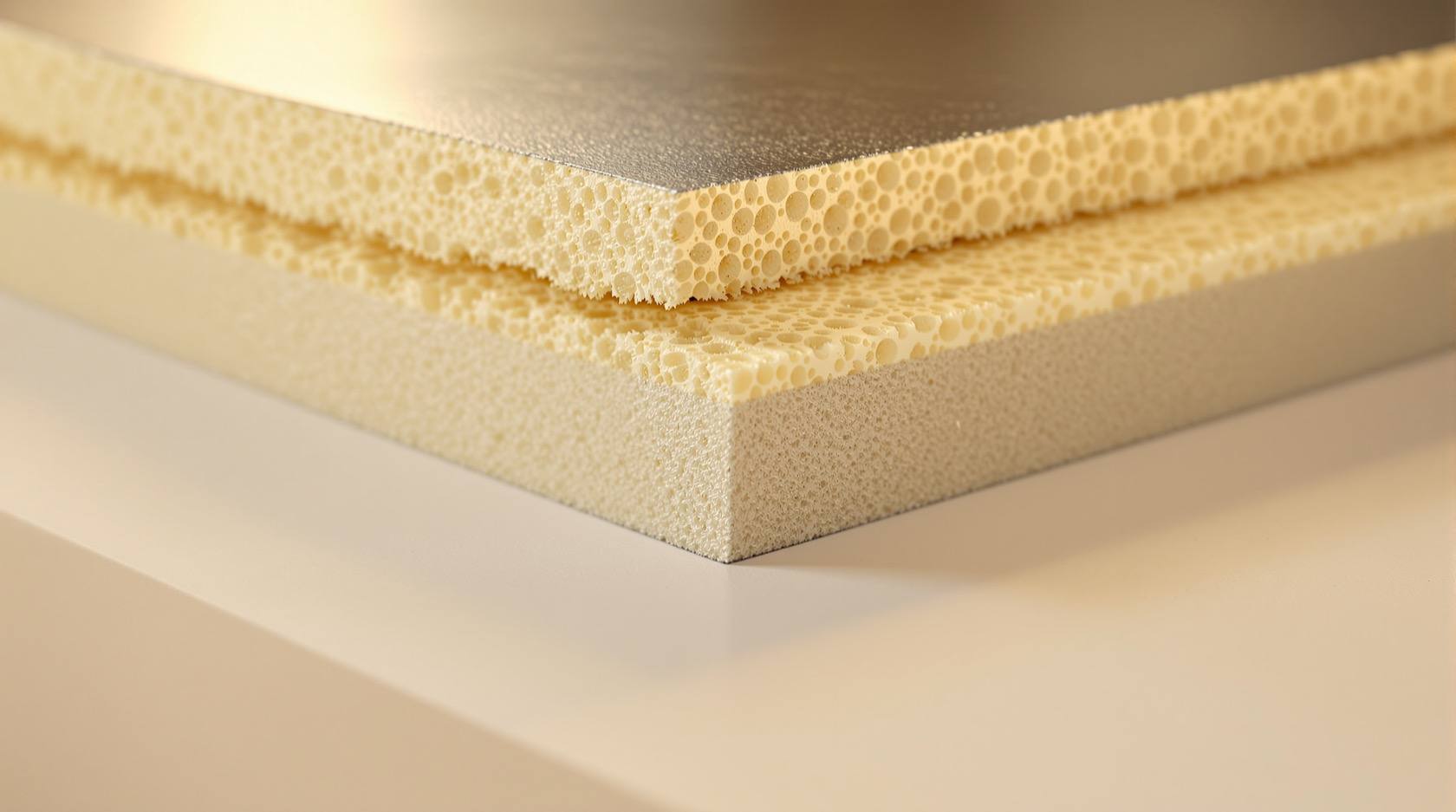
PU & PIR Foam Insulation in India: Boards, Sandwich Panels & Spray Foam (2026)
A specifier's guide to polyurethane (PUF) and polyisocyanurate (PIR) rigid foam - the highest R-value per inch of the common insulations - covering boards, sandwich panels and spray foam, their fire behaviour, cost and where each form actually belongs.
When a roof or wall has very little depth to spare but still needs to stop heat, the polyurethane family is usually the answer. Rigid polyurethane (PU or PUF) and its improved cousin polyisocyanurate (PIR) deliver the highest insulating value per inch of any mainstream insulation sold in India - which means the thinnest build-up for a given performance. That is why they dominate cold storage, prefab sandwich panels and pre-engineered steel roofs, and why they are the go-to for tight retrofits where every millimetre counts.
This guide helps you choose and specify the right PU or PIR product: what these foams are, the three forms they come in, how they compare with wools and other foams, and - critically - the fire and installation cautions that must be respected. It does not teach you to spray or fabricate them.
Scope and safety: This is a selection guide. Costs, conductivity figures and thicknesses here are indicative only - foam prices move with oil rates, brand and panel spec, so always get local quotes. Fire compliance, structural fixing of panels, and above all spray foam application are specialist jobs: hand them to a qualified installer, fire consultant or structural engineer. Nothing here replaces the IS codes, the NBC (SP 7:2026) or a licensed professional.
What PU and PIR foams actually are
Both are thermoset plastic foams made by reacting a polyol with an isocyanate. The reaction traps millions of tiny sealed gas pockets, producing a rigid, closed-cell structure. "Closed-cell" is the key phrase: because the cells do not interconnect, the foam barely absorbs water and resists vapour far better than open, fibrous insulations. The trapped low-conductivity blowing gas is what gives these foams their exceptional thermal performance.
PU (polyurethane, PUF) is the original chemistry - decades of use in cold chain, appliances and building panels.
PIR (polyisocyanurate) is a refinement: by running the reaction with an excess of isocyanate, the foam forms tougher, more heat-stable chemical rings. In plain terms, PIR is a higher-fire-performance, higher-temperature cousin of PU - it chars rather than melting away as readily, holds up better at elevated temperatures, and is usually specified where fire behaviour matters more. For most thermal purposes the two perform similarly; the difference shows up under heat and flame.
The headline strength: highest R-value per inch
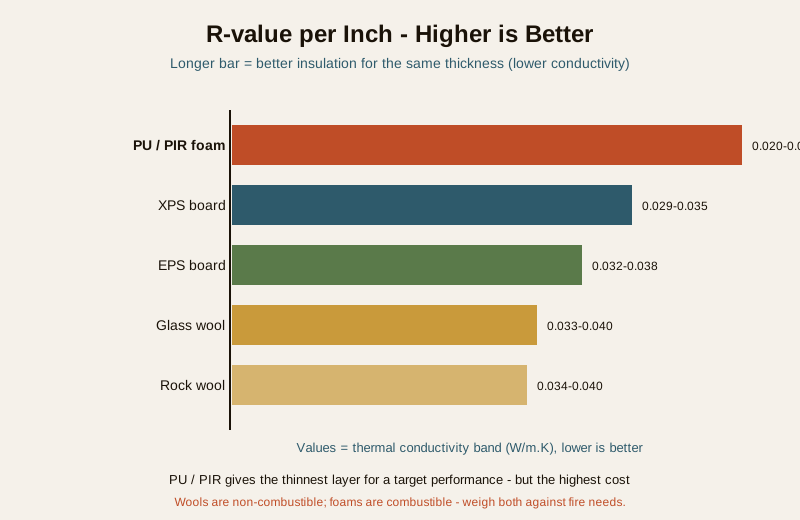
Insulation is ranked by thermal conductivity (lower is better) or its inverse, R-value per unit thickness (higher is better). PU and PIR sit at the top of the common-materials table with a conductivity of roughly 0.020 to 0.025 W/m.K, versus about 0.030 to 0.035 for XPS and EPS, and 0.033 to 0.040 for mineral wools. Translated to the site: a PU or PIR board does the same job as a noticeably thicker slab of wool, XPS or EPS.
That thinness is the whole commercial case. In a cold room you gain storage volume; on a PEB roof you cut panel weight and depth; in a retrofit you can insulate a slab or terrace without losing usable height. To size a real build-up for your climate and target, run the numbers through our insulation R-value calculator, then confirm the specification with your supplier.
The three forms - and where each belongs
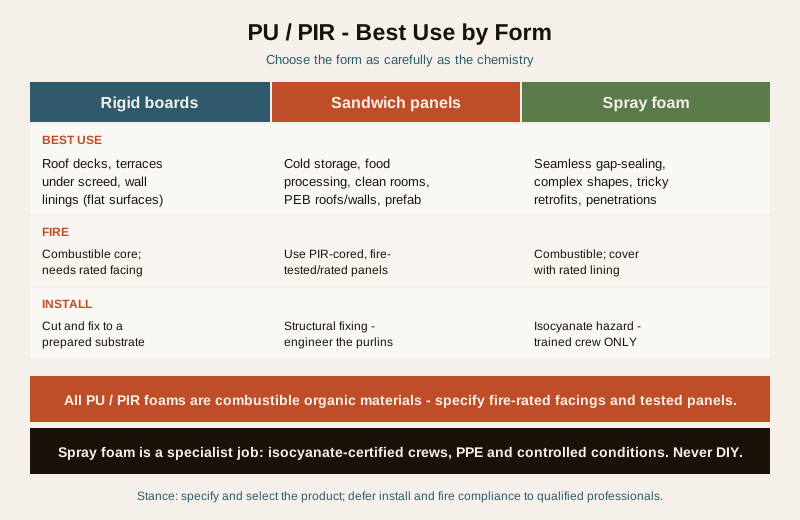
PU and PIR reach the site in three quite different formats. Choosing the form is as important as choosing the chemistry.
1. Rigid boards
Factory-made foam boards, often with foil or fleece facings, are used over roof decks (over-deck insulation), under metal roofs, on terraces below a screed, and as a warm layer inside wall linings. Foil-faced PIR boards double as a partial vapour and radiant barrier. Boards are the tidy, predictable, dimensionally-stable choice for flat and simple surfaces.
2. Sandwich (insulated) panels
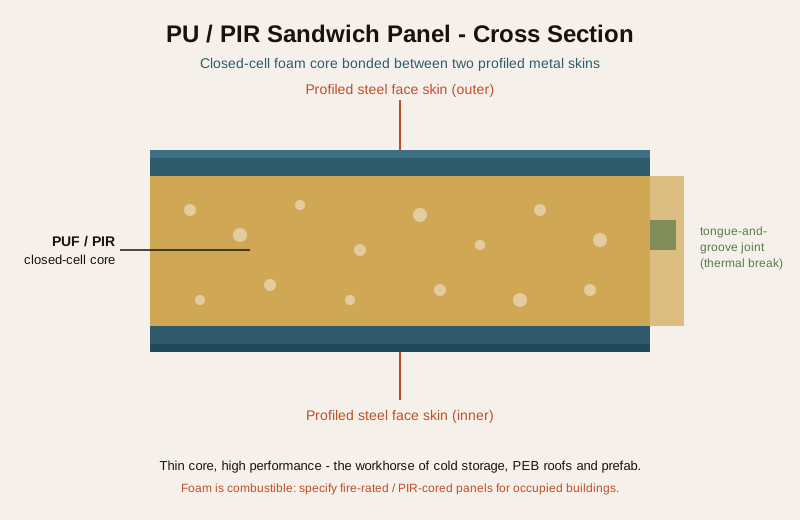
This is the form most people picture: a foam core bonded between two profiled metal skins to make a single structural, insulating, weatherproof element. PUF and PIR sandwich panels are the workhorse of cold storage, food processing, clean rooms, prefab cabins and pre-engineered building (PEB) roofs and walls. The panels interlock with tongue-and-groove joints, install fast, and arrive as a finished surface. PIR-cored panels are specified where a better fire rating is required.
3. Spray foam (in-situ)
Spray polyurethane foam (SPF) is mixed and sprayed as a liquid that expands and cures in place, forming a seamless, gap-sealing layer that follows any shape - the undersides of complex roofs, around penetrations, into irregular retrofit cavities. Its unique strength is air-sealing: it stops the draughts and thermal bridges that boards leave at joints. But spray foam is emphatically not a DIY product. It is a two-part chemical reaction involving isocyanates, and applying it demands trained crews, respiratory and skin protection, controlled ventilation and correct substrate prep. Poor application traps moisture or leaves it under-cured. Treat spray foam as a specialist install, always.
PU versus PIR - when the difference matters
| Property | PU / PUF | PIR |
|---|---|---|
| Thermal conductivity | Very low (about 0.022 to 0.025 W/m.K) | Very low, similar or slightly better |
| Fire behaviour | Combustible; softens and melts sooner | Combustible but chars; better flame and smoke behaviour |
| Temperature tolerance | Good to moderate service temperatures | Higher - holds up better at elevated temperatures |
| Typical use | Cold storage, appliances, general panels and boards | Panels and boards where fire rating is prioritised |
| Relative cost | Baseline | Slightly higher |
| Closed-cell, low water uptake | Yes | Yes |
The practical rule: default to PIR where fire performance is a stated requirement - occupied buildings, escape routes, anywhere a facade or roof fire spec applies. Use PU where the priority is pure thermal or cold-chain performance and the fire strategy is handled by other means. Either way, the facings, compliance and fire strategy are a professional's call, not a catalogue choice.
How PU/PIR compares with the other insulations
| Material | Conductivity (W/m.K) | R-value per inch | Water resistance | Fire behaviour | Relative cost | Best for |
|---|---|---|---|---|---|---|
| PU / PIR foam | 0.020 - 0.025 | Highest | Excellent (closed-cell) | Combustible (PIR chars better) | High | Thin, high-performance roofs, panels, cold rooms |
| XPS board | 0.029 - 0.035 | High | Excellent | Combustible | Medium-high | Below-grade, inverted roofs, wet zones |
| EPS board | 0.032 - 0.038 | Good | Good | Combustible | Low-medium | Budget board insulation, ICF, screeds |
| Glass wool | 0.033 - 0.040 | Moderate | Poor (needs protection) | Non-combustible | Low | Ceilings, partitions, acoustics |
| Rock wool | 0.034 - 0.040 | Moderate | Poor (needs protection) | Non-combustible, high fire rating | Medium | Fire-rated and high-temperature work |
Read this alongside its neighbours: XPS insulation, EPS insulation, rock wool and glass wool. The trade-off is plain - PU and PIR buy you the thinnest, best-performing, most water-resistant layer, at the highest material cost and with the poorest inherent fire behaviour among these. Where non-combustibility is the overriding need, a mineral wool is the honest choice; where thinness and moisture resistance rule, PU/PIR wins.
The fire caution you must not skip
PU and PIR are organic plastics - they are combustible. Under fire they can ignite and, if unprotected, contribute fuel and smoke. PIR behaves better than PU because it chars and resists flame spread, but neither is inherently non-combustible like a mineral wool. This is the single most important limitation of the family, so specify accordingly:
- Foam must sit behind a fire-rated facing or lining appropriate to the building - not left exposed in occupied spaces.
- Sandwich panels for occupied or high-risk buildings should be the PIR-cored, fire-tested grades, with documented ratings - never unrated commodity panels.
- Fire strategy, compartmentation and compliance with the NBC (SP 7:2026) and relevant IS fire standards are engineering and consultant decisions. Insist on tested products with certificates; do not accept fire performance on a salesperson's word.
Cold-storage and warehouse fires involving unrated foam panels are a well-known hazard precisely because this caution gets skipped. Respect it.
Installation and health - a specialist's territory
Beyond fire, two execution points are non-negotiable. First, spray foam involves isocyanates, which are respiratory and skin sensitisers; application needs trained, protected crews and controlled conditions - it is never a homeowner job. Second, panel and board fixing is structural: purlin spacing, fastener selection, joint sealing and wind-uplift resistance all matter, and get them wrong and you have a leaking or failing roof. Both belong to a qualified installer and structural engineer. Your job is to specify the right product and demand certificates and proper detailing.
Indicative cost
As a rough guide, PU/PIR boards run higher per square foot than EPS or XPS for the same thickness - but because you need less thickness, the installed gap can narrow. Sandwich panels are priced per square foot by core thickness (commonly 30 to 100 mm) and skin gauge. Spray foam is quoted per square foot at a target thickness and includes the specialist crew. Treat all of these as starting points and get written local quotes, since foam pricing tracks crude oil and panel specification closely.
Key takeaways
- PU (PUF) and PIR are rigid, closed-cell foams with the highest R-value per inch of common insulations - the thinnest build-up for a given performance, plus excellent water resistance.
- PIR is the higher-fire-performance, higher-temperature cousin of PU - it chars rather than melting readily; default to PIR wherever fire behaviour is a stated requirement.
- Three forms: rigid boards (roofs, terraces, linings), sandwich panels (cold storage, PEB, prefab) and spray foam (seamless, gap-sealing, but strictly specialist).
- Both foams are combustible. They need fire-rated facings, tested/rated panels and compliance signed off by a professional - never leave foam exposed in occupied spaces.
- Spray foam and panel fixing are specialist jobs (isocyanate safety, structural fastening). Specify and select; defer install and fire compliance to qualified professionals.
References
- Bureau of Indian Standards - IS standards covering rigid polyurethane and polyisocyanurate insulation and insulated sandwich panels; consult the current editions for thermal, fire and product requirements.
- National Building Code of India (SP 7:2026) - fire safety, materials and thermal provisions relevant to insulation and panel systems.
- GRIHA / IGBC / LEED - green-building rating frameworks that credit thermal performance and low-conductivity envelope insulation.
- Studio Matrx guides: the building insulation materials guide, XPS insulation, EPS insulation, reflective foil insulation, the roof insulation guide, the complete building materials guide and the insulation R-value calculator.
Export this guide
Related Guides — Deep-dive reading
Fire-Resistant Building Materials in India: A Specify-and-Select Guide (2026)
The difference between how a material reacts to fire and how long a rated assembly resists it, then the materials that deliver passive fire protection - non-combustible structure, mineral wool, fire-rated boards, intumescent coatings, spray fireproofing and fire-stopping - with a material-to-role selection table.
Building MaterialsBuilding Insulation Materials Guide (India): Types, R-Value & How to Choose (2026)
The complete anchor guide to building insulation in Indian homes - why it matters, the physics in plain terms, where insulation goes, and a side-by-side comparison of every material family with clear guidance on how to choose the right one.
Building MaterialsXPS Insulation in India: Extruded Polystyrene Boards, Uses & Cost (2026)
A specifier's guide to XPS (extruded polystyrene) rigid board insulation - what it is, why its high compressive strength and near-zero water absorption make it the default for over-deck roofs, podium decks and basements, how it compares with EPS, and what it costs in India.
Building MaterialsRelated Tools — Try Free
Cross-Ventilation Analyzer
Estimate airflow and air changes per hour (ACH) from room size, window areas, layout, and local wind — with NBC 2016 Part 8 compliance check.
Ventilation CalculatorStamp Duty Calculator — All Indian States
Stamp duty + registration charges for all 28 states and 8 UTs — gender concessions, urban/rural variants, metro cess built in.
Stamp DutyAcoustic Privacy (STC) Visualizer
Indian healthcare acoustic visualizer — compare wall assemblies and noise sources, see received SPL after STC attenuation, and check FGI 2018 / IS 1950 / NABH speech-privacy compliance with live dual-canvas waveform.
Acoustic Tool