
Natural Insulation Materials in India: Cork, Cellulose, Wool & Coir (2026)
The low-carbon, bio-based alternatives to glass wool, rock wool and foam - cork, cellulose, sheep wool, coir, jute/hemp and agro-panels - decoded for Indian homes: R-values, moisture and fire behaviour, pest treatment, real availability and honest limits.
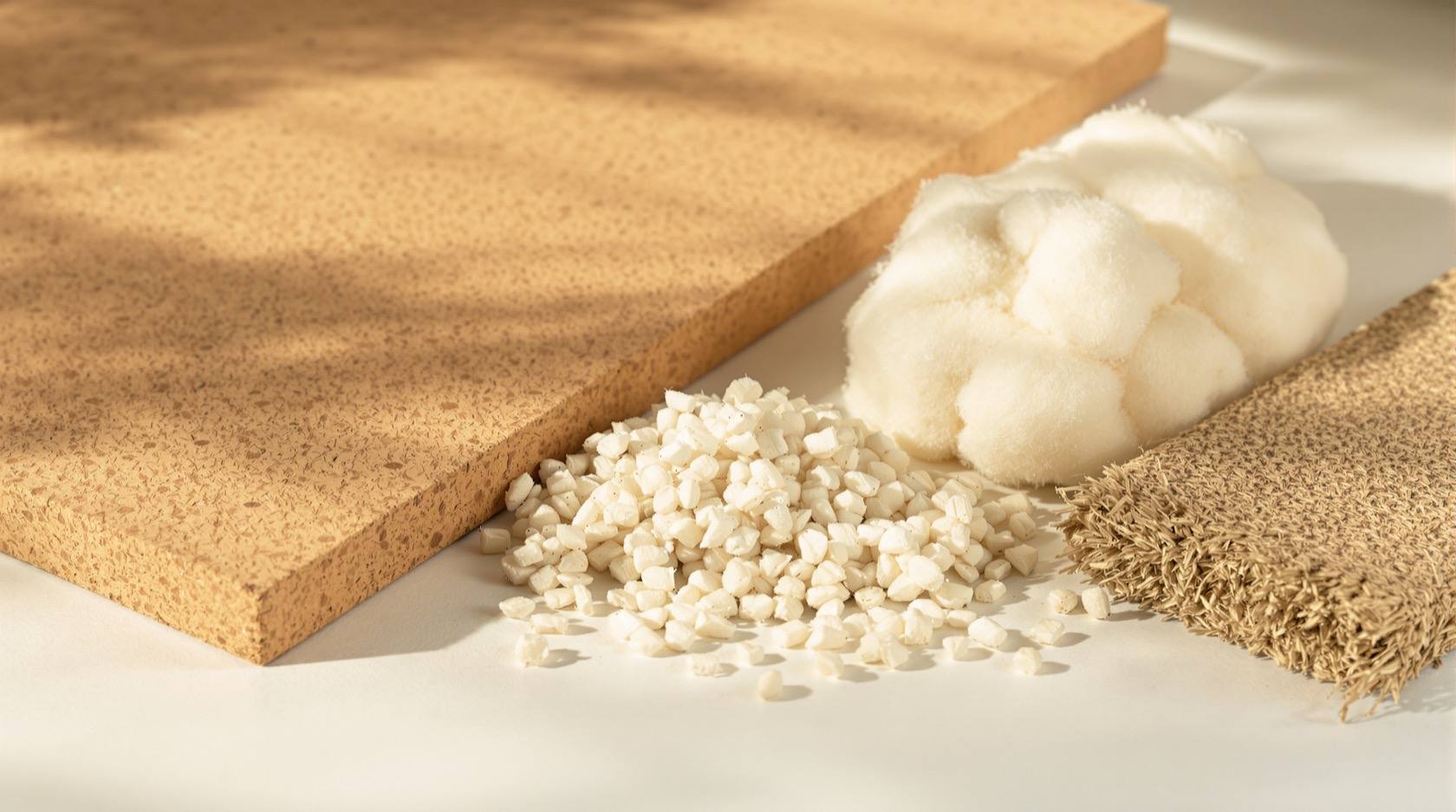
Most insulation sold in India is mineral or plastic: glass wool, rock wool, EPS and XPS foam, PU and PIR. They work, they are cheap, and they dominate every mainstream project. But they carry embodied carbon, some off-gas or shed fibres, and none of them are renewable. A quieter family of natural, bio-based insulants - cork, recycled-paper cellulose, sheep wool, coir, jute and hemp fibre, and rice-husk agro-panels - offers a low-carbon alternative that fits green-rated and passive-design homes. This guide helps you choose and specify them honestly: where they genuinely fit in India, and where the mainstream products still win.
The aim is selection, not evangelism. Natural insulation is a real, sometimes excellent choice - but it is often costlier, thinner on availability, and dependent on fire and pest treatment to be safe. You should know all of that before you spec it.
Scope and safety: This is a selection guide. R-values, prices and treatment claims here are indicative only - they move with product, thickness, density and region, so always get current data sheets and local quotes. Fire-retardant and pest treatment, moisture detailing, vapour barriers and the actual installation are execution decisions - hand them to a qualified contractor, and confirm every fire and biological-durability claim against the manufacturer's test certificate. Nothing here replaces IS codes, a green-building consultant or a licensed professional.
Why look past glass wool and foam at all
Every insulant is judged first on thermal resistance - its R-value per unit thickness. On that number alone, foams beat almost everything and mineral wools are strong. Natural insulants are usually middling performers: good, not spectacular, so you need a little more thickness for the same R. What they trade that for is a much lower embodied carbon footprint, renewability, healthier indoor air (no fibreglass shedding, low or no VOCs), and often better humidity buffering - they absorb and release moisture without collapsing. For a full grounding in R-values and the mainstream options, read our building insulation materials guide alongside this one, and compare directly with glass wool and rock wool.
The natural insulants, one by one
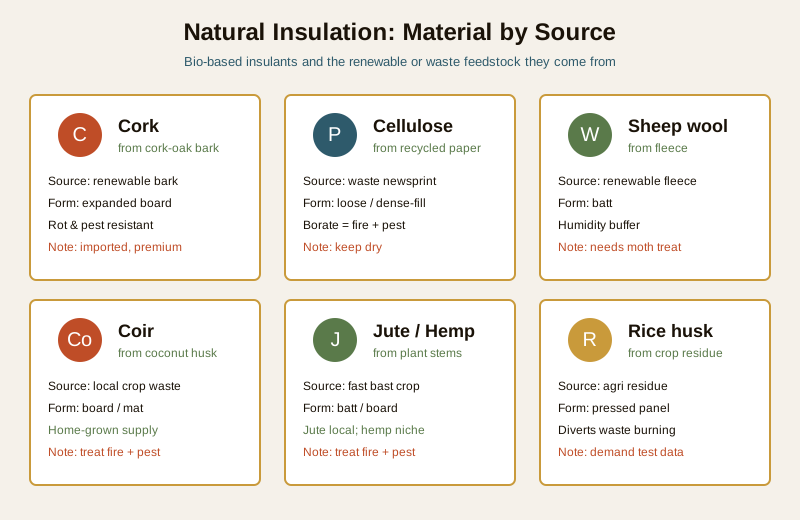
Cork. Harvested from the renewable bark of the cork oak, expanded cork board is the aristocrat of natural insulation: dimensionally stable, naturally rot- and pest-resistant, and reasonably fire-behaved thanks to its cellular structure and suberin content. It handles moisture well and even offers acoustic damping. The catch for India is supply and cost - almost all cork is imported (Portugal, Spain, North Africa), so it is a premium, niche specification best reserved for feature walls, high-value green homes and acoustic uses.
Cellulose (recycled paper). Loose-fill or dense-packed cellulose is shredded recycled newsprint treated with borate salts, which give it its fire retardancy and its pest and mould resistance in one step. It has a respectable R-value, fills irregular cavities beautifully, and has one of the lowest embodied-carbon figures of any insulant because the feedstock is waste. Its limits: it can settle over time if poorly installed, it must be kept dry (wet cellulose loses R and can rot), and the borate treatment is what makes it fire- and pest-safe - untreated paper is neither. Installation is a machine-blown, professional job.
Sheep wool. Wool batts insulate well, are naturally fire-resistant (wool self-extinguishes and needs a lot of heat to ignite), and are superb humidity buffers - wool can absorb around a third of its weight in moisture and release it again without losing much R-value. It even adsorbs some indoor pollutants. The honest limits: wool needs moth and pest treatment (usually a borate or ionic treatment) to survive, it is costly, and India has little domestic building-grade wool supply, so most product is imported or artisanal.
Coir (coconut fibre). India is one of the world's largest coir producers, which makes coir one of the few natural insulants with a genuine home-grown supply chain. Coir boards and mats offer moderate insulation plus useful acoustic absorption. But raw coir is organic: it must be treated against fire, fungus and insects, and it absorbs moisture, so it needs to be kept dry and detailed carefully. It shines in low-cost, regional and experimental green builds where local sourcing matters.
Jute and hemp fibre. Both are plant-stem (bast) fibres made into batts and boards. Hemp in particular is a fast-growing, carbon-hungry crop and hemp/jute batts perform comparably to other fibre insulants with good moisture handling. Jute has an Indian supply base (it is a major eastern-India crop); hemp product is mostly imported or specialist. Like all plant fibres they need fire-retardant and pest treatment to be building-safe.
Rice-husk and agro-panels. Rice husk, an abundant Indian crop residue, is pressed - sometimes carbonised or bound - into boards and composite panels that offer modest insulation plus the virtue of diverting agricultural waste from burning. These are emerging, regionally made products; performance and fire behaviour vary by manufacturer, so demand test data. They suit sustainability-led and research projects more than mainstream spec today.
Traditional and vernacular approaches. Long before any of the above, Indian building kept interiors comfortable with thick mud and mud-plaster walls, thatch roofs, cavity walls and lime finishes - high thermal mass and breathable envelopes tuned by passive design rather than a factory insulant. These remain valid, genuinely low-carbon strategies for the right climate and building type, and they are the honest "thermocol alternative" for those avoiding foam entirely. They belong to a passive-first design approach - pair them with cool-roof and roof-insulation thinking rather than treating them as drop-in replacements for a batt.
The comparison - performance, sustainability and honesty
The table below sets the natural family side by side. Treat R-value as "per typical installed thickness", and cost and availability as relative and indicative - confirm both against current supplier data.
| Material | R-value / thickness | Sustainability | Fire behaviour | Moisture behaviour | Relative cost | India availability |
|---|---|---|---|---|---|---|
| Cork board | Moderate | Very high (renewable bark) | Fair, naturally char-forming | Good, rot-resistant | High (imported) | Niche / imported |
| Cellulose (recycled paper) | Moderate to good | Very high (waste feedstock) | Good only if borate-treated | Poor if wetted; keep dry | Low to moderate | Growing, blown-in installers |
| Sheep wool | Good | High (renewable) | Good, self-extinguishing | Excellent buffer | High | Mostly imported / artisanal |
| Coir (coconut fibre) | Moderate | High (local waste) | Poor unless treated | Absorbs; needs detailing | Low to moderate | Good (home-grown) |
| Jute / hemp fibre | Moderate to good | Very high (fast crop) | Needs treatment | Good buffer | Moderate to high | Jute local; hemp niche |
| Rice-husk / agro-panel | Modest | High (crop residue) | Varies; demand data | Varies by binder | Low to moderate | Emerging / regional |
And here is the trade-off that decides most real projects - the natural family against the mainstream mineral and foam insulants:
| Aspect | Natural / bio-based | Glass & rock wool | Foam (EPS/XPS/PU/PIR) |
|---|---|---|---|
| Thermal R per thickness | Moderate | Good | Best |
| Embodied carbon | Lowest | Moderate to high | High |
| Renewable / recyclable | Yes | Partly (mineral) | No (petro-based) |
| Fire behaviour | Depends on treatment | Non-combustible (mineral) | Combustible, needs protection |
| Indoor-air / health | Low VOC, no glass fibres | Fibre handling care | Can off-gas |
| Cost | Higher, variable | Low | Moderate |
| Mainstream availability | Limited / niche | Everywhere | Everywhere |
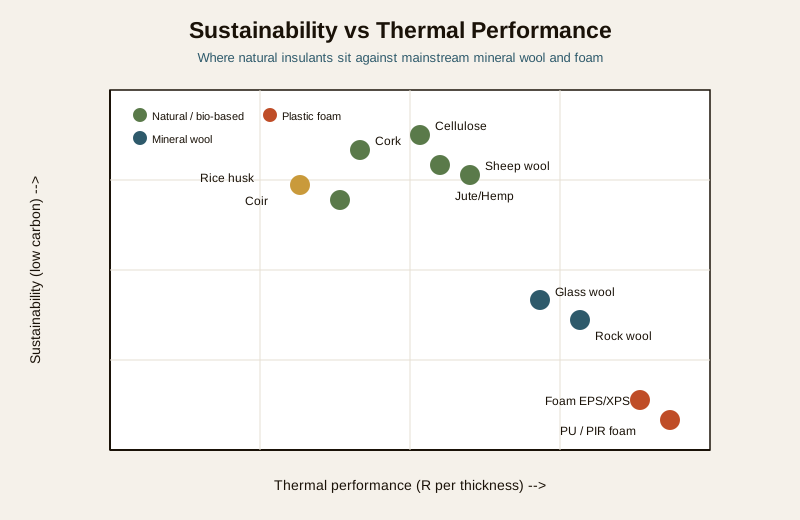
The single honest message of that chart: natural insulants win on sustainability and health, mainstream products win on cost, availability and raw R-value. For a green-rated or passive-design home where carbon and indoor air are the priorities, that trade is worth making. For a routine budget build on a deadline, it usually is not - which is exactly why most Indian projects still reach for glass or rock wool and foam.
Where natural insulation realistically fits in India
Be clear-eyed. Natural insulation makes the most sense when at least one of these is true:
- You are chasing a green rating - GRIHA, IGBC or LEED credits reward low embodied carbon, renewable content and healthy materials, and natural insulants earn those points.
- You are doing passive, climate-responsive design where the envelope, thermal mass and ventilation do most of the work and insulation is a supporting layer, not the whole strategy.
- Indoor air quality and health are a priority - no fibreglass handling, low or no VOCs.
- You have a regional, local-sourcing goal - coir, jute and rice-husk products keep the supply chain and carbon local.
It makes less sense when cost, speed, guaranteed availability, or a demanding fire rating dominate - there, the mainstream products remain the sane default. To weigh any of these against thickness and target R-value, run the numbers with our insulation R-value calculator.
The non-negotiables: fire, pest and moisture
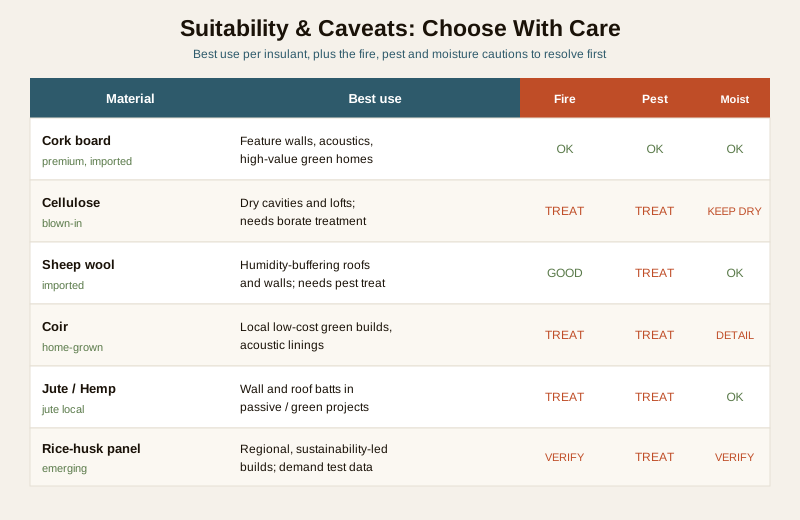
Almost every natural insulant shares three vulnerabilities that the mineral products do not, and ignoring them is how a good sustainable choice turns into a failure:
- Fire. Most bio-based insulants are combustible unless treated. Cellulose relies on its borate loading; coir, jute and hemp need factory fire-retardant treatment; wool and cork behave better naturally but still need checking against the fire requirement for the location. Never assume - insist on a fire test certificate for the exact product.
- Pests and biological attack. Organic material feeds insects, rodents and fungus. Borate treatment protects cellulose and can be applied to wool; coir and other plant fibres need explicit pest treatment. In a warm, humid Indian climate this is not optional.
- Moisture. Several of these insulants absorb water and lose R-value or rot if they stay wet. That puts the burden on detailing - vapour control, drainage and keeping the assembly dry - which is precisely the kind of execution decision to leave to a qualified contractor and, on a green project, a building-science consultant.
For the wider material-selection picture, and to see how insulation sits among cement, steel, brick and finishes, start from our complete building materials guide, and for the sustainability rationale behind choosing low-carbon materials at all, see the sustainability and green buildings hub.
Key takeaways
- Natural insulants - cork, cellulose, sheep wool, coir, jute/hemp and rice-husk panels - trade some raw R-value for the lowest embodied carbon, renewability and healthier indoor air.
- They suit GRIHA / IGBC / LEED and passive-design projects; mainstream Indian builds still default to glass wool, rock wool and foam for cost, speed and availability.
- Coir, jute and rice-husk have genuine Indian supply chains; cork, sheep wool and hemp are largely imported or niche.
- Almost all of them need fire and pest treatment and careful moisture detailing to be safe - always demand a test certificate.
- Decide with a clear head: use the insulation R-value calculator to size thickness, and leave treatment, vapour control and installation to a qualified professional.
References
- Bureau of Indian Standards - insulation and building-material standards; consult current editions for thermal, fire and product requirements, and verify each product's designation on its data sheet.
- National Building Code of India (SP 7:2026) - thermal performance, fire and materials provisions.
- GRIHA, IGBC and LEED rating frameworks - credits for low embodied carbon, renewable content and healthy indoor materials.
- Studio Matrx guides: building insulation materials, glass wool, rock wool, the complete building materials guide and the sustainability and green buildings hub.
Export this guide
Related Guides — Deep-dive reading
Green Building Materials Guide (India): Low-Carbon, Healthy & Sustainable Choices (2026)
What actually makes a building material green - low embodied carbon and energy, recycled and renewable content, local sourcing, durability, recyclability, low VOC and water efficiency - mapped honestly across the whole Indian building, with the lifecycle nuance no label can give you.
Building MaterialsBuilding Insulation Materials Guide (India): Types, R-Value & How to Choose (2026)
The complete anchor guide to building insulation in Indian homes - why it matters, the physics in plain terms, where insulation goes, and a side-by-side comparison of every material family with clear guidance on how to choose the right one.
Building MaterialsFire-Resistant Building Materials in India: A Specify-and-Select Guide (2026)
The difference between how a material reacts to fire and how long a rated assembly resists it, then the materials that deliver passive fire protection - non-combustible structure, mineral wool, fire-rated boards, intumescent coatings, spray fireproofing and fire-stopping - with a material-to-role selection table.
Building MaterialsRelated Tools — Try Free
Cross-Ventilation Analyzer
Estimate airflow and air changes per hour (ACH) from room size, window areas, layout, and local wind — with NBC 2016 Part 8 compliance check.
Ventilation CalculatorMaterial Decision Framework (M-Score)
Score 30+ Indian construction materials across cost, durability, climate fit, maintenance, and sustainability.
MaterialsRainwater Tank Sizer
How big should your rainwater tank be? Computes annual harvest, recommended tank capacity in litres, water-bill savings, and payback — for 10 Indian cities.
RWH Calculator