
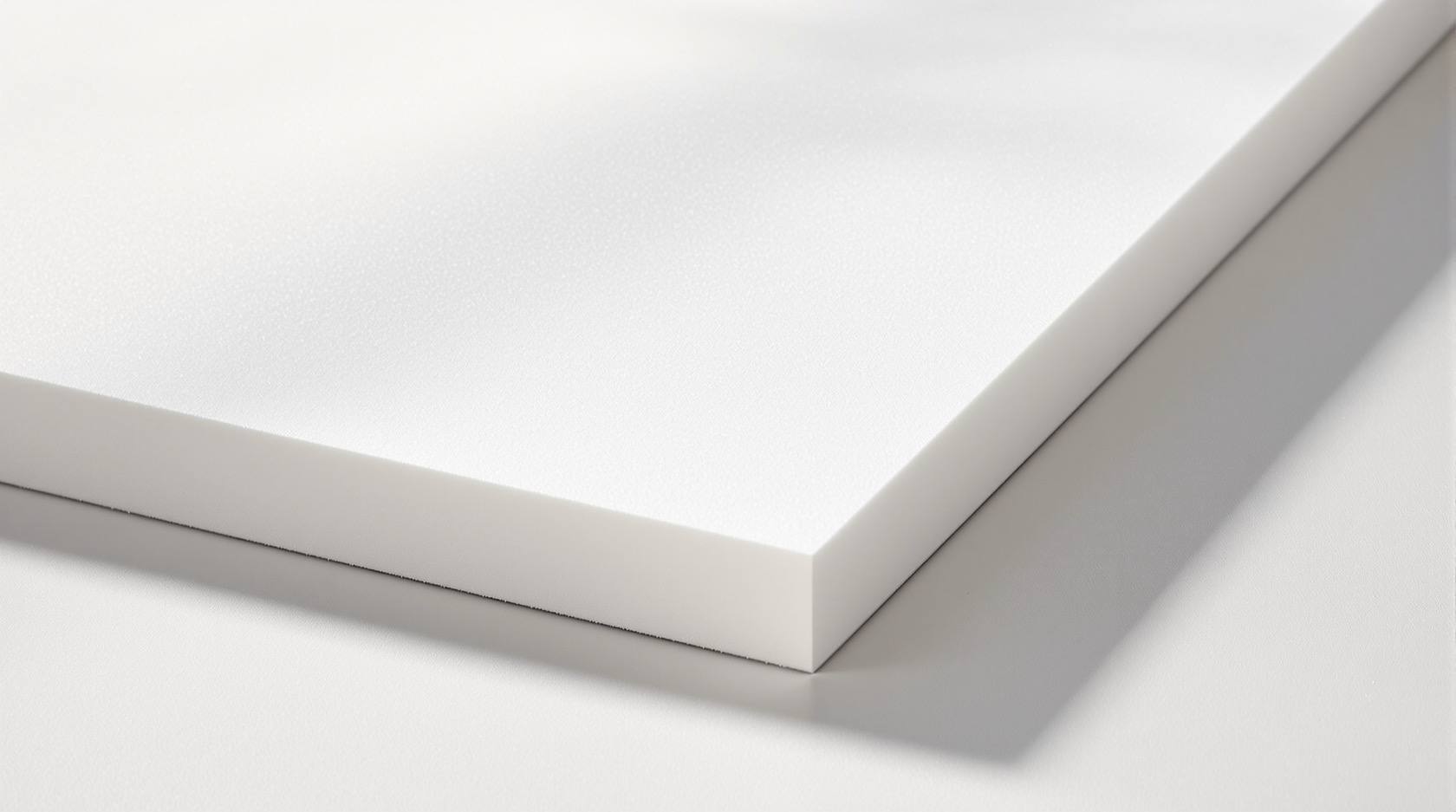
EPS Insulation (Thermocol) in India: Boards, Panels, Cost & Fire Cautions (2026)
A plain-English guide to expanded polystyrene - the familiar white thermocol - as building insulation: what it is, its forms and density grades, where it works, how it compares with XPS, indicative cost, and the fire-safety caution that decides everything.
Almost everyone in India has held expanded polystyrene without knowing its real name. It is "thermocol" - the light white foam that cushions a new television, moulds around a fridge, or forms the disposable cup. That same material, made denser and to a controlled specification, is one of the most widely used building insulations in the country: EPS, expanded polystyrene. It is the cheapest rigid foam you can buy, it is feather-light, it cuts with a hot wire or a kitchen knife, and it delivers a respectable thermal resistance for the money.
This guide helps you choose and specify EPS sensibly - to know what it is good at, where it falls short against its stiffer cousin XPS, which density and grade to ask for, and, most importantly, to respect the one property that governs every EPS decision in a building: it is combustible. The material is simple; using it safely in a home is not, and that part belongs to professionals.
Scope and safety: This is a selection guide, not an installation or fire-engineering manual. Prices, R-values and densities here are indicative only - they move with grade, brand, thickness and region, so get local quotes and manufacturer data sheets. EPS is a combustible plastic foam; its fire compliance, the fire barrier that must cover it, and its use in any facade or escape route are decisions for a qualified architect, fire consultant or structural engineer working to the National Building Code and local fire bye-laws. Nothing here replaces that advice.
What EPS actually is
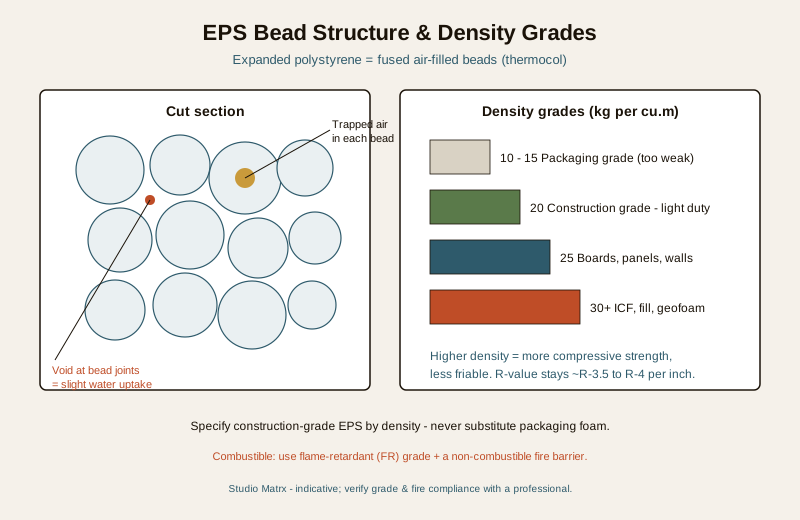
EPS starts as tiny beads of polystyrene containing a blowing agent (usually pentane). Steam heats the beads so they expand up to about forty times their size into light spheres full of trapped air, and a second steaming fuses those spheres together inside a mould into a solid block or board. The finished material is roughly 95 to 98 percent trapped air by volume - and trapped, still air is what makes it insulate. Cut a piece and you can see the structure clearly: fused white balls, with tiny voids at the points where the spheres meet.
That closed-bead-but-open-joint structure is the key to understanding EPS. Each bead is closed and full of air, but the boundaries between beads leave interconnected micro-channels, which is why EPS absorbs a little more moisture than a truly closed-cell foam. The looks-simple white block behaves quite differently from the smooth, uniform blue or pink boards of XPS.
Its strengths - why EPS is everywhere
EPS earns its place through a simple, honest set of advantages:
- Lowest cost of any rigid foam. Board for board, EPS is the cheapest way to buy real thermal resistance in India.
- Extremely light. It adds almost nothing to the dead load of a roof or wall, and one person can carry large boards.
- Decent R-value. Around R-3.5 to R-4 per inch of thickness (roughly 0.035 to 0.037 W/mK conductivity) - a little below XPS but perfectly useful, and you can simply specify a bit more thickness.
- Easy to cut and shape. A hot wire, a fine saw or even a sharp blade works; it moulds to complex shapes, which is why it forms packaging so well.
- Stable and rot-proof. It does not decay, and it holds its insulating value over decades if kept dry and protected.
- Available everywhere, in many densities and thicknesses, from countless Indian manufacturers.
Forms and density grades
The single most important thing to specify with EPS is its density, measured in kilograms per cubic metre. Density drives compressive strength, and it separates the flimsy packaging foam from a material you can build with.
- Packaging-grade EPS (about 10 to 15 kg/cu.m) is the crumbly stuff around appliances. It is too weak and too friable for most building duty and should not be substituted for the real thing.
- Construction-grade EPS (about 20, 25 and 30 kg/cu.m and above) is denser, stronger and less friable - this is what you specify for insulation boards, panels and load-bearing fills.
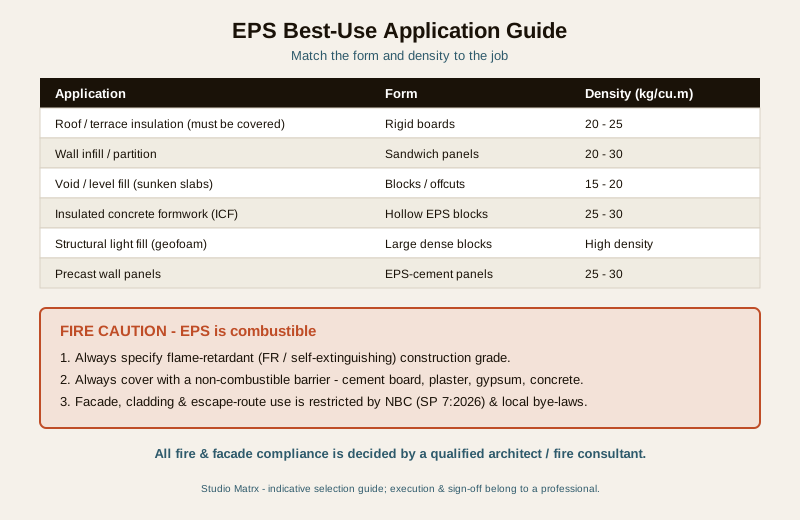
The table below pairs each density band with the duty it suits; use it as a starting point and confirm the load with your engineer.
| Density (kg/cu.m) | Grade | Typical duty | Friability |
|---|---|---|---|
| 10 - 15 | Packaging | Cushioning only - not for building | High |
| 15 - 20 | Light construction | Void and level fill, non-load boards | Moderate |
| 20 - 25 | Standard construction | Roof, terrace and wall boards, panels | Low |
| 25 - 30 | High construction | ICF, sandwich panels, light loads | Low |
| 30 and above | Geofoam / high density | Engineered structural fill under load | Very low |
EPS reaches the building in several forms:
- Rigid boards for roof, terrace and wall insulation.
- Sandwich and EPS-cement panels - an EPS core faced with cement board or steel, used as light partition and wall panels and as a cheaper alternative to PUF panels for non-cold-storage duty.
- ICF blocks (insulated concrete formwork) - hollow EPS blocks that stack up, get filled with reinforced concrete, and stay in place as permanent insulation on both faces.
- Geofoam - very large high-density blocks used as ultra-light structural fill under roads, podiums and against basement walls.
- Precast EPS-cement wall panels - factory panels combining an EPS core with a reinforced cement skin.
Where EPS is used in an Indian home
- Roof and terrace insulation. EPS boards under a screed or protective layer cut heat gain through the slab. Because EPS is combustible and degrades in sunlight, it must always be covered and protected - never left exposed on a terrace. Pair this with our roof insulation guide and the choice between over-deck and under-deck insulation.
- Wall infill and sandwich panels. As the core of light partition and external panels, or as board insulation inside a cavity or behind a finish.
- Void and level fill. Light EPS fills sunken slabs, planter boxes and level differences without adding weight.
- Under-slab and geofoam. High-density grades support loads as engineered structural fill.
For the bigger picture of where EPS sits among all the options, start at the building insulation materials guide, and to size the thickness you need, use the insulation R-value calculator.
EPS vs XPS - the comparison that matters
EPS and XPS are both polystyrene, but they are made differently. XPS (extruded polystyrene) is melted and forced through a die into a uniform closed-cell board, giving it a smoother, denser, tougher body. That difference shows up exactly where it counts. The table below is the heart of choosing between them; treat cost as relative and confirm current rates locally.
| Property | EPS (expanded) | XPS (extruded) |
|---|---|---|
| Structure | Fused beads, small voids at joints | Uniform closed cell |
| R-value per inch | About R-3.5 to R-4 | About R-4.5 to R-5 |
| Water absorption | Higher - more porous | Lower - closed cell, water-resistant |
| Compressive strength | Lower at a given price (rises with density) | Higher for demanding loads |
| Friability | More crumbly, especially low density | Less friable, cleaner edges |
| Best duty | Cheap general insulation, panels, fill, ICF | Wet, buried, high-load, inverted roof |
| Relative cost | Lowest rigid foam | Higher than EPS |
| Fire behaviour | Combustible - needs FR grade + fire barrier | Combustible - needs FR grade + fire barrier |
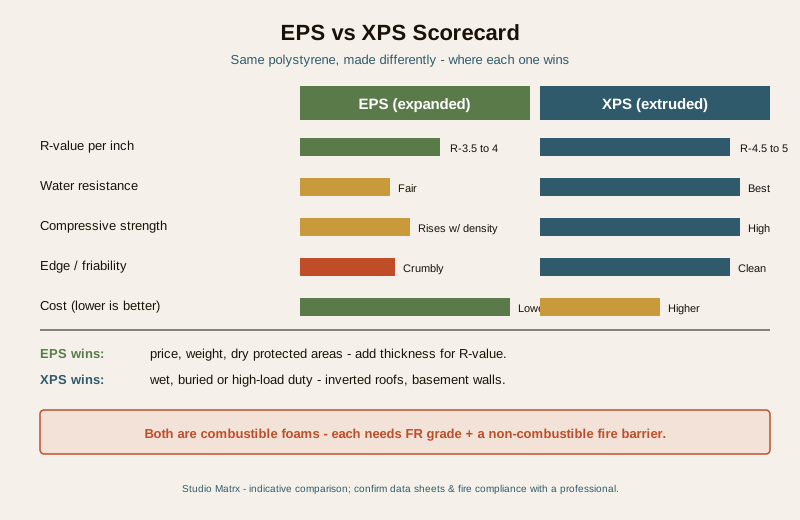
The plain reading: XPS is the better foam where water, load or abuse are present - buried walls, inverted or wet terraces, under heavy screeds. EPS is the better value where the environment is dry and protected and you can add a little thickness to make up the R-value gap. For a full XPS treatment, see the XPS insulation guide; if you need the highest R-value per inch and better fire performance in a foam, compare with PU and PIR foam.
The fire caution - read this before anything else
Expanded polystyrene is a hydrocarbon plastic. It is combustible. Ordinary packaging thermocol ignites readily and, once burning, melts, drips and can spread flame fast while giving off dense smoke. This single fact must shape every building use of EPS.
Two things reduce, but never eliminate, that risk:
- Flame-retardant (FR) grade. Construction-grade EPS should always be the FR (self-extinguishing) grade, which contains an additive that stops the material sustaining a flame once the ignition source is removed. Never accept plain non-FR packaging foam for building work. Ask for the manufacturer's declaration of the FR grade and its fire test classification.
- A fire barrier. Even FR-grade EPS must not be left exposed inside a building. It has to be covered by an approved non-combustible barrier - cement board, plaster, gypsum, concrete screed or masonry - so that it is separated from the room and from any ignition source.
Beyond the material, its use in facades, cladding, escape routes and tall buildings is tightly restricted and is not a decision for a homeowner or a general contractor. How much EPS is allowed, where, and with what protection is set by the National Building Code and your local fire bye-laws, and it must be signed off by a qualified architect or fire consultant. If a supplier or mason tells you EPS is "fine, just plaster over it" without reference to grade, barrier and code, treat that as a warning sign, not an approval.
Indicative cost
EPS is priced by thickness and density, and it is the cheapest rigid foam on the market. As a rough guide only, construction-grade EPS boards run in the region of Rs 30 to Rs 90 per sq ft depending on thickness (25 mm to 50 mm) and density, with FR grade a little more. That typically undercuts XPS of the same thickness by a useful margin - which is exactly why EPS remains popular for large, dry, protected areas where budget matters. These figures move constantly, so treat them as a starting point and get current local quotes with the density and FR grade written on them.
Sustainability notes
EPS is a petroleum product and it is not biodegradable, which is its main environmental knock. On the other side of the ledger, it is largely trapped air, it contains no ozone-depleting blowing agents in modern manufacture, it is recyclable where collection exists, and the energy it saves over a building's life usually far outweighs the energy in the board. Under GRIHA, IGBC or LEED, insulation contributes to energy-efficiency credits regardless of type; the decisive sustainability question is whether the building is well insulated at all.
Key takeaways
- EPS is thermocol - expanded polystyrene, the cheapest, lightest rigid foam insulation in India, with a decent R-value of about R-3.5 to R-4 per inch.
- Density is everything. Specify construction-grade EPS (20 kg/cu.m and up), never flimsy packaging foam, and match density to the load.
- EPS vs XPS: EPS wins on price; XPS wins on water resistance, strength and edge quality - use XPS where it is wet, buried or heavily loaded.
- It is combustible. Always specify FR (flame-retardant) grade and always cover it with a non-combustible fire barrier.
- Leave fire and facade compliance to professionals - the code limits, barriers and sign-off are an architect and fire consultant's job, and cost figures are indicative only.
References
- Bureau of Indian Standards - IS 4671 covers expanded polystyrene for thermal insulation; consult the current edition for grades, densities and requirements, and the relevant fire test standards for the FR classification.
- National Building Code of India (SP 7:2026) - fire and life safety provisions and material use restrictions; local fire bye-laws govern facade and escape-route use.
- Studio Matrx guides: building insulation materials guide, XPS insulation, PU and PIR foam, roof insulation, and the complete building materials guide; size thickness with the insulation R-value calculator.
Export this guide
Related Guides — Deep-dive reading
XPS Insulation in India: Extruded Polystyrene Boards, Uses & Cost (2026)
A specifier's guide to XPS (extruded polystyrene) rigid board insulation - what it is, why its high compressive strength and near-zero water absorption make it the default for over-deck roofs, podium decks and basements, how it compares with EPS, and what it costs in India.
Building MaterialsFire-Resistant Building Materials in India: A Specify-and-Select Guide (2026)
The difference between how a material reacts to fire and how long a rated assembly resists it, then the materials that deliver passive fire protection - non-combustible structure, mineral wool, fire-rated boards, intumescent coatings, spray fireproofing and fire-stopping - with a material-to-role selection table.
Building MaterialsPU & PIR Foam Insulation in India: Boards, Sandwich Panels & Spray Foam (2026)
A specifier's guide to polyurethane (PUF) and polyisocyanurate (PIR) rigid foam - the highest R-value per inch of the common insulations - covering boards, sandwich panels and spray foam, their fire behaviour, cost and where each form actually belongs.
Building MaterialsRelated Tools — Try Free
Green Building Water Score Calculator
Score a building's water efficiency 0–100 from treated-water reuse, rainwater harvesting, low-flow fixtures and metering, with an IGBC/GRIHA-style rating and your biggest improvement lever.
SustainabilityInsulation R-Value Calculator
The R-value and U-value of an insulation layer by material and thickness, and the thickness for a target R.
Material CalculatorMaterial Decision Framework (M-Score)
Score 30+ Indian construction materials across cost, durability, climate fit, maintenance, and sustainability.
Materials