
Restaurant Security in India (2026): Cash, Kitchen Fire, POS Fraud and Staff Safety
A practical, right-sized security plan for a restaurant, cafe, bar or cloud-kitchen — a public-facing, cash-heavy, late-hours business with a fire-prone kitchen, valuable stock and liquor, and staff plus customer payment data to protect. How front-of-house, back-of-house, cash, data and fire risks compose, with life-safety first.
A restaurant is one of the most exposed small businesses there is. It is open to the public and often open late; it takes real cash across the counter all evening; it holds stock and liquor worth stealing; it processes card and UPI payments for hundreds of customers; it runs a hot, fire-prone kitchen a few metres from a full dining room; and it sends its staff home after midnight past a cash drawer that was full an hour earlier. A cafe, a bar, a fine-dining room and a cloud-kitchen each tilt the mix differently, but the shape is the same: many small risks stacked on top of one another, most of them ordinary, one of them — kitchen fire — potentially fatal.
The instinct after a bad incident is to bolt on cameras and a shutter and call it secure. That misses how a restaurant actually loses money and safety. The largest, quietest loss in food and beverage is rarely the late-night robber; it is the slow bleed of employee theft and point-of-sale fraud that never shows up as a crime at all. The most dangerous event is not a break-in; it is a flare-up over a fryer. Good restaurant security treats the business as a set of zones — front-of-house, back-of-house, the cash, the data, and fire — and composes the right control for each, in the right order of priority.
Scope & safety. This is a planning and coordination guide for restaurateurs, cafe and bar owners, cloud-kitchen operators and their architects — not an installation manual, and strictly defensive. Right-size to the real threats: cash robbery, staff/POS shrinkage, payment-data exposure, storefront break-in and lone-worker risk — not a fortress. Life-safety comes before every security measure: a commercial kitchen is a fire risk, and egress for diners and staff, kitchen-hood suppression and clear exits are governed by the National Building Code (NBC = SP 7:2026) and take absolute priority over any lock, shutter or camera. CCTV and customer/staff data are personal data under the DPDP Act 2023; any deployed guards must come through a PSARA 2005-registered agency; liquor and food-safety licensing apply separately. Verify all standards current, and engage a licensed installer, fire consultant or security consultant for anything at scale.
Because a restaurant sits inside the wider hospitality and commercial world, two companion guides give the broader frame: the commercial-buildings security guide for shopfront, cash-business and public-access fundamentals, and the hotels and resorts security guide for hospitality-grade guest, staff and food-service security at larger scale. This guide focuses on the standalone eatery.
The restaurant as zones — where each risk lives
Security follows the building. A restaurant divides cleanly into a public front, a working back, the cash it collects, the data it processes, and the fire hazard running through the kitchen. Each zone has its own threat and its own control, and the cameras, alarms, locks and routines compose differently in each.
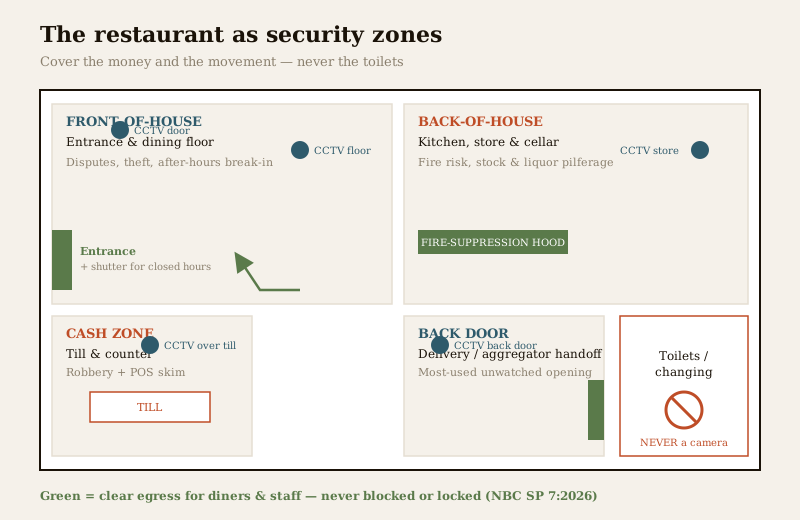
- Entrance and dining (front-of-house). The public face. The risks are visible incidents — disputes, intoxication, dine-and-dash, occasional theft of bags or phones — and, after hours, break-in through the front. Controls: a camera on the entrance and one covering the dining floor, a calm and legible layout, and a shutter or grille for the closed hours.
- Till and counter (the cash zone). Where money and payments concentrate, and where both robbery and quiet fraud happen. Controls: a camera positioned to see the till and the hands at the counter, minimal cash in the drawer, and disciplined POS access.
- Kitchen, store and cellar (back-of-house). Where stock, liquor and the fire hazard live. Controls: a camera over the store and stock area, inventory discipline, and — above all — kitchen-fire suppression and clear staff egress.
- Back door and delivery point. The most-used unwatched opening in most restaurants — propped open for air, deliveries and smoke breaks. Controls: a self-closing secure door, a camera on it, and a routine for aggregator and supplier handoffs.
- Toilets and changing areas — never a camera. This line is absolute. CCTV covers approaches and public areas; it never covers toilets, washrooms or any changing space. That is both basic privacy decency and squarely a DPDP Act 2023 and dignity boundary. Cameras stop at the toilet door.
Cash and robbery — a cash-heavy business open late
A restaurant that takes cash all evening and closes after the neighbours have gone to bed is, plainly, a robbery target. The goal is not to make the place a bunker; it is to make it a poor target — little cash on hand, no predictable routine to exploit, and a clear plan if it happens anyway.
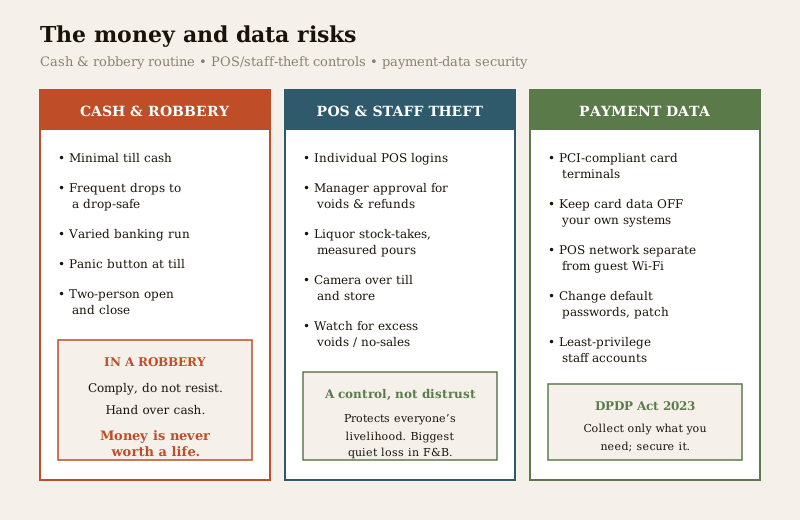
- Keep till cash minimal. The single most effective measure is to hold as little cash at the counter as possible. Frequent cash drops into a secured drop-safe during service mean the drawer is never worth robbing and a bad night never exposes a full day's takings.
- A real safe, out of sight. A drop-safe or time-delay safe, anchored and away from the public counter, holds the day's cash until banking. It removes the temptation and the target from the counter entirely.
- Vary the banking routine. Predictability is the robber's friend. A cash-out and banking run that happens at the same minute by the same door every night invites a wait-and-take. Vary timing and route.
- Careful opening and closing. The riskiest moments are opening (alone, with the previous day's float) and closing (alone, with cash, late). Two people for open and close, doors secured while cashing out, and never counting cash in view of the street.
- Train staff to comply, not resist. This matters most. In a robbery, the money is not worth a life. Staff should be trained to stay calm, hand over cash, not resist, not chase, and to observe rather than fight. A panic button at the till gives a silent way to summon help without provoking the robber; understand honestly what alarm monitoring does and does not guarantee, since automatic police dispatch is not a given in India.
Employee theft and POS fraud — the biggest quiet loss
Here is the uncomfortable truth of the trade: for most restaurants, staff-side shrinkage costs more over a year than any robber ever will. It is undramatic and continuous — a few notes here, an unrecorded round of drinks there, a voided sale, a short-poured bottle, a cut of meat out the back door. None of it looks like a crime, which is exactly why it adds up. The response is not suspicion of good people; it is ordinary controls that make the honest path the easy path and remove temptation. Framed that way, staff understand it as protecting everyone's livelihood, not policing them.
- Till and POS discipline. Individual logins on the point-of-sale so every sale, void and discount is attributable; manager approval for voids and refunds; and an eye on the patterns that signal skimming — excessive voids, no-sale drawer opens, unusually round cash totals. See the audit-trail thinking in access-control audit trails applied to the POS.
- Stock and liquor inventory. Liquor is the classic F&B leak because it is valuable, portioned and hard to count by eye. Regular stock-takes, measured pours, and reconciling what sold against what left the shelf turn the cellar from an honour system into a counted one.
- Kitchen pilferage controls. A back door that opens onto a lane, unwatched, is where portions and produce quietly walk. A camera over the store and prep line, and a secured back door that is not a free exit for stock, close the common route.
- A camera over the till and the store — not the staff's every move. CCTV positioned to see the counter, the drawer and the stockroom is a control on the money and the goods, framed as protecting takings and inventory. It is not there to watch people eat lunch. Keep it on the assets, be open with staff that it exists and why, and it reads as fair. This is a control, not distrust — and being clear about that is what keeps a team's trust.
Payment-data and POS cybersecurity — card and UPI
Every card swipe and UPI scan is customer financial data flowing through the restaurant's point-of-sale and network. A compromised POS or a leaky network turns a food business into a data-breach headline. You do not need to be a security engineer to get the hygiene right — you need to insist on a few generic, non-negotiable basics from your POS vendor and payment provider.
- Keep card data out of your hands. Use PCI-compliant payment terminals and providers so that raw card numbers are handled by the payment processor, not stored on your systems. The less cardholder data touches your POS, the smaller your risk. (This is the spirit of PCI-DSS hygiene, referenced generically — verify current requirements with your acquirer.)
- Segment and secure the POS network. The POS should not share a flat network with the guest Wi-Fi. Guests get an isolated network; the POS and back-office sit on their own, behind a changed default password and a maintained router. This is the single most-skipped basic.
- Patch, password and least-privilege. Default passwords changed, POS and back-office software kept updated, staff accounts individual and limited to what each role needs. These undramatic habits stop the majority of real incidents.
- DPDP duties on customer data. Any customer data you keep — loyalty details, contact numbers, order history, payment tokens — is personal data under the DPDP Act 2023. Collect only what you need, keep it only as long as you need it, and secure it. For the full network, account and device discipline, the security-system cybersecurity pillar is the reference; the principle is that an insecure connected system can be worse than none.
CCTV — cover the money and the movement, never the private
Cameras earn their place in a restaurant, but only when they are placed for a reason. The brief is to cover the entrance, the dining floor, the till, the kitchen and store, and the back door — the places where money moves, goods move, and incidents happen — and to stop dead at anywhere private.
- Where cameras belong. The entrance (who came and went), the dining area (incidents and disputes), the till (the money), the kitchen and store (goods and safety), and the back door (the unwatched opening). That coverage handles robbery evidence, dispute resolution, shrinkage control and after-hours intrusion in one system.
- Where cameras never go. Toilets, washrooms, changing rooms — never, under any circumstance. This is the hard line of both decency and the DPDP Act 2023.
- Handle footage lawfully. CCTV footage of customers and staff is personal data. Post notice that recording is in progress, restrict who can view footage, keep it only as long as you genuinely need it, and store it securely. The CCTV hub covers placement, retention and lawful handling.
- Quality where it counts. A camera over the till and entrance needs enough resolution and light to actually identify faces and read the drawer — coverage that is offline or too dark to use is coverage on paper only.
Storefront and after-hours — the closed restaurant
For a good part of every day the restaurant is empty, dark and full of stock. A street-facing front is an obvious target once the staff have gone. The after-hours job is to make the closed premises hard to enter and quick to detect.
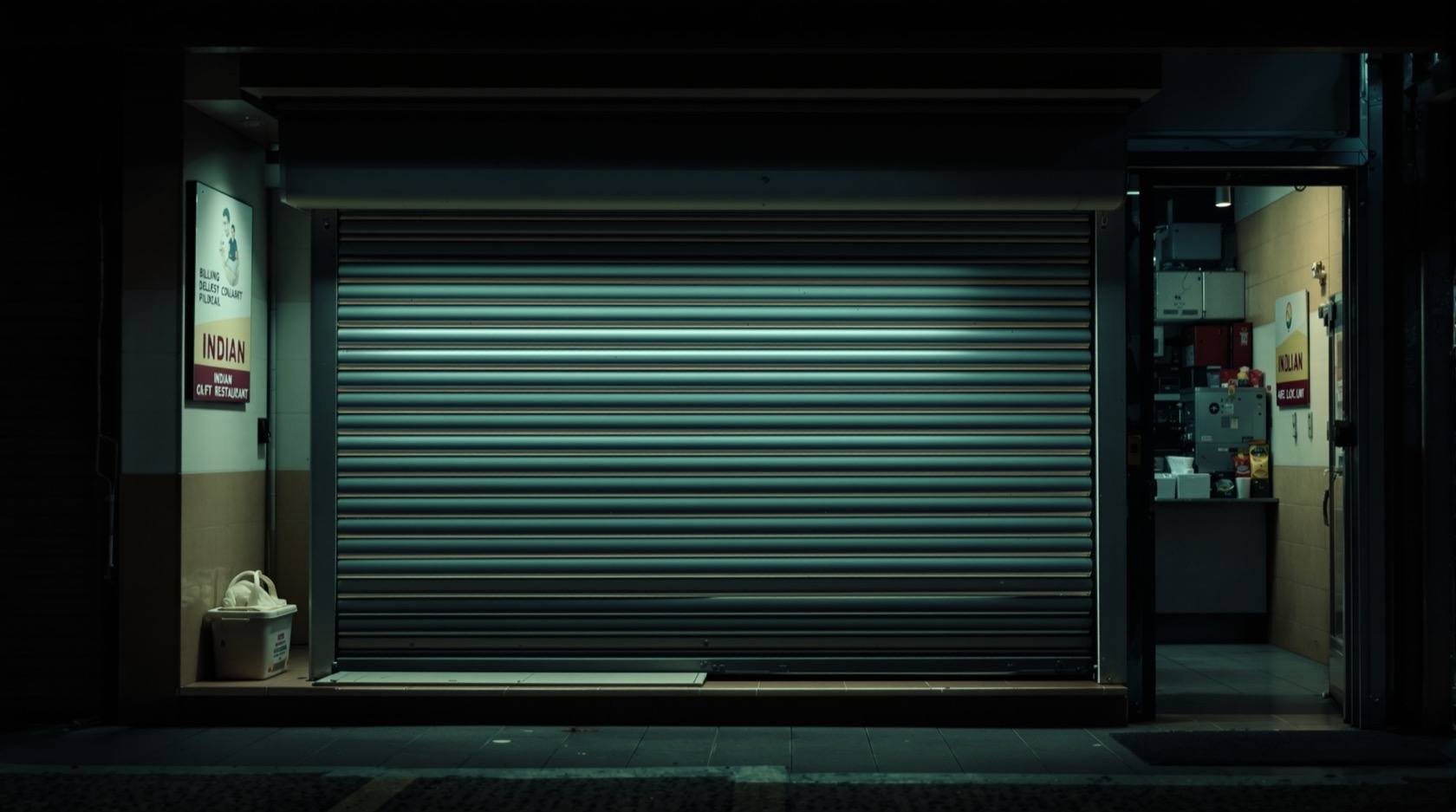
- Shutters or grilles on the street front. A street-facing frontage of glass needs a roller shutter or grille for the closed hours. It is the single biggest deterrent to a smash-and-grab on a dark high street. See the openings hub for doing doors, glass and shutters right.
- A genuinely secure back door. The back door is where real break-ins happen, because it is out of public view. It should be a solid, self-closing, properly locked door — not the propped-open convenience it usually becomes. Treat it as the most important lock in the building.
- An alarm for the empty hours. An intrusion alarm covering the front, the back door and the store, armed at close and disarmed at open, turns an empty restaurant into a monitored one. Know honestly what alarm monitoring delivers before paying for a monitored plan.
- Light the perimeter and the back. A lit frontage and — especially — a lit back lane and delivery point remove the cover a night intruder relies on. Modest, reliable security lighting does a lot of quiet work.
Staff safety — late closers and lone workers
The people who close a restaurant do it late, tired, and often with the day's cash. A closer alone at 1 a.m., cashing out behind a half-shuttered front, is one of the more exposed workers in any small business. Their safety is not an afterthought to the cash plan — it is part of it.
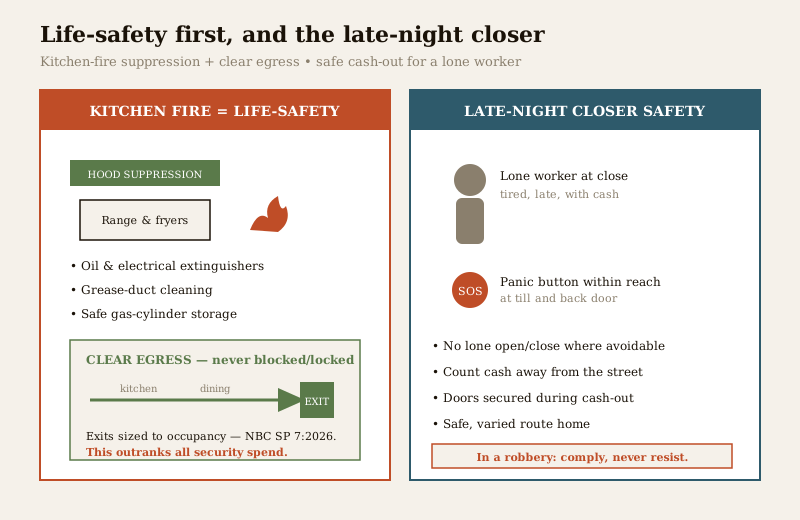
- Never a lone open or close. The float and the cash-out are two-person jobs wherever possible. If a solo shift is unavoidable, the routine matters more, not less.
- A panic option within reach. A panic button at the till and near the back door gives a closer a silent way to call for help. Match it to a real response plan, not just a noise.
- A safe cash-out routine. Cash counted away from the street, doors secured while cashing out, and a varied, unpredictable banking or safe-drop so the walk out with money is never the same easy pattern.
- A safe way home. For late closers — especially women and lone workers — how staff get home after midnight is a genuine safety question the business should own, not ignore. Where a worker also lives alone, the security for people living alone guide has relevant personal-safety habits, and security for specific users covers tailoring measures to who is actually at risk.
Customer incidents — disputes, intoxication, evidence
A public room serving food, and in many places alcohol, will occasionally see a dispute, an unpaid bill, an intoxicated guest or a scuffle. Handling these is mostly about calm design and staff protocol, with CCTV as the impartial record.
- A layout that keeps calm. Clear sightlines from the counter to the floor, unobstructed aisles, and a legible path to the exit help staff spot trouble early and keep tense moments from escalating. Crowding and blind corners do the opposite.
- Staff protocol over confrontation. A trained, de-escalating response — a manager who steps in, a calm script for refusing further service or handling a walkout — resolves far more than a heavy hand, and keeps staff and other guests safe.
- CCTV as neutral evidence. When an incident does happen — a disputed bill, an injury claim, an assault — dining-floor and entrance footage is the impartial account that protects the business and the honest party. This is one of the clearest returns on well-placed cameras.
- Bars carry more. Where alcohol is served, intoxication, later hours and stronger emotions raise the incident rate; the front-of-house protocol and camera coverage should be sized to that reality, and licensing conditions respected.
Kitchen fire is life-safety — this comes first
Set every other risk aside for a moment, because this one is different in kind. A commercial kitchen is the single most dangerous thing in a restaurant, and a kitchen fire is a life-safety emergency for everyone in the building — staff and diners alike. Hot oil, open flame, gas and grease exhaust sit metres from a full room of people who do not know the exits. No amount of security spend matters if the place is not safe from fire. This section outranks all the others.
- Kitchen-hood fire suppression. A commercial cooking line — especially deep-frying — needs a proper kitchen-hood suppression system over the range and fryers, designed to smother a grease fire the instant it starts, before it reaches the exhaust duct. This is specialist, code-governed equipment, not an optional extra.
- The right extinguishers, maintained. Fire extinguishers rated for cooking-oil and electrical fires, placed where the code requires, checked and in date, and staff who actually know how to use them. An extinguisher nobody can find or operate is decoration.
- Clear egress for staff and diners — never blocked. Every exit path, for the dining room and the kitchen both, must stay clear, unlocked from the inside, and never obstructed by storage, deliveries or a security shutter that traps people in. A crowded dining room needs marked, reachable exits sized to the occupancy — this is exactly what NBC (SP 7:2026) occupancy and egress rules govern. A security measure that blocks an escape route is not a saving; it is a fatal error.
- Gas, exhaust and housekeeping. Grease build-up in the exhaust duct is a classic restaurant-fire cause; regular hood and duct cleaning, safe gas-cylinder storage and handling, and a tidy line are prevention, not chores. The fire-safety hub covers detection, suppression and egress together.
Deliveries and cloud-kitchen handoff
Deliveries and the rise of aggregator pickups have made the back of the restaurant a busy, semi-public place — and a cloud-kitchen is almost entirely back-of-house, existing to feed that flow. That changes the security picture.
- A controlled delivery point. Suppliers and pickup riders should meet a defined handoff point, not wander the kitchen. A camera on the delivery door and a simple routine keeps the busiest unwatched opening watched, and keeps stock from walking out with the traffic.
- Verify the handoff. Aggregator pickups mean a stream of unfamiliar riders at the back door all evening. Order-and-code verification at handoff (as the platforms provide) and a staff member who owns the handoff point stop both mix-ups and opportunist theft.
- Cloud-kitchen specifics. A cloud or dark kitchen has no dining room to defend but concentrates the fire, stock and back-door risks — and often sits in a shared or industrial unit. Its security is essentially back-of-house security done thoroughly: fire suppression first, a secured and watched handoff door, stock control, and a POS/data setup as disciplined as any storefront's.
The restaurant security composition table
| Zone | Primary risks | Core security measures | Life-safety note |
|---|---|---|---|
| Front-of-house (entrance, dining) | Disputes, intoxication, theft, after-hours break-in | Entrance + floor CCTV, calm layout, shutter/grille for closed hours | Clear, marked, unlocked egress sized to occupancy (NBC) |
| Back-of-house (kitchen, store, cellar) | Kitchen fire, stock/liquor pilferage, back-door intrusion | Store CCTV, inventory control, secured self-closing back door | Hood suppression + clear staff egress — first priority |
| Cash (till, safe, banking) | Robbery, till skimming, cash-out exposure | Minimal till cash, drop-safe, varied banking, panic button, comply-not-resist training | Staff safety over money — never resist a robber |
| Data (POS, card/UPI, customer records) | Payment-data breach, POS compromise | PCI-compliant terminals, segmented POS network, patched/passworded systems, DPDP-limited data | — |
| Fire (kitchen line, exhaust, exits) | Grease fire, blocked exits, gas | Hood suppression, rated extinguishers, duct cleaning, clear exits | Life-safety — outranks all security spend |
Two Studio Matrx tools help an operator turn this into a checklist: the home security risk scorecard surfaces the gaps that matter most so a limited budget goes to the right place first, and the site perimeter security assessment checks the storefront, back-door and boundary fundamentals the after-hours plan is built on.
Key takeaways
- A restaurant stacks many risks at once — cash and robbery, staff/POS shrinkage, payment data, storefront, staff safety, customer incidents and a fire-prone kitchen. Compose a control for each zone; do not just bolt on cameras.
- Kitchen fire is life-safety and comes first. Hood suppression, rated extinguishers, duct cleaning and clear, unlocked, occupancy-sized egress for diners and staff outrank every other measure — NBC (SP 7:2026) governs.
- Employee theft and POS fraud are the biggest quiet loss in F&B — individual POS logins, void/refund approval, liquor stock-takes and a camera over the till and store, framed as controls that protect everyone's livelihood, not distrust.
- Make the place a poor robbery target — minimal till cash, frequent drops to a drop-safe, varied banking, a panic button, and staff trained to comply and never resist. The money is never worth a life.
- Protect payment data — PCI-compliant terminals, a POS network kept off the guest Wi-Fi, changed passwords, patched systems, and DPDP-limited customer data.
- CCTV covers the money and the movement — never toilets or changing areas. That line is absolute under the DPDP Act 2023.
- Own staff safety at closing — no lone open/close where avoidable, a panic option, a safe cash-out and a safe way home for late workers.
Where to go next
- Commercial-buildings security and hotels and resorts security — the wider retail and hospitality context around a standalone eatery.
- Fire-safety — kitchen-hood suppression, detection and egress; the life-safety priority for any restaurant.
- CCTV and openings: doors, glass and shutters — camera placement and the storefront/back-door hardening this guide leans on.
- Panic buttons, alarm monitoring and security lighting — the alerting and after-hours layers.
- Security-system cybersecurity and access-control audit trails — the POS and payment-data discipline.
- The building-type security pillar and the building-types sub-hub, plus the main security hub.
References
- National Building Code of India (SP 7), Bureau of Indian Standards — occupancy classification for assembly/mercantile occupancies, means of egress, exit width and travel distance, and fire-safety provisions that govern a restaurant's kitchen fire risk and diner/staff escape. Verify the current edition (SP 7:2026) via the BIS catalogue: https://www.services.bis.gov.in/
- Digital Personal Data Protection Act, 2023 — CCTV footage of customers and staff, POS payment data and customer records are personal data; collect only what is needed, secure it, restrict access, retain it no longer than necessary, and never place cameras in toilets or changing areas.
- Private Security Agencies (Regulation) Act, 2005 (PSARA) — any guard deployed at a restaurant, bar or event must be supplied through a PSARA-registered agency; verify licensing before contracting.
- PCI-DSS payment-card security principles (referenced generically) — use PCI-compliant payment terminals and providers, keep cardholder data off your own systems, and segment the POS network; verify current requirements with your acquirer and payment provider.
- Crime Prevention Through Environmental Design (CPTED) — the named design approach behind natural surveillance, clear sightlines, lighting and legible layout applied to a public dining room; apply its principles rather than any single product.
This is an educational, right-sizing overview for restaurateurs, cafe and bar owners, cloud-kitchen operators and their designers — not legal advice, an installation manual, or a fire-engineering document. Life-safety, kitchen-fire suppression and egress take priority over any security measure; engage a licensed installer, fire consultant or security consultant for anything at scale, deploy guards only through PSARA-registered agencies, respect food-safety and liquor licensing, and verify any standard's current status via the BIS catalogue before relying on it.
Export this guide
Related Guides — Deep-dive reading
Security for People Living Alone in India (2026): Calm, Practical Habits When There Is No Second Person to Notice
Living alone is an ordinary and growing part of Indian life - the student in a new city, the working single, the elder whose children are abroad, the person after a separation. It does not call for fear. It calls for a few deliberate habits, because there is no second person in the home to notice trouble, raise the alarm, or catch an accident. This is calm self-reliance, layer by layer.
SecurityComplete Guide to Security System Cybersecurity in India (2026): Protecting the Systems That Protect You
The cameras, locks, alarms and door phones you install to feel safer are internet-connected computers that can themselves be attacked, and an insecure one is worse than none. This pillar maps the whole attack surface — devices, network, accounts and data, operations — and points to every guide that hardens it.
SecurityComplete Guide to Building Type Security in India (2026): Right-Sizing Protection to Homes, Schools, Hospitals, Warehouses and Temples
The same security building blocks — perimeter, gate and access, CCTV, alarms, lighting, fire, guards and cyber — are composed very differently for a villa, a school, a hospital, a warehouse or a temple. This pillar maps the whole library of building-type guides and gives you the framework to tailor security to each kind of building.
SecurityRelated Tools — Try Free
CCTV Camera Coverage & Count Calculator
Estimate how many CCTV cameras you need, the NVR channels, storage in TB for your retention period, and an indicative all-in cost with GST.
CCTV CalculatorCCTV Placement Planner
Pick your property and zones to get a prioritised, zone-by-zone checklist of which camera goes where and how to mount it.
Placement PlannerHome Security Risk Scorecard
Score your home across six security layers — perimeter, entry points, lighting, detection, alarm and habits — and get a prioritised action plan.
Security Scorecard