
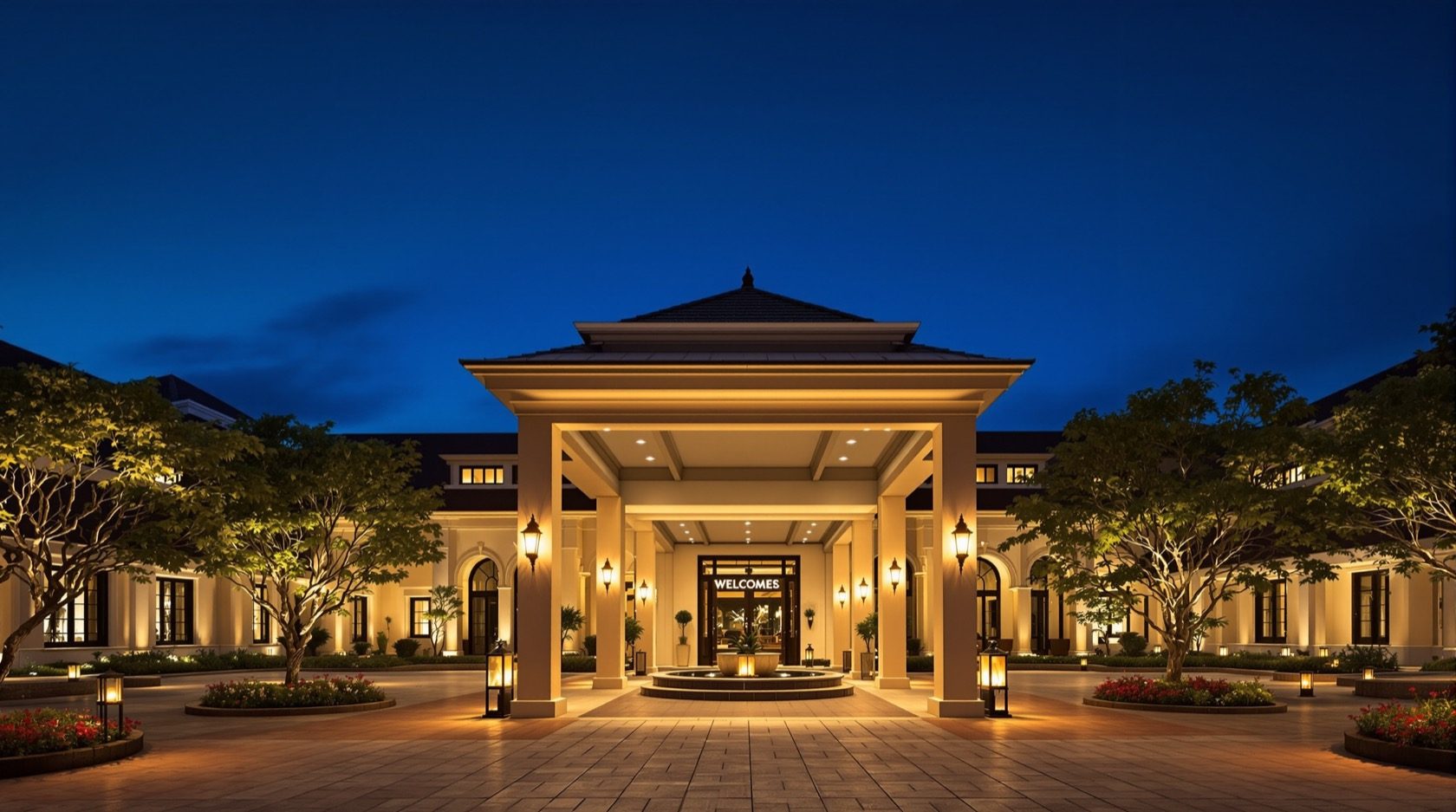
Security Guide for Hotels and Resorts in India
How to protect guests, staff and property across a hotel or resort in India without ever losing the warm, unobtrusive welcome that hospitality depends on. Zoning, guest-room and floor access control, CCTV with strict privacy limits, sprawling resort perimeters, back-of-house control, staff vetting, in-room safes and egress-first emergency planning — for owners, operators and architects.
The paradox at the heart of hospitality security is that it must be felt but not seen. A guest should sense, without being able to say why, that they are safe — a calm lobby, a well-lit corridor, a room door that closes with a reassuring solidity — while never once feeling watched, corralled or suspected. A hotel that looks like a fortress has already failed at hospitality; a hotel that is genuinely open has failed at security. The craft is to hold both at once.
This guide is for the people who carry that responsibility: owners and operators running a property, and architects and consultants designing one. It makes the general principles of the Studio Matrx Security Knowledge Hub specific to Indian hotels and resorts — from a compact business hotel on an arterial road to a sprawling beach or hill resort over many acres. It will help you assess risk, zone the property, choose systems and coordinate professionals; for a property of any real size, engaging a security consultant is part of the plan, not an admission of failure.
Scope & safety. This guide helps you plan, decide and coordinate. Fire detection and alarm, electronic access control and electric locks, guest-room lock systems, mains electrical work and the structural perimeter are life-safety-critical and code-governed: specify them, then engage a qualified hospitality security consultant and licensed installers to design, install and certify them. Above all, security hardware must never impede fire escape or evacuation — egress always wins. Nothing here replaces a site-specific assessment.
Why hotels are a distinct security problem
A home protects a known set of people from strangers. A hotel does the opposite: it invites strangers in by the hundred, every day, houses them overnight beside one another, and must still keep each one — and every staff member — safe. That inversion drives everything.
- A transient, anonymous population. Guests arrive unknown, stay briefly and leave. You cannot vet them the way an office vets employees, so security leans on zoning, access control and observation, not identity.
- Valuables in motion. Cash at reception, guest jewellery and laptops in rooms, liquor and stores in the back — all concentrated and, to a thief, predictable.
- A legal duty of care. An Indian hotel owes its guests a real duty of care; lapses become liability. Security is part of the licence to operate.
- The ambience constraint. Unlike a bank, a hotel cannot buy safety by looking hard. Every measure is judged twice — does it protect, and does it preserve the welcome?
- Scale and sprawl (resorts). A resort may have a kilometre of boundary, detached villas, water bodies and back gates for supplies. Its perimeter problem is an order of magnitude larger than a city hotel's.
The response is the same discipline used everywhere in security — layers — expressed through the language of hospitality. The master logic is set out in the ultimate guide to home security in India and, for buildings specifically, in the building security systems guide; this guide bends it to the hotel.
Think in zones: the four-zone model
The single most useful idea for hotel security is zoning. Instead of one uniform level of protection, you divide the property into zones by who belongs there, and you control the boundaries between them. A guest flows smoothly through the zones they are entitled to, and meets a quiet, polite friction at every boundary they are not.
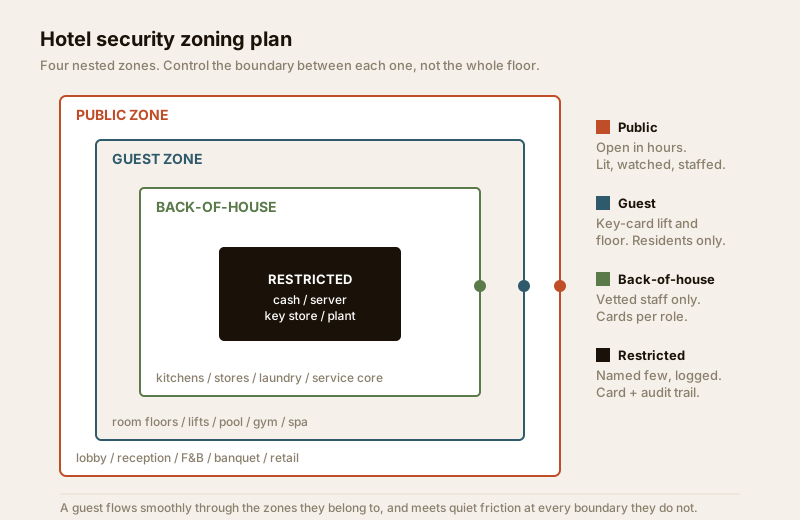
- Public zone — lobby, reception, restaurants, bars, banquet and conference areas, retail. Open to anyone during operating hours; secured by observation, good lighting, CCTV and staff presence rather than barriers.
- Guest zone — the guest-room floors and their lifts, corridors and amenities (pool, gym, spa, club lounge). Access limited to resident guests, ideally by a key-card-controlled lift and floor so a card only reaches the floors it is entitled to.
- Back-of-house (BOH) zone — kitchens, stores, laundry, staff areas, service corridors and lifts, plant rooms. Staff only; controlled by access cards or keys and separated from guest circulation.
- Restricted zone — the small, high-consequence core: cash room and count room, server/IT and CCTV control room, master-key and safe-deposit store, main electrical and fire panels. Tightly controlled, logged, and open to a named few.
Written as a table, the zones make the design decisions explicit:
| Zone | Who belongs | Typical spaces | Primary control | CCTV stance |
|---|---|---|---|---|
| Public | Anyone (operating hours) | Lobby, F&B, banquet, retail | Observation, lighting, staff | Yes — overt, in common areas |
| Guest | Resident guests only | Room floors, lifts, pool, gym, spa | Key-card lift/floor + room lock | Corridors & lift lobbies only — never inside rooms |
| Back-of-house | Vetted staff only | Kitchens, stores, laundry, service cores | Access cards / keys, staff ID | Yes — stores, receiving, corridors |
| Restricted | Named few, logged | Cash, server/CCTV room, plant, key store | Card + audit log, sometimes dual control | Yes — with strict access to footage |
Get the zoning right on the drawing board and most other decisions — where cameras go, which doors get card readers, how a guest reaches a room — fall out of it naturally. Architects designing a new property should read this alongside the security design guide for architects, which puts these zones into plans and specifications.
Guest-room and floor access control
The guest room is where hospitality security is most personal. The guest must feel that their room is wholly private and wholly theirs for the length of the stay — and that the same door will keep everyone else out.
Electronic locks and key cards
Modern hotels use electronic guest-room locks — RFID key cards, or increasingly a phone as the key — rather than mechanical keys. Well specified, they are a large security and service upgrade:
- A credential, not a key. A lost card is deactivated and reissued in seconds; every stay gets a fresh credential.
- An audit trail. The lock records which credential opened it and when — invaluable if a guest reports a theft, and a deterrent to internal misuse.
- Time-bound access. A card works from check-in to check-out and then dies, so a departed guest cannot return.
- A controlled master hierarchy. Housekeeping, maintenance, supervisors and security carry tiered master credentials, each logged and tightly administered.
The critical safety rule: a guest-room lock must always allow free exit from inside without a card or key, and must fail in a way that supports escape, not traps people, in a power or fire emergency. This is why electronic guest-room locking is licensed, coordinated work — never a DIY retrofit. Scope it with the access control system designer and price it with the access control cost estimator before briefing an installer.
Floor and lift access
In a good design the guest card does more than open a door — it governs vertical movement. A card presented in the lift releases only the floors that card is entitled to, so a casual visitor cannot ride to a random guest floor and wander the corridors.
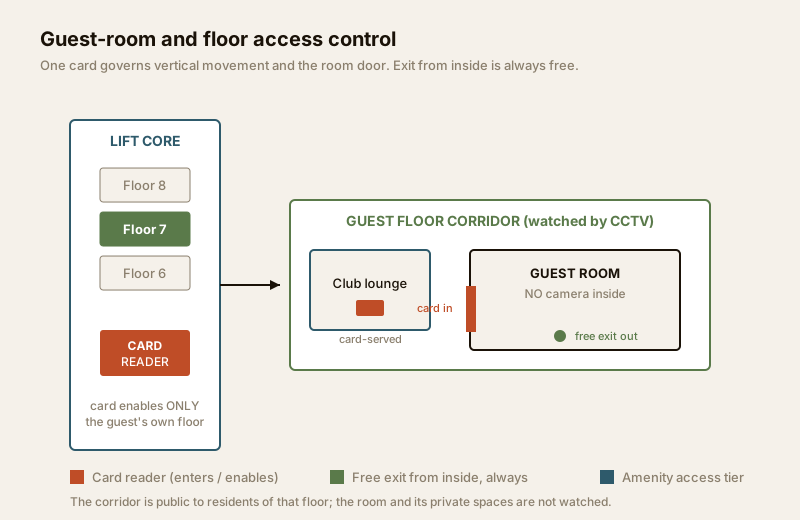
This floor-access layer is what quietly separates the public zone from the guest zone. It also protects guests from each other: the corridor outside a room should only ever hold people entitled to be on that floor. For a large or high-profile property, VIP or club floors can be given an additional access tier the same way.
CCTV: coverage with hard privacy limits
CCTV is the eyes of the property, but in a hotel it comes with bright red lines. Cameras are a tool for public and service spaces, and they stop dead at the threshold of anywhere private.
Cameras belong in: entrances and the porte-cochere, the lobby and reception, lift lobbies and inside lifts, guest-floor corridors, F&B and banquet public areas, car parks and driveways, receiving/loading bays, stores and cash areas, and the perimeter. Coverage should be continuous at the points that matter — every entry/exit, every cash point, every zone boundary — and recorded with enough retention to be useful after the fact. Plan camera positions and counts with the CCTV camera coverage calculator.
Cameras must NEVER be placed in: guest rooms, bathrooms, changing rooms, spa treatment rooms, toilets, or any space where a person has a reasonable expectation of privacy. This is not a preference — it is a legal and ethical line. A hidden or wrongly-placed camera in a private space is a serious offence and an existential reputational risk. State it plainly in your policy, brief every installer against it, and audit for it. Guest-floor corridors are watched; the rooms and private spaces that open off them are not.
Two further disciplines protect the guests you are trying to serve:
- Access to footage is itself restricted. The CCTV recorder and control room live in the restricted zone; only named, trained staff view footage, and access is logged. A camera system with loose viewing is a privacy breach waiting to happen.
- Signage and retention. Notify guests that common areas are monitored, keep recordings only as long as there is a legitimate need, and secure them against copying. Follow the building regulations and compliance guidance and your local bye-laws.
The perimeter — and the special problem of resorts
For a city hotel the perimeter is often just the building line and its car park, controlled at the porte-cochere and the basement ramp. A resort is a different animal entirely: many acres, a long boundary, detached villas or cottages, pools and water bodies, gardens designed to feel limitless, and multiple gates including a service gate for supplies.
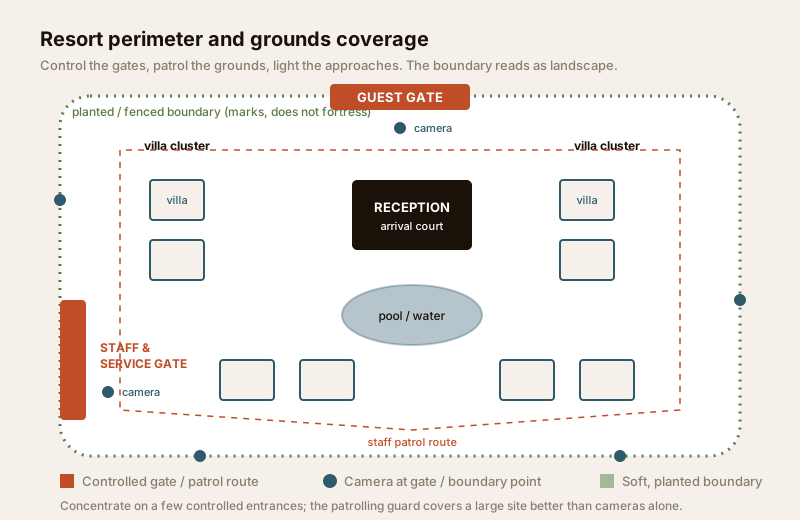
The resort perimeter strategy is layered, and kept gentle enough to preserve the sense of escape guests pay for:
- Define the boundary without a fortress wall. Dense planting, water features, level changes and discreet fencing can mark and secure a boundary while reading as landscape, not prison. The structural safety trades handle the physical elements.
- Control the gates, not the whole line. Concentrate on a few controlled entrances — a guest gate and a separate staff and service gate for supplies — rather than making a kilometre of hedge impenetrable.
- Light and observe the approaches. Lit pathways, cameras at gates and key boundary points, and regular staff patrols on defined routes cover a large site better than cameras alone. On a resort, the patrolling guard is a primary layer, not a backup.
- Watch the water and the edges. Pools, lakes and beach access are safety and security concerns needing lighting, sightlines, signage and the life-safety measures local bye-laws require.
- Villa-level security. Each detached villa becomes a mini guest zone, with its own electronic lock, in-villa safe and a way to summon help quickly.
Back-of-house and staff access control
Most losses in hotels are not dramatic break-ins; they are quiet, internal, and continuous — pilferage from stores, unauthorised access, credentials shared. Back-of-house control is where a hotel's real loss prevention lives.
- One controlled staff entrance. Staff enter and leave through a single point with ID and, ideally, a card reader — not through the guest lobby and not through whichever service door happens to be propped open.
- Card-controlled service cores. Service lifts, store rooms, kitchens and plant rooms carry readers so that a housekeeping card cannot open the liquor store and a kitchen card cannot reach the cash room. Access follows the job.
- Receiving discipline. The loading/receiving bay is a classic loss point; it should be supervised, camera-covered, and separated from the free flow of stores into the property.
- Key and master-credential control. Master keys and cards are issued against signature, logged, and audited; a lost master is treated as an incident.
The guest-versus-back-of-house distinction is worth making explicit as a matrix — it is the everyday logic of who may pass which boundary:
| Boundary / space | Guest with room card | General staff | Restricted-zone staff | Visitor / contractor |
|---|---|---|---|---|
| Lobby & public F&B | Yes | Yes | Yes | Yes (hours) |
| Own guest floor (via lift) | Yes — own floor only | On duty only | On duty only | Escorted only |
| Other guest floors | No | On duty only | On duty only | No |
| Back-of-house / service core | No | Yes — per role | Yes | Escorted, logged |
| Restricted (cash, server, key store) | No | No | Yes — logged | No |
Every "No" and "escorted only" in that matrix is a door, a reader or a supervised threshold on your plan. Design them in early; retrofitting access control into a running hotel is disruptive and expensive.
Staff vetting and the human layer
Systems are only as trustworthy as the people who hold the credentials. In a hotel — where staff have legitimate access to rooms, stores, cash and master keys — vetting and culture are core security, not HR paperwork.
- Pre-employment verification. Verify identity, previous employment and references, and conduct police verification where applicable — especially for staff with access to rooms, cash or master credentials. Extend the same diligence to outsourced and contract staff (housekeeping, guards, F&B), often the least-vetted and most-accessed group.
- Onboarding into the security culture. Every staff member learns the zoning, the CCTV privacy lines, guest-privacy expectations, incident reporting and their evacuation role.
- Credential lifecycle. Access is granted to match the role, changed when the role changes, and revoked immediately on exit — the most-missed step, and the one that turns a departed employee's card into an open door.
- A no-blame reporting culture. Staff who feel safe reporting a propped door, a lost card or an odd request are your best sensor network — cheaper and better than any device.
In-room safes and handling valuables
Guests arrive with jewellery, cash, passports and laptops, and they will judge the hotel harshly if those are lost. Give them safe, easy choices:
- In-room safes. A digital in-room safe, bolted to the structure, lets guests secure valuables themselves. Housekeeping must be trained never to touch guest belongings, and a controlled override procedure (logged, dual-witnessed) handles forgotten codes.
- Safe-deposit lockers at reception. For high-value items, front-desk safe-deposit lockers under dual control (guest key/credential plus hotel key) offer a stronger option — and a clear place to point guests carrying serious valuables.
- Cash handling. Reception cash, F&B floats and the day's takings move on a disciplined route to a restricted count room and safe, out of guest sightlines, ideally camera-covered along the way.
- A clear liability position. Post the property's valuables policy (in-room safe, safe-deposit, declared valuables) so expectations are set and the duty of care is discharged honestly.
Emergency planning: egress always wins
This is the section that overrides every other. A hotel is full of people who do not know the building, may be asleep, and may not speak the local language. In a fire or emergency, the entire security apparatus must get out of their way.
- Security must never impede egress. Every access-controlled door on an escape route must fail safe — release automatically on fire alarm and allow free exit by a single motion — so that the very locks protecting the property can never trap a guest inside it. This is the hard constraint that governs all access-control design, and it is why the work is licensed and code-governed.
- Detection and alarm to code. Fire detection, alarm and voice-evacuation systems must be designed, installed and certified per the National Building Code fire and life-safety provisions and your local municipal bye-laws — engaged as qualified professional work, not value-engineered away.
- Clear, lit, unobstructed routes. Escape routes, signage and emergency lighting kept clear at all times — never blocked by a locked service gate, a stored banquet table or a decorative screen.
- Trained staff and rehearsed plans. Staff drilled on evacuation roles, guest assistance (including guests with disabilities), assembly points and headcount. In an emergency, trained staff are worth more than any device.
- Coordination with local services. A working relationship with the local fire brigade and police, up-to-date plans lodged with them, and defined coordination for medical, fire and security incidents. Resorts far from a fire station must plan for longer response times with more on-site capability.
Security and life-safety are not in tension here — they share the same goal of protecting people — but where a specific piece of hardware ever seems to pit "keep them out" against "let them out", let them out is always the answer.
When to bring in a professional
You — the owner, operator or architect — set the brief, choose the systems and coordinate the trades. You do not design, wire or certify the following yourself:
- A qualified hospitality security consultant — for any property of real size, to run a proper risk assessment and design the integrated scheme. Frame the assessment using the security risk assessment guide.
- Fire detection, alarm and voice evacuation — life-safety-critical; designed, installed and certified to the National Building Code and local bye-laws by licensed professionals.
- Electronic access control and electric locks — including guest-room lock systems and fail-safe egress doors; poorly installed locks can trap people. Specify, then use a licensed integrator.
- Mains electrical work — cameras, gates, locks and alarms all need proper wiring; use a licensed electrician (see the electrical hub).
- Structural perimeter and safe rooms — walls, gates, grilles and anchored safes, detailed by a competent professional so they are both effective and fire-escapable.
For a hotel, "coordinate the professionals" is not a fallback — it is the plan. The property is too large, too public and too legally exposed to secure by instinct.
Key takeaways
- Felt, not seen. Great hotel security protects completely while preserving the welcome; a property that looks like a fortress has already failed at hospitality.
- Zone first. Public, guest, back-of-house and restricted zones — control the boundaries between them, and most other decisions follow.
- Access control governs floors, not just doors. Key cards that limit lift and floor access quietly separate guests from the public and from each other.
- CCTV has hard limits. Watch common and service areas; never guest rooms, bathrooms or any private space — and restrict who can view the footage.
- Resorts are a perimeter problem. Control the gates, patrol the grounds, light the approaches, and keep the boundary reading as landscape, not prison.
- Vet the people, revoke on exit, and drill for emergencies — and remember that egress always wins: security hardware must never impede escape.
Where to go next
- Start from first principles: The Ultimate Guide to Home Security in India and the Building Security Systems Guide.
- Design it into the building: Security Design Guide for Architects.
- Assess the risk properly: Security Risk Assessment Guide.
- Scope the systems: Access Control System Designer, Access Control Cost Estimator and the CCTV Camera Coverage Calculator.
- Related building types and browse: Commercial Buildings, Gated Communities, the Security Knowledge Hub, or all guides.
References
- National Building Code of India (SP 7), Bureau of Indian Standards — fire and life-safety, egress, detection and alarm provisions relevant to hotels and assembly occupancies; verify the current edition via the BIS catalogue.
- Local municipal building bye-laws, fire NOC requirements and licensing conditions — govern occupancy, egress, CCTV in common areas, and safety systems; check your city and state rules.
- Local police and fire services guidance on hotel registration, guest records, staff verification and emergency coordination.
This is an educational overview for planning and decision-making. Fire detection and alarm, electronic access control, guest-room lock systems, mains electrical work and the structural perimeter are qualified professional work — engage a hospitality security consultant and licensed professionals for design, installation and certification, ensure all life-safety hardware fails safe for egress, and verify any standard's current status via the BIS catalogue before relying on it.
Export this guide
Related Guides — Deep-dive reading
Access Control Maintenance in India (2026): Readers, Locks and Fail-Safe Egress
How to keep a card, keypad, fingerprint or face access-control system reading reliably and locking securely — and, above everything, how to test that its doors still release on a fire alarm and on power loss, so an access-controlled door never becomes a life-safety trap.
SecurityFail-Safe vs Fail-Secure Locks: The Guide (India 2026)
Why fail-safe vs fail-secure is the single most important access-control decision, and how to get it right for every door.
Home Doors & EntrancesSecurity Fire Alarm Integration in India (2026): Smart Alerts, Certified Systems, Fail-Safe Egress
The most important sentence a smart-home designer can say about fire is also the least profitable: a smart-home smoke sensor or fire notification is a helpful add-on, not a substitute for a certified fire-alarm system. This guide draws the line hard — life-safety detection and alarm belongs to the NBC-governed certified system — and then covers the genuinely useful, correctly-scoped automations the smart layer can add on a verified fire signal: unlock for egress, open the gate for the fire tender, light the escape path, stop the away-scene, and notify everyone loudly. All of it fail-safe. None of it in the way of the system that actually saves lives.
SecurityRelated Tools — Try Free
Home Security Risk Scorecard
Score your home across six security layers — perimeter, entry points, lighting, detection, alarm and habits — and get a prioritised action plan.
Security ScorecardCCTV Camera Coverage & Count Calculator
Estimate how many CCTV cameras you need, the NVR channels, storage in TB for your retention period, and an indicative all-in cost with GST.
CCTV CalculatorCircadian Light Meter
Patient-centric circadian lighting visualizer for Indian healthcare design — time-of-day × intensity → CCT, melanopic lux (EML / mEDI), melatonin suppression, and an alertness curve. Calibrated against WELL v2 L03 Circadian Lighting Design, CIE S 026:2018, Brainard 2001, and Lucas et al. 2014.
Circadian Tool