
Parking Entry Doors and Barriers in India: Boom Barriers, Shutters, Gates and Access Control (2026)
How to control vehicle access at apartment, mall, office and basement parking in India - boom barriers with RFID, FASTag and ANPR, rolling shutters and sliding gates for secured closure, high-speed doors for conditioned basements, plus the NBC fire and ventilation rules for enclosed parking - each ranked by the driver that decides it, with indicative per-barrier and per-door costs.
A parking entrance is not really one door - it is a sequence of decisions about who gets in, how fast, and what happens when the place is locked for the night. At the ramp mouth you control the moving vehicle; deeper in, you seal the basement against intruders, fire and weather. An apartment gate that lets a resident in within two seconds, a mall barrier that clears a Sunday queue without a jam, an office basement that recognises a car's number plate and lifts the arm before the driver reaches it - these are all the same problem solved with different equipment. Choose the wrong combination and you get tailgating, fender-benders at the arm, queues onto the public road, or a basement that fails its fire inspection.
This guide treats the parking entry as a layered system: the access-control barrier that meters vehicles, the security closure that shuts the opening after hours, and the pedestrian and code requirements that wrap around both. For each layer we name the recommended equipment, the single driver that should decide it, indicative 2026 rupee costs and how it ties into your cameras and access system. We complement the door-type and automation guides rather than repeat them - follow the links for full detail on any one mechanism.
What a parking entry actually has to do
A parking opening juggles demands that pull in different directions, and the building type decides which one wins.
- Vehicle access control - the core job is letting authorised vehicles in and keeping others out, via RFID tag, FASTag, ticket or automatic number-plate recognition (ANPR). This is what the boom barrier exists for.
- Throughput at peak - office basements and malls see a rush at shift change or on weekends. A slow barrier or a single lane creates a queue that backs onto the public road, which is both a nuisance and, at a busy junction, a safety hazard.
- Security closure - a boom barrier stops a car but a person can duck under it. After hours, or for a secured basement, you need a solid closure - a rolling shutter or a sliding gate - that physically seals the opening.
- Fire and ventilation code - an enclosed basement parking is a fire-risk space under NBC 2016. Any closure across the opening must respect mechanical ventilation and smoke-exhaust requirements and must not block the fire-tender or escape route. This is the constraint people forget until the inspection.
- Automation and integration - the barrier, shutter or gate should be motorised and wired to the access-control system, the boom-camera and the guard cabin, so one event (a valid tag) triggers the right response (arm up, photo logged).
- Durability - this equipment lives outdoors at a ramp, takes thousands of cycles a month, and sees Indian dust, monsoon and heat. Cheap actuators and thin shutter laths fail first.
- Pedestrian separation - residents and visitors on foot must never share the vehicle lane. A separate pedestrian side door or wicket gate keeps them out of the path of moving cars.
Security and fire matter far more here than appearance, which flips the priority order you would use for a living room door or a showroom front.
The three layers of a parking entry
Think of the entrance as three independent decisions. A small apartment may need only the first two; a conditioned office basement may need all three plus the pedestrian door.
1. The access-control barrier - meters vehicles in and out. Almost always a boom barrier.
2. The security closure - seals the opening when parking is locked, or for a fully secured basement. A rolling shutter or a sliding gate.
3. The pedestrian door - a separate side door so people on foot never cross the vehicle lane.
1. The access-control barrier - the boom barrier is the standard
For metering vehicles, a boom barrier (the lifting arm) is the default across Indian apartments, malls, offices and tech parks. It is fast, it is unambiguous, and it pairs with every access method. What changes is how the arm is triggered:
- RFID long-range tag - a sticker or card tag on the windscreen is read from 3-8 m, so the arm lifts before the car stops. This is the workhorse for residents and staff with a fixed vehicle - apartment complexes and office basements run on it. Common in India from Spintly, Essem, Matrix, Roboticgen and similar.
- FASTag / ANPR (number-plate recognition) - the barrier reads the FASTag or the registration plate via camera and lifts automatically. ANPR suits places with rotating users and no tags - malls, hospitals, large offices - and gives you a logged photo of every plate. It is the fastest-growing method.
- Ticket / pay-on-foot - a button dispenses a ticket on entry and the driver pays before exit. Standard for paid public parking at malls and airports.
- UHF card, Bluetooth or app - alternatives for staff and members.
The mechanism, automation and integration of these barriers and gates is covered in depth in our motorised gate automation guide and the door access control guide - follow those for actuator types, controllers and wiring. The barrier on its own does not provide security: it stops a car, but anyone can walk under the arm, which is why it is paired with a closure and cameras.
A few practical rules: use a separate in and out lane wherever traffic justifies it so entering and exiting cars never deadlock; add a safety loop or photocell under the arm so it never drops on a vehicle; and put the boom-camera and a guard intercom at the barrier so exceptions can be handled without a queue.
2. The security closure - shutter or sliding gate
After the last car parks for the night, or for a basement that must stay sealed, you need a real physical closure across the opening. Two options dominate.
- Rolling shutter - a steel or aluminium roller shutter pulls down over the ramp opening to seal the basement after hours. It is the most common secured-parking closure: compact (rolls into a drum overhead), strong, and available motorised with remote and timer. For an enclosed basement, specify a perforated or grille-type shutter or a louvred section so it still ventilates when partly down, or interlock it with the ventilation system - a solid shutter sealing an enclosed basement can breach the fire and air-change requirement. A fire-rated rolling shutter is used where the opening is also a fire-compartment line.
- Motorised sliding or swing gate - at the property boundary or the head of the ramp, a sliding gate (or, with room to swing, a pair of swing gates) closes the whole driveway. A collapsible gate is a lighter, see-through alternative that still ventilates and lets the guard see through. Sliding gates suit wide driveways with no swing room; see motorised gate automation for the operator and safety detail.
The driver here is secured closure plus ventilation: you want to physically seal the opening at night without choking an enclosed basement of air - so favour grille, perforated or louvred closures, or interlock a solid shutter with the mechanical ventilation.
3. High-speed doors for conditioned or clean basements
Where a basement is air-conditioned, pressure-controlled, or must keep dust and fumes out - some premium office and data-centre basements, or a vehicle airlock into a clean zone - a plain shutter that takes 15 seconds to close wastes conditioned air on every cycle. A high-speed door (a fast-rolling fabric or PVC door that opens and closes in 1-2 seconds) limits the air exchange and dust ingress while still passing vehicles quickly. These are industrial doors - see that guide for the roll-up, sectional and high-speed mechanisms and their costs. A high-speed door does not replace the access barrier or the after-hours security shutter; it sits alongside them where air separation matters.
Recommendation table - which equipment for which parking entry
| Parking type | Access barrier | After-hours / security closure | Indicative cost (+18% GST) | Why this combination |
|---|---|---|---|---|
| Apartment complex (gated) | RFID boom barrier, separate in/out lane | Motorised sliding gate or collapsible gate at boundary | Boom barrier 45,000-1,50,000 each; sliding gate operator 25,000-90,000 | Residents pass on tag; gate seals the compound at night, still ventilates |
| Office / IT park basement | RFID + ANPR boom barrier | Perforated rolling shutter at ramp, interlocked to ventilation | Boom barrier 60,000-2,00,000; rolling shutter 18,000-60,000+ per opening | Tag for staff, plate-log for visitors; shutter secures basement without choking air |
| Mall / paid public parking | Ticket or FASTag/ANPR boom barrier, multiple lanes | Rolling shutter on each ramp for closing hours | Per-lane barrier 60,000-2,50,000; shutter per ramp 25,000-80,000+ | Rotating users, peak throughput needs lanes; ANPR logs every plate |
| Secured / conditioned basement (data centre, premium office) | Access-controlled boom barrier + interlock | High-speed door (air separation) + fire-rated security shutter | High-speed door 2,50,000-8,00,000+; fire shutter 60,000-2,50,000+ | Fast cycle limits conditioned-air and dust loss; fire-rated where it crosses a compartment |
| Small commercial / standalone | Manual or motorised boom barrier | Rolling shutter or collapsible gate | Boom barrier 35,000-90,000; shutter/gate 15,000-50,000 | Low traffic; one closure both secures and ventilates |
Costs are indicative for 2026 and vary widely by lane width, brand, length of arm, shutter size, motor and city. Use the door cost calculator for a sized estimate on the shutter or gate, and get barrier quotes per lane.
A parking entry plan - barrier, reader and shutter in sequence
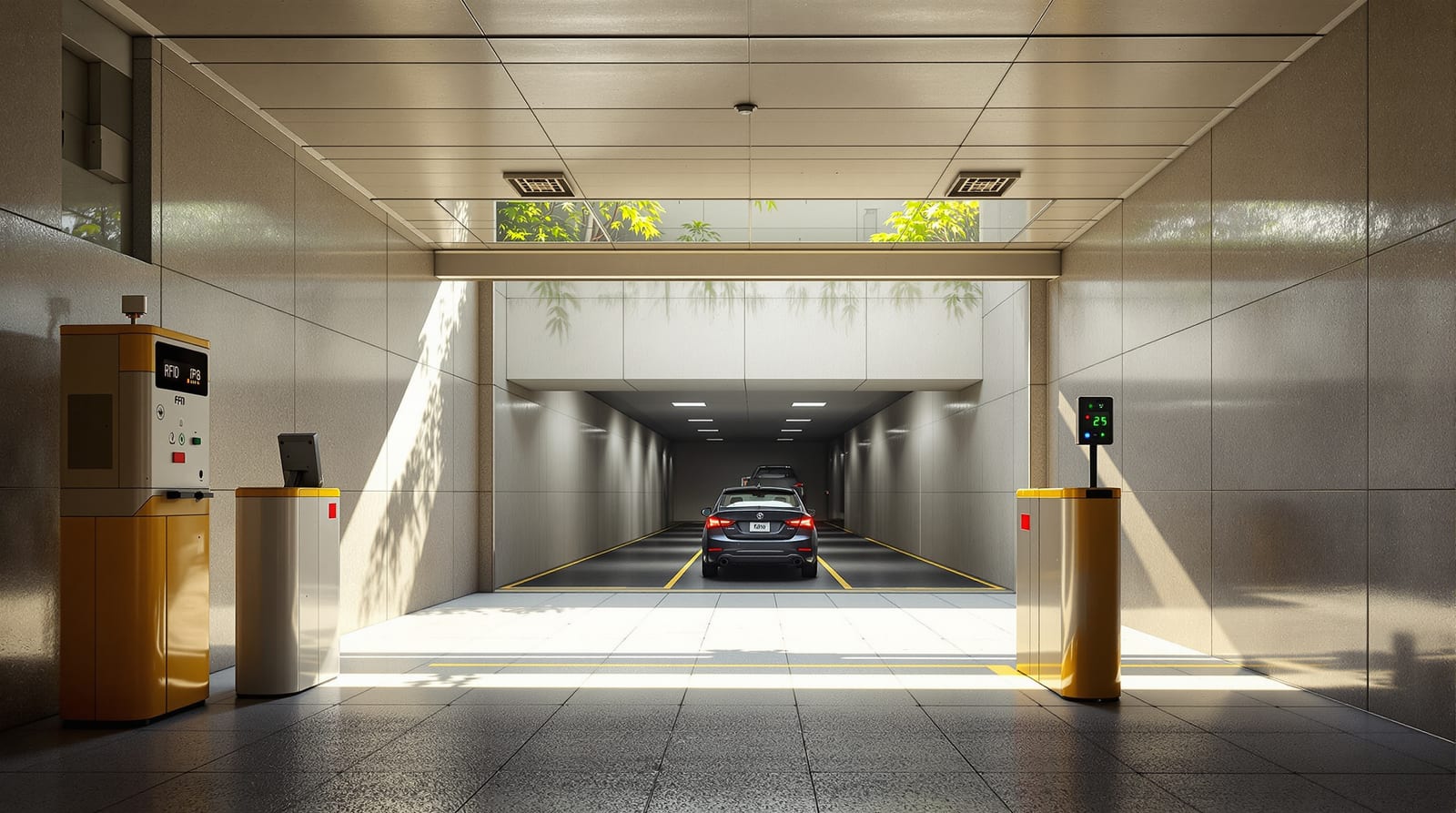
The sketch shows the three layers in the order a car meets them: the RFID reader and boom barrier at the ramp mouth that meters the vehicle, the safety loop under the arm, the rolling shutter behind it that seals the basement after hours, and a separate pedestrian door to one side so people never walk in the vehicle lane.
Fire and ventilation - the code that decides your closure
This is the part that catches projects out. Under NBC 2016, an enclosed (basement) parking is a designated fire-risk occupancy with mandatory mechanical ventilation and smoke-extraction, marked exit signage, and unobstructed access for the fire tender. The closure you put across the parking opening must respect all of that:
- Do not seal an enclosed basement air-tight. A solid rolling shutter pulled fully down across the only opening can defeat the air-change and smoke-exhaust requirement. Use a perforated, grille or louvred shutter, leave a ventilation gap, or interlock the shutter to keep the mechanical ventilation running - and clear the design with your fire consultant.
- Never block the escape route or the fire-tender path. The vehicle barrier and shutter must not stand on a fire-exit door or the dedicated fire-tender movement space. The pedestrian escape from the basement is a separate, code-compliant fire-exit door with panic hardware - it is never the boom barrier or the shutter.
- Fire-rated shutters where the opening is a compartment line. If the parking opening also separates fire compartments, the shutter must be a fire-rated rolling shutter (fire-rated doors) with the required rating and an automatic-close on fire alarm.
- Power-failure release. Barriers and shutters must fail-safe so vehicles and people can get out in a power cut or alarm - manual override and battery backup are essential.
When in doubt, the ventilation and exit requirements override the convenience of a tight seal. A secured basement that suffocates in a fire is a code failure and a danger.
The pedestrian door - keep people out of the vehicle lane
Residents, visitors and staff on foot must never share the boom-barrier lane with moving cars. Provide a separate pedestrian side door or wicket gate beside the vehicle entry, on its own access control (RFID, intercom or video door). For a residential complex this also lets a visitor be screened at a video door system before they reach the building. Keep its clear width at least 900 mm and, for accessibility, a lever handle and a threshold under 12 mm. This pedestrian route, the boom barrier and the basement fire-exit are three distinct openings - do not let one try to do another's job.
Hardware and integration
The equipment is only as good as the system behind it.
- Access controller and software. The barrier, reader and camera report to a controller and a guard dashboard so every entry is logged with time and (with ANPR) a plate photo. See door access control for controller types and integration.
- Safety loops and photocells. A ground loop and a beam under the boom arm stop the arm dropping on a vehicle - mandatory for safety and for insurance.
- Boom camera and intercom. A camera at the barrier and an intercom to the guard cabin let exceptions (a visitor, a failed tag) be handled without blocking the lane.
- Motorised, backed-up operators. Gate and shutter motors (from Roger, BFT, Came, Godrej and similar in India) need battery or manual backup so the entry works in a power cut.
- Durable, weatherproof rating. Everything at the ramp is outdoors - specify IP-rated, galvanised and dust-sealed components for the Indian monsoon and heat.
Do and don't for parking entries
- Do run separate in and out lanes wherever traffic backs onto the road - a single shared lane deadlocks at peak.
- Do fit a safety loop or photocell under every boom arm so it never drops on a vehicle.
- Do clear any enclosed-basement closure with your fire consultant for ventilation and smoke-exhaust before you order a solid shutter.
- Do provide a separate pedestrian door and a separate code-compliant basement fire-exit - never make people walk the vehicle lane.
- Don't treat the boom barrier as security - a person walks under it; pair it with a shutter or gate for real closure.
- Don't seal an enclosed basement air-tight with a solid shutter - use perforated, grille or louvred closures, or interlock the ventilation.
- Don't specify the cheapest actuator and shutter - this equipment cycles thousands of times a month outdoors and the cheap parts fail first.
Working out the right barrier-and-closure mix for your building? The industrial door selector tool helps shortlist shutters and high-speed doors, and the wider doors by space guide covers every other building type and space.
Frequently asked questions
What is the best parking entry barrier for an Indian apartment complex?
For a gated apartment, an RFID boom barrier with separate in and out lanes is the standard - residents' windscreen tags lift the arm before they stop, while visitors are screened by the guard. Pair it with a motorised sliding gate or collapsible gate at the boundary to seal the compound at night, and a separate pedestrian door so people on foot stay clear of the car lane.
Do I need a shutter as well as a boom barrier in a basement parking?
Usually yes. A boom barrier only meters vehicles - anyone can walk under the arm, so it is not a security closure. To seal a basement after hours you add a rolling shutter (or a sliding gate at the ramp head). For an enclosed basement, use a perforated, grille or louvred shutter, or interlock a solid shutter with the ventilation, so you do not breach the NBC air-change and smoke-exhaust requirement.
What does the NBC require for enclosed basement parking ventilation and fire?
NBC 2016 treats an enclosed basement parking as a fire-risk space needing mechanical ventilation, smoke extraction, exit signage and unobstructed fire-tender access. The practical consequence for doors is that you cannot seal the only opening air-tight with a solid shutter - use ventilating closures or interlock the system - and the basement must have a separate, panic-hardware fire-exit door that the barrier and shutter never obstruct. Always confirm the detail with your fire consultant.
What does a parking boom barrier cost in India?
Indicatively for 2026, a boom barrier runs roughly 35,000-1,50,000 per lane for residential and standard commercial use, and 60,000-2,50,000 per lane for heavy-duty, FASTag or ANPR systems with cameras and controllers - varying by arm length, speed, brand and integration, plus 18% GST. A motorised sliding-gate operator adds about 25,000-90,000, and a rolling shutter across the ramp 15,000-80,000 or more by size. Get per-lane quotes from automation suppliers.
When do I need a high-speed door instead of a normal shutter at parking?
Use a high-speed door only where the basement is air-conditioned, pressure-controlled, or must keep out dust and fumes - some premium offices, data-centre and clean-zone vehicle entries. Because it opens and closes in 1-2 seconds, it limits the loss of conditioned air and dust ingress on every cycle. It sits alongside, not instead of, the access barrier and the after-hours security shutter.
Export this guide
Related Guides — Deep-dive reading
Boom Barriers in India (2026): Traffic Control at the Gate - and What They Do NOT Stop
The rising arm at the society, office and parking entrance controls honest vehicle flow one authorisation at a time - but a boom barrier is not an anti-ram device, and here is how to specify, integrate and make it safe.
SecurityRFID Vehicle Access in India (2026): Hands-Free Boom Entry, and Its Honest Limits
The FASTag-style windscreen tag and long-range reader lift the society or office-park boom without the driver stopping - fast, logged and far better than a photocopied resident sticker. But an RFID tag identifies the TAG, not the driver, so treat it as convenience and audit, never high assurance.
SecurityVisitor Vehicle Management in India: A Professional Guide
The everyday weak point of every society and office gate is not the resident's car — it is the visitor, the cab, the delivery rider and the contractor who must be let in without opening the whole park to anyone. This is the process, not just the hardware: verify at the gate before the boom lifts, park visitors away from resident bays, and never jam the gate a fire tender needs.
SecurityRelated Tools — Try Free
Gate Access Planner
Size a vehicle gate or boom barrier — lanes needed at peak and the right credential speed (RFID, ANPR, manual).
Gate FlowVisitor Access Planner
Size visitor handling at a gate or reception — lanes needed at peak and the temporary-pass pool.
Visitor FlowAccess-Control Battery-Backup Calculator
Size the standby battery so an access system keeps running through a power cut, with an egress life-safety note.
Battery Backup