
The Oxidation Ditch Process: A Complete Guide for Indian STPs
A looped-channel variant of extended aeration that runs sewage around a racetrack under slow surface aerators — robust, forgiving, low on sludge, and heavy on land. How it works, where it fits, and its honest pros and cons.
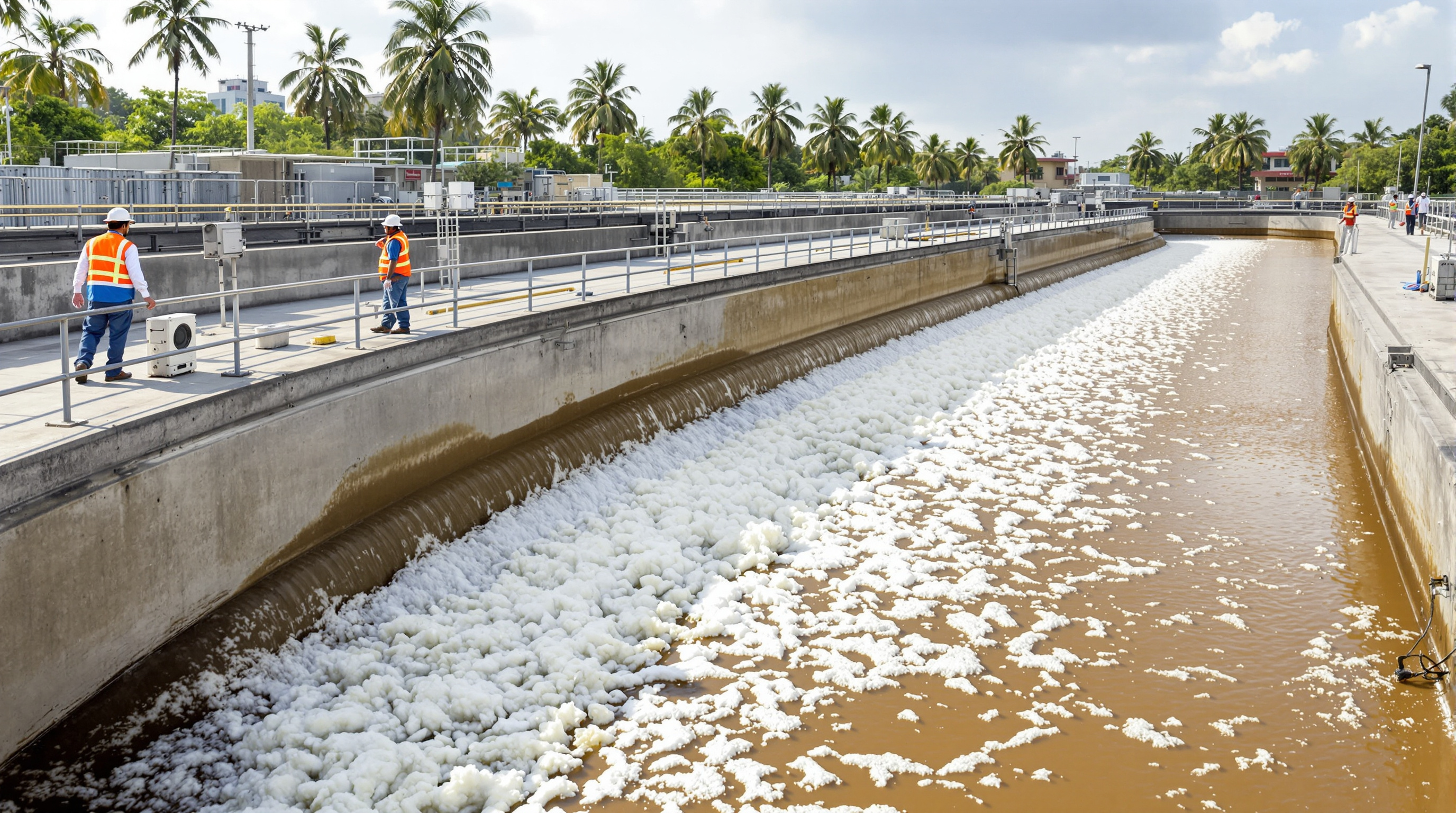
Among the many ways to build the biological heart of a sewage treatment plant, the oxidation ditch is one of the oldest, simplest and most stubbornly reliable. Strip away the branding and it is a single idea executed with unusual patience: instead of holding sewage in a rectangular aeration tank, you make it run laps around a long looped channel — a racetrack — while slow-turning aerators both feed it oxygen and push it forward. Keep it circulating for the better part of a day and the microbes do the rest.
It is, in effect, a geometric variant of the extended aeration process: same low-load, long-retention philosophy, different shape. That shape gives it a distinctive set of strengths — and a distinctive weakness — that decide exactly where it belongs in the Indian market.
An oxidation ditch treats sewage the way a river treats it, only bent into a closed loop: the water never stops moving, the aerators never stop breathing air into it, and over many hours the pollution is simply consumed.
What an oxidation ditch actually is
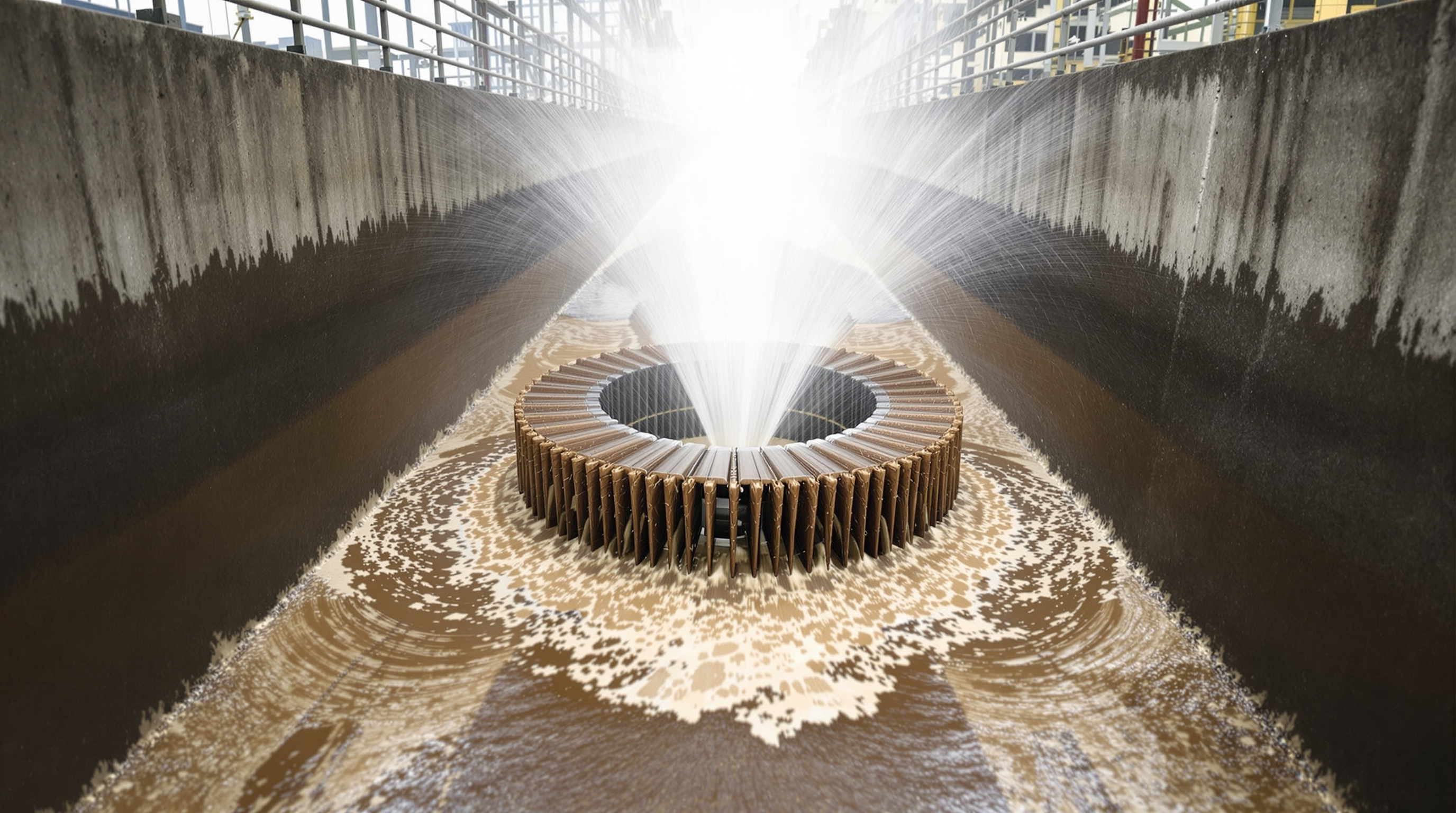
Picture an oval or horseshoe-shaped channel — like an athletics track — built in reinforced concrete, typically 1 to 1.5 metres of water depth, sometimes more in deeper "carousel" designs. The screened, de-gritted sewage enters this loop and joins a large, continuously circulating body of mixed liquor — water thick with the biological culture that does the cleaning.
Straddling the channel at one or more points are the aerators. In the classic design these are horizontal brush rotors (often called cage or Mammoth rotors) that sit across the width of the channel and whisk the surface as they spin; in others they are vertical surface aerators or submerged disc aerators. Each aerator does two jobs at once:
- Oxygenation — flinging the mixed liquor into the air so it absorbs oxygen the microbes need.
- Propulsion — pushing the water along the channel at roughly 0.3 metres per second, fast enough to keep the sludge in suspension and moving around the loop.
That dual role is the elegance of the design. There are no separate blowers, no diffuser grids on the floor, no complex air piping — just a handful of rugged mechanical aerators turning slowly over an open channel.
How the process works, stage by stage
The oxidation ditch is the secondary (biological) stage of the plant. Sewage still needs to be prepared before it and polished after it.
1. Preliminary treatment. Raw sewage passes through a bar screen and grit chamber to remove rags, plastics and sand that would otherwise foul the channel and wear the aerators.
2. The ditch itself. The sewage enters the loop and circulates for a long hydraulic retention time (HRT) — commonly 18 to 30 hours, far longer than a conventional activated sludge process. Over these hours the bacteria consume the dissolved organic matter (BOD) as food.
3. Alternating zones. Here is the clever part. As the mixed liquor travels around the loop, oxygen is high just downstream of each aerator and steadily falls as the water moves away from it. This creates natural aerobic zones (near the rotors) and anoxic zones (in the far reaches of the channel). The aerobic zones drive nitrification; the anoxic zones drive denitrification — so a well-tuned ditch removes nitrogen without any separate tank, simply by exploiting its own geometry.
4. Clarification. The overflow leaves the ditch and enters a secondary clarifier, where the fattened microbial flocs settle out as sludge. Clear water spills over the weir.
5. Return and wasting. Most of the settled sludge is pumped back to the ditch as return activated sludge (RAS) to keep the population strong; a small surplus is periodically wasted and sent to sludge drying.
6. Tertiary polishing. The clarified water is filtered and disinfected — by chlorination or UV — before reuse or discharge.
Because the biomass lives in the ditch for a very long time (a sludge age, or SRT, often of 20 to 40 days), it is a mature, stable, slow-growing culture. That single fact explains almost every advantage the technology has.
Why the long sludge age matters
Long sludge age means the microbes stay in the system long enough to consume not just the incoming waste but also much of their own cell mass — a process engineers call endogenous respiration. The consequences run right through the plant's economics and operation:
- Low sludge production. Because the biomass partly digests itself, the ditch produces noticeably less waste sludge than a high-rate plant — one of its headline selling points and a real saving on sludge handling and disposal.
- Stability under shock. A large, well-fed, mature culture shrugs off surges in flow and strength that would upset a leaner, faster process. Long HRT is a giant buffer.
- Inherent nutrient removal. The alternating aerobic/anoxic pattern removes nitrogen for free, and the long retention gives good, consistent BOD removal — treated water routinely well within CPCB discharge norms.
The honest pros and cons
No technology is free of trade-offs, and the oxidation ditch wears its own on its sleeve.
| Aspect | Oxidation ditch strength | The catch |
|---|---|---|
| Robustness | Extremely forgiving of load and flow swings; hard to upset | — |
| Sludge | Low waste sludge, well-stabilised, easy to dry | Still needs a clarifier and RAS pumping |
| Effluent quality | Reliable BOD removal + built-in nitrogen removal | Not reuse-grade alone; needs tertiary polishing |
| Operation | Simple, low-skill; few moving parts; no diffuser fouling | Rotors/aerators need periodic mechanical upkeep |
| Footprint | — | Large — the long HRT demands a big channel and a lot of land |
| Energy | Aerators are efficient oxygen-transfer devices | Continuous aeration over a large volume = meaningful running power |
| Odour | — | Open channel can release odour if under-aerated |
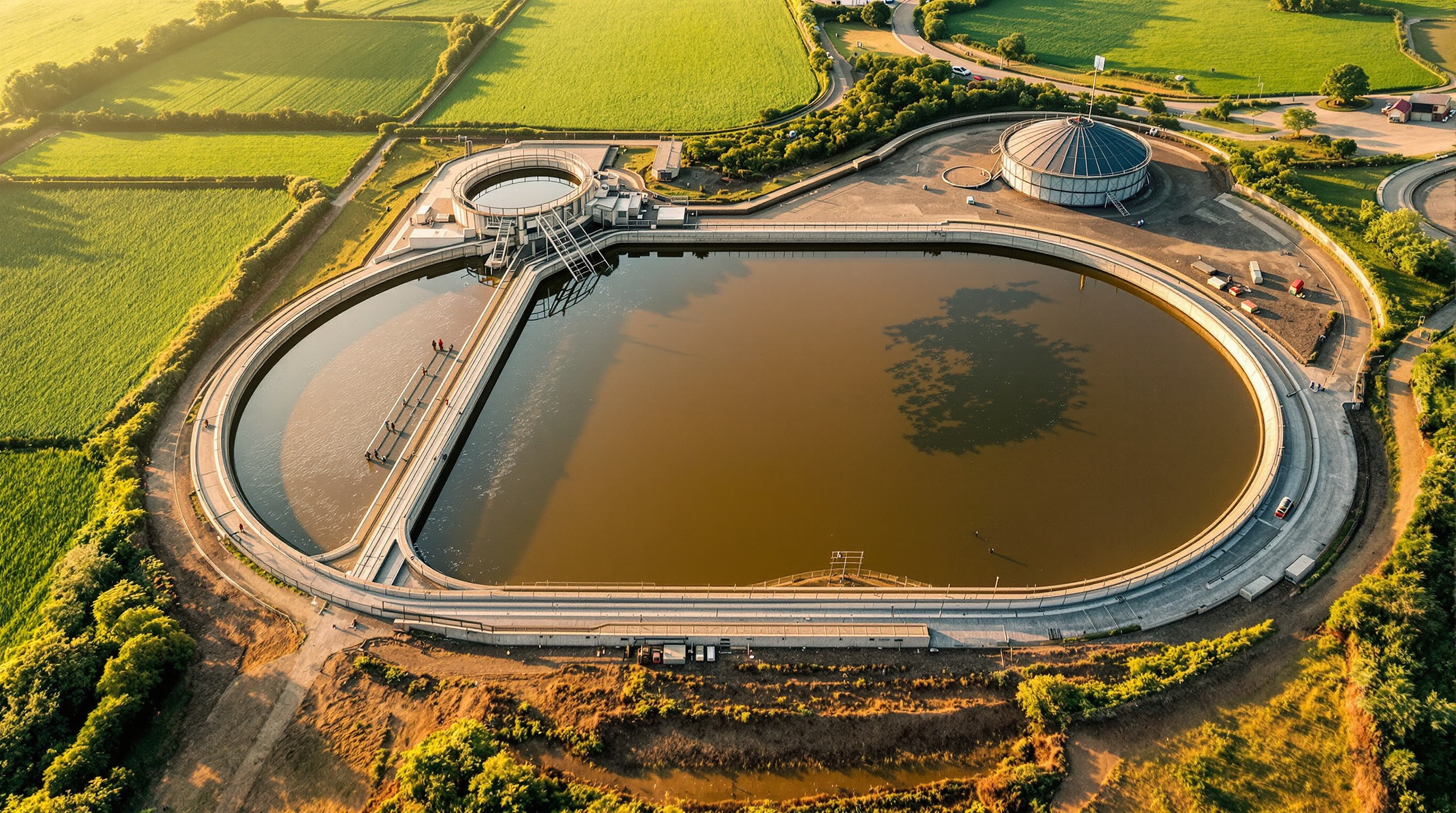
The land requirement is the decisive constraint. An oxidation ditch's 18–30 hour retention makes it inherently bulky, which is why you rarely see one squeezed into a city basement. It wants open ground.
Where oxidation ditches are used
The economics point clearly at a certain kind of project:
- Municipal and town-scale STPs where land is available and the priority is a plant that runs for decades with minimal fuss.
- Institutional campuses — universities, large hospitals, townships, defence and industrial estates — with room on the plot and their own maintenance teams.
- Applications where reliable nitrogen removal matters and the operator would rather buy that with land than with a more complex, chemical-heavy process.
Conversely, a compact high-rise on an expensive urban plot is a poor fit; there, a smaller-footprint technology such as MBBR, SBR or MBR will almost always win despite higher complexity or cost. The right way to weigh these against each other for a specific project is to work through the STP Technology Selector, and to size the biological volume the ditch would need with the STP Capacity Calculator.
Keeping the running cost sensible
The oxidation ditch's one ongoing expense is aeration power, since the rotors run continuously over a large volume. Two levers keep it in check:
- Dissolved-oxygen control. Fitting DO probes and variable-speed or timer control on the aerators — running them only as hard as the incoming load demands — is the single biggest saving, and it also sharpens the anoxic zones for better denitrification.
- Right-sizing. An oversized ditch wastes power aerating water that is already clean. Benchmarking the design against typical figures with the Energy Benchmark Calculator flags a plant that is drawing more than its peers, and the broader principles are covered in reducing STP electricity consumption.
The bottom line
The oxidation ditch is the tortoise of sewage treatment: slow, unglamorous, land-hungry — and almost impossible to kill. By bending extended aeration into a loop and letting a mature microbial culture circulate for the better part of a day, it delivers reliable BOD removal, built-in nitrogen removal and unusually low sludge, all with a handful of rugged aerators and very little operator skill. Where land is available and longevity matters more than footprint, it remains one of the soundest choices in the book. To place it against the alternatives, start from the Sewage Treatment Plants guide hub.
Export this guide
Related Guides — Deep-dive reading
Aeration Tank: The Biological Heart of an STP
The tank where blowers push oxygen into billions of microbes that eat the sewage's organic load — how it works, what DO, MLSS, F/M and HRT mean, and why it quietly runs up the biggest electricity bill in the plant.
Sewage Treatment PlantsBiological Culture Management in an STP: The Heart of Good O&M
The microbes in your aeration tank do the actual work of cleaning sewage. Keep them healthy — the right MLSS, food, oxygen and nutrients — and everything else falls into place. Here is how operators manage the living culture, diagnose bulking and foaming, and recover after a crash.
Sewage Treatment PlantsActivated Sludge Process (ASP): How It Works, Pros & Cons
The classic suspended-growth biological treatment behind most large sewage plants — how microbial floc forms and settles, the control parameters that keep it alive (MLSS, F/M, SRT, DO), where ASP fits, and how it stacks up against MBBR, SBR and MBR.
Sewage Treatment PlantsRelated Tools — Try Free
STP Technology Selector
Weight your priorities — footprint, effluent quality, cost, power and simplicity — and get a scored recommendation between Extended Aeration, MBBR, SBR and MBR.
SelectorRainwater Tank Sizer
How big should your rainwater tank be? Computes annual harvest, recommended tank capacity in litres, water-bill savings, and payback — for 10 Indian cities.
RWH CalculatorHealing View Impact Calculator
Evidence-Based Design dashboard quantifying the recovery impact of nature view + daylight factor on analgesic use, length of stay, and HCAHPS patient-experience uplift. Calibrated against Ulrich 1984 (Science), Park & Mattson 2008, and the CHD EBD evidence base.
EBD Calculator