
Swimming Pool Maintenance: The Complete Home Guide
Filtration, sanitising, water chemistry and a simple weekly routine — how to keep a home pool clean, safe and clear, what it costs, and when to call a professional.
A swimming pool is a wonderful thing to own, but anyone who has watched a sparkling pool turn green in a single monsoon weekend knows the truth: a pool is only as good as its maintenance. The good news is that pool care is not mysterious. It runs on a handful of simple, repeatable habits, and once you understand why each one matters, the weekly routine takes less time than mowing a lawn. This guide walks you through how a pool actually stays clean, the equipment that does the work, the water chemistry numbers worth memorising, and a realistic week-by-week and month-by-month routine for Indian conditions, where heat, dust and heavy monsoon rain all conspire against you. If you are still in the planning stage, start with the complete home pool guide and swimming pool cost in India, then come back here once the water is in.
The single most reassuring fact to hold on to is this: clean water is the result of two things working together, good circulation and balanced chemistry. Get those two right and almost every problem disappears on its own. Get either one wrong and no amount of chemicals will save you. So let us begin with circulation, the part most homeowners never think about until something goes wrong.
How a pool stays clean: the circulation circuit
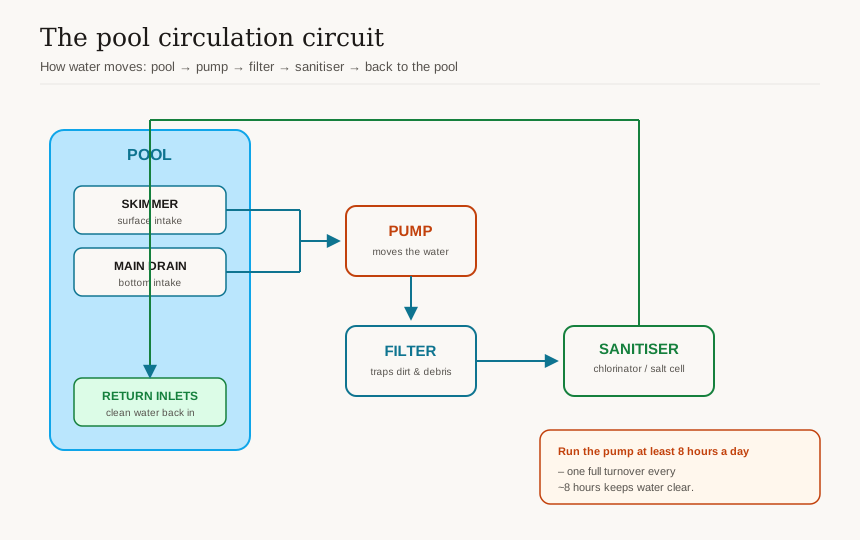
Every healthy pool is really a loop. Water is pulled out, cleaned, treated and pushed back in, around the clock. Understanding this loop is the key to everything else.
Water leaves the pool through two points. The skimmers, set into the wall at the waterline, draw off the top layer where leaves, dust, insects and floating oils collect. The main drain, at the deepest point of the floor, pulls from the bottom where heavier debris settles. From there the water travels to the pump, the heart of the system, which provides the suction and pressure that keep everything moving. After the pump, the water passes through the filter, which physically removes the fine particles that make water cloudy. Next it may pass through a heater or a sanitiser unit such as a salt chlorine generator or a UV chamber. Finally, the cleaned and treated water returns to the pool through the return inlets, usually angled jets in the wall that keep the whole body of water gently turning over.
If you have an overflow or infinity-edge pool, there is one extra piece. Water spills over the edge into a channel, drains into a surge or balance tank, typically sized at around 5 to 10 percent of the pool volume, and a second pump returns it. The balance tank absorbs the water displaced when swimmers get in and the constant overflow, which is why these pools feel so dramatic but ask a little more of the equipment.
The most important number in this whole section is the turnover. As a rule of thumb you want the pump to move the entire volume of the pool through the filter at least once every 8 hours, which usually means running the pump for a minimum of 8 hours a day. Skimping here is the single most common cause of trouble, because if the water is not turning over, debris settles, chlorine is not distributed, and algae gets a foothold faster than the filter can recover. To size all this correctly for your own pool, the Pool Volume Calculator and Pool Pump Calculator will do the arithmetic for you.
Filters: sand vs cartridge vs DE
The filter is where clarity is won or lost. Three types dominate, and each suits a different priority.
Sand filters are the workhorse of Indian residential pools. Water is forced down through a bed of graded sand, which traps particles down to about 20 to 40 microns. They are the cheapest to buy and very forgiving. The catch is cleaning: you clean a sand filter by backwashing, reversing the flow to flush the trapped dirt out to drain. Backwashing is quick but it wastes a good deal of water each time, which matters in water-scarce cities. The sand bed itself loses its sharp edges over time and should be replaced every 3 to 5 years.
Cartridge filters use a pleated fabric element, like a giant version of a car air filter, and capture finer particles in the 10 to 20 micron range. Their big advantage is that they need no backwashing, so they save water and run with less energy. When they get dirty you simply take the cartridge out and hose it down, and the element itself is replaced every 2 to 3 years. For homes watching their water bill, cartridge is increasingly the smart choice.
DE, or diatomaceous earth, filters are the finest of all, trapping particles as small as 2 to 5 microns by coating a grid with a fine powder of fossilised diatoms. They produce the clearest water and clear an algae bloom faster than anything else. The trade-off is effort: they are the most maintenance-heavy, the DE powder must be recharged after cleaning, and the powder needs careful handling. Most homeowners reserve DE for showcase pools or for rescuing a badly cloudy one.
Whichever type you have, the rule for cleaning is the same and it is gloriously simple. Watch the pressure gauge on the filter. Note the pressure when the filter is freshly cleaned, this is your baseline. When the reading climbs to roughly 8 to 10 psi above that baseline, the filter is dirty enough to restrict flow, and it is time to backwash or clean it. Cleaning too early wastes water and effort; waiting too long starves the circulation.
Sanitising your water: chlorine, saltwater, ozone/UV, mineral
Filtration removes what you can see. Sanitising kills what you cannot, the bacteria, viruses and algae spores that filtration alone will never catch. You have several options, but they are not equal, and one principle ties them all together: you almost always need a measurable chlorine residual in the water at all times.
Chlorine is the proven, inexpensive, day-to-day workhorse, and for good reason. It is cheap, it is reliable, and it leaves a residual that keeps protecting the water between doses. The faint smell people dislike is usually not too much chlorine but too little, the by-products of chlorine that has already done its job, a sign you need more, not less.
Saltwater pools are widely misunderstood. A salt chlorine generator does not make a chlorine-free pool. It makes chlorine on site from dissolved salt by electrolysis, so you are still swimming in chlorinated water, just produced automatically and continuously. The payoff is a gentler, silkier feel on the skin and a lower running cost once installed, since you buy salt rather than chlorine. The two cautions are real, though: salt is corrosive to concrete, natural stone and metal fittings over time, so coping and surrounds must be chosen and sealed with that in mind, and the generator cell itself needs periodic cleaning and eventual replacement.
Ozone and UV systems are powerful supplemental sanitisers. They destroy contaminants very effectively as water passes through the chamber, but they leave no residual whatsoever behind in the pool. That means they cannot be your only line of defence, and must always be paired with a chlorine residual to protect the water once it has left the unit.
Mineral or ioniser systems release tiny amounts of copper and silver, which have a longer-lasting residual and meaningfully cut your chemical load. They are a pleasant addition, but they too are supplemental: you still need a low level of chlorine running alongside them. In short, ozone, UV and mineral systems all reduce how much chlorine you use, but none of them replace it.
The numbers that matter: water chemistry targets
This is the part that feels intimidating and turns out to be the easiest of all once you have a test kit. There are only a handful of numbers, and they rarely move fast. Keep them in range and your water stays clear, comfortable and safe.
Reading Target range Why it matters
Free chlorine 2 to 4 ppm The active sanitiser; below about 1.0 ppm algae outpaces the filter
pH 7.4 to 7.6 Comfort for eyes and skin, and chlorine works best here
Total alkalinity 80 to 120 ppm Buffers pH so it does not swing around
Cyanuric acid (stabiliser) 30 to 50 ppm Shields chlorine from the sun; problems appear above about 80 to 100 ppm
Calcium hardness 200 to 400 ppm Too low corrodes surfaces, too high scales them
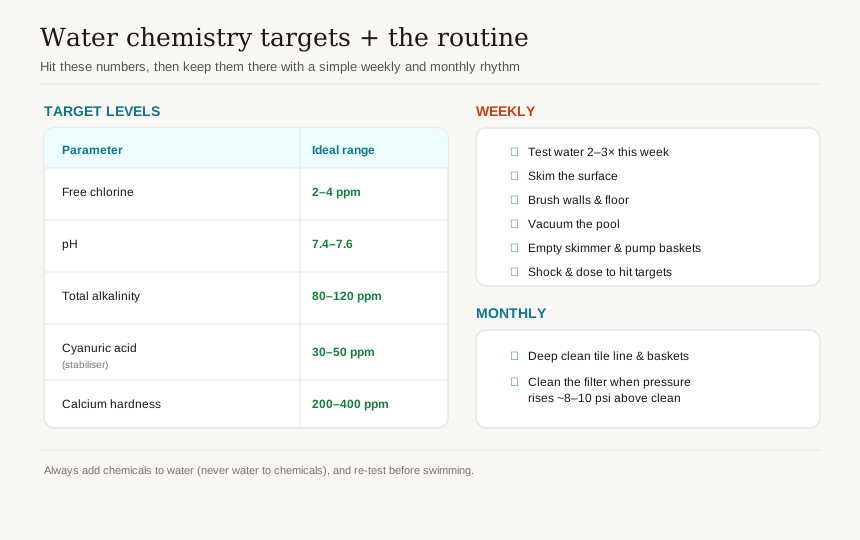
The one number to watch above all others is free chlorine. If it drops below roughly 1.0 ppm, algae will reproduce faster than your filter can remove it, and you are heading for a green pool. pH comes second, because when it drifts high the chlorine you do have becomes sluggish and far less effective. Cyanuric acid is a quiet troublemaker: a little protects your chlorine from being burned off by harsh Indian sun, but too much, above about 80 to 100 ppm, locks the chlorine up and the only real fix is to dilute with fresh water. To translate these numbers into actual quantities of product for your pool, the Pool Water Calculator takes the guesswork out of dosing.
Your weekly and monthly routine
Pool care becomes effortless when it becomes a rhythm. Here is a routine that works for most Indian homes.
Each week, test the water two or three times so you catch any drift before it becomes a problem, more often in peak summer or after heavy use. Skim the surface for leaves and debris, brush the walls and floor to dislodge the thin film where algae likes to start, and vacuum the settled dirt off the bottom. Empty the skimmer and pump baskets so suction stays strong. Then shock the pool, a deliberate high dose of chlorine that burns off accumulated by-products, and dose any chemicals needed to bring your readings back into range.
Each month, do a deeper clean: scrub the waterline tile where oils and sunscreen leave a ring, check the equipment for leaks or odd noises, and clean the filter, but remember the trigger is the pressure gauge, not the calendar. When the filter pressure has climbed 8 to 10 psi above its clean baseline, backwash the sand or DE filter or hose down the cartridge.
After any monsoon downpour or a dust storm, treat it as an unscheduled event: rain dilutes your chemistry and washes in contaminants, so test and rebalance promptly rather than waiting for the next scheduled day.
Common problems and fixes
Cloudy water is the most frequent complaint and almost always has a chemical or mechanical cause rather than a mysterious one. The usual suspects are poor filtration or a pump not running long enough, high pH, low chlorine, high calcium hardness, the very first stage of an algae bloom, high total dissolved solids, or simply a load of fine debris. Work through them in order: check that the pump is running its full hours, test and correct chlorine and pH first, then clean the filter. If high TDS is the culprit, the cure is partial draining and refilling with fresh water.
Algae, the dreaded green or slippery pool, comes down to chlorine that fell too low, often after rain or a hot spell of heavy bathing. Brush the surfaces vigorously to break up the colonies, shock hard, run the pump continuously until the water clears, and keep cleaning the filter as it loads up with dead algae. A DE filter clears a bloom fastest, but patience and chlorine win every time.
Eye and skin irritation is usually misread. People assume too much chlorine, but the common cause is pH that has drifted away from the 7.4 to 7.6 comfort band, or chloramines, the spent chlorine by-products that build up when the chlorine level is actually too low. The fix is counter-intuitive: correct the pH and shock the pool to clear the by-products, rather than cutting back on sanitiser.
DIY vs an annual maintenance contract
Most of this work is genuinely doable yourself. The weekly skimming, brushing, vacuuming and testing need no special skill, just consistency, and many proud pool owners come to find the routine quietly satisfying. Going DIY also keeps you in close touch with your pool, so you spot a small problem before it becomes an expensive one.
The case for an annual maintenance contract, or AMC, is mainly about time and reliability. A professional service visits on a schedule, carries the test kit and chemicals, handles the equipment servicing, and is on the hook if the water goes wrong. For a busy household, a frequently used pool, or an overflow pool with more complex equipment, the convenience is well worth it. A sensible middle path that many homeowners adopt is to handle the daily skimming and weekly testing themselves while keeping a professional on call for the periodic deep service and any equipment trouble.
What maintenance costs
Costs vary widely with pool size, your local water and electricity tariffs, how heavily the pool is used, and your city, so treat any figure as a broad guide rather than a quote. As a rough indication, doing it yourself, paying mainly for chemicals and the electricity to run the pump, tends to land somewhere around 2,000 to 3,000 rupees a month for a typical residential pool. A professional annual maintenance contract commonly ranges from about 3,000 to 10,000 rupees a month depending on pool size, the frequency of visits and whether chemicals are included. Larger pools, infinity edges, heaters and saltwater systems all push the running cost up, while a water-saving cartridge filter and a well-sized, efficient pump pull it down. For a tailored estimate based on your own pool, the Pool Maintenance Cost Calculator is the quickest way to a realistic number.
Keep it effortless
A clean pool is not luck and it is not hard work. It is a loop that turns over every 8 hours, a filter cleaned when the pressure tells you to, a chlorine residual you never let fall too low, and a short weekly rhythm that becomes second nature. Do those few things and your water stays clear all season, monsoon and all.
When you are ready to put numbers to your own pool, our calculators do the heavy lifting: start with the Pool Volume Calculator and Pool Pump Calculator to size the circuit, use the Pool Water Calculator for exact dosing, and check your running budget with the Pool Maintenance Cost Calculator. And if you are still shaping the space around the water, pool landscaping will help you make the whole setting as effortless to enjoy as it is to keep clean.
Export this guide
Related Guides — Deep-dive reading
CCTV Maintenance and AMC in India (2026): Keeping the System Alive
How to keep a CCTV system actually working after install: clean lenses and housings, check every camera still records, watch drive health and retention, update firmware, and decide whether an Annual Maintenance Contract (AMC) is worth it.
SecurityHow to Clean Bathroom Tiles (India): Shine, Hard-Water Film & Soap Scum
A practical, India-first routine for cleaning bathroom tiles and keeping them glossy — the daily squeegee habit, weekly wash, monthly deep clean, and the safe cleaner for each tile type, including the golden rule that natural stone must never meet acid.
BathroomsFurniture Maintenance Guide: Keep Every Piece Lasting in India (2026)
The start-here routing guide to keeping furniture in good condition through Indian heat, humidity, monsoon, dust, hard water and termites — the one enemy and one habit for each material, a routine schedule you can actually follow, and where upkeep hands off to a professional.
FurnitureRelated Tools — Try Free
Pool Water Calculator
Chlorine, shock and salt doses plus top-up water for your pool — an indicative balancing guide.
Pool CalculatorPool Maintenance Cost Calculator
Monthly and yearly running cost of a home pool — chemicals, electricity, water and service, DIY vs AMC.
Pool CalculatorSwimming Pool Cost Calculator
Estimate a home pool's build cost by type, size and finish, with an indicative range and a build breakdown.
Pool Calculator