
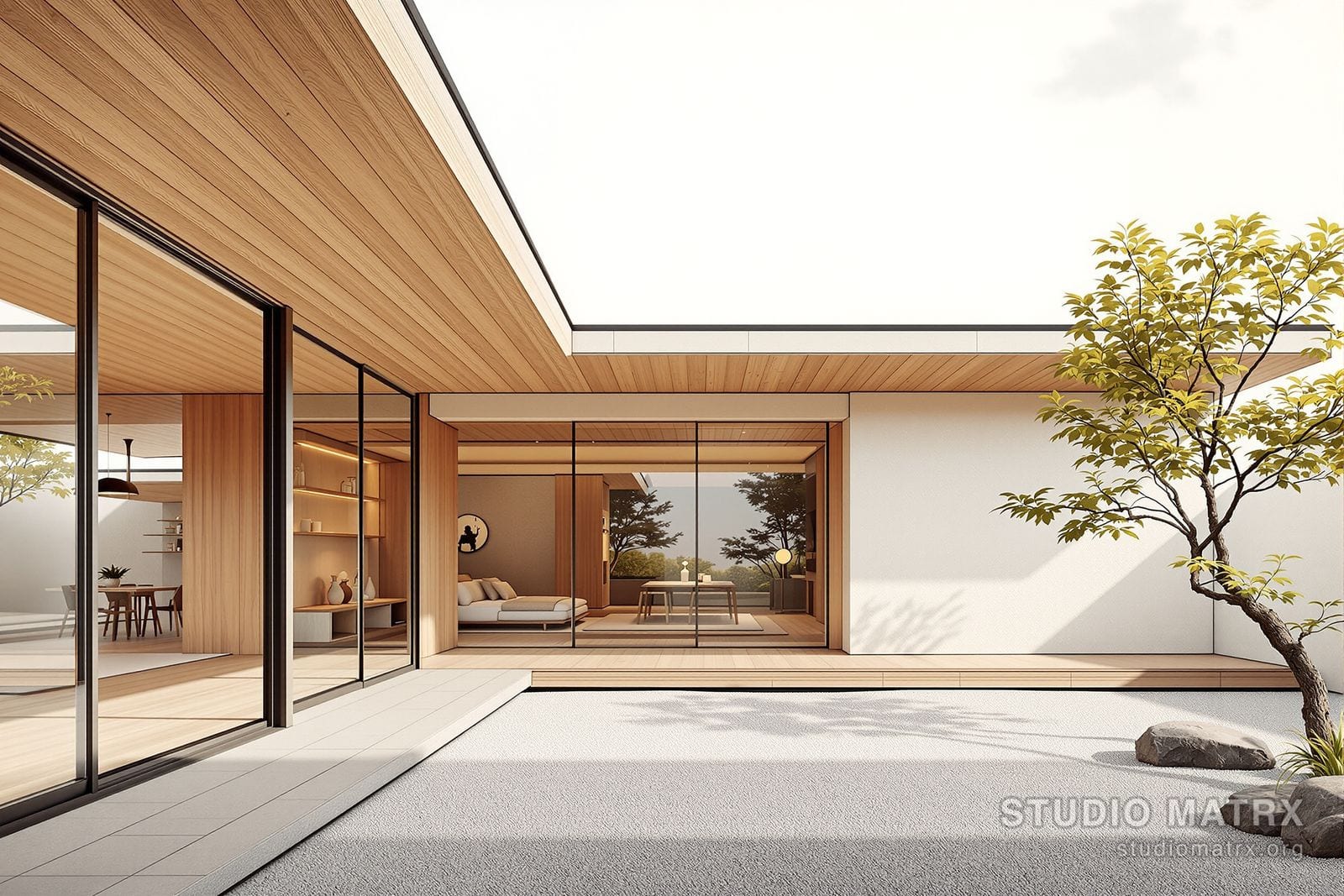
Japandi Architecture in India
Where Japanese and Scandinavian minimalism meet - warm, natural and calm
Japandi is what happens when two of the world's great minimalist traditions discover they are related. Japanese architecture and Scandinavian design grew up on opposite sides of the planet, yet they share a single instinct: strip away the unnecessary, honour natural materials, prize craftsmanship, and keep the building close to nature. Put them together and you get Japandi - a warm minimalism that is calmer than Scandinavian and softer than Japanese, and one of the most sought-after directions in considered Indian homes today.
Most of what is written about Japandi is about interiors - the low furniture, the muted palette, the linen and ceramics. But Japandi is, at root, an architectural idea. It lives in the way a roof oversails to make deep shade, in the timber structure left honestly on show, in the sliding wall that dissolves the line between room and garden. This guide looks at Japandi as architecture: the building, not just the styling. (For the interiors, see our companion Japandi apartment guide.)
What defines it
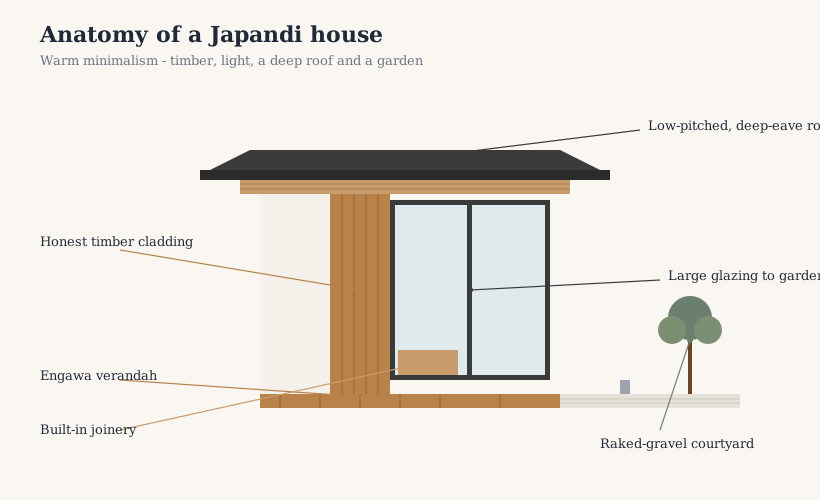
Japandi is the overlap of two minimalisms - and the overlap is larger than you would expect.
| From Japanese architecture | From Scandinavian design | The Japandi fusion |
|---|---|---|
| Ma - the art of empty space | Functionalism - form follows use | Uncluttered rooms that still feel warm |
| Wabi-sabi - beauty in the imperfect and natural | Hygge - cosiness and comfort | Natural, tactile, lived-in calm |
| Engawa, shoji, timber joinery | Light woods, big windows for scarce light | Warm timber, generous glazing, soft light |
| Connection to garden and nature | Bringing the outdoors in | A home built around its landscape |
The result is a deliberately quiet architecture: low and horizontal, made of wood, stone and plaster, organised around light and a garden, and finished in a narrow, muted palette. Nothing shouts; everything is considered.
The architectural elements
As building rather than decoration, Japandi resolves into a clear set of moves.
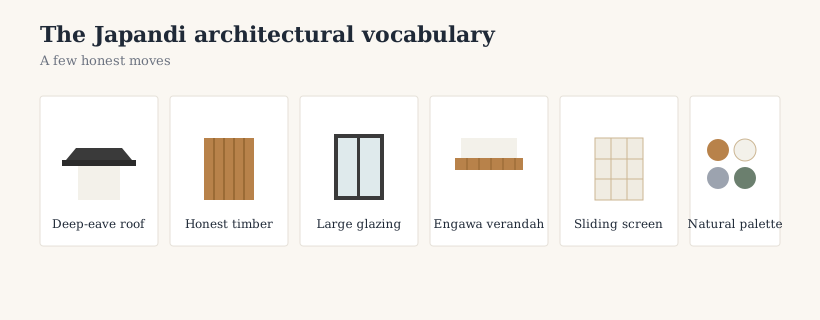
| Element | What it is | Why it works in India |
|---|---|---|
| Low-pitched, deep-eave roof | A horizontal roof that oversails the walls | Deep shade and rain control - exactly what the Indian climate needs |
| Honest timber | Exposed wood structure and cladding | Warmth, craft and a low-carbon material |
| Large glazing to a garden | Full-height sliding glass to a court or lawn | Light, view and the indoor-outdoor life of the tropical home |
| Engawa - the transition space | A timber verandah between inside and out | A shaded edge room, cool and sociable |
| Sliding screens and partitions | Light, movable walls | Flexible, airy, gentle daylight |
| Muted natural-material palette | Wood, stone, lime plaster, linen, paper | Calm, tactile and quietly luxurious |
The two roots
Japandi only makes sense once you see where each half comes from - and the architects who shaped those halves.
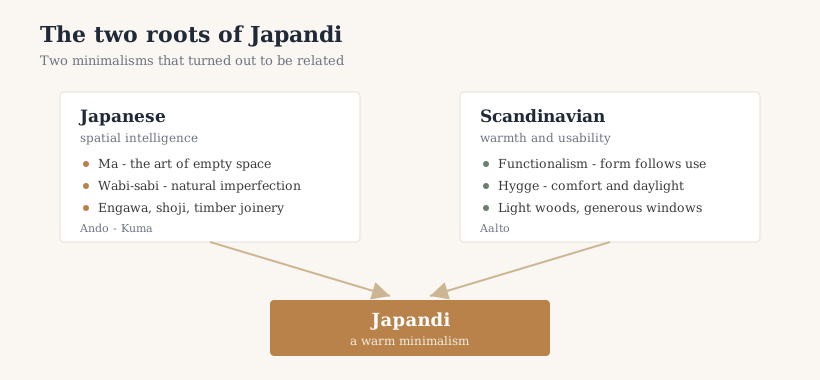
The Japanese half gives Japandi its spatial intelligence - the engawa edge, the sliding screen, the reverence for empty space and natural imperfection that we also know as wabi-sabi. Its modern masters, Tadao Ando and Kengo Kuma, show the two poles of the tradition: Ando's serene concrete and light, Kuma's warm, dissolving timber. The Scandinavian half gives Japandi its warmth and usability - the functionalism and humane materiality of Alvar Aalto, and the cult of comfort, daylight and pale wood born of long northern winters. Japandi is the handshake between them.
Best for
Japandi suits the homeowner who wants calm above all - a quiet, warm, low-key luxury rather than a loud one. It is ideal for:
- Serene urban villas and farmhouses, organised around a courtyard, a garden and the light.
- Premium, calm-luxury apartments, where the palette and the joinery carry the look even without a full garden.
- Weekend and wellness retreats, where the whole point is to slow down.
It is a close cousin of minimalism, but a more forgiving one: where strict minimalism punishes any warmth or clutter, Japandi welcomes wood, texture and a lived-in softness. Its deep eaves, natural ventilation and natural materials also make it a genuinely good climate fit for India - and a natural ally of sustainable design. The main risk is thinness: done on the cheap, with laminate instead of timber and no real connection to a garden, it collapses into a beige, lifeless box. Done with real materials and real daylight, few styles feel as restful to live in.
Where it comes from
Japandi has no single inventor - it is a contemporary synthesis, named only in the last decade, of two much older traditions. But its DNA is clear, and it runs through some of the most admired architecture of the twentieth century: the spatial poetry of Tadao Ando and Kengo Kuma in Japan, and the humane modernism of Alvar Aalto in Finland. For where it sits among India's other directions, see our Neo-Traditional profile and the deeper Contemporary Indian Architecture guide; if you are choosing, start with the right style for your home.
Japandi endures, and keeps growing, because it answers a very modern wish: for a home that is simple without being severe, natural without being rustic, and luxurious in the quietest possible way. As architecture, it comes down to a few honest moves - timber, light, a deep roof and a garden - which happen to be exactly the moves a thoughtful Indian home has always wanted to make.
This profile refreshes every 12 months. Last verified: June 2026 · Next verify: June 2027.
Export this guide
Related Guides — Deep-dive reading
Homes That Improve Mental Wellbeing
The whole-home, indoor-biophilia approach to calm — how plants, light, air, quiet and the right balance of togetherness and retreat make an Indian home restorative.
Healthy HomesModern Farmhouse Architecture in India
The clean gable, the deep verandah and the weekend home reimagined
Design StylesJapandi Window Design Ideas
Japanese and Scandinavian calm applied to windows: warm oak frames, shoji-style screens, diffused soft light and a low-contrast neutral palette, adapted for Indian homes and apartments.
Windows & GlazingRelated Tools — Try Free
Cross-Ventilation Analyzer
Estimate airflow and air changes per hour (ACH) from room size, window areas, layout, and local wind — with NBC 2016 Part 8 compliance check.
Ventilation CalculatorFuture Home Comfort Score
Score your home 0 to 100 on daylight, ventilation, thermal and acoustic comfort and find the weak link.
Window ToolMaterial Schedule Generator
Generate a room-wise finish schedule — walls, floors, ceilings, trim, and joinery by location.
Material Schedule