
Kengo Kuma
The anti-object architect who dissolves buildings into wood, light and place
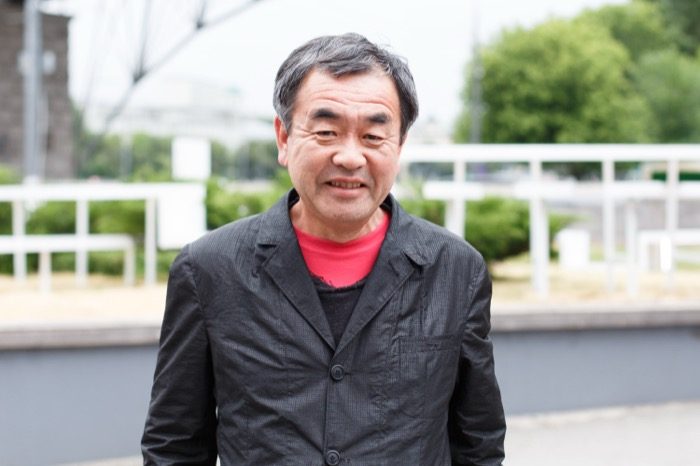
Photo: Strelka Institute for Media, Architecture and Design, CC BY 2.0, via Wikimedia Commons
Movements
Signature works
- Water / Glass, Atami (1995)
- Great (Bamboo) Wall, Beijing (2002)
- Nezu Museum, Tokyo (2009)
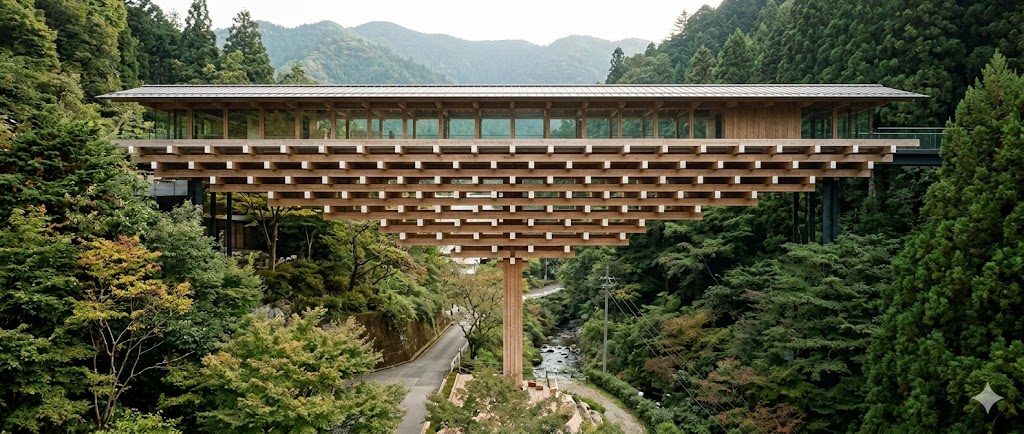
- Yusuhara Wooden Bridge Museum (2010)
- V&A Dundee, Scotland (2018)
Stand on a hillside in Yusuhara, a small forestry town deep in the mountains of Shikoku, and look up at the bridge that crosses the road. It does not arch in stone or stretch in steel. It rises from a single central pier in a fan of stacked timber arms — small cedar members, no thicker than your forearm, cantilevered out and crossed over one another until they hold up a walkway and a museum in the air. There is no great beam doing the work. Instead, hundreds of slender pieces of local wood lean on each other, the way the old timber temples of Japan have leaned for a thousand years. The structure looks less like a machine and more like a thicket — a piece of the surrounding cedar forest that has organised itself into a bridge.
The architect is Kengo Kuma, and this is exactly how he wants you to feel: not that a heavy object has been dropped into the landscape, but that the landscape has thickened, for a moment, into shelter. Kuma is one of the most influential architects working today, the founder of Kengo Kuma & Associates and the designer of buildings on four continents — yet his entire life's work is a quiet argument against the very idea of the building as a monument.
Kuma's contribution is a philosophy he calls "anti-object" architecture — the deliberate dissolving of a building into its place. Where modern architecture taught us to make bold, sculptural, photogenic objects standing proud of their site, Kuma does the opposite. He breaks a building's mass into countless small particles — slats, louvres, tiles, woven strips, thin timber members — so that the surface dematerialises into texture, light and shadow. And he insists on local, natural materials handled by local hands: wood, bamboo, stone, paper, earth and tile, often joined in the old Japanese carpentry that needs few nails. The result is architecture you experience less as a shape and more as an atmosphere. (For a close reading of his building skins — the layered timber louvre screen, the cidori joint and the particle-wall that works like a jaali — see our Kengo Kuma facade signature guide.)
The idea: making the building disappear
Most of architectural history is a contest of objects. A great building is supposed to stand out — to be a singular, finished form you can photograph from across a plaza and recognise instantly. Kuma's deepest conviction is that this is a mistake. In his book "Anti-Object," he argues that the obsession with the building-as-object cuts architecture off from its surroundings, from time, and from the people who use it. His ambition is to "erase" architecture — to make a structure so woven into its place that it stops reading as a separate thing.
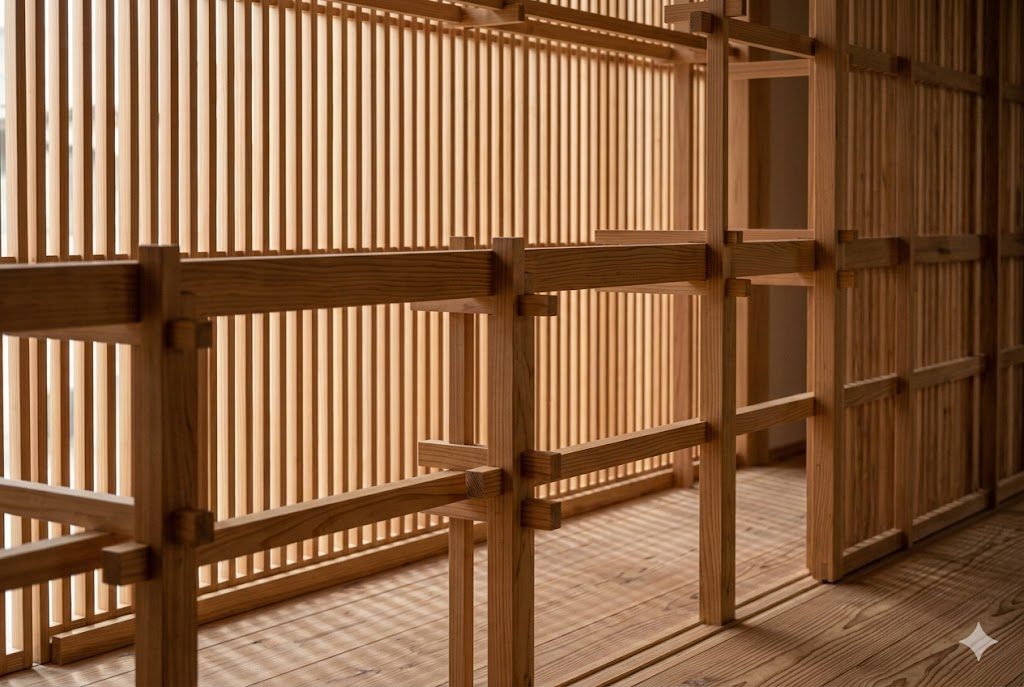
He achieves this less through shape than through what might be called particlisation. Take a solid wall and a heavy roof, and instead of leaving them as masses, dissolve them into many small parts: a screen of thin timber louvres, a curtain of bamboo, a skin of stacked stone slips, a lattice of interlocking sticks. From a distance the building seems to shimmer and breathe rather than block. Light filters through. Shadows move across the day. The eye is given texture and depth instead of a flat, final surface. The mass has been turned into particles, and the particles let the world pass through.
This is why his choice of material is never incidental. Kuma reaches almost always for natural, local substances — the cedar of the forest the building sits in, the stone of the local quarry, the bamboo of the region, the washi paper of traditional craft, the tile of the old roofs nearby. These materials carry the climate, the grain, the smell and the imperfection of a place. They weather. They age. They belong to a particular ground in a way that polished steel and mirror glass — the placeless materials of the international city — never can. Kuma calls this a "weak" or natural architecture, using "weak" not as an insult but as praise: gentle, yielding, connected, the opposite of the hard, dominating "strong" architecture of the twentieth century.
Underneath it all runs a profoundly Japanese sensibility: a love of light and shadow, of texture over polish, of materials that show their age and impermanence honestly. Kuma's buildings are designed to be felt with the whole body — the dappled light through a timber screen, the cool of stone, the soft give of a wooden floor — rather than admired from a single heroic viewpoint.
Life and path: from the Olympic dream to anti-object
Kengo Kuma was born on 8 August 1954 in Yokohama, Japan. The decisive moment of his childhood came in 1964, when he was ten years old and Tokyo hosted the Olympic Games. His father took him to see Kenzo Tange's new sporting venues — above all the great Yoyogi National Gymnasium, with its sweeping, tent-like suspended roofs. The young Kuma was overwhelmed. From that day he wanted to be an architect, and the spell those buildings cast on him never quite wore off — it is no accident that, decades later, he would design the national stadium for Tokyo's own next Olympics.
He studied architecture at the University of Tokyo, the country's most prestigious school, where he worked under the architect and theorist Hiroshi Hara — a teacher known for studying the world's vernacular villages, which left a lasting mark on Kuma's interest in local, indigenous building. In the 1980s he travelled to New York as a visiting scholar at Columbia University, immersing himself in the intellectual ferment of American architecture at the height of the postmodern moment. He returned to Japan and, in 1990, founded his own practice, Kengo Kuma & Associates.
His early career carried him through a hard and clarifying experience. Some of his first independent work in the bubble-era boom was bold and object-like, in tune with the flashy mood of late-1980s Japan. When the economic bubble burst at the start of the 1990s, the big-city commissions dried up, and Kuma found himself working instead in the Japanese countryside — in small towns, on modest budgets, with regional craftsmen and whatever materials were close at hand. This apparent exile became the making of him. Forced to work with local wood, local stone and local carpenters rather than imported glamour, he discovered the architecture that would define his life: rooted, material, humble, and bound to place. The lean years taught him that weakness and locality were not limitations but a whole new way to build.
From those rural beginnings his reputation grew steadily, then globally. Kengo Kuma & Associates expanded into one of the most sought-after practices in the world, with offices in Tokyo and Paris and projects across Asia, Europe and beyond. He has taught at the University of Tokyo, written a series of influential books — "Anti-Object" and "Natural Architecture" among them — and become, alongside his contemporaries, one of the defining voices of contemporary Japanese architecture.
The signature works
Kuma's buildings reward being read one at a time, because each is an experiment in a single material and a single way of breaking mass into particles. A clear thread runs from his small early rural museums all the way to his largest civic commissions.
| Work | Place & year | Why it matters |
|---|---|---|
| Kiro-san Observatory | Ehime, Japan, 1990s | An early statement of intent: rather than crown the hilltop with a tower, Kuma cut the observatory into the mountain so it almost vanishes — the anti-object idea made literal. |
| Water / Glass | Atami, 1995 | A guesthouse where a thin sheet of water runs to the edge of the building and seems to merge with the sea beyond, dissolving the boundary between architecture and ocean. |
| Stone Museum | Nasu, Japan | A renovation in the local stone, where Kuma slices the stone thin and stacks it with gaps so that the heavy material reads as a porous, light-filtering screen. |
| Bato Hiroshige Museum | Tochigi, Japan, 2000 | A museum for the woodblock prints of Hiroshige, wrapped entirely in fine timber louvres of local cedar, so the whole building becomes a soft, striped filter of light — a homage to the rain-lines in Hiroshige's prints. |
| Great (Bamboo) Wall | Beijing, China, 2002 | A house near the Great Wall whose walls are screens of bamboo, blurring inside and out and binding the building to the Chinese landscape and its native material. |
| Nezu Museum | Tokyo, 2009 | A serene museum of Asian art in central Tokyo, approached along a long bamboo-lined corridor under a deep eave, where a busy city is hushed into a garden threshold. |
| Yusuhara Wooden Bridge Museum | Kochi, 2010 | The fan of stacked cantilevered cedar over a mountain road — local forestry timber turned into a structure that looks grown rather than built. |
| GC Prostho Museum Research Center | Aichi, 2010 | A building assembled from "cidori" — a traditional interlocking-timber toy joint — scaled up into a structural lattice held together without nails or glue. |
Beyond these, the list runs long and varied. At the Asakusa Culture Tourist Information Center in Tokyo, Kuma stacked what looks like a pile of small wooden houses into a single tower, each "house" sliced by a sloping timber-clad roof. At the V&A Dundee in Scotland (2018), his first major building in the United Kingdom, he wrapped a riverside museum in long horizontal bands of pre-cast stone evoking the layered cliffs of the Scottish coast, with a prow reaching toward the River Tay. At the Odunpazarı Modern Museum in Eskişehir, Turkey, he stacked timber volumes in a tribute to the town's old Ottoman wooden houses. And in his home city of Tokyo, he designed the Japan National Stadium (2019) for the 2020 Olympics — closing, in his seventh decade, the circle that opened when his father took him to Tange's Olympic halls in 1964.
What unites a tiny rural observatory, a bamboo house in Beijing, a Scottish stone museum and a national stadium is method, not style. In each, Kuma identifies the material that belongs to the place, breaks the building's bulk into many small repeated parts of that material, and lets light, weather and the surrounding landscape pass through the result. The building is never finished as a hard object; it is always left a little open, a little porous, a little alive.
The philosophy: weak architecture and the return to nature
Kuma is usually grouped, correctly, within a great lineage of modern Japanese architecture — after the heroic concrete-and-steel modernism of Kenzo Tange, and alongside contemporaries such as Tadao Ando and the practice SANAA. But where Tange's generation chased monumental form, Kuma's project is, in a sense, a reaction against it — a turn away from the building as a strong object and toward architecture as a soft, woven part of its environment.
His work is, above all, an expression of Japanese architecture carried into the present. The deep timber roofs and broad sheltering eaves, the screens that filter rather than block, the love of natural wood and paper and the old joinery that fits members together without metal — these are the values of the temple and the traditional house, abstracted and rebuilt at a contemporary scale. Kuma does not copy the old forms; he keeps the underlying logic — light, shadow, natural material, the porous boundary between inside and garden — and gives it new geometry.
It is also profoundly connected to wabi-sabi, the Japanese aesthetic that finds beauty in plainness, in imperfection, in age and in the visible passing of time. Kuma chooses materials precisely because they are humble and because they weather: cedar that silvers, stone that stains, bamboo that fades, paper that yellows. He prizes the rough texture over the polished finish, the imperfect handmade joint over the seamless industrial panel. His buildings are not meant to look brand-new forever; they are meant to grow old gracefully alongside the place they belong to. Beauty, for Kuma, is not added on top — it is what emerges when natural material is left to be honestly itself.
Kuma has long described his aim as erasing the building — not abolishing architecture, but dissolving its mass so completely into wood, light and place that you feel the surroundings rather than the object standing in them.
This is why he calls his architecture "weak" and "natural." After a century in which concrete and steel let architects dominate any site with sheer force, Kuma argues for buildings that yield to their place — that take their cue from the forest, the river, the climate and the craft traditions around them, and that aim to belong rather than to conquer.
India: why Kuma's method speaks to how we build here
Kuma has no famous building in India, and it would be wrong to invent one. Yet of all the global masters, his philosophy may be among the most directly useful to Indian architecture — because India, perhaps more than any other country, still possesses exactly the things his method depends on: deep, living craft traditions and a wealth of local natural materials.
Kuma's whole argument is that architecture should be built from what is close at hand by the hands that know it best — local timber, local stone, local bamboo, joined in regional techniques. India is one of the last great storehouses of this kind of knowledge. The bamboo construction of the Northeast, the lime and stone of Rajasthan, the laterite of the Konkan and Kerala, the terracotta tile of Bengal and the South, the carved timber of Himachal and Kashmir, and an enormous surviving population of skilled masons, carpenters and weavers — these are precisely the raw materials of a Kuma-style architecture. Where a Western architect must often reach hard for craft that has all but vanished, an Indian architect can frequently still find it in the next district. This is the heart of vernacular architecture in modern Indian homes: the conviction that the most contemporary thing we can do is build with the materials and skills of the place.
His treatment of the screen speaks directly to the Indian climate. Kuma's timber louvres and porous lattices are, functionally, a contemporary version of the jali — the perforated stone or wood screen that has cooled Indian buildings for centuries, breaking harsh sun into soft, moving light and pulling breeze through while keeping glare and heat out. The same logic of the particlised, breathing skin that Kuma uses in cedar is what the jali has always done in sandstone. For serious passive design across India's climate zones and for genuine tropical architecture in India, the screen that filters rather than the glass wall that bakes is not a stylistic preference but a survival strategy — and Kuma offers a sophisticated modern grammar for it.
There is a philosophical kinship, too, with India's own great climate-and-craft modernists. The instinct to build from local material, to let the wall breathe, to bind a building to its ground and its weather, connects Kuma to the legacy of Geoffrey Bawa in the tropics next door and to the material honesty that Laurie Baker brought to brick in Kerala — architects who, like Kuma, refused to import a placeless international finish and instead made a richer architecture out of what was near. For a country negotiating between glass-tower aspiration and a deep vernacular inheritance — the tension explored in contemporary Indian architecture — Kuma is a powerful argument that the future need not mean abandoning local craft. It can mean reinventing it.
It is worth being honest about the gap, because that is where the real lesson sits. Kuma's exquisite timber lattices are the product of disciplined fabrication, generous budgets and a building culture that still pays for craft. In India, cost and speed pressures are relentless, and skilled handwork is too often discarded as slow in the rush to concrete and aluminium. But the ambition translates even where the budget does not. The takeaway is not "import Japanese cedar joinery" but "use the craft you still have." Specify the local stone, the regional bamboo, the handmade tile and the carpenter down the road; let a jali do the cooling an air-conditioner would otherwise do. Kuma's deepest lesson for India is to value, rather than discard, the very craft inheritance the rest of the world is straining to recover.
Legacy and what we can learn
Kuma's influence on contemporary architecture has been large and is still growing. He helped lead a worldwide turn back toward timber and natural materials at exactly the moment the climate crisis made carbon-heavy concrete and steel look not just heavy but irresponsible. The current global enthusiasm for engineered timber, for biophilic design, for porous breathing facades and for buildings that defer to their landscape owes a real debt to the example he and his practice set across three decades. He took the soft, particlised, material-led architecture once dismissed as minor and "weak," and made it one of the most admired modes of building in the world.
For anyone designing today, his work suggests a handful of durable lessons. Build with what belongs to the place — the local material and the local hand will always root a building more deeply than an imported finish. Break the mass: a wall need not be a solid block; turned into a screen of small repeated parts, it can filter light, move air and lighten the whole. Let materials weather honestly rather than freezing them in a perfect, ageless state. And design for the body and the senses — the dapple of filtered light, the texture of timber, the cool of stone — not only for the camera and the single heroic view.
Perhaps the deepest lesson is the one his own career teaches. It was the collapse of the boom, and the years of small rural commissions that followed, that made Kuma who he is. Cut off from glamour and forced to work with humble local means, he found a richer architecture than the bubble would ever have let him build. There is a lesson in that for any designer working under constraint: limitation, met honestly, can be the doorway to something more authentic than abundance ever produces.
These principles — natural material, the breathing screen, architecture that belongs to its place — live on in how we approach space at DesignAI, where the aim is rooms that connect to light, texture and climate rather than seal themselves away from them.
References
- Kengo Kuma, "Anti-Object: The Dissolution and Disintegration of Architecture" (Architectural Association) — the architect's central argument against the building-as-object.
- Kengo Kuma, "Natural Architecture" — Kuma's writings on material, place and the "weak" building.
- Kengo Kuma & Associates, "Kengo Kuma: Complete Works" (Thames & Hudson) — collected projects with the architect's commentary.
- Botond Bognar, "Kengo Kuma: Selected Works" (Princeton Architectural Press) — survey and critical essays on the buildings.
- Kenneth Frampton, "Modern Architecture: A Critical History" — context for critical regionalism and the lineage of modern Japanese architecture.
- William J. R. Curtis, "Modern Architecture Since 1900" — background on Tange and the post-war Japanese tradition Kuma extends and resists.
To continue: read about the philosophies Kuma carries forward in Japanese architecture and wabi-sabi architecture; meet his fellow Japanese master Tadao Ando, who answers the same tradition in concrete rather than wood; and see how his material logic resonates with vernacular architecture in modern Indian homes. To shape your own filtered light, try the Sun Path Analyzer.
Philosophies they championed