
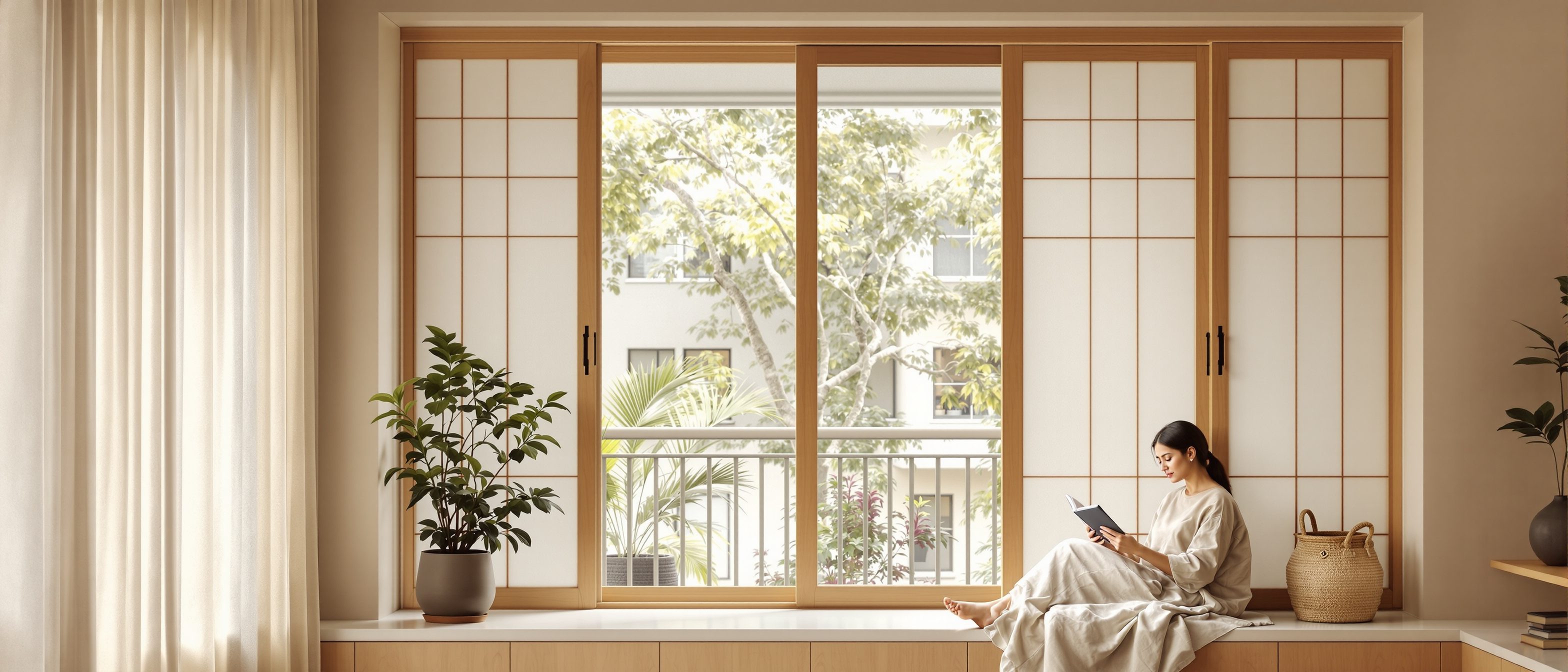
Japandi Window Design Ideas
Japanese and Scandinavian calm applied to windows: warm oak frames, shoji-style screens, diffused soft light and a low-contrast neutral palette, adapted for Indian homes and apartments.
Japandi is the quiet marriage of Japanese wabi-sabi restraint and Scandinavian hygge warmth, and the window is where the whole mood is decided. Get the frame colour, the glazing pattern and the quality of light right, and a plain builder opening turns into the calmest feature in the room. This guide stays in the window styling lane: proportion, frame profile, screen pattern and the soft diffused light that defines the look, adapted honestly for Indian heat, dust and apartments.
Japandi windows are not about more glass. They are about warmer light, slimmer lines and one well-chosen screen.
What makes a window read as Japandi
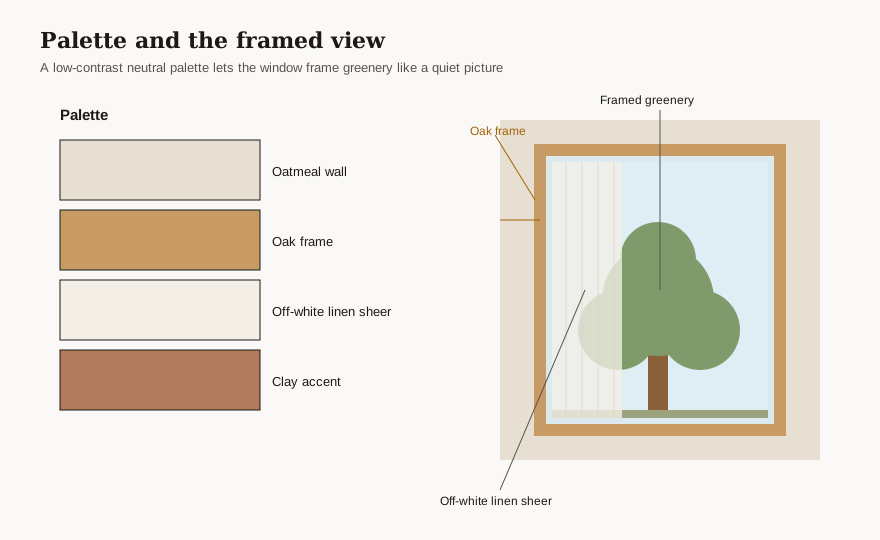
Where pure minimalist windows go cool, monochrome and almost invisible, Japandi keeps the same calm but adds warmth and natural texture. The frames you notice are made of timber, not erased. Light is softened by paper, linen or a slatted screen rather than blasting straight in. The palette stays low-contrast, but it is oatmeal, oak and clay, not black-and-white.
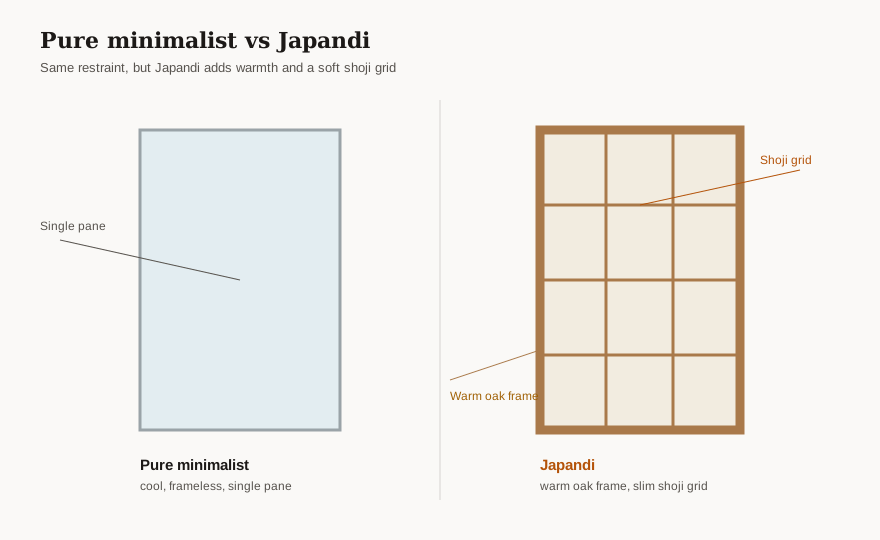
| Trait | Japandi window | How it differs from pure minimalist |
|---|---|---|
| Frame colour | Warm natural oak, or slim matte black as accent | Minimalist hides the frame or keeps it cool grey/white |
| Light quality | Diffused, soft, paper-or-linen filtered | Minimalist wants maximum clear daylight |
| Glazing pattern | Slim shoji-inspired grid, calm rhythm | Minimalist avoids all grids, single pane |
| Palette | Oatmeal, oak, clay, off-white (warm) | Cool monochrome, grey-on-white |
| Mood | Wabi-sabi, tactile, lived-in calm | Crisp, sharp, almost clinical |
This is exactly how to keep the two apart on a moodboard: Japandi is warm-natural minimal, minimalist is cool-monochrome minimal. For the slimline, frameless, no-grid end of the spectrum, see our minimalist window designs guide; come back here when you want the same calm but warmer and more textured.
The four Japandi window moves
1. Warm timber or oak-tone frames
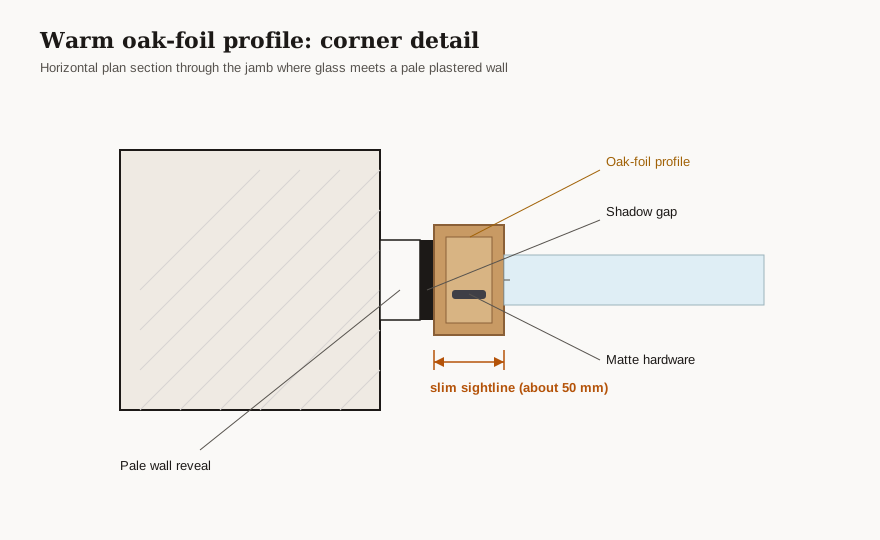
The signature is a frame you can read as wood. True oak is rarely practical in Indian humidity and budgets, so the honest options are teak or local hardwood finished pale, or wood-finish aluminium and uPVC in oak laminates that survive heat, dust and monsoon far better. Aluminium runs roughly Rs 350 to 3000 per sqft and uPVC Rs 250 to 800 per sqft, so a foil-wrapped oak finish costs little more than a plain one. If you do want a graphic edge, a single slim matte black frame against pale walls is fully Japandi, just used sparingly.
2. Shoji-inspired screens and slim grids
The shoji screen, a timber lattice over translucent paper, is the most recognisable Japandi cue. You almost never use real rice paper in India, so adapt it three ways shown below.
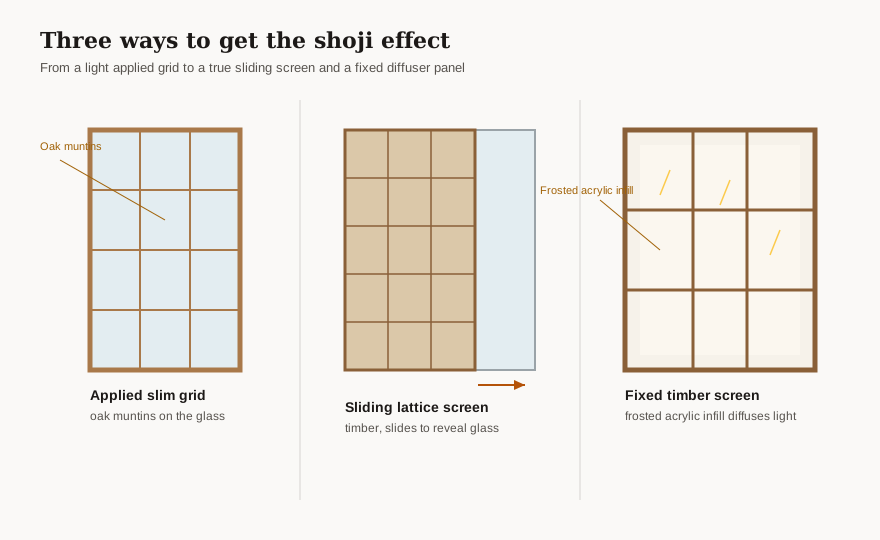
| Shoji option | What it is | Best for | Indian-climate note |
|---|---|---|---|
| Applied slim grid | Thin oak or black muntin bars laid on a single pane | Renters, low cost, quick look | No moving parts, easy to dust |
| Sliding lattice screen | Timber frame with a translucent infill, slides over the window | Privacy and soft light on demand | Use frosted acrylic or polycarbonate, not paper |
| Fixed timber screen | Permanent lattice-and-diffuser panel inside the reveal | Calm fixed feature, glare control | Pairs well with west light and dusty zones |
A slim 3-by-3 or 2-by-3 grid is the calmest rhythm. Avoid busy small panes, which tip the look toward industrial steel-grid windows rather than serene Japandi.
3. Paper-soft, diffused light
Japandi light is never harsh. Achieve it with frosted or acid-etched glass in lower panes, a layer of linen or cotton-blend sheer, or rice-paper-look frosted film on a clear pane. This diffusion is also practical in India: it cuts glare, hides the building next door and softens the strong tropical sun.
4. Low-contrast neutral palette and a green view
Keep the wall, frame and dressing within a tight warm-neutral band, then let one connection to nature carry the drama: a courtyard, a balcony planter, a single framed tree.
Get the look, room by room
| Element | Choose this | Avoid this |
|---|---|---|
| Frame | Oak-laminate aluminium or teak, or one slim black accent | High-gloss white uPVC, chunky profiles |
| Glazing | Large clear pane plus a frosted or screened lower section | Heavily tinted or mirrored glass |
| Screen | Slim oak grid or sliding frosted-acrylic shoji | Ornate carved jali, heavy grilles |
| Dressing | Unlined linen or cotton sheer, raw wood or bamboo blind | Shiny synthetic curtains, dark blackout drapes |
| Hardware | Matte black or unlacquered brass, minimal | Chrome, ornate handles |
| Sill and reveal | Pale wood or microcement, kept bare | Cluttered displays |
Pick warm over cool at every fork. That single rule keeps a room Japandi instead of merely minimal.
Adapting Japandi windows for the Indian home
- Heat: Soft diffused light is lovely, but glass still gains heat. Pair frosted or sheer-filtered windows with Low-E or solar-control glass on west and south faces, and treat any matte-black frame on a sunny wall with care, since dark frames absorb heat. See types of glass for windows for the right pane.
- Dust and monsoon: Real shoji paper and untreated raw oak will not last. Choose foil-wrapped or properly oiled hardwood frames and washable linen-look sheers. Sliding screens should run on quality tracks you can wipe down.
- Apartments: Japandi is ideal for flats because it works on standard openings. A renter can get most of the look with an applied oak grid, a frosted film and a linen sheer alone, no construction.
- Operability: For the how-it-works choice between casement, sliding and fixed, lean on types of home windows. Japandi pairs cleanly with slim sliding or fixed picture windows.
Japandi windows versus whole-home Japandi
This guide is deliberately about the window element only. For the full architectural treatment, layouts, courtyards, natural materials throughout, read Japandi architecture in India; for furnishing and styling a Japandi flat end to end, read Japandi apartment ideas. Those cover the whole home. Use this page when your question is specifically how the windows should look, frame, screen, glaze and dress.
For the broader modern-window idea framework that this style sits within, start from the pillar, modern window design ideas for India.
References
Export this guide
Related Guides — Deep-dive reading
Minimalist Window Designs for Indian Homes
The slimline, near-frameless look — hidden frames, single large panes, no grids, monochrome detail, and how to get it without the heat and cleaning traps.
Windows & GlazingTypes of Home Windows in India (2026): Complete Comparison and How to Choose
Every window type compared on ventilation, cost and best use, plus a frame, glazing and climate framework to choose right.
Windows & GlazingJapandi & Scandinavian Curtain Styles (India 2026)
The two calm-minimalist styles that share one idea — light-filtering linen, floor-length restraint and warm-neutral palettes — and exactly how to adapt their soft daylight look to bright, glaring Indian light.
Window TreatmentsRelated Tools — Try Free
Window Material Comparison Tool
Compare uPVC, aluminium, wood, steel and composite windows on cost, life, upkeep and insulation.
CompareCross-Ventilation Analyzer
Estimate airflow and air changes per hour (ACH) from room size, window areas, layout, and local wind — with NBC 2016 Part 8 compliance check.
Ventilation CalculatorDoor Material Comparison Tool
Compare 2–4 door materials on cost, durability, maintenance, security and moisture resistance.
Comparison Tool