
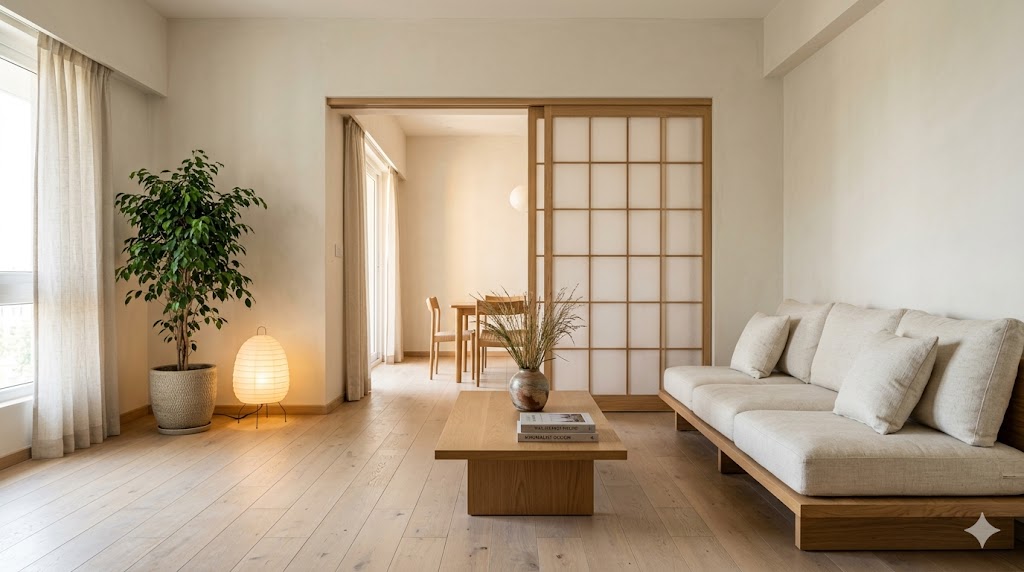
Japandi Apartment Ideas for Indian Homes
Japanese restraint meets Scandinavian warmth — seven principles, low-furniture proportions, material palette, and 20 numbered ideas across the apartment
Japandi is the apartment-design world's quietest love story. Two traditions — Japanese minimalism, with its wabi-sabi appreciation for imperfection and asymmetry, and Scandinavian design, with its hygge cosiness and devotion to natural light — turned out to share more than they differed. Both prefer natural materials. Both keep palettes restrained. Both believe empty space is a feature. Both treat handcraft as a daily ritual rather than a luxury.
For Indian apartments, Japandi turns out to be an unexpectedly natural fit. Indian craftsmanship — block-printing, brass work, raku-adjacent stoneware, handwoven textiles — sits within the Japandi vocabulary without translation. Indian apartments tend toward smaller, lower-ceilinged spaces where Japandi's low-furniture proportions help the room read taller. And the Indian climate's monsoon-and-dust reality rewards Japandi's preference for washable cotton, oak, and ceramic over wool and pale birch.
This guide is a working reference for Japandi-style Indian apartments. It covers the seven principles, where Japanese and Scandinavian traditions actually overlap, the material and colour palette, the low-furniture proportions, the adaptations needed for Indian climate and Vastu, and twenty numbered ideas across the five core rooms.
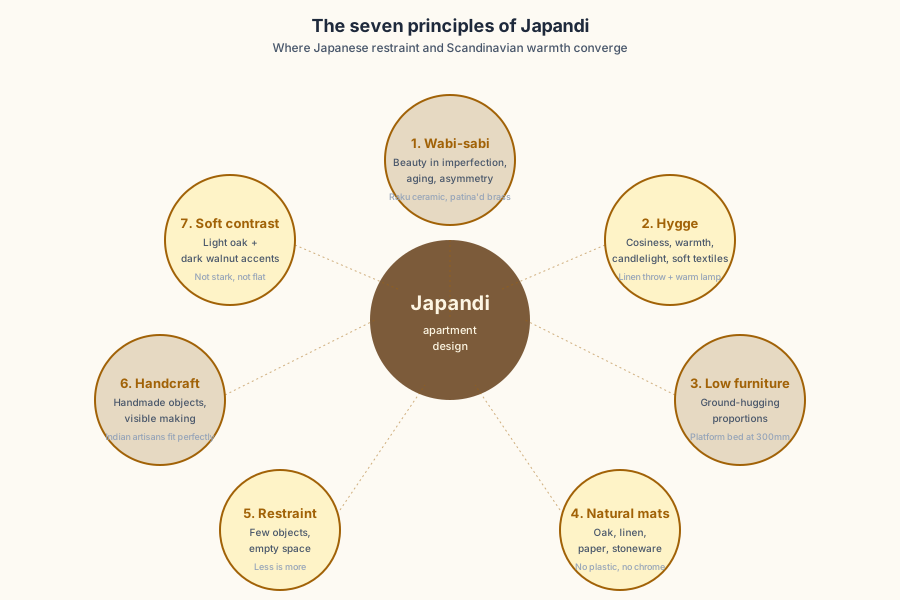
The Seven Principles of Japandi
Japandi is not a colour scheme — it is seven principles, each visible in every room:
1. Wabi-sabi — beauty in imperfection, aging, asymmetry. The chipped raku bowl, the brass that has tarnished, the wooden bowl with visible grain and tool marks. The opposite of factory-finish.
2. Hygge — cosiness, warmth, conviviality. Pools of warm light, soft textiles, candle-friendly evenings. The opposite of clinical.
3. Low furniture — ground-hugging proportions. Platform beds at 300 mm, sofa seats at 350 mm, coffee tables at 280 mm. The opposite of Western 600 mm bed-frames.
4. Natural materials — oak, walnut, linen, paper, stoneware, brass, bronze. The opposite of plastic and chrome.
5. Restraint — empty space is the design. Fewer than five decorative objects per room. The opposite of "more is more".
6. Handcraft — visible making. Joinery shows the joiner; ceramic shows the thrower; weave shows the hand. The opposite of mass production.
7. Soft contrast — light oak meets dark walnut. Warm whites meet inky charcoal accents. The opposite of stark monochrome and the opposite of flat beige.
The seven only work as a set. Drop any one and the room slides into Scandi, minimalist, traditional Japanese, or warm-modern — adjacent styles that look superficially similar but feel different.
Where Japandi Lives — Hygge ∩ Wabi-Sabi
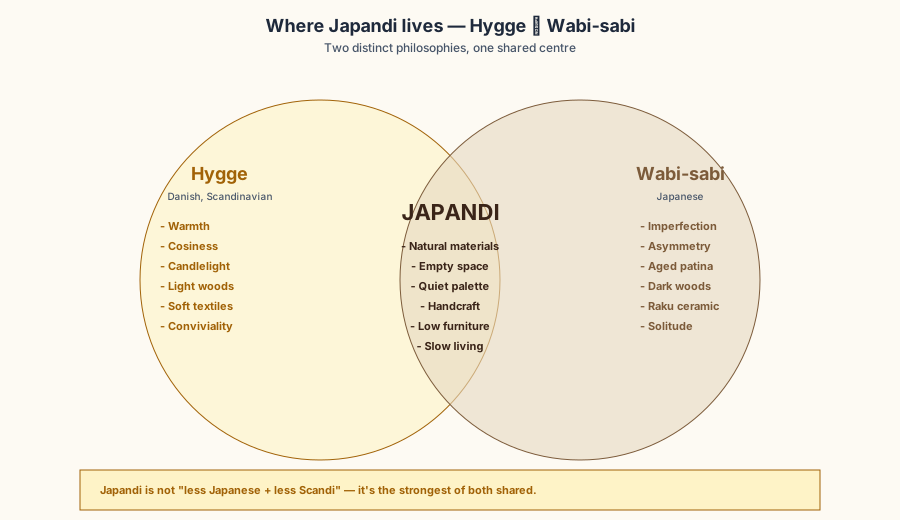
The Venn diagram helps. Japandi is the intersection, not the union. It picks the principles that hygge and wabi-sabi share — natural materials, empty space, quiet palette, handcraft, low furniture, slow living — and stays disciplined about the principles that only one tradition holds (Scandi's bright whites, wabi-sabi's solitude focus).
In Indian apartments, the overlap is the safe territory. Pure hygge (chunky knit throws + sheepskin) struggles in 80% monsoon humidity. Pure wabi-sabi (tatami floors + paper screens + entirely Japanese furniture) reads as theme-park to most Indian visitors. The intersection — oak floor, linen throw, raku vase, paper-shade lantern, washable cotton bed — is the natural fit.
Material + Colour Palette
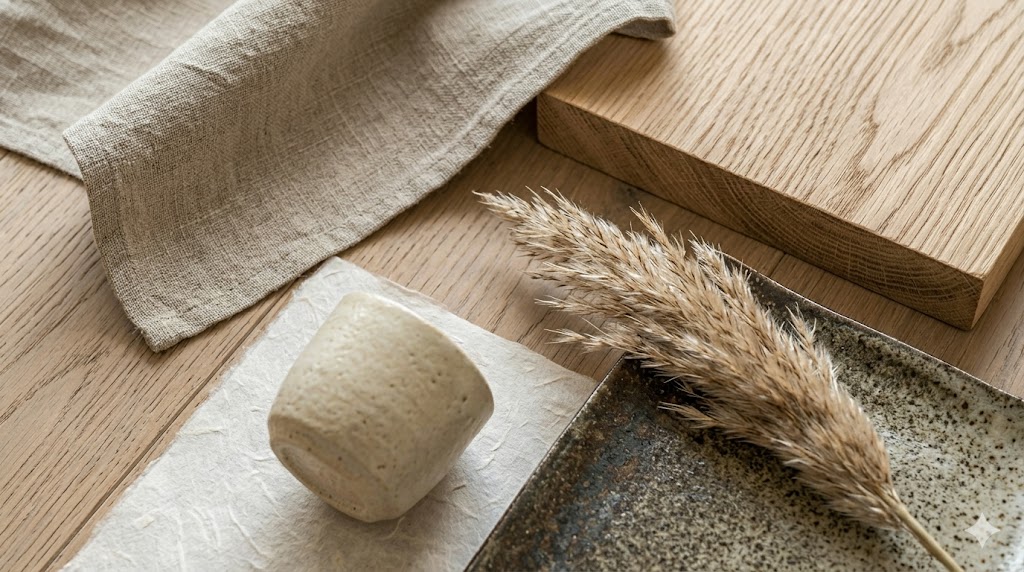
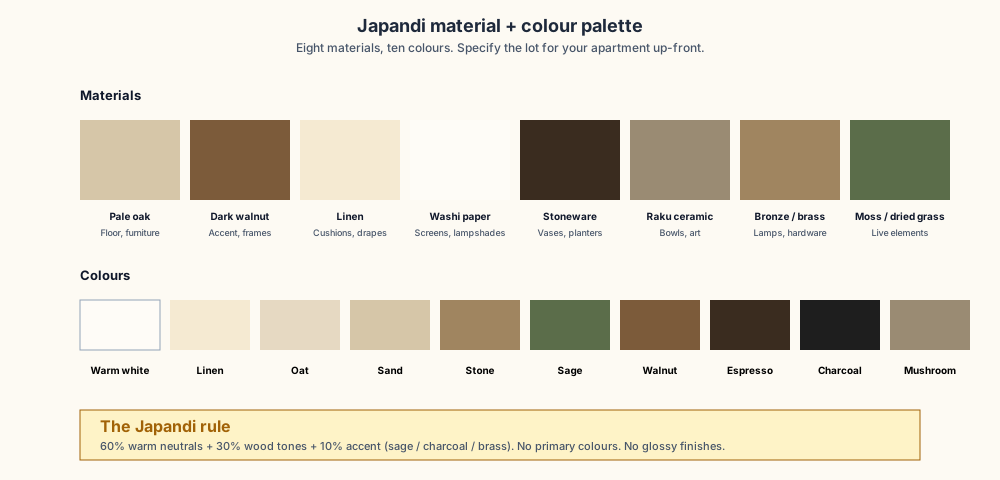
The Japandi specification fits on a single page:
Eight materials:
- Pale oak (floor + furniture)
- Dark walnut (accent + frames)
- Linen (cushions, drapes, throws)
- Washi paper (lampshades, screens, partitions)
- Stoneware (vases, planters, dinnerware)
- Raku-style ceramic (small bowls, candle holders, art objects)
- Bronze or brushed brass (lamps, hardware, frames)
- Moss or dried grass (live or preserved botanical elements)
Ten colours, three categories:
- Warm neutrals (60%) — warm white, linen, oat, sand, mushroom
- Wood tones (30%) — stone, walnut, espresso
- Accents (10%) — sage, charcoal, brushed brass
The single rule: no primary colours, no glossy finishes, no plastic, no chrome. A Japandi room that contains a chrome lamp or a glossy white kitchen door is no longer Japandi.
Low-Furniture Proportions
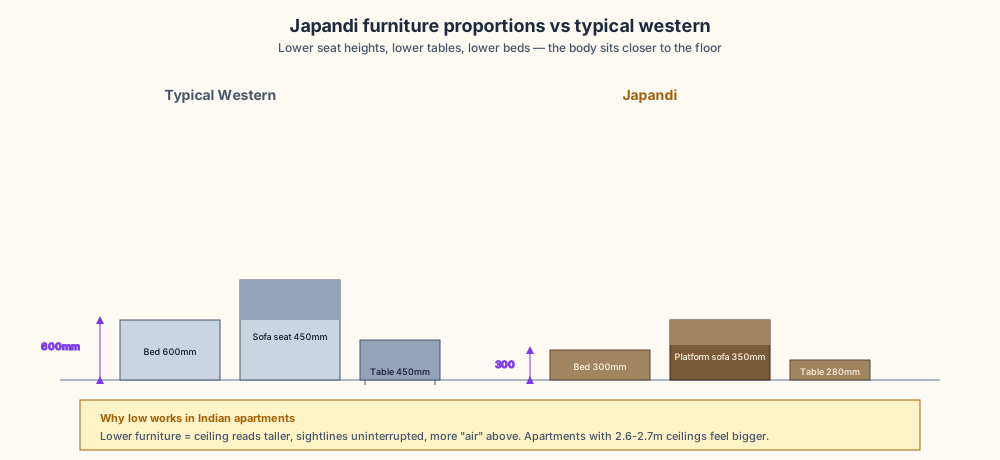
The single most-visible Japandi trait is how low everything sits. The body is closer to the floor, the ceiling reads taller, and the room feels twice the size.
| Furniture | Western typical | Japandi |
|---|---|---|
| Bed total height | 550-650 mm | 280-350 mm |
| Sofa seat | 450 mm | 320-380 mm |
| Coffee table | 420-450 mm | 250-300 mm |
| Dining chair seat | 450 mm | 380-420 mm |
| TV centre AFF | 1100-1200 mm | 950-1050 mm |
For Indian 2.6-2.7 m ceilings, the low-furniture rule is the single highest-leverage move — it can make an average 3 BHK apartment feel like a premium 4 BHK.
Adapting Japandi for Indian Climate + Vastu
Pure Japandi survives surprisingly well in India, but three small adaptations make it long-lasting:
Climate adaptations:
- Replace pure wool throws with cotton-linen blends for 7 hot months / year
- Replace tatami flooring with engineered oak with tatami-style edge (real tatami harbours mites in humidity)
- Replace heavy chunky-knit textiles with breathable linen + light wool combinations
- Add a single ceiling fan in living + bedroom — Japandi-style wood-blade fans (Haiku / Hunter / Hunter-style) match perfectly
Vastu adaptations:
- Position the pooja corner in the north-east, with Japandi-style oak shelf and washi-paper screen backdrop
- Bed head south or east as Vastu prefers (Japandi is direction-agnostic so this is free)
- No mirrors facing the bed (both Vastu and Japandi tend to avoid them anyway)
- Use a single brass diya rather than candles for hygge — same warmth, culturally Indian
Monsoon adaptations:
- Replace dried grass / moss arrangements with stoneware planters of resilient ZZ + snake plants
- Apply 2 coats of clear matte sealer on oak floors in coastal cities (Mumbai, Chennai, Kerala)
- Use cotton dust covers on linen sofas during peak monsoon weeks
Twenty Japandi Apartment Ideas
The twenty ideas below are organised by room — four per room across living, bedroom, dining, pooja, and balcony.
Living Room (Ideas 1-4)
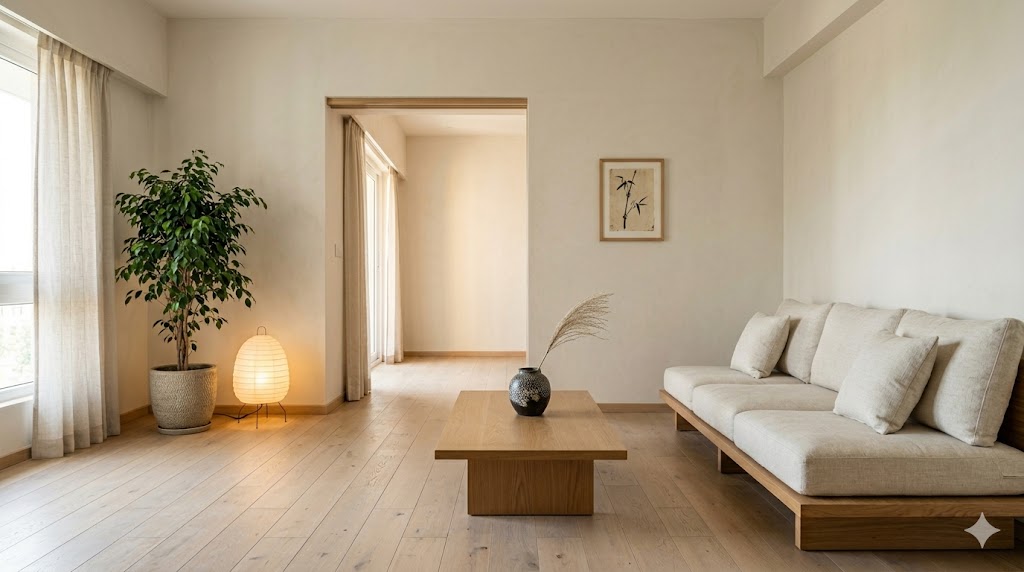
1. Platform sofa Japandi living — A low oak platform sofa (350 mm seat height) with three flax-linen cushions, a low oak coffee table (280 mm), a single raku ceramic vase, a paper floor lantern in one corner. No other furniture.
2. Washi-screen partition — Living room separated from the dining or pooja zone by a sliding white washi-paper screen on an oak frame. Diffuses light, divides space, references both traditions.
3. Single-stem ikebana — A single eucalyptus stem in a tall stoneware vase on the coffee table. One arrangement, one message.
4. Wood-blade ceiling fan — Living room anchored by a single Japandi-style wood-blade ceiling fan in oak finish — replaces the standard Indian aluminium-blade fan and pulls the whole room into the style.
Bedroom (Ideas 5-8)
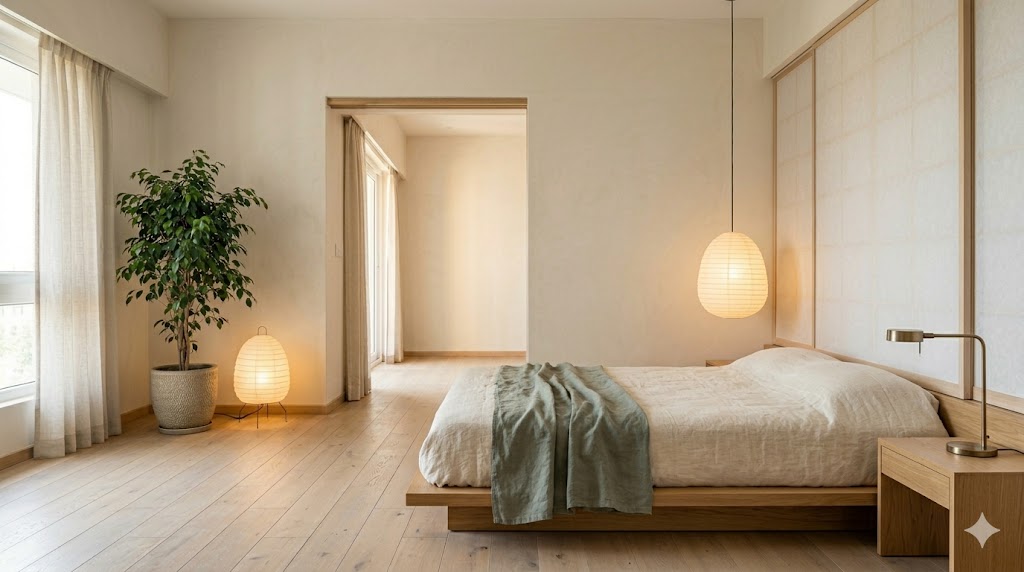
5. Platform bed at 300mm — A pale oak platform bed at 300 mm total height, cream linen duvet with one dusty-green throw, washi paper headboard back wall, low oak side table, bronze-shade reading lamp.
6. Tatami-edge oak floor — Engineered oak floor with a single tatami-style mat insert at the foot of the bed — practical Japandi without the tatami maintenance burden.
7. Paper-shade pendant low — A low-hung paper-shade pendant at one side of the bed, 1300-1400 mm AFF (much lower than typical ceiling pendant), creating a soft pool of light for reading.
8. Asymmetric bedside — One side of the bed has a small oak side table; the other has nothing — or a single floor cushion. Asymmetry is wabi-sabi.
Dining (Ideas 9-12)
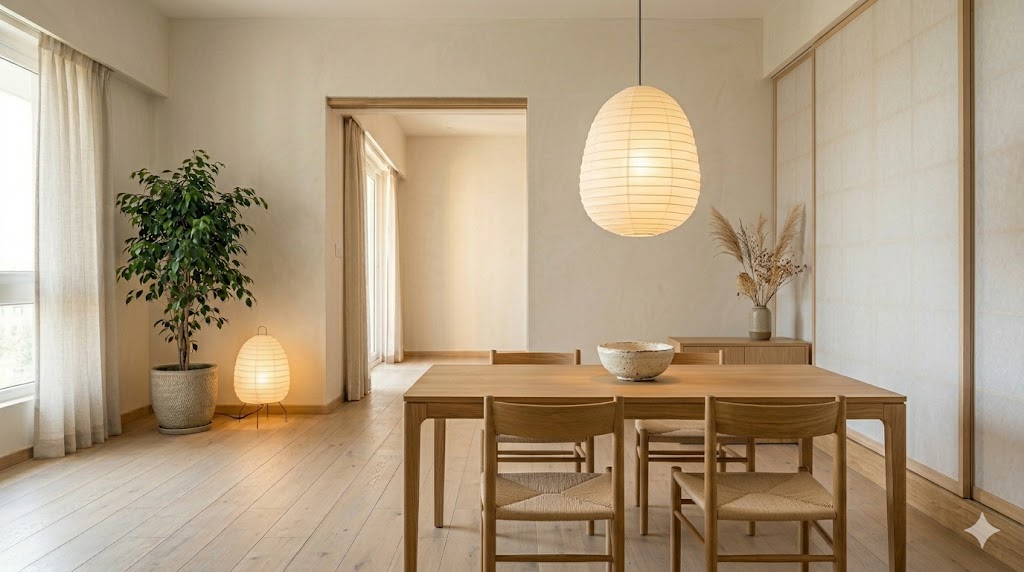
9. Oak round table Japandi dining — A 1.6 m oak round dining table for four, four matching low-back chairs in pale oak with linen seats, a single rattan paper-shade pendant 700 mm above the table.
10. Stoneware tableware — Stoneware plates, bowls, and cups in earthy tones replacing porcelain. The dining set becomes part of the design.
11. Sideboard with single object — A low oak sideboard against the wall with one stoneware vase, one bowl, one stack of two books. Three objects, evenly spaced, deliberate.
12. Dried-grass arrangement — A single tall dried-pampas or dried-bamboo arrangement in a stoneware floor vase beside the dining table. Living-but-preserved botanical.
Pooja Corner (Ideas 13-16)
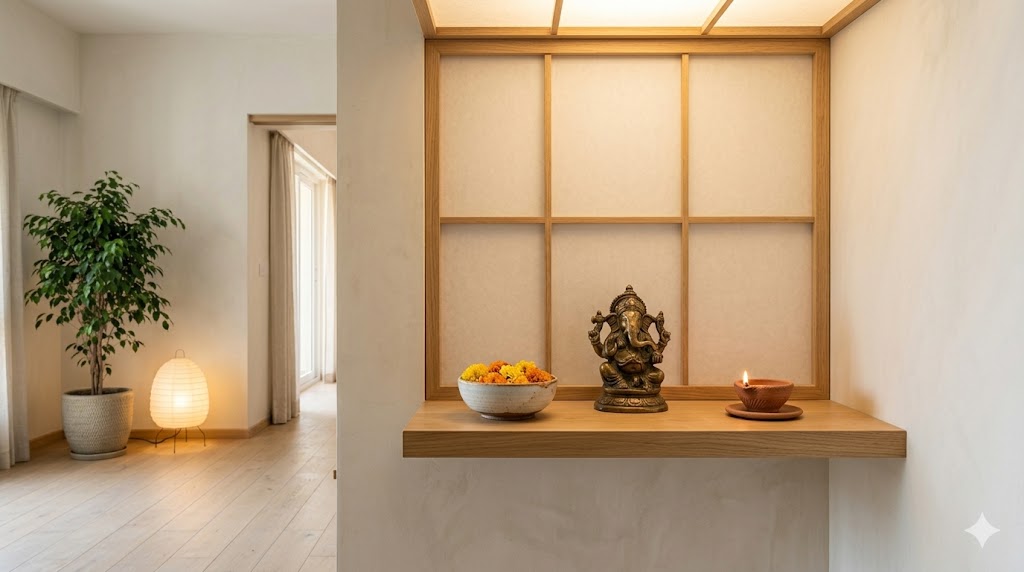
13. Oak-shelf Japandi pooja — A single oak shelf at chest height as the pooja platform, with a small brass Ganesha or Buddha figurine, a stoneware bowl for flowers, an unglazed clay diya. Washi paper screen behind.
14. Floor-platform pooja — A low oak platform (250 mm AFF) for floor-seated pooja, with a brass diya stand and a stoneware bowl. Japanese floor-seating tradition adapted for Indian ritual.
15. Tulsi in stoneware — Tulsi planted in a tall stoneware floor planter beside the pooja corner — replaces the traditional terracotta with Japandi-vocabulary stoneware.
16. Hanging brass bell + washi — A single small brass bell hanging from a leather strap beside the pooja corner, washi paper screen as backdrop. Hindu daily ritual + Japanese restraint.
Balcony (Ideas 17-20)
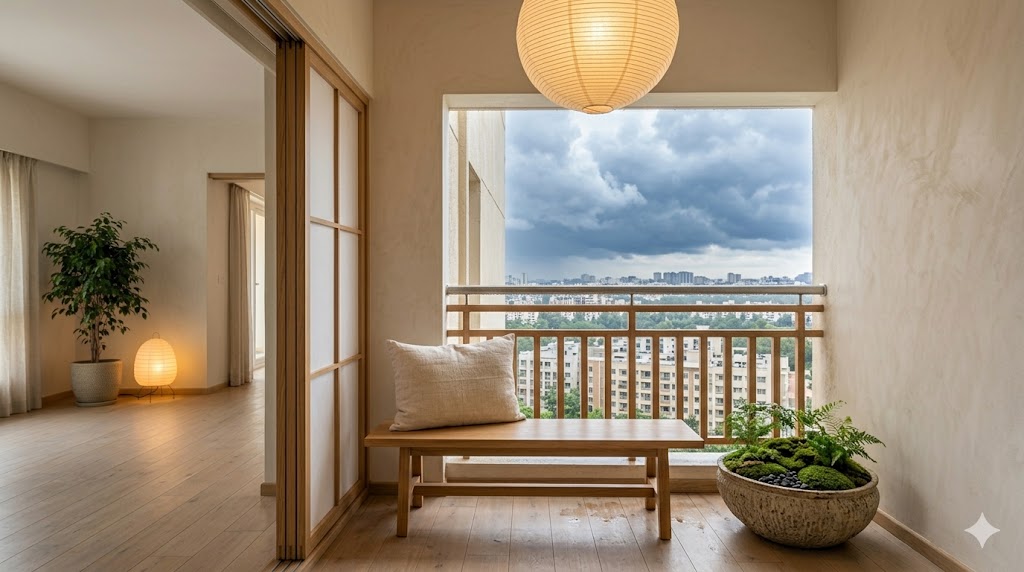
17. Oak bench monsoon balcony — A low oak bench with one cream linen cushion (brought inside in monsoon), a single stoneware planter with moss garden, a paper-shade ceiling lantern.
18. Indoor-outdoor washi screen — A washi-paper-style frosted-glass screen between the living room and the balcony — diffuses light, references the tradition, survives monsoon.
19. Single feature plant balcony — A single tall snake plant or ficus benjamina in a stoneware planter — one plant, one statement, no clutter.
20. Stoneware planter line — Three stoneware planters of varying heights along the balcony railing, each with a different green (pothos, ZZ plant, peace lily). Asymmetric and disciplined.
Common Japandi Mistakes
1. Too Japanese, not enough Scandi — pure dark wood + tatami + paper everywhere reads as theme. Add warm-white walls and oak (not just walnut) to keep hygge in.
2. Too Scandi, not enough Japanese — pure white + birch + bouclé is Scandi-minimal, not Japandi. Add at least one raku or stoneware piece per room.
3. Western furniture height — a 600 mm bed in a "Japandi" room kills the genre instantly. Low or it isn't Japandi.
4. Decorative clutter — three vases on the coffee table is not Japandi. One stem in one vase is.
5. Plastic / chrome / synthetic — single biggest violation. Audit every surface.
References:
1. Tanizaki, Jun'ichirō. In Praise of Shadows, 1933. (Foundational Japanese aesthetics text.)
2. Wiking, Meik. The Little Book of Hygge — The Danish Way to Live Well, 2016.
3. Koren, Leonard. Wabi-sabi for Artists, Designers, Poets and Philosophers, 1994.
4. Bureau of Indian Standards. IS 3646 — Illumination Requirements for Residential Buildings.
5. Bureau of Indian Standards. IS 1328 — Decorative Veneers.
6. Indian Council of Agricultural Research (ICAR). Indoor Plant Selection for Indian Apartments.
7. Vastu Vidya Pratisthan. Pooja Corner Vastu Guidelines for Modern Apartments, 2024.
8. India Meteorological Department (IMD). Monsoon Humidity and Building Material Selection, 2024.
9. Council of Architecture (India). Conditions of Engagement — Interior Design Scope.
10. Royal Institute of British Architects (RIBA). Plan of Work — Stage 4 Technical Design.
Related Guides
- /guides/warm-minimal-bedroom-ideas-india — adjacent warm-minimal palette guidance; shared discipline of restraint and natural materials
- /guides/scandinavian-indian-home-ideas — sister style; Scandinavian adapted for Indian climate
- /guides/modular-kitchen-guide — Japandi-friendly kitchen specifications and material choices
- Pooja room design — deeper reference for pooja-corner design that adapts to Japandi vocabulary
- /guides/wardrobe-finish-ideas — Japandi-compatible finish picks (oak veneer, suede laminate, matte PU)
Interactive · Japandi principle scorer
Score 34/100 · Scandi or Minimal
Toggle the principles your space already follows. The score shows how close you are to authentic Japandi.
Scandi or Minimal. You have a clean modern look but not Japandi — Japanese elements are missing.
Japandi is a philosophy, not a checklist — but ticking these principles is the practical path. Adapt for Indian climate: linen over heavy wool, breathable cotton over chunky knits.
Export this guide
Related Guides — Deep-dive reading
Scandinavian Indian Home Ideas — Adapted for Indian Climate
Where pure Scandi fails in India and what to change — palette swap, room-by-room adaptations, material durability matrix, and 20 numbered ideas
Design StylesWarm Minimal Interiors — A 2026 Style Guide for Indian Homes
Restraint with warmth · Oat & oak & linen · Curated negative space
Design StylesJapandi Apartment — A 2026 Style Guide for Compact Indian Homes
Japanese restraint × Scandinavian function · Low furniture · Two-wood discipline
Design StylesRelated Tools — Try Free
Apartment Furniture Size Chart
Standard furniture dimensions for Indian apartments — sofas, beds, tables, dining, storage.
Reference ChartCross-Ventilation Analyzer
Estimate airflow and air changes per hour (ACH) from room size, window areas, layout, and local wind — with NBC 2016 Part 8 compliance check.
Ventilation CalculatorMaterial Comparison Sheet
India's interior material cheatsheet — plywood, finishes, hardware, countertops, paints, waterproofing.
Reference Guide