
The Refrigerant Phase-Down: Montreal, Kigali and What to Buy Now
Why the gas in your AC keeps changing — the global agreements retiring ozone-damaging and high-warming refrigerants (the Montreal Protocol and Kigali Amendment), India's commitments and timeline, and how to future-proof an air-conditioner purchase.
If it feels like the gas inside air conditioners keeps changing — R22, then R410A, now R32 — that's not marketing churn. It's a planned, treaty-bound global transition away from refrigerants that damage the ozone layer or heat the climate, unfolding over decades. Two international agreements drive it, India is a committed party, and the direction is set. Knowing the phase-down explains why some refrigerants are being retired, and helps you buy an AC that won't be orphaned by obsolete gas in a few years. This guide lays out the timeline and what it means.
It builds on the HVAC Refrigerants Guide, part of the HVAC Knowledge Hub.
Scope. This explains the regulatory transition to inform buying and planning. Specific compliance obligations for businesses are governed by MoEFCC rules and professional advice.
Two agreements, two problems
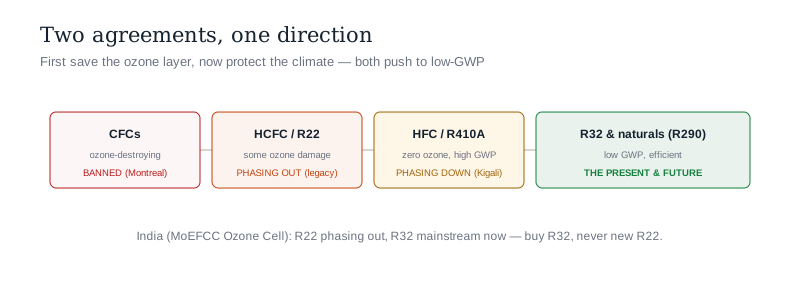
The transition tackles two distinct environmental harms in sequence:
- The Montreal Protocol (1987) — tackled the ozone hole. It phased out ozone-depleting CFCs (banned) and is phasing out HCFCs like R22. Hugely successful — the ozone layer is recovering.
- The Kigali Amendment (2016) to the Montreal Protocol — tackles climate change. It phases down HFCs (like R410A) — which don't harm ozone but are potent greenhouse gases — to curb their warming impact.
So the story is two chapters: first save the ozone layer (retire R22 and its kin), now protect the climate (cut down the high-GWP HFCs). Both push the industry the same way — toward low-GWP refrigerants like R32 and naturals.
India's commitments and timeline
India is a party to both agreements, implemented through the MoEFCC Ozone Cell:
- HCFC (R22) phase-out — India has been progressively phasing out R22 in new equipment under the Montreal Protocol's HCFC phase-out schedule; R22 room ACs are effectively legacy, and R22 supply is shrinking and dear.
- HFC phase-down (Kigali) — India ratified the Kigali Amendment and has a phase-down schedule that begins its HFC reduction later than developed countries (reflecting its development stage), with a stepwise reduction over the coming decades toward large cuts by mid-century.
- The practical trajectory — new room ACs have largely moved to R32; R290 appears in some models; R410A is on the long path down. Exact dates shift with policy, so treat the direction as certain and verify current specifics with MoEFCC.
The upshot for India: R22 is the past, R32 is the present, and even lower-GWP options are the future.
How to future-proof an AC purchase
Because an AC lasts 10–15 years, the refrigerant it uses matters for its whole life:
- Buy R32 (or R290 where suitable) — today's low-GWP mainstream, efficient, well-supported, and not facing near-term phase-down. See R32 vs R410A.
- Avoid new R410A — it still works, but it's on the phase-down path, so long-term gas supply and service will get costlier.
- Never buy R22 equipment — it's obsolete; R22 is scarce, expensive and being withdrawn. Servicing an old R22 unit gets harder every year.
- Think about serviceability — a refrigerant that will still be widely stocked in ten years is easier (and cheaper) to service after a leak repair.
- Efficiency compounds it — a low-GWP and efficient unit (high ISEER) minimises both leak-impact and running emissions.
What it means beyond buying
- Servicing legacy R22/R410A systems — still done, but plan for rising gas cost and eventual replacement; recovered gas must not be vented.
- Commercial & bulk users — face specific reporting and phase-down obligations under MoEFCC rules; get professional compliance advice.
- The bigger climate lever — because leaks release these gases, tight, leak-free systems and proper recovery matter as much as the choice of gas (see refrigerant leaks).
The one-line answer
The gas in air conditioners keeps changing because of a planned, treaty-bound global phase-down, not marketing. The Montreal Protocol (1987) first tackled the ozone hole, banning CFCs and phasing out HCFCs like R22 (a recovery success), and the Kigali Amendment (2016) now tackles climate change by phasing down high-GWP HFCs like R410A — both pushing the industry toward low-GWP refrigerants. India, via the MoEFCC Ozone Cell, is progressively phasing out R22 (now legacy, scarce and dear) and follows a Kigali HFC phase-down schedule that steps down over the coming decades — so new room ACs have largely moved to R32, with R290 emerging and R410A on the long path down. Because an AC lasts 10–15 years, future-proof your purchase by buying R32 (or R290 where suitable), avoiding new R410A, and never buying R22 equipment — and remember that tight, leak-free systems and proper gas recovery matter as much for the climate as the refrigerant you pick.
Where to go next
- The refrigerant fundamentals: HVAC Refrigerants Guide.
- The buying comparison: R32 vs R410A vs R290.
- Why leaks matter so much: Refrigerant Leak Guide · GWP Impact Calculator.
- Buy efficient too: Choosing an Air Conditioner.
References
- The Montreal Protocol on Substances that Deplete the Ozone Layer (1987) and the Kigali Amendment (2016) — UNEP Ozone Secretariat.
- MoEFCC Ozone Cell, India — HCFC phase-out & HFC phase-down implementation: https://ozonecell.nic.in/
- Bureau of Energy Efficiency (BEE) — appliance efficiency; ISO 817 / ASHRAE 34 — refrigerant classification.
This guide informs buying and planning. Business compliance obligations are governed by MoEFCC rules and professional advice. Verify current phase-down specifics and any standard's status before relying on them.
Export this guide
Related Guides — Deep-dive reading
HVAC Refrigerants: What's Inside Your AC and Why It's Changing
The working fluid that makes cooling possible — what a refrigerant is, the properties that matter (GWP, ODP, efficiency, flammability), the generations from R22 to R32 and R290, the safety classes, and why the whole industry is transitioning to low-global-warming gases.
HVAC & CoolingR32 vs R410A vs R290: Which AC Refrigerant Is Better?
The gas inside your AC matters more than you think — how R32, R410A and R290 compare on efficiency, global-warming impact and safety, why the industry is moving to lower-GWP refrigerants, and what it means when you buy an air conditioner today.
HVAC & CoolingDesigning Adaptable & Universal-Design Homes
Accessibility, Aging-in-Place, and the Multi-Stage Family — Code, Anthropometrics, and Plan-Stage Discipline for Indian Residential Architects
Room PlanningRelated Tools — Try Free
Healing View Impact Calculator
Evidence-Based Design dashboard quantifying the recovery impact of nature view + daylight factor on analgesic use, length of stay, and HCAHPS patient-experience uplift. Calibrated against Ulrich 1984 (Science), Park & Mattson 2008, and the CHD EBD evidence base.
EBD CalculatorBefore & After Studio
Generate AI before-and-after renders to preview how your redesign could look.
DesignAIRenovation vs New Build Calculator
Compare renovating vs building new interiors city-wise across 13 work scopes with GST and per-sqft rates.
Cost Comparison