
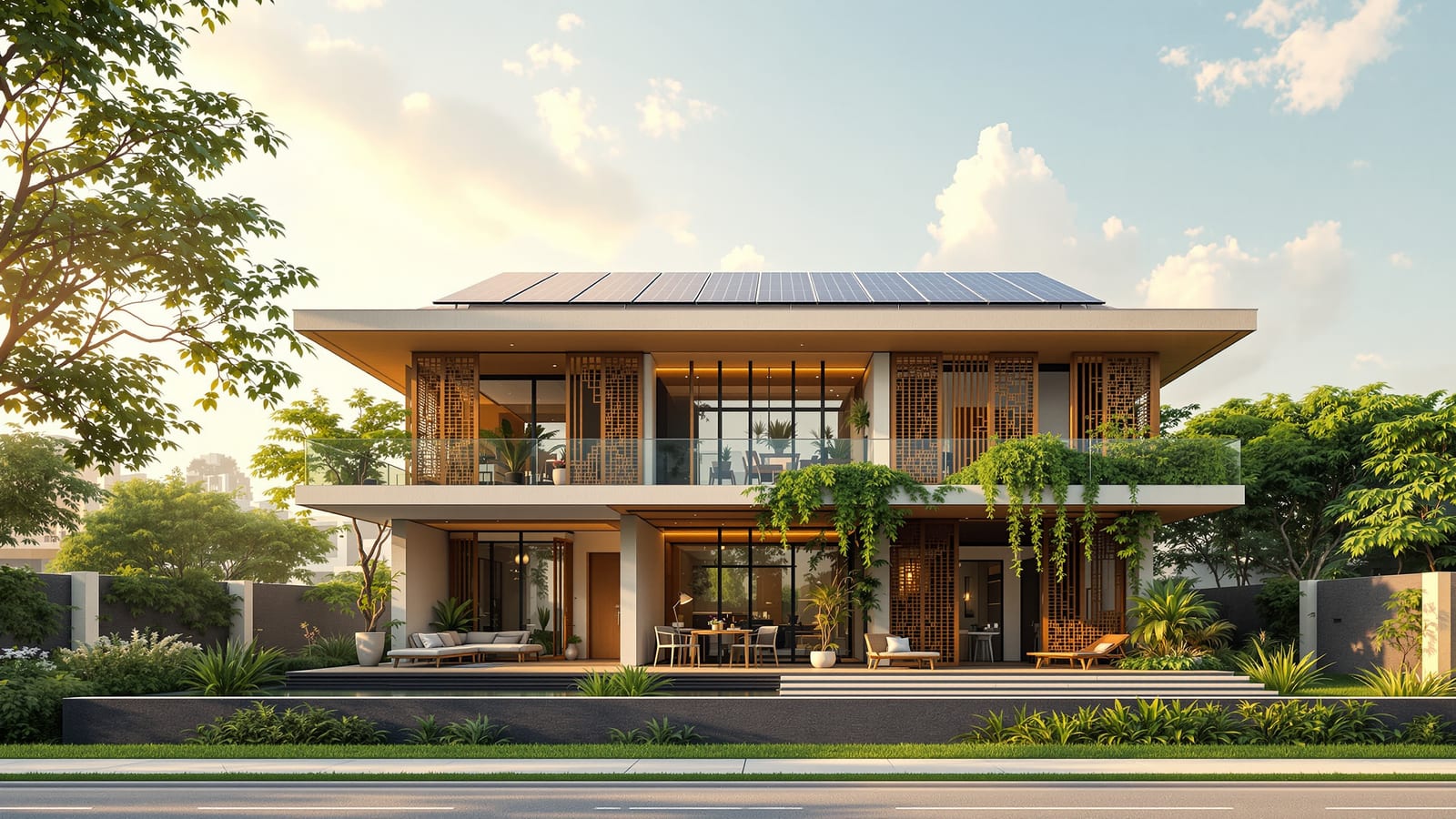
The Future of Building Regulations in India
Where India's building rules are heading on energy, climate resilience, digital approvals and green construction, and what it means for the home you build next.
If you are building or buying a home in India today, you are building for the next 30 to 50 years. The rules that govern that home, however, are changing faster than at almost any point in the country's history. Energy codes that were voluntary are becoming mandatory. Climate disasters that were once treated as bad luck are being written into law as design requirements. Plan approvals that took months of office visits are moving online and, in some cities, becoming nearly automatic.
This guide walks you through where India's building regulations are actually heading, and what that means for the home you build next. We have been careful to separate what already exists in law from what is emerging or likely, because honesty matters more than hype here. Some of these shifts are settled rules you must follow. Others are direction-of-travel: clear in intent, uneven in rollout, and not yet enforced everywhere. We flag which is which throughout. If you want the longer backstory of how we got here, read the evolution of building regulations in India. For the live, state-by-state picture of what applies where, the India Regulatory Atlas is your reference.
1. Energy codes are tightening, and the target is net-zero
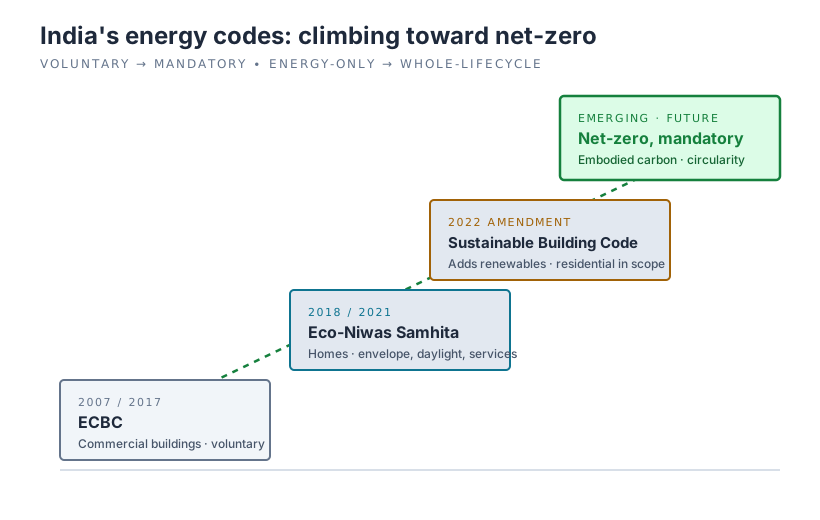
For most of India's history, building energy rules covered only large commercial buildings. That has changed. The Energy Conservation Building Code (ECBC), first launched in 2007 and revised as ECBC 2017, set minimum energy standards for commercial buildings. For homes, the Bureau of Energy Efficiency (BEE) introduced the Eco-Niwas Samhita (ENS) in 2018, with a second part added in 2021 covering building services and renewable energy. ENS focuses on the things that quietly decide your electricity bill: how much heat your walls and windows let in, how much daylight and natural ventilation you get, and how efficient your building services are.
The bigger shift came with the Energy Conservation (Amendment) Act, 2022. This law expanded the scope of energy codes to formally include residential buildings, and it renamed the framework the Energy Conservation and Sustainable Building Code. Crucially, the new code is meant to go beyond saving energy. Its stated direction includes renewable energy use and other green-building requirements. Government and policy commentary around it talks about incorporating embodied carbon, net-zero emissions, material efficiency, and circularity into future norms.
Be clear about the status here. ENS is still largely voluntary at the national level and only becomes binding when a particular state notifies and enforces it. So "net-zero homes" is the direction of travel, not a rule you must meet today. But the trajectory is unambiguous: from voluntary to mandatory, from energy-only to whole-of-lifecycle. For practical steps on building a low-energy home now, see sustainable home design in India.
2. Climate resilience is being written into the code
India's building rules were historically about strength and sanitation. They are increasingly about survival in a hotter, wetter, more volatile climate. Three forces are pushing this.
Heat is the first. As cities record longer and deadlier heatwaves, heat-resilient design is moving from advice to policy. Cool-roof requirements are a leading example. Telangana introduced what is widely described as India's first state-wide cool-roof policy, and several Heat Action Plans, beginning with Ahmedabad's pioneering 2013 plan, now reference reflective roofs and shaded public spaces. Expect cool roofs, light-coloured surfaces, and shading to appear more often in local bye-laws.
Urban flooding is the second. With cities paving over the ground that once absorbed rain, rules on rainwater harvesting, permeable surfaces, and stormwater management are tightening in many municipal bye-laws. Some states already make rainwater harvesting mandatory above a certain plot size.
Disaster strength is the third. India's seismic and wind-load standards, maintained by the Bureau of Indian Standards (BIS), are periodically revised as understanding of earthquake and cyclone risk improves. The National Building Code (NBC) 2016 already strengthened disaster-resilient design, and future revisions are expected to push further. The honest caveat: a strong code on paper means little if it is not enforced, and enforcement remains the weak link in much of the country.
3. The National Building Code is moving toward performance
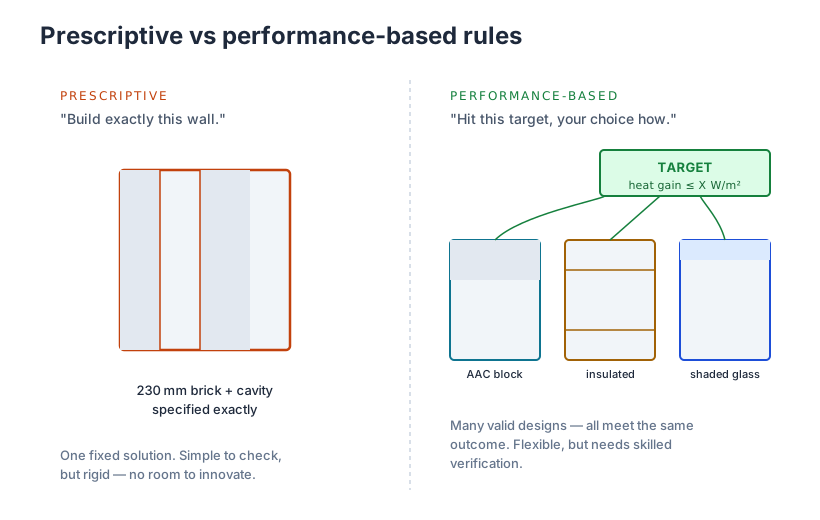
A quiet but important shift is in how rules are written. Traditional codes are prescriptive: they tell you exactly what to do, for example a specific wall thickness or window size. Performance-based codes instead tell you the outcome to achieve, for example a maximum heat gain or a structural safety level, and let your design team find the best way to get there.
The NBC 2016, India's model code recommended by BIS for adoption by states, already moved in this direction and reflects contemporary international practice. The advantage of performance-based rules is flexibility: they reward genuinely good design and new materials instead of forcing everyone into one fixed solution. The trade-off is that they demand more skilled verification, which is harder in places with stretched municipal capacity. This is why the move is gradual, not a switch flipped overnight.
4. Approvals are going digital, and getting faster
For most homeowners, the regulations that hurt most are not the technical ones but the bureaucratic ones: the months of waiting, the repeated office visits, the opacity. This is the area changing fastest and most visibly.
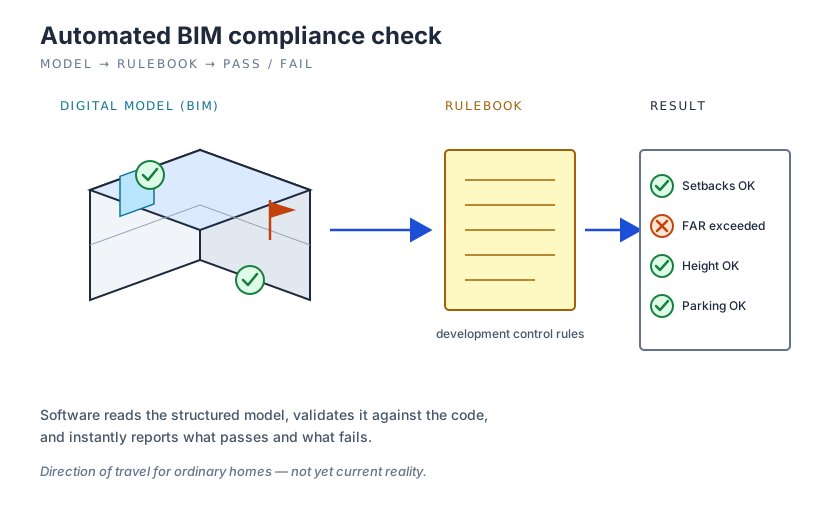
The Online Building Permission System, often called OBPAS or OBPS, is a Mission Mode Project under the Ease of Doing Business initiative led by the Ministry of Housing and Urban Affairs (MoHUA). It is an end-to-end online system covering plan submission, fee calculation and payment, plinth and roof verification, and the occupancy certificate. At its core is automated plan scrutiny, often branded AutoDCR, where software reads your architect's CAD drawing and checks it against the local development control rules automatically, flagging violations before a human ever opens the file.
The reform direction also includes time-bound and deemed approvals, where an application is treated as approved if the authority fails to respond within a set window, and single-window clearances that bundle multiple no-objection certificates. OBPAS-type systems are now live in many states including Odisha, West Bengal, Haryana, and others. The honest picture: coverage, reliability, and how strictly auto-scrutiny is enforced vary widely between states and even cities, and the underlying development control rules still differ everywhere. To understand how those local rules shape what you can build, read how urban regulations shape cities.
| Trend | What exists now | Where it is heading |
|---|---|---|
| Energy code | ENS for homes, ECBC for commercial, mostly voluntary | Mandatory, expanding toward low-energy and net-zero |
| Climate resilience | Cool-roof and rainwater rules in some states; NBC 2016 disaster provisions | Heat, flood, seismic and cyclone resilience standardised in codes |
| Code structure | Mixed; NBC 2016 partly performance-based | More outcome-based performance codes |
| Approvals | OBPAS and AutoDCR live in many states | Single-window, time-bound and deemed approvals nationwide |
| Green building | GRIHA, IGBC, LEED ratings, largely voluntary | Embodied carbon and circularity entering mandatory norms |
| Accessibility | Harmonised Guidelines under RPwD Act 2016 | Wider enforcement, universal design as default |
5. Green ratings and the rise of embodied carbon
India already has mature green-building rating systems: GRIHA (Green Rating for Integrated Habitat Assessment), IGBC (Indian Green Building Council), and the international LEED. These have long been voluntary marks of quality rather than legal requirements, though some states offer incentives such as extra floor area for certified green buildings. For a full comparison, see green building certifications in India.
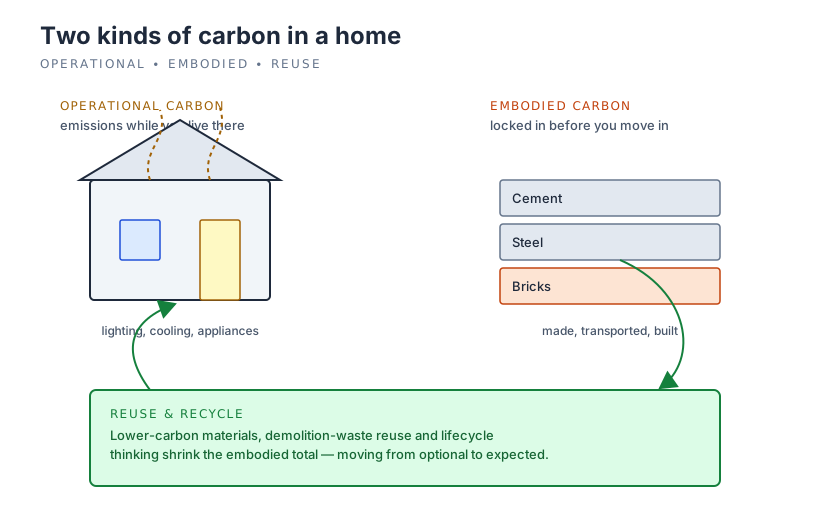
The emerging shift is what these ratings measure. The conversation is moving from operational energy, the power your home uses while you live in it, to embodied carbon, the emissions locked into the cement, steel, and bricks before you even move in. GRIHA already emphasises embodied energy and lifecycle impact. The direction of travel, reinforced by the 2022 energy law's language on material efficiency and circularity, is that material choice, reuse of demolition waste, and lifecycle thinking will gradually move from optional rating points toward expected norms. This will not happen all at once, but it changes what a "good" home means.
6. Accessibility and universal design are becoming the default
A home should work for a wheelchair user, an elderly grandparent, and a parent with a pram, not just a fit adult. Indian policy is steadily moving in this direction. The Rights of Persons with Disabilities (RPwD) Act, 2016, under Section 40, empowers the government to set accessibility standards for the built environment.
The practical expression of this is the Harmonised Guidelines and Space Standards for Universal Accessibility in India, prepared by MoHUA, which were updated and referenced in the RPwD (Amendment) Rules, 2023. The language itself has evolved, from "barrier-free" design that retrofits access as an afterthought, to "universal" design that builds it in from the start. For now these guidelines bite hardest on public and government buildings. The emerging direction is wider application and stronger enforcement, so designing in step-free entries, wider doors, and ground-floor flexibility today is a sensible bet on where rules are going.
7. AI- and BIM-assisted compliance is on the horizon
The same digital wave reshaping approvals is reaching the design process itself. Building Information Modelling (BIM) replaces flat drawings with a structured 3D data model of the building. With effect from recent years, large government projects above a high cost threshold are required to use BIM, and it is becoming a basic eligibility requirement for major government tenders.
Why does this matter for a homeowner who is not building a flyover? Because BIM and automated rule-checking move regulation from "submit a drawing and wait for a human to judge it" toward "submit structured data that software validates against the code." Research and early tools already demonstrate automated code-compliance checking against building rules. The plausible future is approval systems that read a model and instantly report what passes and what fails. Be honest about the timeline, though: this is direction-of-travel for ordinary home construction, not current reality. Most individual house approvals still run on conventional drawings.
8. The honest caveat: India is a patchwork
Run through all of the above and one truth holds across every trajectory: adoption is uneven. India is a union of states, and most building regulation is implemented at the state and municipal level. A code that BEE, BIS, or MoHUA publishes is a model. It only becomes enforceable when a particular state notifies it and a particular municipality has the capacity to enforce it. So two homes built in the same year in different states can sit under very different rules.
This is why you should treat national headlines about codes as the destination, not the current map. Always confirm what actually applies on your plot, in your city, this year. RERA, the Real Estate (Regulation and Development) Act, has improved transparency for buyers of apartments and plots, but it governs disclosure and project delivery, not the technical building code. The detailed, state-aware picture is what the India Regulatory Atlas is built to give you.
What this means for you
You cannot control how fast your state adopts new codes. But you can build a home that is comfortably ahead of where the rules are clearly heading, which protects its value, its running cost, and its resale future. A few concrete moves:
- Build to the energy code even if it is voluntary where you are. Insist on a well-shaded, well-oriented envelope, decent insulation, and good natural ventilation. Treat ENS as your minimum, not your aspiration.
- Design for the climate you will actually face. A cool or reflective roof, real rainwater harvesting, and permeable surfaces are cheap to add now and increasingly likely to be required later.
- Confirm structural compliance with current seismic and wind standards for your zone, and insist your engineer documents it. Resilience is the hardest thing to retrofit.
- Choose lower-carbon, durable materials and ask about reuse. Embodied carbon is moving from a niche concern to a measured one.
- Build in accessibility from day one. A step-free entry and a usable ground-floor bathroom cost little upfront and a fortune to add later.
- Keep clean digital records. As approvals and compliance go digital, an organised model, drawings, and certificates will save you time and stress.
- Verify the local, current rules before you commit. Use the India Regulatory Atlas, and pair it with sustainable home design in India and green building certifications in India.
The home you build today will live through the rules of tomorrow. Building a little ahead of the curve is not over-engineering. It is simply reading the direction of travel and choosing not to be caught behind it.
Sources
- Bureau of Energy Efficiency, Eco-Niwas Samhita (ENS) and ECBC programme pages, beeindia.gov.in
- The Energy Conservation (Amendment) Act, 2022, key highlights, Cyril Amarchand Mangaldas (corporate.cyrilamarchandblogs.com)
- Bureau of Indian Standards, National Building Code of India 2016, bis.gov.in
- Ministry of Housing and Urban Affairs, Online Building Permission System (OBPS/OBPAS), Ease of Doing Business, smartnet.niua.org and state OBPAS portals
- Harmonised Guidelines and Space Standards for Universal Accessibility in India, MoHUA / NIUA (niua.org), and Press Information Bureau release, pib.gov.in
- RPwD Act 2016 and RPwD (Amendment) Rules 2023, Office of the Chief Commissioner for Persons with Disabilities, ccpd.nic.in
- GRIHA, IGBC and LEED rating overviews; comparative analyses, ScienceDirect and OneClick LCA
- NRDC, India's first state-wide cool roof policy factsheet, nrdc.org
- GFDRR, Building Regulations for Resilience in India, gfdrr.org
- Government BIM mandate for large public projects and automated code-compliance research, Nature Scientific Reports and industry analyses
Export this guide
Related Guides — Deep-dive reading
Solar Energy Mandates in Buildings: Where India Requires Solar
Solar water heating and rooftop PV requirements in building bye-laws and energy codes, and how they differ from subsidies
Building Regulations & ComplianceRooftop Rainwater Harvesting Rules in India: Where It's the Law
In much of India, a rooftop rainwater harvesting system is not a green extra — it is a condition of your building sanction, completion and occupancy certificate. What the rule typically requires, the standard it points to (IS 15797), who designs and certifies it, and why the exact threshold, rebate and penalty are set by your city, not the country.
RoofingUnderstanding Building Bye-Laws in India: A Homeowner's Guide
What municipal building bye-laws are, who makes them, and how to find and read the ones that actually govern your plot
Building Regulations & ComplianceRelated Tools — Try Free
Cross-Ventilation Analyzer
Estimate airflow and air changes per hour (ACH) from room size, window areas, layout, and local wind — with NBC 2016 Part 8 compliance check.
Ventilation CalculatorRainwater Tank Sizer
How big should your rainwater tank be? Computes annual harvest, recommended tank capacity in litres, water-bill savings, and payback — for 10 Indian cities.
RWH CalculatorBrise-Soleil Visualizer
Interactive horizontal-louvre cut-off angle calculator — sun altitude, louvre depth, and spacing inputs with a live shadow preview. Computes θ = arctan(spacing/depth) for façade shading, ECBC envelope compliance, hospital daylight design, and tropical sun-control detailing.
Sun Shading Tool