
Home Low-Voltage & ELV Systems: The Signal Side of a Modern Home
Beyond the power wiring lies a second network — the extra-low-voltage systems that carry data and signals: networking, CCTV, intercom, audio, home theatre, fire alarm, access control and automation. What ELV is, why it must be kept separate from the mains, and how to plan the one conduit backbone they all share.
Every modern home has two electrical networks, not one. There's the power wiring you already know — the circuits that run lights, sockets and appliances. And there's a quieter second network: the extra-low-voltage (ELV) systems that carry data and signals rather than power — your network, CCTV, intercom, audio, home theatre, fire alarm, access control and automation. As homes get smarter, this signal side grows, and planning it well (and keeping it properly separate from the mains) is what makes a connected home reliable. This guide is the overview of a home's low-voltage and ELV systems in India.
It is the ELV anchor of the Electrical Knowledge Hub, extending the smart-home wiring and structured cabling guides into the wider family of signal systems.
The safety line. ELV systems run at low, safer voltages — but their power supplies and adaptors are mains-fed, so a licensed electrician provides those, and ELV cabling must be kept separated from mains wiring (IS 732). Life-safety ELV like the fire alarm is critical work for qualified installers.
What "ELV" means
Extra-Low Voltage (ELV) refers to systems running at low voltages (broadly, up to about 50 V AC), far below the 230 V mains — which is why they're safer to touch and used for signal and data. You'll also meet:
- SELV / PELV — Separated and Protective Extra-Low Voltage: designs where the low-voltage circuit is safely isolated from the mains, the basis of much ELV equipment.
- Low-voltage / signal wiring — the practical umbrella for the data and control cabling in a home.
The key idea for a homeowner: ELV is the safer, signal-carrying layer — but it still needs proper design, quality cable and, crucially, separation from the mains.
The family of home ELV systems
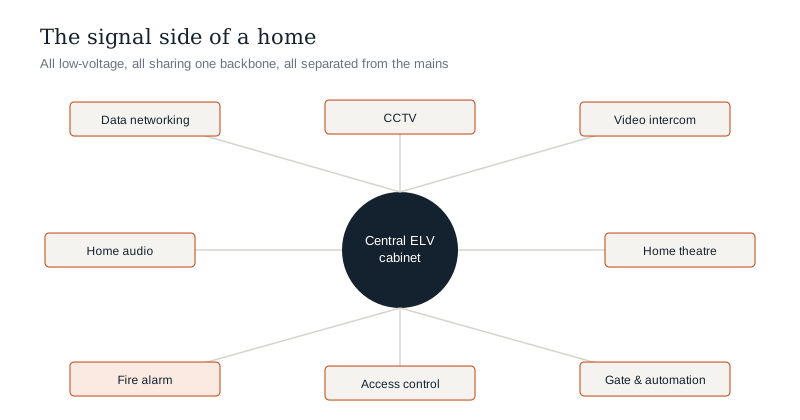
A well-equipped home may include several of these, all low-voltage:
- Data networking — structured Ethernet cabling, the backbone for everything connected.
- CCTV & video door phone — security cameras and door entry.
- Intercom & access control — door stations, smart locks and keypads.
- Home audio — multiroom and ceiling speakers.
- Home theatre — dedicated AV and surround cabling.
- Fire & smoke alarm — detection and alarm, the life-safety ELV system.
- Gate automation — automatic gates and barriers.
- Home automation — the control bus/hub tying smart devices together.
They differ in purpose but share the same principles: low-voltage cable, careful routing, a central point, and separation from power.
The golden rule: separate from the mains
The single most important ELV rule is keep low-voltage/signal cabling separated from mains power cabling:
- Run ELV cables in their own conduits, not sharing with 230 V power cables.
- Maintain separation at crossings and along runs, per IS 732.
- Why — proximity to mains induces interference (noise on data, audio hum) and raises safety concerns; separation keeps signals clean and the installation safe.
This is why ELV is planned alongside but distinct from the power wiring, ideally at the same time.
Plan one backbone for all of them
The efficient way to do ELV is to plan a shared low-voltage backbone rather than a tangle of afterthoughts:
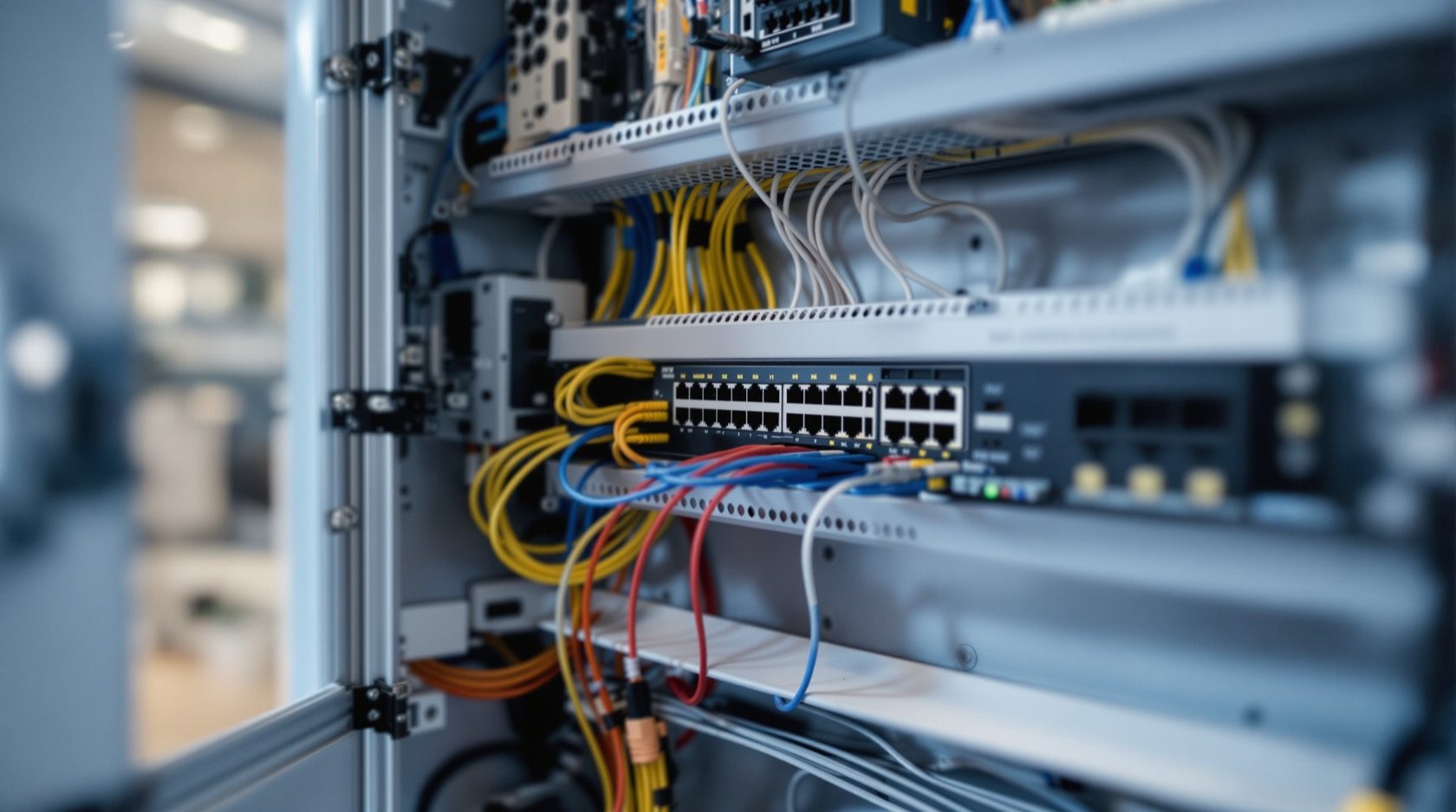
- A central ELV/network location — the same ventilated, powered cabinet as your smart-home hub, where cabling, switches, the router, NVR/DVR and controllers live.
- A conduit network with spare capacity, separate from mains, radiating from that centre to every point that needs a signal (TVs, cameras, speakers, door stations, sensors).
- Star topology — home runs back to the centre, as with structured cabling.
- Plan it before the walls close — like power wiring, ELV is inexpensive to install during construction and disruptive to retrofit.
Get this backbone right and every ELV system — now and future — has a clean home.
Who installs ELV
- Low-voltage / ELV specialists (often the networking, AV or security installer) run and terminate the signal cabling.
- A licensed electrician provides the mains supply and power points for ELV equipment (the router, NVR, amplifiers, controllers all need power) and ensures separation from mains.
- Coordinate them — the best results come from planning ELV and power together, on one set of drawings.
The one-line answer
A modern home has a second electrical network — the extra-low-voltage (ELV) systems that carry data and signals rather than power: networking, CCTV, intercom, audio, home theatre, fire alarm, access control and automation. ELV runs at safer low voltages (SELV/PELV isolate it from the mains), but its golden rule is separation from mains cabling (own conduits, per IS 732) to keep signals clean and the installation safe. Plan them as one shared low-voltage backbone — a central powered cabinet with conduit home-runs to every signal point, laid before the walls close — coordinated by ELV specialists with a licensed electrician providing the mains power. Do that, and every connected system in the home just works.
Where to go next
- The data foundation: Structured Cabling & Home Networking.
- The systems in depth: Home Theatre Wiring · Multiroom Audio · Video Intercom & Access Control.
- The life-safety one: Home Fire Alarm Guide.
- The electrical foundation: Smart Home Wiring Guide.
References
- IS 732 : 2019, Code of Practice for Electrical Wiring Installations (segregation of services; ELV), Bureau of Indian Standards.
- IS/ISO/IEC 11801 (Parts 1–6), Generic Cabling for Customer Premises, BIS.
- National Electrical Code of India, SP 30 : 2023 (extra-low-voltage and communication systems), BIS: https://www.bis.gov.in/
ELV categories and equipment evolve; low-voltage cabling must be installed by qualified professionals and kept separated from mains wiring, with mains power provided by a licensed electrician. Verify any standard's status via the BIS catalogue before relying on it.
Export this guide
Related Guides — Deep-dive reading
Electrical Safety for Security Systems in India (2026): Powering It Without Peril
A homeowner's guide to the power side of home and RWA security systems, CCTV, alarms, gates, access control and NVRs, done so it protects you instead of quietly becoming a shock or fire hazard. What makes a supply safe, what to insist on, and why the mains work belongs to a licensed electrician.
SecuritySecurity Cabling Requirements for Indian Homes
How to plan the wiring behind a home security system - which cable feeds which device, the 90-metre ethernet rule and the interference rules, and why laying conduit at construction stage beats surface trunking every time.
SecuritySecurity Planning for New Homes in India: Build It In From Scratch
The cheapest, cleanest security you will ever buy is the security you design into a house while it is still being built. A build-stage playbook for Indian homes — CPTED site planning, structural and cabling provisions, and a checklist keyed to construction milestones.
SecurityRelated Tools — Try Free
Security Cabling & PoE Planner
Estimate cable length, drops, PoE power budget, the right switch, conduit and cost for a CCTV/security cabling plan.
Cabling PlannerHome Security Risk Scorecard
Score your home across six security layers — perimeter, entry points, lighting, detection, alarm and habits — and get a prioritised action plan.
Security ScorecardElectrical Safety & Load Audit
Home electrical audit — 10 categories, 65+ checkpoints across earthing, RCCB, MCB, wiring, switchboards, appliance circuits, DG/inverter backup.
Safety Audit