
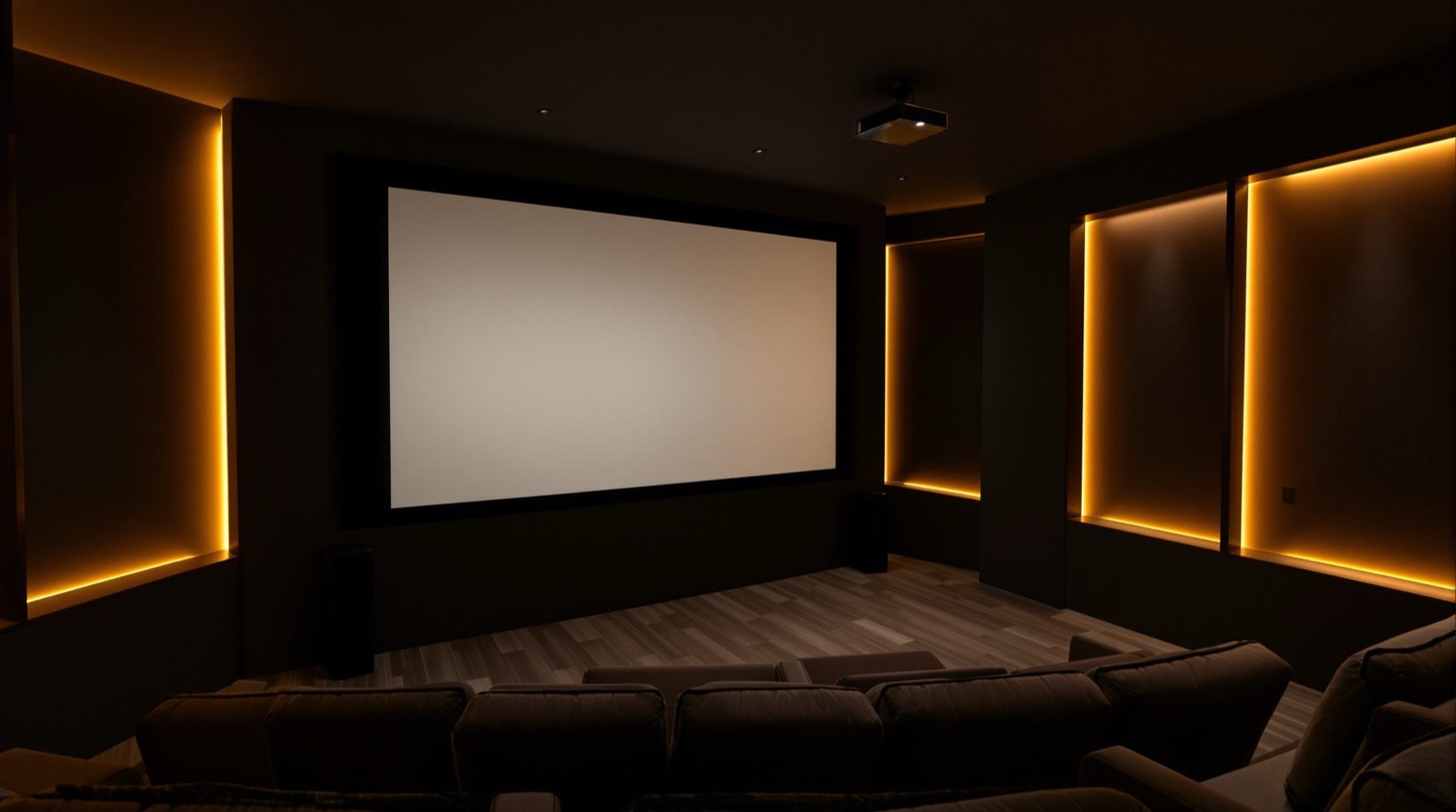
Home Theatre Wiring: The Electrical & AV Plan for a Cinema Room
A cinema room is built in the wiring — how to plan a home theatre's electrics and AV: in-wall speaker cabling to surround positions, a projector or TV point, a ventilated AV rack, clean protected power, and the conduit that hides every cable, all set before the room is finished.
A great home theatre is decided long before the first movie — in the wiring laid inside the walls. Surround speakers need cable run to precise positions, a projector needs power and signal at the ceiling, the AV gear needs a ventilated home, and every cable needs to disappear into conduit. Get this planned before the room is finished and you get a clean, immersive cinema; leave it to afterthoughts and you get visible wires, compromised speaker placement and a rack that overheats. This guide is the electrical and AV wiring plan for a home theatre in India.
It is the home-theatre guide of the ELV set in the Electrical Knowledge Hub, going deeper than the living-room electrical guide for a dedicated cinema.
The safety line. This guide helps you specify the AV and power provision. The speaker and signal cabling is low-voltage (installed by an AV professional); the mains power, sockets and protected supply are a licensed electrician's work — coordinate the two on one plan.
Plan the room as a system
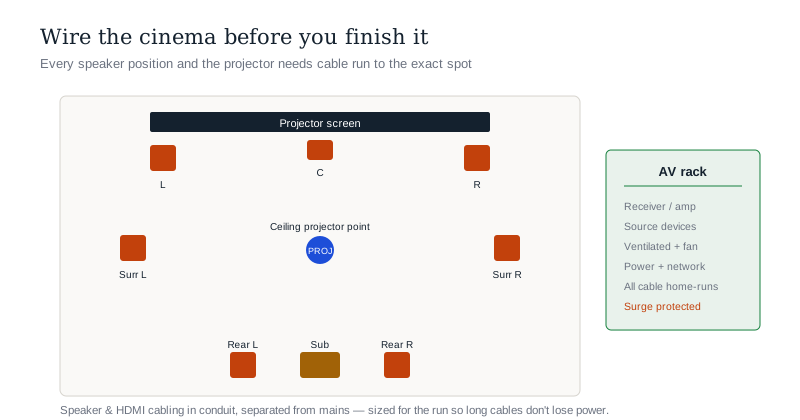
A home theatre is a set of connected positions, each needing cable:
- The screen wall — projector screen or large TV, with power and signal.
- Speaker positions — front left/centre/right, surrounds and often rears (a 5.1 or 7.1 layout), each needing speaker cable run in-wall to the exact spot.
- The subwoofer — its own position and cable.
- The AV rack — where the receiver/amplifier, source devices and network live.
- The seating — sometimes powered recliners needing points.
Decide the layout first; the wiring follows the positions.
In-wall speaker cabling
The heart of a home theatre is speaker cable run inside the walls to each speaker position:
- Run quality speaker cable from the AV rack to each speaker location, sized for the run (see the speaker wire gauge calculator — longer runs need a heavier gauge to avoid power loss).
- Terminate neatly at wall plates at each position, so speakers connect cleanly.
- Plan for your layout — 5.1, 7.1 or Atmos (with ceiling speakers) — and run cable to every position now; adding one later means opening a finished wall.
- Keep speaker/AV cabling separated from mains to avoid hum and interference (the ELV golden rule).
The projector (or big screen) point
- A ceiling point for a projector — power and signal (HDMI, ideally in conduit) run to the projector position, with a return to the rack.
- A screen point if a motorised screen is used.
- Or a robust TV point on the screen wall for a large TV, with the media-wall provision from the living-room guide.
- Conduit for HDMI/signal so long runs can be pulled and upgraded.
The AV rack: give the gear a home
The receiver, sources and network need a proper location:
- A ventilated rack or cabinet — AV gear runs hot; plan ventilation (and sometimes a fan) so it doesn't cook.
- Power sockets and a network point at the rack.
- All speaker, HDMI and signal cabling home-runs back here.
- Accessible for changing devices, not sealed into a cabinet.
Clean, protected power
- Surge protection — a home theatre is a lot of expensive, surge-sensitive electronics; protect it.
- A dedicated circuit for the AV gear so heavy household loads don't cause dips or noise.
- Enough sockets at the rack, screen and seating.
- RCCB protection and good earthing, as everywhere.
- Consider a stabiliser/clean-power where the mains is poor.
The one-line answer
A home theatre is built in its wiring, so plan the whole room before it's finished: in-wall speaker cable run to every surround position (sized for the run so long cables don't lose power), a ceiling projector point (or robust screen-wall TV point) with signal in conduit, a ventilated, powered, networked AV rack where all cabling home-runs, and clean, protected, dedicated power with surge protection for the costly electronics. Keep all AV/speaker cabling separated from the mains to avoid hum, hide every cable in conduit, and coordinate the low-voltage AV work with a licensed electrician's mains provision on one plan — and the room becomes a real cinema instead of a tangle of wires.
Where to go next
- The wider signal network: Home Low-Voltage & ELV Systems Guide.
- Size the speaker cable: Speaker Wire Gauge Calculator.
- Whole-home sound: Multiroom Audio Wiring Guide.
- The room's power basics: Living Room & Home-Theatre Electrical.
References
- IS 732 : 2019, Code of Practice for Electrical Wiring Installations (segregation of ELV and mains), Bureau of Indian Standards.
- IS/ISO/IEC 11801 (Parts 1–6), Generic Cabling for Customer Premises (AV/data), BIS.
- National Electrical Code of India, SP 30 : 2023, BIS: https://www.bis.gov.in/
AV layouts and equipment vary; low-voltage/AV cabling must be installed by an AV professional and mains power by a licensed electrician, kept separated. Verify any standard's status via the BIS catalogue before relying on it.
Export this guide
Related Guides — Deep-dive reading
Electrical Safety for Security Systems in India (2026): Powering It Without Peril
A homeowner's guide to the power side of home and RWA security systems, CCTV, alarms, gates, access control and NVRs, done so it protects you instead of quietly becoming a shock or fire hazard. What makes a supply safe, what to insist on, and why the mains work belongs to a licensed electrician.
SecurityLiving Room & Home-Theatre Electrical: Points, AV & Lighting
The home's most-used, most-flexible room — how to plan a living room's electrics: a proper TV/media wall with concealed cabling and surge protection, enough sockets for a changing layout, layered and scene-controlled lighting, and the provision a home theatre really needs.
Electrical & WiringSecurity Power Supply Requirements for Indian Homes
How to plan and provision the electricity a security system needs — PoE over the data cable versus local 12V adapters, where mains points actually belong, a dedicated circuit for the equipment room, and surge, earthing and drawing coordination for the Indian grid.
SecurityRelated Tools — Try Free
Electrical Safety & Load Audit
Home electrical audit — 10 categories, 65+ checkpoints across earthing, RCCB, MCB, wiring, switchboards, appliance circuits, DG/inverter backup.
Safety AuditEarth Conductor Size Calculator
Find the minimum protective (earth) conductor size for a circuit from its phase conductor size, using the standard IS 732 / IEC 60364 rule.
ElectricalSpeaker Wire Gauge Calculator
Find the right speaker cable size (sq mm and AWG) for a run length and impedance, with cable resistance and power loss — so long runs don't lose sound.
Audio / ELV