
Home Fire & Smoke Alarms: Detection That Buys You Time
The one ELV system that saves lives — how home fire and smoke detection works: smoke, heat and gas detectors and where each belongs, standalone alarms versus a wired panel system, why the kitchen needs a heat (not smoke) detector, and the standard behind it all.
Of all a home's low-voltage systems, one exists purely to save lives: fire and smoke detection. A fire's greatest danger is that it starts unseen — often at night — and smoke overcomes people before flames do. A detector's job is to sense that early and raise the alarm while there's still time to get out. Indian homes have historically under-invested here, but detection is inexpensive, and increasingly expected. This guide explains home fire and smoke alarms — the detector types, where each belongs, and how to think about a system.
It is the fire-safety guide of the ELV set in the Electrical Knowledge Hub, complementing the broader electrical safety and fire-resistant cables guides.
The safety line. Fire detection is life-safety work. This guide helps you understand and specify it; selection, installation and maintenance follow IS 2189 and should be done by a qualified fire-safety professional, especially for a wired panel system. Standalone alarms you can fit, but test and maintain them.
The detector types — and what senses what
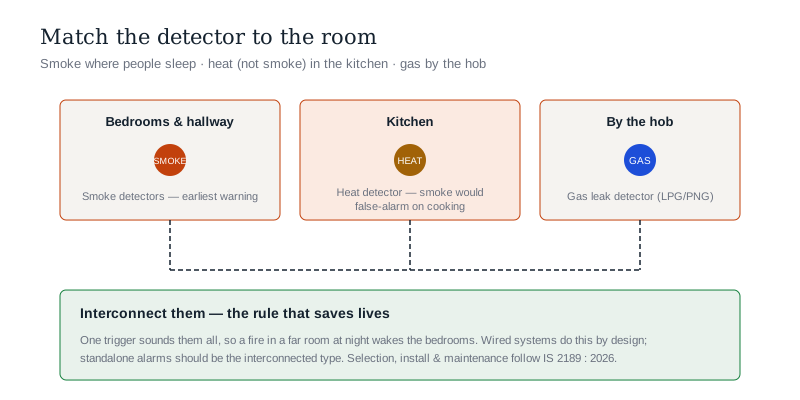
Different detectors sense different threats — matching the type to the room is the core skill:
- Smoke detectors — sense smoke particles; the primary life-safety detector for bedrooms, hallways and living areas. The earliest warning of a smouldering fire.
- Heat detectors — sense a rise in temperature; used where smoke detectors would false-alarm — crucially the kitchen (cooking smoke and steam would constantly trip a smoke detector).
- Gas detectors — sense a cooking-gas (LPG/PNG) leak; placed near the hob/cylinder (LPG being heavier than air, lower down). A different hazard from fire, but a common Indian addition.
The golden placement rule: smoke detectors in sleeping and living areas; a heat detector (not smoke) in the kitchen; a gas detector by the cooking point.
Standalone alarms vs a wired system
There are two broad approaches:
- Standalone (battery) alarms — self-contained smoke/heat alarms you mount on the ceiling; cheap, easy, no wiring, ideal as a first step or for an existing home. Best when interconnected (wirelessly) so all sound when one triggers — vital so a fire in one part wakes the whole house.
- A wired panel system — detectors wired back to a central fire alarm panel, with sounders and often monitoring; the more robust, expandable approach for larger homes/villas, planned as an ELV system with cabling to IS 2189 and typically fire-survival cable so the wiring keeps working in a fire.
For most homes, interconnected standalone alarms are a huge step up from nothing; larger or higher-risk homes benefit from a proper wired system.
Why interconnection matters
The single most important feature is that detectors alert the whole home, not just their own room:
- A fire starting in a far room at night must wake the bedrooms — so all alarms sounding together is what saves lives.
- Wired systems interconnect by design; standalone alarms should be the interconnected type (wireless-linked).
- Consider alarms with app/notification so you're alerted even when away.
The standard: IS 2189
Automatic fire detection and alarm systems in India are covered by IS 2189 — Selection, Installation and Maintenance of Automatic Fire Detection and Alarm System (Code of Practice) (current edition IS 2189 : 2026). It guides detector selection, placement, wiring and upkeep. For any wired system, design and install to IS 2189 via a qualified professional; even for standalone alarms, its placement principles are worth following.
Maintenance: a detector only works if it works
- Test alarms regularly (most have a test button) and after any long absence.
- Replace batteries on schedule (or use long-life/mains-backed types), and never remove a battery to stop a nuisance alarm — relocate or change the detector type instead.
- Keep detectors clean of dust and cobwebs, and replace at end of life (detectors age out).
- Include fire detection in your electrical maintenance routine.
The one-line answer
Fire and smoke detection is the one home system that exists to save lives, by warning early enough to get out. Match the detector to the room — smoke detectors in bedrooms, hallways and living areas; a heat detector (not smoke) in the kitchen to avoid cooking false-alarms; and a gas detector by the hob for LPG/PNG leaks. Choose interconnected standalone alarms (so one trigger sounds them all) as a big step up for any home, or a wired panel system to IS 2189 for larger or higher-risk homes, installed by a fire-safety professional with fire-survival cabling. Above all, interconnect so a fire anywhere wakes the whole house — and test and maintain the detectors, because one only protects you if it still works.
Where to go next
- The wider signal systems: Home Low-Voltage & ELV Systems Guide.
- The broader safety picture: Home Electrical Safety Guide.
- Cables that resist fire: Fire-Resistant Cables Guide.
- Keep it working: Home Electrical Maintenance Guide.
References
- IS 2189 : 2026, Selection, Installation and Maintenance of Automatic Fire Detection and Alarm System — Code of Practice, Bureau of Indian Standards.
- IS 732 : 2019, Code of Practice for Electrical Wiring Installations (ELV segregation), BIS.
- National Building Code of India, SP 7 (fire and life safety — verify current edition), BIS: https://www.bis.gov.in/
Fire detection is life-safety work; selection, installation and maintenance must follow IS 2189 and, for wired systems, be carried out by a qualified fire-safety professional. Verify any standard's status via the BIS catalogue before relying on it.
Export this guide
Related Guides — Deep-dive reading
Smoke Detectors in India (2026): Photoelectric vs Ionisation, Placement & Testing
The single most important fire-safety device every Indian home should own - how smoke detection works, which type to buy, exactly where to fit it, and how to keep it alive for a decade.
SecuritySmoke Detector vs Heat Detector in India (2026): Which Belongs Where
An honest, even-handed head-to-head for Indian homes: what a smoke detector and a heat detector each sense, why the smoke detector is the primary early-warning device, and where a heat detector belongs instead — kitchens, garages and dusty or steamy rooms — because a proper design uses both, chosen to the code and the space.
SecurityLPG Leak Detectors in India (2026): The Kitchen Gas Alarm Every Home Should Fit
Almost every Indian home cooks on LPG or PNG, and a leak pools invisibly until one spark ignites it. Here is the cheap kitchen gas alarm to fit, and the one placement rule that decides whether it works.
SecurityRelated Tools — Try Free
Fire Detector Selector
Smoke, heat, CO, gas or flame? Pick a space and its fuels and hazards and get the right detector type(s) to consider — with the one placement rule that matters most for each, including the LPG-low vs PNG-high gas rule.
Detector SelectorFull-Room BOQ — Living, Bedroom, Kitchen, Bath
Room-wise BOQ across living, bedrooms, kitchen, utility, and bathrooms with line-item pricing.
Full-Room BOQElectrical Safety & Load Audit
Home electrical audit — 10 categories, 65+ checkpoints across earthing, RCCB, MCB, wiring, switchboards, appliance circuits, DG/inverter backup.
Safety Audit