
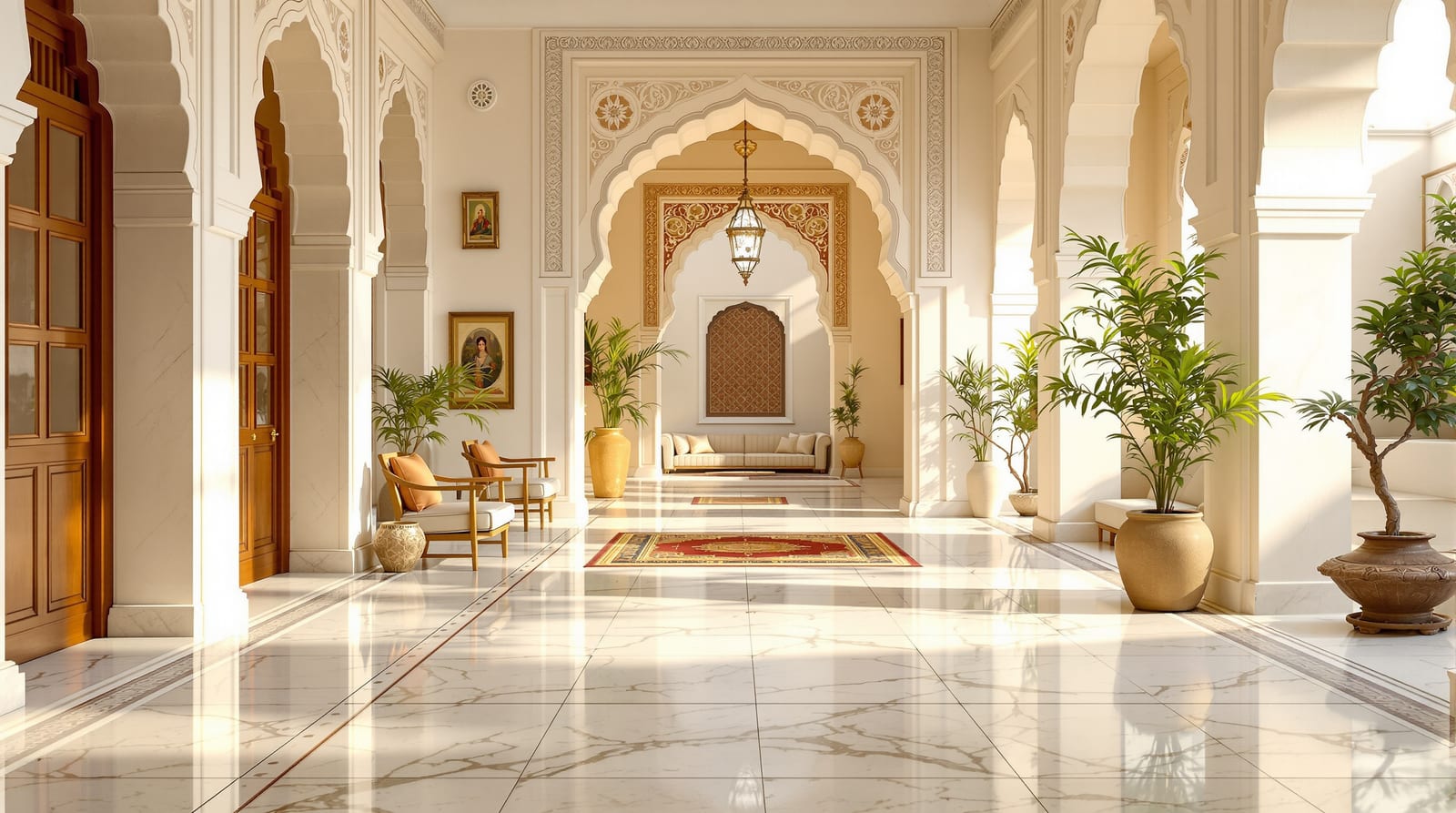
Flooring for Hot Climate in India: Cool-Underfoot Floors for Rajasthan, Delhi, Ahmedabad and Nagpur
How to use the floor itself to stay cool in hot-dry India — why marble and Kota stay cold underfoot, why light colours beat heat-trapping dark surfaces, why stone wins over wood and carpet here, and why expansion joints and dust control matter more.
In Jaipur, Bikaner or Ahmedabad, summer afternoons cross 45 degrees Celsius and the floor becomes one of the few surfaces in the house that can fight back. Walk barefoot across a marble or Kota stone floor at 2 pm and it still feels cool — that cold underfoot is not an accident, it is thermal mass at work. Choose the wrong floor in a hot-dry region and you do the opposite: you trap heat, glare and dust, and run the air conditioner harder than you needed to. This guide is about using the floor itself as a passive cooling tool for the dry-heat belt of India.
What "hot-dry" actually means for a floor
Hot-dry India — Rajasthan, most of Delhi-NCR, Gujarat around Ahmedabad and Rajkot, Vidarbha around Nagpur, and large parts of inland Madhya Pradesh and Telangana — has a specific climate signature that should drive flooring choices:
- Extreme daytime heat (often 42-48 degrees Celsius in May-June) with intense direct sun.
- Large day-to-night temperature swing — nights can drop 12-18 degrees below the day peak. Materials expand by day and contract by night, every single day.
- Very low humidity for most of the year, so moisture warping (the enemy in coastal homes) is barely a concern.
- Dust and fine sand, especially in the Thar belt and during loo winds and dust storms. Floors get gritty fast.
Unlike a coastal home, you are not fighting damp or salt. You are fighting heat, thermal movement and dust. That flips the usual flooring logic on its head: the cool, heavy, "old-fashioned" stone floor that feels wrong in a Shimla cottage is exactly right in a Jodhpur haveli.
The big idea: thermal mass keeps the floor cool
Dense stone — marble, granite, Kota — has high thermal mass. It absorbs heat slowly and releases it slowly. In a shaded interior, the floor sits close to the building's stable lower temperature rather than the blazing air temperature outside. Because it conducts heat away from your foot quickly, it also feels cooler than it actually is — the same reason a metal railing feels colder than a wooden one at the same temperature.
A lightweight, insulating floor (wood, laminate, vinyl, carpet) does the reverse. It does not conduct heat away from your skin, so it feels warm — wonderful in Manali, oppressive in Nagpur. Carpet is the worst offender in hot-dry homes: it insulates, traps dust and dust mites, and holds heat exactly when you want the opposite.
Cool-underfoot material guide for hot-dry homes
The table below ranks common Indian floors by how they behave in dry heat. "Coolness" is the combination of thermal mass and conductivity; "heat reflection" depends on the colour and finish you pick.
| Material | Cool underfoot? | Heat reflection (light = good) | Suits hot-dry India? | Indicative cost (₹/sq ft, +18% GST) |
|---|---|---|---|---|
| Marble (Indian — Makrana, Ambaji, Banswara) | Excellent — high mass, cold to touch | Very good in white/cream | Ideal — the classic Rajasthan choice | 80-350 |
| Kota stone (honed/polished) | Excellent — dense limestone, stays cool | Moderate (greenish-grey, mid-tone) | Ideal — cheap, tough, cool | 40-90 |
| Granite (light/grey) | Very good — dense, cool | Choose light greys, avoid black | Excellent, very durable | 80-250 |
| Double-charged / GVT vitrified (light) | Good — tile mass over slab | Good if light, matte, low-gloss | Fine — pick light shades, matte | 50-160 |
| Terrazzo / mosaic (light chips) | Very good — cement+stone mass | Good in pale aggregates | Excellent, traditional, cool | 60-150 |
| IPS / cement (light oxide) | Good — slab mass | Good if pale | Fine for budget/utility | 40-90 |
| Engineered / solid wood | Poor — insulating, feels warm | N/A | Avoid as main floor | 250-900 |
| Laminate / SPC / vinyl | Poor — insulating, feels warm | Often dark wood looks | Avoid in heat (bedrooms only at most) | 60-300 |
| Carpet / broadloom | Worst — insulates, traps dust+heat | N/A | Avoid | 40-300 |
The headline: stone and stone-like tile win in hot-dry India. Wood, vinyl and carpet — the warm, soft choices that make a hill home cosy — work against you here.
Why light colours matter more than you think
Colour is free thermal performance. A pale cream marble or a light-grey vitrified tile reflects far more of the radiant heat coming through windows than a dark charcoal or near-black floor, which absorbs it and re-radiates warmth into the room all evening. In a west-facing Ahmedabad living room with afternoon sun streaming across the floor, a dark glossy tile can become a heat panel; the same room in honed cream marble stays markedly more comfortable.
Two practical rules for the dry-heat belt:
- Go light. Whites, creams, pale greys, sandstone tones. They reflect heat and also hide the fine dust of the region better than glossy dark surfaces.
- Go matte or honed, not high-gloss. A mirror-gloss dark floor produces glare under the harsh local sun and shows every speck of dust. Honed marble, leather-finish granite and matte vitrified are easier to live with.
This is the floor-level version of the same logic that drives heat-reflective, high-SRI surfaces on terraces. If your roof terrace is in the picture, the companion guide on heat-reflective terrace flooring for India covers china-mosaic, cool-roof tiles and IPS over waterproofing.
Why stone beats wood and carpet here
In hot-dry regions the case against soft, insulating floors is strong on every count:
- Comfort: stone pulls heat from your feet and feels cool; wood and vinyl feel warm exactly when you do not want them to.
- Dust: the Thar and inland-plain dust load is heavy. Hard stone wipes clean; carpet becomes a dust and mite reservoir, and textured laminate seams collect grit.
- Durability under thermal swing: solid stone shrugs off the daily expand-contract cycle. Click-lock wood and laminate move more and can gap or creak.
- Longevity: a Kota or marble floor laid well lasts decades and can be re-polished; laminate cannot be refinished and ages faster in harsh dry heat and UV.
Wood is not banned — many Jaipur and Delhi homes use a warm wooden floor in a single bedroom for softness. But as the main living-area floor in a hot-dry house, dense stone or light vitrified is the smarter default. For the broader trade-off, see the comparison of wooden flooring versus tiles in India.
Expansion joints matter MORE in dry heat
This is the detail most homeowners and even some contractors skip — and it bites hardest in hot-dry India. Floors here see the largest daily and seasonal temperature swing in the country. Materials expand when the slab heats and contract at night. If there is nowhere for that movement to go, the floor pushes against itself and tents — tiles lift off the slab along a line, arch upward and sometimes pop with a loud crack. Large-format vitrified tiles are especially prone because each tile moves more.
Hot-dry essentials, beyond normal practice:
- Perimeter gap: leave an 8-10 mm gap all around the room, hidden under the skirting — never grout tiles tight to the wall.
- Intermediate movement joints: in big halls, every roughly 20-25 sq m or every 8-10 m run, with a flexible (not rigid cement) filler.
- Doorways and changes of plane: put a joint at every doorway and where floor meets a different material.
- Use flexible C2 adhesive for large-format tiles, and back-butter for full coverage so tiles do not go hollow and then crack under thermal stress.
- Do not lay on green concrete. Let the slab cure; a damp slab plus extreme heat causes problems later.
This is standard IS 15622 and tile-council practice, but in the dry-heat belt treat it as non-negotiable. The dedicated guide on floor expansion joints in India explains spacing, joint width and retrofitting in full, and the guide on flooring installation mistakes in India shows what tenting looks like when it goes wrong.
Dust control: a hot-dry-specific design choice
Fine wind-blown dust and sand are a daily fact in the Thar belt and dry plains. Flooring choices that quietly reduce dust hassle:
- Light, matte stone or tile hides dust between cleans far better than dark gloss.
- Minimise grout lines and textures — large rectified tiles or honed stone slabs with thin joints trap less grit than small mosaics or heavily textured surfaces.
- A robust entry zone: an anti-skid stone or matte tile at the threshold plus a coir mat catches grit before it spreads. (Anti-skid only where you also need wet grip; most dry-region floors are otherwise comfortably smooth.)
- Easy wet-mopping: vitrified and granite take a daily damp mop; marble needs a pH-neutral cleaner only — never acids or hard-water acid, which etch it.
For day-to-day routines by material, see the floor cleaning guide for India; for keeping marble cool and bright without etching it, see the marble polishing and care guide.
Putting it together: a hot-dry flooring plan
A typical comfortable, low-running-cost choice for a Jaipur, Delhi, Ahmedabad or Nagpur home:
- Living, dining, passages: light Indian marble (Makrana/Ambaji) or honed Kota — cool, dust-friendly, re-polishable.
- Budget alternative: light double-charged or GVT vitrified in a matte cream/grey, laid with C2 adhesive and proper expansion joints.
- Kitchen and utility: matte anti-skid vitrified — cool, tough, easy to clean.
- Bathrooms: anti-skid matte tile with slope to drain.
- One bedroom (optional): a warm wooden or SPC floor if someone prefers softness underfoot — purely a comfort exception, not the house default.
To pressure-test a choice against your exact city and room, the Studio Matrx flooring climate selector matches materials to your climate zone, and the broader companion guide how to choose flooring for Indian weather walks through the wider climate logic. For the specific materials above, see marble flooring in India, Indian marble flooring, Kota stone flooring in India and the thermal-comfort deep dive at flooring and thermal comfort in India.
Frequently asked questions
Which is the coolest flooring for an Indian summer?
Dense, light-coloured natural stone — Indian marble (Makrana, Ambaji) and Kota stone — is the coolest underfoot. Their thermal mass keeps them near the building's stable lower temperature and they conduct heat away from your feet, so they feel cold even on a 45-degree afternoon. Light granite and light matte vitrified are close behind. Wood, vinyl and carpet feel warm and should be avoided as the main floor.
Is marble really cooler than vitrified tiles?
In practice they are close, because both are dense and laid over the same cool slab. Marble has slightly higher mass and a colder touch, which many people in Rajasthan and Delhi prefer. Light matte vitrified is an excellent, lower-maintenance, lower-cost alternative — just avoid dark, high-gloss tiles, which absorb heat and show dust. See the detailed comparison in the marble-versus-vitrified guide.
Should I avoid dark-coloured floors in a hot climate?
Yes, generally. Dark floors absorb radiant heat from windows and re-radiate warmth into the room in the evening, and high-gloss dark surfaces also create glare and show every speck of the region's fine dust. Light creams, pale greys and sandstone tones in a matte or honed finish reflect more heat, stay cooler and hide dust better.
Why do my floor tiles arch up and pop in summer?
That is tenting — the floor expanding in the heat with nowhere to move, so tiles lift and crack along a line. It is more common in hot-dry India because of the large daily temperature swing, and worst with large vitrified tiles laid tight to the walls or with poor adhesive coverage. The fix is proper expansion joints: an 8-10 mm perimeter gap under the skirting and intermediate movement joints. See the floor expansion joints guide.
Can I use wooden flooring at all in Rajasthan or Delhi?
You can, but it works against you for cooling — wood insulates and feels warm, the opposite of what you want in dry heat, and it moves more under the local temperature swing. Many people use a wooden or SPC floor in just one bedroom for softness while keeping cool stone or light tile everywhere else. As the main floor in a hot-dry home, stone or light vitrified is the better choice.
Export this guide
Related Guides — Deep-dive reading
Flooring Thermal Comfort in India: How Your Floor Affects Heat, Cold and Energy Bills
The physics of why stone and tile feel cool while wood, cork and carpet feel warm, and how to match the floor to your climate zone so the surface under your feet works with the weather instead of against it.
Flooring & SurfacesComplete Home Flooring Guide for Indian Homes (2026)
The authoritative overview of every flooring family — tiles, stone, wood, vinyl and seamless — with India ₹/sq ft costs, room-by-room logic and laying basics.
Flooring & SurfacesMarble Flooring in India: Indian vs Italian, Types, Cost & Care (2026)
Marble is India's aspirational natural-stone floor — cool underfoot, luxuriously veined and re-polishable. Here is the homeowner's honest guide to Makrana and the popular Indian types, Indian vs Italian marble, ₹/sq ft costs, the staining and etching downsides, where to use it and how it is laid and polished.
Flooring & SurfacesRelated Tools — Try Free
Cross-Ventilation Analyzer
Estimate airflow and air changes per hour (ACH) from room size, window areas, layout, and local wind — with NBC 2016 Part 8 compliance check.
Ventilation CalculatorFlooring Cost Calculator
Estimate the all-in cost of a floor — material, laying, wastage, skirting and GST — by area and material.
Flooring CalculatorFull-Room BOQ — Living, Bedroom, Kitchen, Bath
Room-wise BOQ across living, bedrooms, kitchen, utility, and bathrooms with line-item pricing.
Full-Room BOQ