
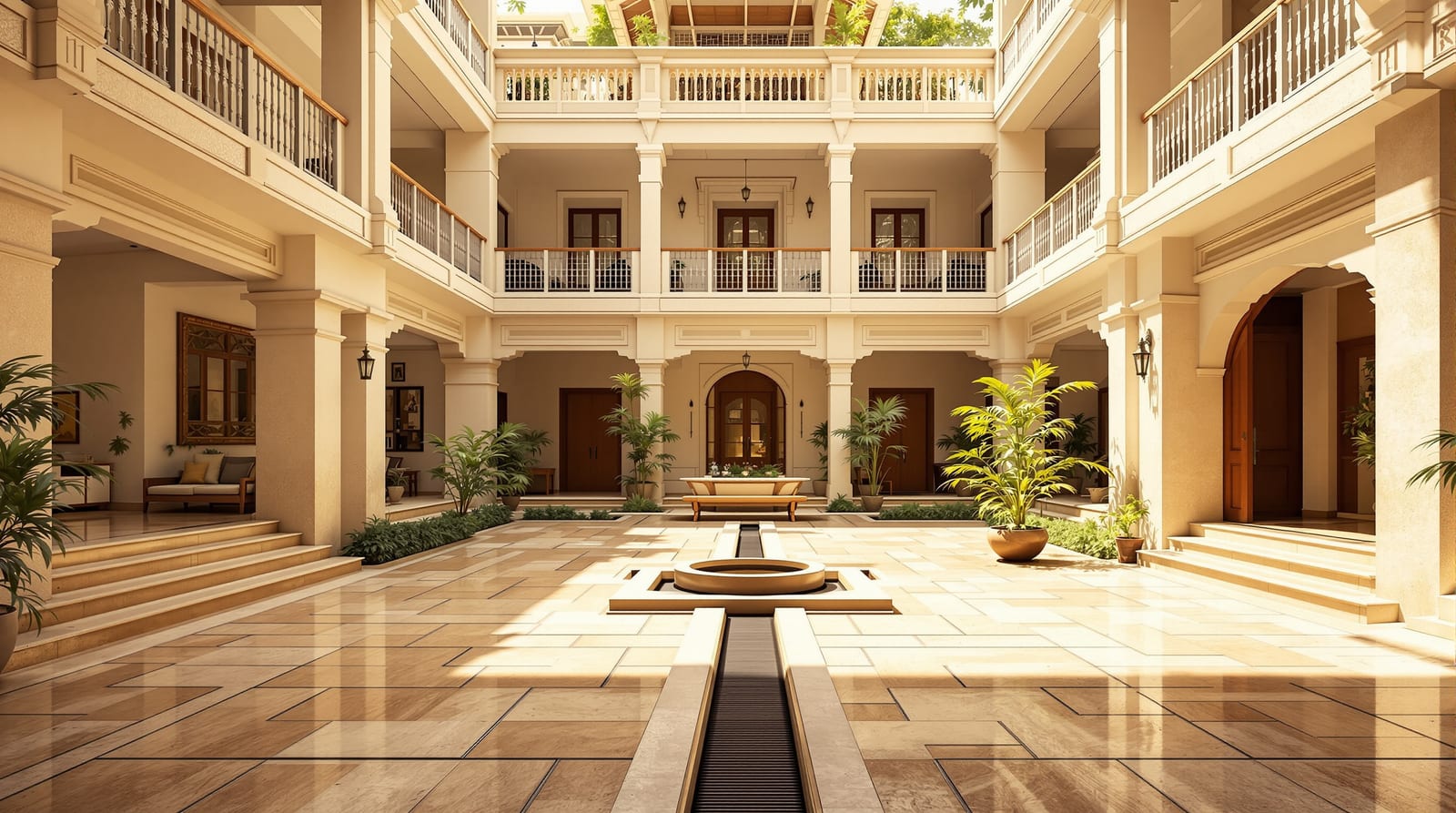
Courtyard Flooring in India: Cool, Anti-Slip Stone & Aangan Materials (2026)
How to floor an open-to-sky aangan or central courtyard so it stays cool underfoot, grips in the rain, drains to a central point and ages beautifully.
The courtyard, the aangan, the central court open to the sky, is the oldest and most beautiful idea in Indian housing: a pool of light and air at the heart of the home that pulls a draught through the rooms and gives the family a private patch of sky. But its floor lives a hard double life. For most of the year it bakes in direct sun; for three months it takes the full monsoon; and all year it must stay cool enough to walk barefoot, grip when wet, and drain every drop to a central point. This guide ranks the surfaces that have floored Indian courtyards for centuries, and the modern budget choices, and tells you what each costs per square foot.
What a courtyard floor really has to do
An open-to-sky court is neither a sealed indoor room nor a fully exposed terrace. It is the in-between, and its floor has to answer five demands at once.
- Cool underfoot. This is the whole point of an aangan. A heavy, dense, light-coloured stone floor acts as thermal mass, soaking up the night cool and staying pleasant under bare feet well into a hot day. This is why natural stone, IPS and terracotta beat dark tiles and any glossy surface that throws heat and glare back at you.
- Grip when wet, never polished. The court is rained on directly and washed often, so the finish must be textured and anti-skid. Aim for a honed, leathered, flamed or naturally matt surface in DIN 51130 R10-R11 territory, never a mirror polish. Our anti-slip flooring standards guide explains the R-ratings.
- Drainage to a central drain. Because rain falls straight into it, every courtyard floor must slope gently from all sides toward a central drain or channel (a fall of about 1 in 80 to 1 in 100), often with a decorative grating or a traditional sunken nahani. Standing water and a blocked central drain are the number-one cause of courtyard damp creeping into surrounding rooms. See monsoon-ready flooring.
- Weather and UV stability. Sun, rain and thermal cycling are brutal. Natural stone, fired terracotta, IPS and china-mosaic shrug it off and age gracefully; many printed or laminated surfaces fade, lift or craze when permanently exposed to sky.
- Low maintenance against leaves, dust and stains. An open court collects leaves, dust, bird droppings and rain splash. You want a forgiving, washable surface that hides grime and takes a daily swab without fuss.
A roofed atrium with a skylight is a gentler case (no direct rain, so you can lean a little more decorative), but for a true open-to-sky aangan, treat the floor as semi-outdoor and let drainage and grip lead every decision.
The top picks, ranked
1. Natural stone: kota, shahabad, tandur, kadappa, sandstone, granite
Natural stone is the classic, correct answer for an Indian courtyard and the one tradition has tested for generations. It is dense, cool underfoot, tough, weatherproof and it ages with grace, gathering a soft patina rather than wearing out.
- Kota stone (greenish-blue limestone) is the workhorse: cheap, hard, cool, easy to lay in large slabs with thin joints, and best left honed or leathered (not mirror-polished) for grip. See kota stone flooring.
- Shahabad stone (grey Karnataka limestone) is even more rustic and frost-cool, a traditional verandah-and-courtyard favourite with a naturally matt, grippy surface.
- Tandur and kadappa are dense limestones in grey and near-black, very durable and handsome in a contemporary court.
- Sandstone (Dholpur beige, Mandana red, Agra red, grey) gives warm, earthy colour, a naturally riven anti-skid surface and a perfect monsoon grip; it is arguably the prettiest courtyard stone. See sandstone flooring.
- Granite (flamed or leathered) is the hardest, most stain-proof and longest-lasting if you want a premium, near-indestructible court; keep it textured, never polished, in a rain-exposed yard.
Lay any of these with a slope to the central drain, and avoid high-gloss finishes in the open part of the court.
2. Terracotta, IPS and red-oxide: the traditional, earthy, cool floor
This family is the soul of the vernacular courtyard, cool, handmade and beautifully low-key.
- Terracotta (fired clay tiles, mangalore-tile bricks, kaviani) is breathable, naturally cool, gently anti-skid and gives that warm ochre glow that suits a traditional aangan and a planted court. Seal it to limit moss and staining in the wet zone.
- IPS (Indian Patent Stone) is a monolithic cement floor, often with a fine grit or a brushed/grooved finish, seamless and jointless so there is nothing for water to creep under, easy to slope to a central drain, and cheap. See IPS flooring.
- Red-oxide IPS gives the iconic glossy-yet-cool deep-red Kerala and South-Indian courtyard floor, cool underfoot and stunning, though its smoother finish wants care where it is rained on (keep a matt, non-slip version in the wet centre).
These earthy floors are the cheapest authentic route and the coolest to walk on, which is exactly why villages and old homes used them.
3. China-mosaic and pebble: decorative, cooling, splash-friendly
China-mosaic (broken white ceramic-tile pieces set in cement) is a traditional, very cheap, waterproof and highly reflective finish that keeps the floor and the rooms below it cool, which is why it is so common on terraces; in a courtyard it gives a bright, washable, splash-friendly surface that handles standing rain well. See china mosaic flooring. A border or feature panel of river pebbles set in concrete adds texture, drains freely and looks wonderful around a courtyard plant or water feature.
4. Patterned heritage tiles: Athangudi and cement tiles
For a courtyard that is a showpiece, handmade Athangudi tiles (the glass-moulded Chettinad cement tiles) and patterned cement/encaustic tiles bring colour, geometry and heritage. They are cool underfoot like all cement tiles and richly characterful. Reserve them for covered edges, verandahs around the court or a roofed atrium rather than the directly-rained centre, and always specify a matt, sealed finish for grip.
5. Anti-skid vitrified: the modern, low-budget, low-maintenance choice
If you want a sky-lit court that is cheap to lay and effortless to clean, a matt or structured anti-skid (R11) vitrified tile in a stone or concrete look is the pragmatic modern pick. It is non-absorbent, stain-resistant, frost-proof and wipes clean of leaves and dust in seconds. It is not as cool underfoot as real stone or IPS and lacks their patina, but it is the easy, durable, budget-friendly option. Use only matt, anti-skid tiles laid on a full, void-free bed with a slope to the drain, never glossy. See vitrified tile flooring and anti-skid floor treatment.
Comparison: material vs grip, cool, look, cost
The table ranks the realistic courtyard choices. Cost is indicative installed 2026 rupees per square foot and varies with city, finish and base prep.
| Material | Cool underfoot | Wet grip (open court) | Look / character | Maintenance | Cost (₹/sq ft) |
|---|---|---|---|---|---|
| Kota / shahabad / tandur stone | Excellent | High (honed/leathered) | Classic, timeless | Low (reseal occasionally) | 60-150 |
| Sandstone (riven) | Excellent | Very high (natural texture) | Warm, earthy, premium | Low-medium | 90-220 |
| Granite (flamed/leathered) | Very good | High | Premium, near-indestructible | Very low | 130-350 |
| Terracotta | Excellent | Medium-high | Traditional, warm ochre | Medium (seal, watch moss) | 60-150 |
| IPS / red-oxide | Excellent | Medium (matt/brushed) | Seamless, vernacular | Low (jointless) | 90-220 |
| China-mosaic | Good (reflective) | Medium-high | Bright, decorative, splash-proof | Low | 90-180 |
| Athangudi / cement tiles | Excellent | Medium (matt, sealed) | Heritage showpiece | Medium | 90-250 |
| Anti-skid vitrified (R11) | Medium | High (matt/structured) | Modern, many looks | Very low (wipe clean) | 80-220 |
For the wider outdoor picture and the adjoining surfaces, our terrace flooring guide and porch flooring guide cover the spaces that usually meet a courtyard.
How a courtyard floor drains: slope to the centre
The single thing that makes or breaks an open court is drainage. Unlike a room that sheds water to an outside edge, a courtyard takes rain in the middle and must throw it to a central drain. The diagram shows the principle.
Slope the finished floor a clear 1 in 80 to 1 in 100 from every edge toward the central drain, size the drain and downpipe generously for monsoon cloudbursts, and waterproof the slab and turn the membrane up the surrounding walls so courtyard water never tracks into the rooms. A leaf-catching grating over the drain saves you a yearly blockage.
Open aangan vs roofed atrium: choose differently
- Open-to-sky aangan: treat as semi-outdoor. Lead with anti-slip, weatherproof, draining surfaces: honed kota or shahabad, riven sandstone, flamed granite, IPS, china-mosaic or matt anti-skid vitrified, all sloped to the central drain. Reserve glossy stone, red-oxide gloss and decorative tiles for the covered edges.
- Covered verandah around the court: here you can be decorative, Athangudi tiles, patterned cement tiles, polished kota, terracotta, since rain does not fall directly.
- Roofed atrium with skylight: no direct rain, so almost any cool floor works, marble or polished stone for a grand atrium, heritage tiles, terrazzo. Keep a matt finish under the skylight where condensation or a leak could wet the floor.
Do and don't
- Do slope the whole court to a central drain and size the drain for a monsoon downpour; a blocked or undersized drain floods the surrounding rooms.
- Do choose honed, leathered, flamed, riven or matt anti-skid finishes; the open court is rained on and washed daily.
- Do waterproof the slab and turn the membrane up the walls before laying any courtyard floor.
- Do favour light, dense, cool materials, stone, IPS, terracotta, so the aangan does its cooling job.
- Don't lay mirror-polished stone or glossy vitrified in the rained-on centre; it is dangerously slippery wet.
- Don't use fade-prone printed or laminated surfaces, or moisture-sensitive wood/laminate, in a directly-exposed court.
- Don't forget a leaf grating and a yearly drain clean before the monsoon.
Care and upkeep
A courtyard floor is easy to live with: sweep leaves and dust, swab with plain water or a mild floor cleaner, and clear the central drain grating regularly, especially before the monsoon. Seal porous stone, terracotta and IPS every year or two for stain and moss resistance, and scrub off any moss in damp corners promptly so it does not become a slip risk. See our floor cleaning guide and floor resealing guide. After a few monsoons, check that the slope to the drain is still true and that no joint has opened up to let water under the surface.
Frequently asked questions
What is the best flooring for an open courtyard in India?
Natural stone is the classic best answer: honed kota or shahabad, riven sandstone, or flamed granite, all cool underfoot, anti-skid when textured, weatherproof and ageing beautifully. For a traditional, earthy look choose terracotta or IPS; for an easy, low-budget court, a matt anti-skid (R11) vitrified tile. Always keep the finish textured, never polished, and slope it to a central drain.
Why does my courtyard need a central drain?
Because an open-to-sky court takes rain straight into its middle rather than at an outside edge. The whole floor must slope (about 1 in 80 to 1 in 100) from every side toward a central drain or nahani, sized for monsoon downpours, so water never stands and never tracks into the surrounding rooms.
What is the cheapest cool flooring for an aangan?
IPS (Indian Patent Stone) and terracotta are the cheapest authentic, cool-underfoot courtyard floors, jointless and earthy. China-mosaic is also very cheap and bright. Kota stone is the most affordable natural stone. See the IPS flooring guide and kota stone flooring guide.
Can I use marble or polished stone in a courtyard?
Only under cover, in a roofed atrium or a verandah edge that is not directly rained on. In the open part of the court, polished marble and glossy stone are dangerously slippery when wet and can etch and stain. Keep the rained-on centre to honed, leathered, flamed or naturally matt finishes.
How much does courtyard flooring cost per sq ft in India?
Indicatively in 2026: kota/shahabad/tandur ₹60-150, sandstone ₹90-220, flamed granite ₹130-350, terracotta ₹60-150, IPS/red-oxide ₹90-220, china-mosaic ₹90-180, Athangudi/cement tiles ₹90-250 and anti-skid vitrified ₹80-220 per sq ft installed. Base prep, waterproofing, finish and city rates shift these figures, so verify local quotes.
Export this guide
Related Guides — Deep-dive reading
Terrace Flooring in India: Best Heat-Reflective, Waterproof Rooftop Options (2026)
An Indian terrace takes full sun, heavy monsoon and daily thermal expansion, so the floor is the second line of defence over a sound waterproofing layer and slope: cool-roof china mosaic, heat-reflective and anti-skid vitrified pavers, Kota and Tandur, deck and WPC tiles, pedestal pavers and artificial grass, with ₹/sq ft, expansion joints and the waterproofing-first rule.
Flooring & SurfacesPorch Flooring in India: Anti-Slip, Stone & Heritage Sit-Out Materials (2026)
How to choose porch, verandah and sit-out flooring that grips in the monsoon, shrugs off sun and grit, cleans in minutes and welcomes every guest.
Flooring & SurfacesAnti Slip Flooring for Bathroom and Wet Areas in India: R-Ratings, Finishes and Genuinely Safe Tile Choices
How to choose genuinely safe flooring for bathrooms, kitchens, balconies, pools, entrances and elderly- or child-friendly homes — the R-rating system, finishes that grip wet feet, anti-skid natural stone, slope to drains and the tiles to avoid.
Flooring & SurfacesRelated Tools — Try Free
Flooring Cost Calculator
Estimate the all-in cost of a floor — material, laying, wastage, skirting and GST — by area and material.
Flooring CalculatorMonsoon-Readiness Checklist
Pre-rain home audit across 9 categories — terrace, drains, waterproofing, electrical, HVAC, pest, vehicles, documents.
Seasonal AuditMaterial Compare — Side by Side
Compare materials side-by-side: granite vs quartz vs marble, laminate vs acrylic vs PU, and more.
Comparison