
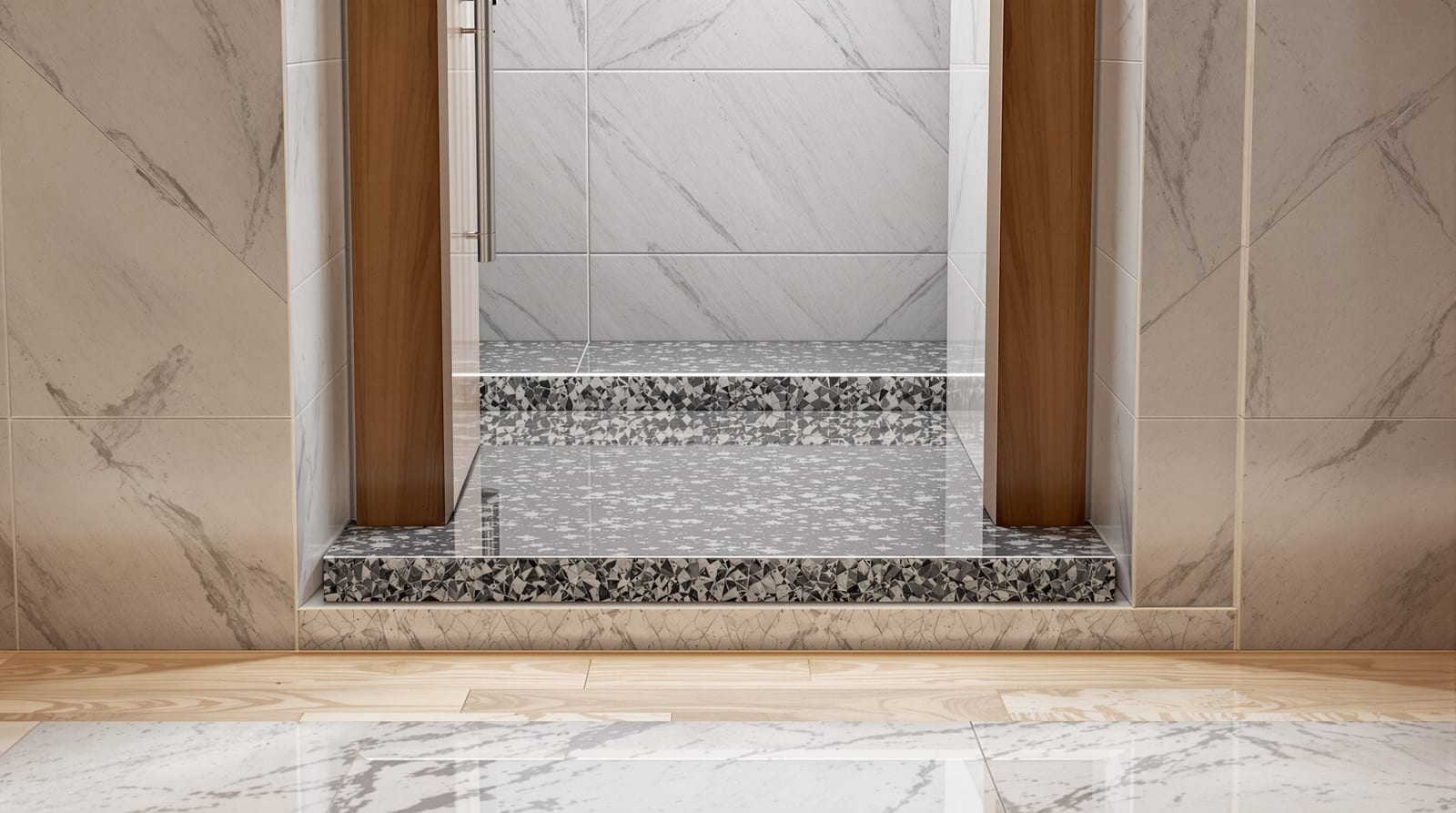
Waterproofing Door Thresholds in India (India 2026)
Stopping water tracking under bathroom and external door frames with a raised kerb, granite saddle and a membrane that turns up into the threshold.
The one place a beautifully finished door fails fastest in India is at the floor. A bathroom leaks a thin film of water at every shower, the monsoon drives rain at an external sill, and within a season the frame foot is black, the architrave is swelling, and there is a damp patch on the wall outside. Waterproofing door thresholds is the detail that prevents all of it: a raised kerb or saddle, a slope that sheds water away from the opening, and — the part most sites skip — the bathroom waterproofing membrane physically turned up and bonded into the threshold so water can never track underneath the frame. This guide is the wet-detail layer: how to build a threshold that stays dry at a bathroom and an external door, what to bed a granite saddle in, and why the frame material you choose at floor level matters as much as the seal.
Why water tracks under a door frame
Water does not respect a closed door. At a bathroom, surface water runs to the lowest point of the floor, finds the gap under the leaf, and capillaries sideways under the frame's sill or jamb foot into the dry room beyond. At an external door, wind-driven monsoon rain is pushed up and under the threshold, and any pooling against the sill wicks into the wall. Three failure paths matter:
- Over the threshold — no kerb or saddle, so the water level simply rises past the door line. The cure is a raised lip.
- Under the threshold — the saddle or sill sits on top of the screed, and the screed wicks water sideways below it. The cure is a continuous membrane turned up behind and under the saddle.
- Up the frame foot — the jamb stands on a wet floor with no damp barrier. The cure is a DPC/stone base block and a water-immune frame material.
A good threshold closes all three at once. Miss any one and the detail leaks.
The wet-area threshold: kerb, membrane, saddle
For a bathroom, the principle is to keep the wet side higher and sealed and let nothing pass below the door line. The sequence, in order, is what makes it work — a saddle bedded last over a membrane that was laid first.
| Step | Action | Why it matters |
|---|---|---|
| 1 | Build a low kerb / raised lip (or set the bathroom floor finish lower) at the door line | Holds surface water on the wet side |
| 2 | Apply the waterproofing membrane across the floor and turn it up the kerb and into the door reveal | The continuous barrier; this is what stops sideways tracking |
| 3 | Lap the membrane under and behind where the saddle will sit | Water hitting the saddle joint meets membrane, not bare screed |
| 4 | Bed a granite/stone saddle in a full bed of sealant / waterproof adhesive | No gap under the saddle for water to creep |
| 5 | Slope the wet-side surface gently toward the floor drain, away from the door | Water is led to the trap, not the threshold |
| 6 | Gun silicone along the saddle-to-floor and saddle-to-frame joints | Seals the last hairline gaps |
The critical move is step 2-3: the bathroom waterproofing membrane — whether a liquid-applied acrylic/polyurethane coat, a cementitious crystalline slurry, or an APP/SBS sheet — must not stop at the door line. It carries up the kerb and laps under the saddle so that any water reaching the threshold meets a bonded barrier and is turned back. A saddle simply laid on the tile or screed, with the membrane stopping short, leaves a wicking path the width of the door that no amount of surface silicone can close for long.
The external threshold: slope, drip groove, weather bar
An external sill has a different job — it must shed driven rain to the outside and never let it pool against the door. The classic Indian detail is a granite or stone sill built to slope outward, with the leaf protected by a weather bar.
| Element | Purpose | Practical spec |
|---|---|---|
| Outward slope on the sill | Sheds water away from the leaf | Gentle fall (a few mm across the sill width) toward outside |
| Throating / drip groove under the sill nose | Breaks the capillary path so water drips clear of the wall | Continuous groove cut on the underside, set back from the face |
| Weather bar at the leaf base | Diverts water that reaches the door foot | Aluminium/stainless bar bedded in sealant on the outside |
| Threshold strip + seal | Closes the gap under the leaf | Aluminium strip with rubber/brush insert |
| Granite/stone sill | Durable, non-rotting wearing surface | Bedded in mortar with the slope built in |
The drip groove (throating) is the detail that separates a sill that stays dry from one that streaks the wall below. Without it, water clings to the underside of the sill nose by surface tension and runs back to the wall face; the groove forces it to drip free. Pair the sloped sill with a weather bar at the base of the leaf so wind-driven rain that reaches the threshold is diverted, and a threshold strip with a rubber or brush seal to close the undercut. Never finish an external sill dead level or, worse, sloping inward — that is a guaranteed monsoon leak.
Accessibility vs waterproofing: the flush-threshold dilemma
A raised kerb sheds water but trips people and blocks wheelchairs. The RPwD Act 2016 and the Harmonised Guidelines 2021 call for accessible thresholds — generally ≤12-13mm, bevelled if over about 6mm, and preferably flush. The two goals genuinely conflict at an external or accessible-bathroom door, and the resolution is drainage, not a tall kerb:
- Keep the threshold low and bevelled, within the accessibility limit.
- Add a slotted drainage channel immediately outside the door to intercept water before it reaches the flush line.
- Slope the external surface firmly to that channel so nothing pools at the door.
- Use a high-quality threshold seal/brush under the leaf to close the residual gap.
This lets a wheelchair roll over a near-flush sill while a drain — not a step — does the waterproofing. It is more work than a kerb, so it is reserved for accessible and main entrances; an ordinary bathroom can use a modest raised saddle. Read more in zero-threshold doors.
Frame material at floor level
None of this survives if the frame foot rots. In any wet zone, do not stand untreated timber on the floor. The Indian realities are termite and rising damp, and both attack a timber jamb at ground contact first.
- WPC frame — wood-plastic composite is termite- and water-proof, the default for bathroom doors; it does not swell or rot at the foot.
- PVC / uPVC frame — fully water-immune, common for bathroom and utility doors.
- RCC / precast cement frame — fire-, termite- and water-proof, cheap, good for wet areas though brittle and hard to re-screw.
- Aluminium frame — for glass/aluminium shower and external doors; corrosion-resistant.
- Timber — if used at an external door, sit it on a DPC and a stone/RCC base block, never directly on a wet floor, and anti-termite treat the foot.
The frame foot must always sit on a damp-proof course, and the wet-area junctions sealed with silicone, not acrylic caulk, which fails when wet. For the broader damp story see door frame damp proofing.
Tying the detail together
Waterproofing a threshold is three things done in the right order: hold the water back with a kerb or sloped saddle, turn the membrane up so nothing tracks underneath, and choose a frame that cannot rot at the foot. The membrane integration is the part that is invisible once tiled, which is exactly why it gets skipped — and why so many bathroom doorways leak into the next room within a year. For the wider threshold picture see the door thresholds guide and door sill design; for the different formats see threshold types, for the leaf-base detail door weather bar, and for fitting the stone door saddle installation. The frame layer starts at door frames and the whole topic at the complete door guide. Pick the right format with the door threshold selector and check accessibility with the zero-threshold feasibility checker.
Frequently asked questions
How do I stop water tracking under my bathroom door frame?
The surface seal alone never holds. The waterproofing membrane must be turned up the kerb and lapped under the saddle so any water reaching the threshold meets a bonded barrier, not bare screed. Bed a granite saddle in a full bed of sealant, slope the wet floor to the drain, and use a WPC, PVC or RCC frame rather than untreated timber.
What should I bed a granite door saddle in?
A full bed of waterproof adhesive or sealant — never a partial blob — so there is no void under the saddle for water to creep through. Gun silicone along the saddle-to-floor and saddle-to-frame joints afterwards. In a wet area always use silicone, not acrylic caulk, which fails once wet.
What is a drip groove and do I need one on an external sill?
A throating or drip groove is a continuous channel cut into the underside of the sill nose, set back from the face. It breaks the capillary path so rainwater drips clear instead of running back to the wall. Yes — any external sill needs one, paired with an outward slope and a weather bar at the leaf base.
Can a wheelchair-accessible door still be waterproof?
Yes, but the kerb does the waterproofing differently. Keep the threshold flush or under about 12mm and bevelled, then add a slotted drainage channel just outside the door and slope the surface firmly to it. A drain, not a step, intercepts the water, so the sill stays both accessible and dry.
Which door frame should I use in a bathroom?
WPC is the usual default — termite- and water-proof, no swelling at the foot. PVC/uPVC and RCC frames are also fully water-immune. Avoid untreated timber on a wet floor; if timber is unavoidable at an external door, stand it on a DPC and stone base block and anti-termite treat the foot.
Export this guide
Related Guides — Deep-dive reading
Zero Threshold Doors in India: Level Access (India 2026)
How to detail a flush, step-free door threshold for wheelchairs and ageing-in-place while still keeping monsoon water out.
Home Doors & EntrancesDoor Saddle Installation: Threshold Fitting (India 2026)
How to fit a granite or aluminium saddle threshold on mortar or adhesive, level it true, and seal it against monsoon water ingress.
Home Doors & EntrancesDoor Threshold Standards for Indian Homes: Sill, Weather Bar & Accessibility (2026)
What the strip under your door actually does - water, dust, draft and insect barrier, level transition and trip-safe accessibility - with the right material, the 12 mm accessibility limit, weather-bar and drip-groove detailing for external doors, and the wet-bathroom threshold.
Home Doors & EntrancesRelated Tools — Try Free
Bathroom Sealant Calculator
How many tubes of silicone sealant a bathroom needs and the cost — by joints to seal, lengths and bead size, with an anti-fungal note.
Bathroom CalculatorMonsoon-Readiness Checklist
Pre-rain home audit across 9 categories — terrace, drains, waterproofing, electrical, HVAC, pest, vehicles, documents.
Seasonal AuditBathroom Waterproofing Calculator
Work out waterproofing material (kg/L) and cost for a bathroom by area, wall band, system type and coats — cementitious, acrylic, PU or SBR.
Bathroom Calculator