
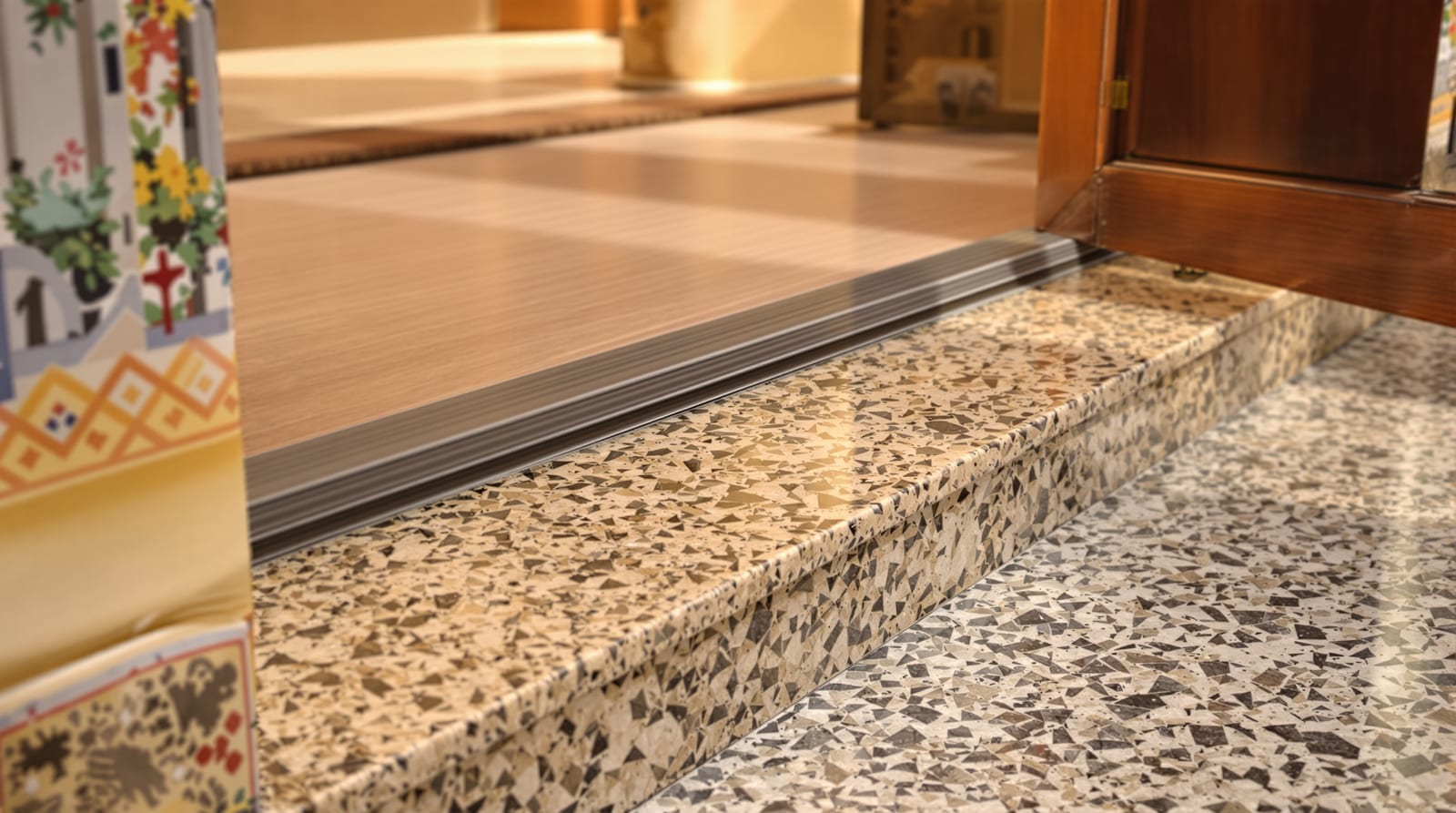
Door Threshold Standards for Indian Homes: Sill, Weather Bar & Accessibility (2026)
What the strip under your door actually does - water, dust, draft and insect barrier, level transition and trip-safe accessibility - with the right material, the 12 mm accessibility limit, weather-bar and drip-groove detailing for external doors, and the wet-bathroom threshold.
The threshold is the most overlooked 50 mm in your whole house. It is the strip you step over at every doorway, and when it is detailed well you never think about it; when it is detailed badly, monsoon water creeps under the main door, dust films the floor every morning, the air-conditioned bedroom leaks cool air all night, and an elderly relative catches a toe on a raised sill. This guide sets out what a door threshold is actually for, the materials Indian homes use, the height limits that keep it safe for wheelchairs and ageing knees, and the weather-bar and drip-groove detailing that keeps rain on the outside where it belongs.
A threshold (the carpenter's "sill", the older Indian term dehleez or chaukhat ki dehri) is simply the horizontal member or strip at the bottom of a doorway. It does five jobs at once, and the trouble is that the best detail for one job often fights another - a high sill keeps water out but trips people; a flush floor is easy to cross but lets water and draft straight in. Getting it right is about choosing the lightest detail that still does the job your specific door needs.
What the threshold is actually for
Before you pick a height or a material, be clear on which of these five jobs your door has to do. An internal bedroom door needs almost none of them; a west-facing main door in coastal Kerala needs all five.
- Water barrier. During the monsoon, wind drives rain horizontally against external doors. Without a raised sill or a sealed bottom, water sheets under the leaf and pools on the floor inside - the single most common threshold failure in Indian homes.
- Dust and insect barrier. The gap under an unsealed door is a 10-15 mm slot the full width of the opening. Street dust, fine soil, mosquitoes and even small reptiles use it. A sealed threshold or door-bottom seal closes it.
- Draft and energy barrier. That same slot is where conditioned air escapes and hot outside air enters. For an AC bedroom or a centrally cooled flat, sealing the threshold is a real comfort and electricity saving.
- Level transition. Floors on either side of a door are often at different levels - a sunken bathroom, a step down to a balcony, an entrance landing. The threshold manages that change cleanly.
- A clean, trip-safe edge. Two different floor finishes (vitrified tile to wooden flooring, marble to bathroom anti-skid) need a defined joint. The threshold is that joint - and it must not become a trip hazard.
Threshold types by use, material and height
The right threshold is a match between the door's job and the lowest safe height. This table maps the common situations in an Indian home.
| Threshold type | Typical use | Usual material | Height above floor | Notes |
|---|---|---|---|---|
| Flush / no sill | Internal bedroom, living-room doors | Floor finish continues; brush seal on leaf | 0 mm (flush) | Easiest to cross; add a door-bottom brush seal for dust/draft |
| Low stone sill | Main door, external doors | Granite, kadappa, marble | 10-12 mm bevelled | Accessibility-safe; pair with weather bar |
| Aluminium threshold strip | External & AC-room doors | Anodised aluminium + rubber insert | 8-15 mm | Sold ready-made; compresses against a door-bottom seal |
| Rubber / drop-down seal | Retrofit on existing doors | Aluminium carrier + rubber/silicone | 0-3 mm gap closed | Automatic drop seal lifts when door opens |
| Wet-area (bathroom) sill | Bathroom doorway | Granite kerb, sloped to wet side | 15-25 mm to wet side | Holds shower water in; chamfer the dry-side edge |
| Raised security/weather sill | Coastal, flood-prone, exposed entries | Granite + weather bar | up to 20-25 mm | Trade-off: more weatherproofing, more trip risk - bevel it |
Heights are indicative and vary by city, vendor and floor build-up - confirm against your actual floor levels on site.
The 12 mm rule: thresholds and accessibility
This is the number to remember. Under the RPwD Harmonised Guidelines 2021 and barrier-free practice referenced in NBC 2016 Part 3, a threshold should not rise more than about 12 mm above the finished floor, and anything above roughly 6 mm should be bevelled (chamfered) rather than left as a square step, so a wheelchair caster or a walking-frame foot rides over it instead of jamming against it. A square 20 mm sill stops a wheelchair dead and is exactly the lip an elderly parent's slipper catches.
For homes built for ageing-in-place or wheelchair use, the target is a near-flush threshold under 12 mm with a gentle bevel both sides, combined with a door-bottom seal to recover the weather performance you lose by going low. This is the threshold half of the accessible-door picture - the clear-width and hardware half is covered in the wheelchair-accessible doors guide, and the room-by-room width numbers in door width standards. A high sill is the most common and most avoidable reason a "wide" door is still not genuinely accessible.
Weather bar and drip groove: keeping monsoon water out
A low, accessibility-friendly sill cannot, on its own, stop wind-driven monsoon rain - so external doors recover their weather performance with two small details rather than a big step.
- Weather bar (water bar / rain deflector.) A small projecting strip - usually anodised aluminium - fixed to the bottom outer face or underside of the door leaf, or a matching upstand on the sill. Rain running down the door is shed forward onto the sill instead of being drawn under the leaf by capillary action. On factory external doors it is often an aluminium section with a rubber lip that wipes the sill as the door closes.
- Drip groove (throat / drip mould.) A small continuous notch cut into the underside of the sill's outer nose (and often under projecting window sills and chajjas too). Water running along the underside reaches the groove, forms a drip and falls clear, instead of tracking back along the soffit toward the wall and inside. It costs almost nothing when the granite is cut but is impossible to add neatly later.
Together these let you keep the sill low for accessibility and still stay dry. For the whole external-door weather strategy - bottom seals, gaskets, brush seals and gasketed frames - read the dedicated door seals and weatherstripping guide; the threshold is the floor-level piece of that same system. Energy-conscious owners should also see energy-efficient doors, since the under-door gap is a major air-leak path.
Threshold materials: what to use where
| Material | Where it suits | Indicative cost | Strengths | Watch-outs |
|---|---|---|---|---|
| Granite | Main door, external, wet areas | ~Rs 80-250 / running ft (material) | Very hard, waterproof, takes a bevel and drip groove, lifelong | Heavier; cut groove and bevel at the fabricator |
| Kadappa / black limestone | Budget external & bathroom sills | ~Rs 40-100 / running ft | Cheap, waterproof, common | Plainer look; can chip at sharp arrises |
| Marble | Internal / showpiece entries | ~Rs 100-300+ / running ft | Premium look, matches flooring | Softer, stains, etches with acid cleaners - not ideal at busy wet thresholds |
| Hardwood (teak/sal) | Traditional / heritage doors | Varies with door | Warm, matches timber frame | Needs sealing; swells in monsoon, termite risk - keep off wet floors |
| Anodised aluminium strip | AC rooms, retrofit, modern flats | ~Rs 150-600 each | Ready-made, slim, rubber insert seals | Can feel utilitarian; fix screws into solid floor |
| Rubber / silicone seal | Retrofit gap-closer on any door | ~Rs 150-600 per door | Closes draft and dust cheaply; drop-seal types auto-lift | Wears; replace every few years |
Costs are material-only and indicative, vary by city and vendor, and exclude fitting labour and 18% GST. Granite is the default for an Indian main door for good reason: it is effectively permanent, shrugs off monsoon water and street grit, and a fabricator can cut both the bevel and the drip groove in one go. Use the door cost calculator to fold the sill into your door budget, and how to measure a door to get the sill length and floor levels right before you order stone.
The bathroom (wet-area) threshold
The bathroom threshold is a special case because its job is reversed - it has to keep water in. A floor that slopes to the drain still throws shower spray toward the door, so a small granite kerb of about 15-25 mm, set higher on the wet side and chamfered down on the dry side, holds water inside the wet zone while staying easy to step over. The dry-side chamfer is what keeps it from becoming a trip edge in a half-asleep night visit. Seal the joint between kerb and floor with a good silicone, and keep the timber of a wooden bathroom door clear of standing water - this is exactly where swelling and rot start. The wider waterproofing and ventilation picture for that doorway is in the bathroom door guide.
For a level, no-kerb "walk-in" wet room (increasingly popular and very accessible), the water is instead held back by a strong floor fall to a linear drain plus a shower screen - a more demanding waterproofing detail, but it removes the kerb entirely for wheelchair and elderly use.
The dehleez: tradition meets the practical sill
In many Indian homes the threshold is far more than a strip of stone. The dehleez is a charged spatial line - the boundary between the street and the sanctuary of the home. Custom holds that one should not sit on the threshold, that brides step over it on entering their new home, that the Lakshmi of the household rests there, and a daily rangoli or kolam is often drawn just inside it to welcome prosperity. The toran (the decorative door hanging strung across the top of the frame) and the threshold together mark the doorway as a threshold in the deeper sense. In Vastu terms the entrance threshold is treated as auspicious and is sometimes raised slightly and marked with a swastik or kalash motif.
There is quiet practicality inside the tradition: a defined, slightly raised, well-kept threshold does keep dust and water out and gives the doorway dignity - which is the same thing this guide argues on engineering grounds. We will not duplicate the ritual and direction detail here; for the belief framework and remedies see the entrance Vastu guide and the threshold-and-toran customs in toran and threshold Vastu. The aim of this guide is simply to make sure that whatever tradition you follow, the physical sill is sized so it is safe to cross and genuinely keeps the weather out.
Frequently asked questions
How high should a door threshold be?
For internal doors, flush (0 mm) with a door-bottom seal is ideal. For external and main doors, keep the sill under about 12 mm and bevel it so it stays wheelchair- and trip-safe, then add a weather bar and door-bottom seal to keep monsoon water out. Bathroom kerbs run a little higher (15-25 mm) but should be chamfered on the dry side.
What is the best material for a main-door threshold in India?
Granite, in most homes. It is waterproof, extremely hard, lasts the life of the house, and a fabricator can cut the accessibility bevel and the drip groove for you. Kadappa is the budget alternative; aluminium strips suit modern flats and retrofits; keep wood off wet or exposed thresholds because it swells and rots.
What is a drip groove and do I really need one?
A drip groove is a small notch cut under the outer nose of an external sill (and projecting window sills and chajjas). It breaks the film of water running along the underside so it drips clear instead of creeping back toward the wall and inside. It is nearly free to cut when the stone is made and impossible to add neatly later, so yes - specify it for any external sill.
My main door lets water in during the monsoon. What is the cheapest fix?
Usually a combination, not one thing: add a door-bottom seal or drop-down threshold seal (around Rs 150-600) to close the gap under the leaf, fit a weather bar to shed water forward, and check that the external ground slopes away from the door. If the sill itself is missing a drip groove or sits below the outside ground, you may need to reset the stone - see the door seals and weatherstripping guide for the full menu.
Can a threshold be completely flat for wheelchair access and still keep water out?
Yes, but the weatherproofing has to move from the sill to the leaf and floor. Use a near-flush bevelled threshold under 12 mm with an automatic drop-down door-bottom seal, plus a weather bar and good external floor falls; for full wet rooms, a strong floor slope to a linear drain and a screen replace the kerb. It is a more careful detail but fully achievable - the wheelchair-accessible doors guide covers the matching width and hardware.
Export this guide
Related Guides — Deep-dive reading
Zero Threshold Doors in India: Level Access (India 2026)
How to detail a flush, step-free door threshold for wheelchairs and ageing-in-place while still keeping monsoon water out.
Home Doors & EntrancesUniversal Design Doors for Indian Homes: Inclusive Doors That Work for Everyone (2026)
How to design and specify doors that serve children, the elderly, pregnant women, the injured and wheelchair users by default - generous width, lever handles, near-flush thresholds, low-force closing, contrast and good lighting - without your home ever looking medical.
Home Doors & EntrancesWheelchair Accessible Doors for Indian Homes: Clear Width, Thresholds & Hardware (2026)
The exact specs that make a door usable from a wheelchair - clear opening width, near-flush threshold, lever hardware, approach clearance and low-force or auto operation, mapped to the RPwD Harmonised Guidelines 2021.
Home Doors & EntrancesRelated Tools — Try Free
Cross-Ventilation Analyzer
Estimate airflow and air changes per hour (ACH) from room size, window areas, layout, and local wind — with NBC 2016 Part 8 compliance check.
Ventilation CalculatorDoor Cost Calculator
Estimate the all-in cost of a door — leaf, frame, hardware, fitting and GST — by type, material and size.
Door CalculatorFlooring Cost Calculator
Estimate the all-in cost of a floor — material, laying, wastage, skirting and GST — by area and material.
Flooring Calculator