
Main Door Threshold Vastu: Umbara Done Right (India 2026)
The umbara/dehleez tradition, favourable door zones, and how to honour Vastu without breaking accessibility or egress rules.
Few details in an Indian home carry as much meaning as the strip of stone or timber under the front door. Main door threshold vastu centres on the umbara (also called dehleez in the north and vasal padi in the south): the raised, clean, unbroken threshold that tradition treats as the boundary between the outside world and the sanctuary of the home. This guide takes the belief seriously and reads it practically. A raised, well-finished threshold genuinely keeps water and dust out, marks where the home begins, and protects the door foot from damp. The trick is to honour the tradition while still meeting modern realities — wheelchair access, free egress and monsoon drainage. None of those have to be in conflict, and this guide shows how to satisfy both.
What the umbara tradition actually says
In Vastu and in everyday custom, the threshold is not just a construction detail; it is the mukhya dwara's footing, the lip you step over to enter. The guidance, stripped of folklore, comes down to a few simple ideas:
- The threshold should be present and slightly raised, not flush and forgotten. A step you consciously cross marks a transition.
- It should be clean and unbroken — no cracks, no chips, no missing piece. A cracked threshold is read as inauspicious, and practically a cracked stone is also a maintenance failure.
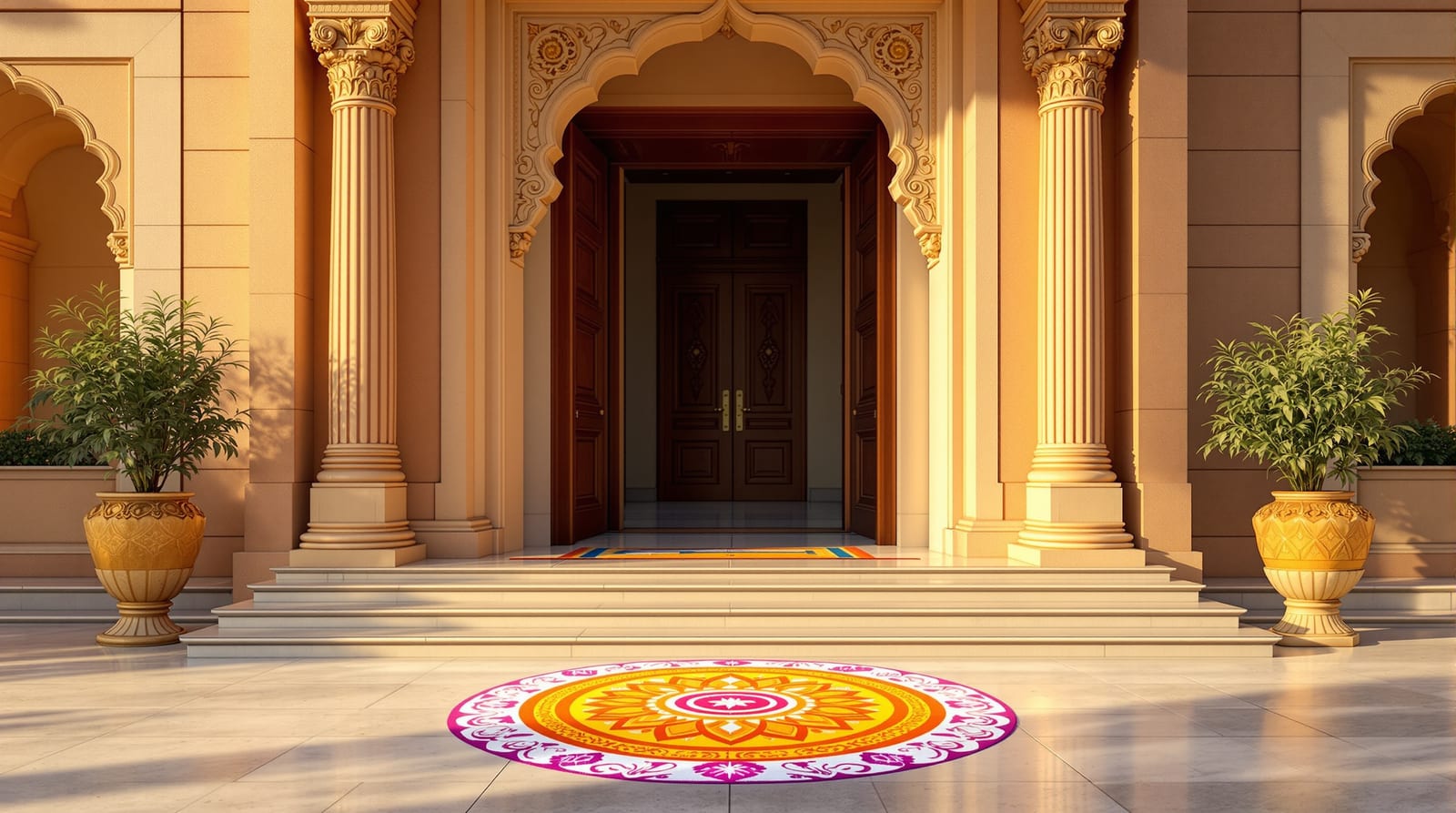
- It is kept decorated and respected — the kolam or rangoli drawn before it each morning, the habit of not stepping ON the threshold but OVER it, the small daily care it receives.
- It is not used as a seat or a place to leave footwear — footwear sits beside, not on, the threshold.
You do not have to believe in the metaphysics to see why these habits endure. A raised, intact, cared-for threshold is exactly what a damp-prone, dusty, monsoon-lashed Indian doorway needs. The tradition encodes good building practice in the language of auspiciousness.
The practical truths behind the belief
Strip away the ritual and a raised, clean, unbroken threshold earns its keep mechanically. This is why the custom survives in homes that no longer think about Vastu at all.
| Vastu instruction | Practical reason it works |
|---|---|
| Threshold should be raised | Sheds rainwater and street wash away from the door; stops water creeping under the leaf during monsoon |
| Keep it clean and swept | Blocks dust and grit from tracking in; protects the door undercut and floor finish |
| It must be unbroken, no cracks | A cracked stone lets water wick through and the joint fail; intact stone stays watertight |
| Step over it, never on it | Stops the threshold edge wearing down and chipping; keeps the seal line true |
| Use durable stone (granite) | Granite resists abrasion, water and termite; it is the natural material for ground contact |
| Mark the boundary clearly | Defines where the home begins — also where weather-sealing, security and the doormat belong |
The single most useful takeaway: the threshold is your first line of defence against water and dust. Everything the tradition asks for — raised, intact, granite, clean — is also what a site engineer would specify for a weatherproof external door foot.
Favourable door zones: N, E and NE
Vastu places the auspicious main door in the north, east, or north-east of the plot, with the north-east (Ishaan) the most prized. The reasoning given is the flow of morning light and the prana it carries; the practical reading is that a north-east entrance catches gentle morning sun and avoids the harsh western afternoon glare and heat in much of India.
| Door zone | Vastu reading | Practical note |
|---|---|---|
| North-east (Ishaan) | Most auspicious | Morning light, cool aspect; favoured where the plot allows |
| East | Highly favourable | Sunrise side; warm but not harsh mornings |
| North | Favourable | Even, soft light; comfortable in hot climates |
| West | Less preferred | Hot afternoon sun; manage with shading/chajja |
| South-west | Generally avoided | Treat with a porch, screen or planting if unavoidable |
A practical word: the door's direction is fixed by your plot and your architect long before the threshold goes in, and structural safety, egress and ventilation always outrank orientation. If your plot only allows a west or south door, a good chajja (sun-hood), a porch and a quality threshold matter far more than the compass reading. Vastu is best treated as one input among several, not an override.
Threshold height and section — getting the number right
This is where tradition and accessibility meet, and where most homeowners get nervous. The good news: a sensible threshold satisfies both.
Tradition asks for the threshold to be raised. Accessibility law sets a ceiling on how much. India's RPwD Act 2016 and the Harmonised Guidelines 2021 ask for thresholds at accessible entries to be no higher than about 12-13mm, and bevelled if over 6mm, so a wheelchair or a walking frame can cross. These two are not in conflict: a granite saddle raised a modest 10-12mm and chamfered at the edge is both the auspicious umbara and an accessible threshold. You only run into trouble if someone builds a tall, sharp-edged step in the name of tradition — that is neither necessary nor required by Vastu, which asks only that the threshold be present, clean and respected.
| Threshold approach | Height | Vastu fit | Accessibility fit |
|---|---|---|---|
| Modest raised granite saddle, bevelled | ~10-12mm | Honours the umbara | Compliant if bevelled |
| Tall stone step (old style) | 25-50mm+ | Traditional but excessive | Trip/access hazard; avoid |
| Flush / zero threshold + drain channel | ~0mm | Marked symbolically (inlay/colour) | Best for wheelchair users |
| No threshold at all | none | Tradition unmet | Fine for access; water risk |
For a fully step-free entrance — needed where a wheelchair user lives — a flush or zero threshold with an external drainage channel is the right engineering answer, and the umbara can be honoured symbolically with a contrasting granite or brass inlay strip set flush, plus the daily kolam. The boundary is marked without the step.
Building it well: stone, slope and waterproofing
A threshold that cracks or leaks fails both the tradition (it is no longer unbroken) and the building. Get the construction right:
- Material: a single piece of granite is the classic choice — hard, water-resistant and termite-proof. A timber saddle is traditional too but must be a durable, treated hardwood and sit on a damp-proof course, never on a wet floor.
- Slope outward: the external face of the threshold should fall away from the house with a drip groove (throating) under the lip so rain sheds onto the porch, not under the door.
- Bed it in sealant and tie it into the floor waterproofing membrane so water cannot track beneath it. Run silicone at the stone-to-floor and stone-to-frame junctions.
- Keep it unbroken: one slab, no patched joints across the opening. A clean, intact threshold is both auspicious and watertight.
- Pair it with a weather bar on the door foot and a quality seal so the small raise actually does its job.
Doing this is mason's and carpenter's work; a granite saddle bedded true and a door undercut to clear it is the difference between a doorway that stays dry for decades and one that wicks damp into the frame. For the engineering of the wet detail, this sits alongside the wider door thresholds guide and the dedicated waterproofing door thresholds and door saddle installation walk-throughs. If a step-free entry is your goal, read zero threshold doors and compare options in threshold types and door sill design. For the orientation and entrance side of the tradition see entrance vastu. For the whole topic start at the complete door guide, and for the frame the threshold sits in, the door frames overview. To check a step-free entry is feasible try the zero threshold feasibility checker, and to weigh saddle options use the door threshold selector.
Frequently asked questions
Does the main door threshold really need to be raised in Vastu?
Tradition treats a present, slightly raised, clean and unbroken threshold (the umbara or dehleez) as auspicious. Practically a modest raise of about 10-12mm sheds water and dust and marks the home's boundary. It does not need to be a tall step — a low, bevelled granite saddle satisfies both the tradition and accessibility.
Can I follow Vastu and still have a wheelchair-accessible threshold?
Yes. India's RPwD guidelines ask for thresholds no higher than roughly 12-13mm, bevelled if over 6mm. A modest, chamfered granite saddle meets that and honours the umbara. For a truly step-free entry, use a flush threshold with an external drainage channel and mark the boundary symbolically with a flush inlay and the daily kolam.
Which direction should the main door face in Vastu?
North, east and north-east are considered favourable, with north-east (Ishaan) the most prized — partly because these catch gentle morning light and avoid harsh western heat. But your plot, structural safety, egress and ventilation come first. If the door must face west or south, good shading and a quality threshold matter more than the compass.
Why is a cracked threshold considered inauspicious?
Custom reads a cracked threshold as a broken boundary. Practically, a cracked stone lets water wick through and the joint fail, so the threshold no longer keeps the doorway dry. Replacing it with a single unbroken granite slab is both the auspicious and the sound building choice.
What material is best for a main door threshold in India?
Granite is the classic and most practical choice — hard, water-resistant and termite-proof, ideal for ground contact. A treated hardwood saddle is traditional but must sit on a damp-proof course and never on a wet floor. Slope the outer face, add a drip groove, and bed the stone in sealant tied to the floor waterproofing.
Should I step on or over the threshold?
Tradition says step over, never on, the threshold. Beyond respect, this is practical: stepping on the edge wears and chips the stone, which breaks the watertight lip. Keeping footwear beside rather than on it follows the same logic.
Export this guide
Related Guides — Deep-dive reading
Zero Threshold Doors in India: Level Access (India 2026)
How to detail a flush, step-free door threshold for wheelchairs and ageing-in-place while still keeping monsoon water out.
Home Doors & EntrancesDoor Threshold Standards for Indian Homes: Sill, Weather Bar & Accessibility (2026)
What the strip under your door actually does - water, dust, draft and insect barrier, level transition and trip-safe accessibility - with the right material, the 12 mm accessibility limit, weather-bar and drip-groove detailing for external doors, and the wet-bathroom threshold.
Home Doors & EntrancesWaterproofing Door Thresholds in India (India 2026)
Stopping water tracking under bathroom and external door frames with a raised kerb, granite saddle and a membrane that turns up into the threshold.
Home Doors & EntrancesRelated Tools — Try Free
Cross-Ventilation Analyzer
Estimate airflow and air changes per hour (ACH) from room size, window areas, layout, and local wind — with NBC 2016 Part 8 compliance check.
Ventilation CalculatorMonsoon-Readiness Checklist
Pre-rain home audit across 9 categories — terrace, drains, waterproofing, electrical, HVAC, pest, vehicles, documents.
Seasonal AuditRainwater Tank Sizer
How big should your rainwater tank be? Computes annual harvest, recommended tank capacity in litres, water-bill savings, and payback — for 10 Indian cities.
RWH Calculator