
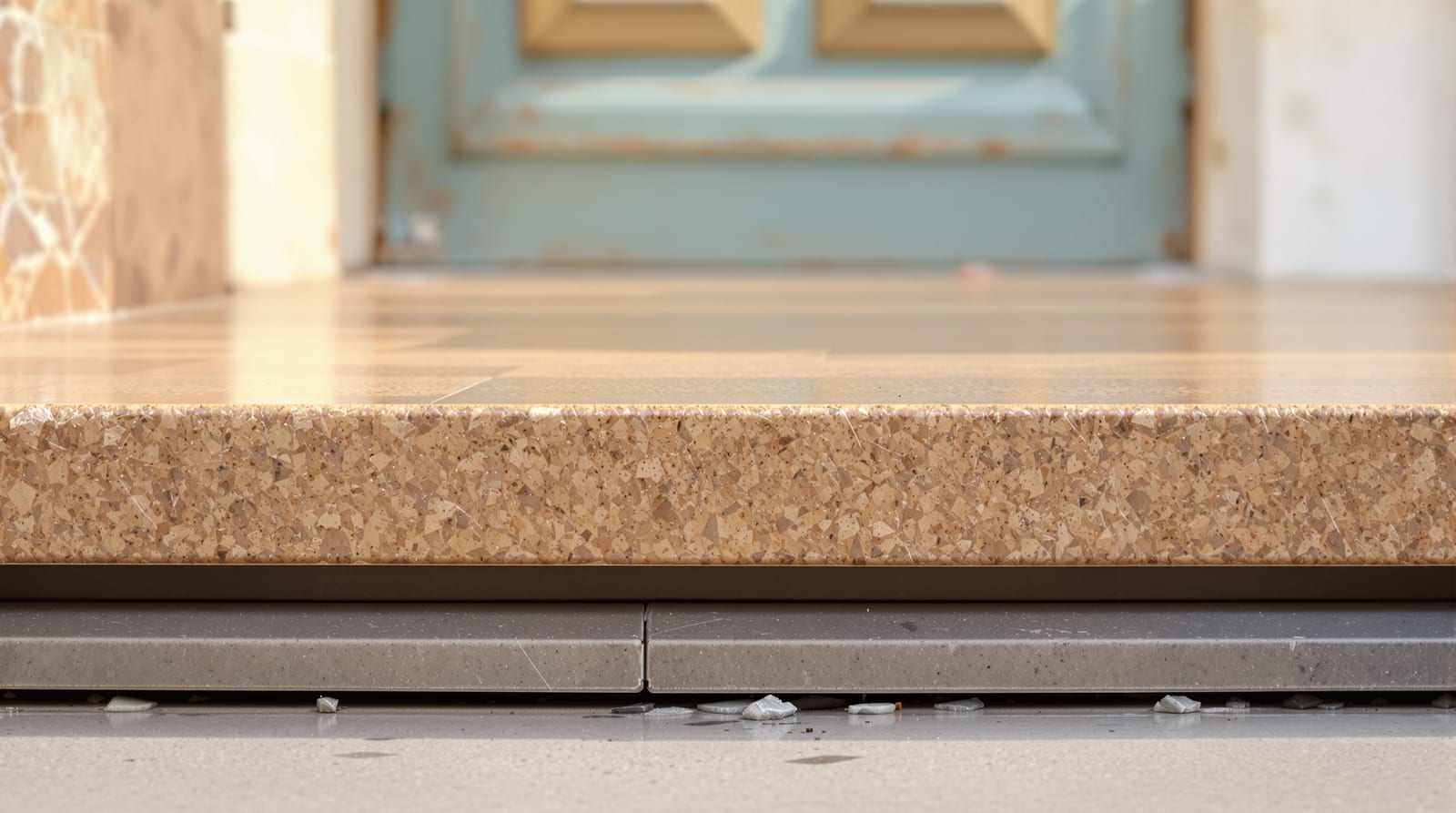
Door Sill Design in India: Slope, Drip Groove (India 2026)
How to detail the bottom member of an external door so a granite or stone sill sheds monsoon water instead of wicking it indoors.
The sill is the most ignored member of a door frame and the one that quietly decides whether an external opening survives the monsoon. Good door sill design is not decoration: it is a small piece of water management built into the bottom of the chowkhat. An external sill has to take the rain that runs down the closed leaf, throw it clear of the wall below, and stop it creeping back under the door into the room. Get the outward slope and the drip groove right, in a hard material like granite, and the threshold stays dry for decades. Get it flat, porous, or sloping the wrong way and you get a damp patch inside the door, a rotting frame foot, and efflorescence on the wall. This guide covers the weathering slope, the throating or drip groove, stone sills, how a sill differs from a threshold, and how to seal it for Indian conditions.
Sill vs threshold: not the same thing
The two words get used interchangeably on site, but they describe different parts and it helps to keep them straight.
- The sill is the bottom horizontal member of the door frame — the structural counterpart to the head at the top and the jambs at the sides. On internal frames it is usually omitted (cut off as a "horn" so the floor runs through), but on external doors it is the weathering member that sheds water. In Indian usage it is the dehleez or umbara in its built form.
- The threshold is the finished step or strip you cross in the doorway — a stone saddle, an aluminium strip with a rubber seal, a ramped piece for a level change. The threshold sits on or forms the top of the sill.
In practice a granite external sill is both: it is the bottom frame member and the threshold you step over. But the distinction matters when you specify, because a sill must shed water (slope, drip groove) while a threshold must also be safe to cross (height, bevel, slip). For the crossing-and-accessibility side, read door thresholds guide and threshold types; this guide concentrates on the sill as a weathering detail.
| Term | What it is | Job | India usage |
|---|---|---|---|
| Sill | Bottom member of the frame | Shed water, support the threshold | Often granite/stone on external doors |
| Threshold | The step/strip you cross | Safe crossing, seal the gap | Saddle, ramp, aluminium strip |
| Weather bar | Upstand at the leaf base | Stop wind-driven rain creeping in | Paired with an external sill |
| Drip groove | Channel under the nose | Break the water film, force a drip | Throating; the key weathering cut |
The weathering slope
The first rule of an external sill is that its top surface slopes outward, away from the building. Water that runs down the closed leaf lands on the sill and must run off towards the outside, never pond, and never run back under the door. A gentle fall of roughly 1 in 15 to 1 in 30 (a few millimetres of fall across the sill width) is enough to drain it without making the step feel tilted underfoot.
The sill should also project slightly beyond the face of the wall below it so that the water leaving the sill drips clear of the plinth rather than running down the wall and staining it. That projecting lip is the "nose", and the nose is where the drip groove lives.
A weather bar — a small upstand (stone rib, or a metal bar set in a groove) just inside the leaf line — works with the slope. The leaf shuts against or just behind it, so wind-driven rain that gets past the bottom of the door is stopped and drained back out rather than crossing into the room. Pair the weather bar with a seal on the leaf bottom for an exposed door; see door weather bar for the detail.
Throating: the drip groove that does the real work
A sloped sill alone is not enough, because water clings to surfaces by surface tension and can travel back along the underside of the nose to reach the wall — exactly where you do not want it. The drip groove (also called throating) defeats this. It is a continuous channel, roughly 8-12mm wide and as deep, cut into the underside of the projecting nose, running the full length of the sill.
When the water film reaches the groove it cannot bridge the sharp edge, so it is forced to break and fall as a drip, clear of the wall. It is a tiny detail that costs almost nothing to cut and is the single biggest difference between a sill that keeps the wall dry and one that streaks it. The same throating logic is used under window sills, copings and lintels across Indian construction.
Stone and granite sills
For an Indian external door the default and best sill material is granite (or another hard, dense stone). It is effectively non-porous, it does not rot or feed termites, it shrugs off the foot traffic of a main entrance, and it can be cut with a clean nose and drip groove. A polished or flamed granite sill at the front door is both a durable detail and a finished look. This is also why the raised stone umbara of a traditional Indian home — auspicious in Vastu and practically a dust-and-water barrier — has lasted as a detail; see main door threshold Vastu.
| Sill material | Durability | Water behaviour | Indicative band | Best for |
|---|---|---|---|---|
| Granite | Excellent | Near non-porous | ₹150-400/sq ft + cutting | Main / external doors |
| Other hard stone (e.g. Kadappa, sandstone) | Good | Low-moderate porosity | ₹60-200/sq ft | Secondary external doors |
| Marble | Moderate | Porous, stains, etches | ₹120-500/sq ft | Internal saddles only |
| Hardwood (teak/sal) | Moderate (needs care) | Rots if wet, treat foot | ₹700-1,200/rft | Sheltered, traditional |
| Aluminium threshold strip | Good | Sheds via seal | ₹150-600/ea | Level / accessible thresholds |
| WPC / RCC | Good | Waterproof | ₹180-1,500 | Wet areas, budget |
Bands are indicative and as a rule of thumb; add fabrication (cutting the nose and drip groove) and bedding. GST is 18% on stone, hardware and joinery. Avoid marble on an external sill — it is porous, etches, and stains; keep it for internal saddles. Never stand an untreated timber frame foot directly on a wet sill: sit it on the stone, on a DPC, and anti-termite-treat the contact face. In bathrooms and other wet areas, prefer a granite saddle or a WPC/RCC/aluminium detail over timber.
Detailing, bedding and sealing
A sill only works if it is bedded and sealed as carefully as it is shaped.
- Bed it on a damp-proof layer. The sill should sit over the DPC so it does not wick rising damp into the frame and floor. The frame foot, in turn, sits on the sill, on its own DPC, away from standing water.
- Slope and project, every time. Confirm the top falls outward and the nose oversails the wall below before the bedding mortar sets — you cannot fix it afterwards without lifting the stone.
- Cut the drip groove before fixing. It is far easier to throat a granite slab on the bench than in place.
- Seal the junctions with silicone. Where the sill meets the jambs and the wall, use an exterior-grade silicone (not internal acrylic caulk) so the joint stays watertight under monsoon driving rain. Integrate the bedding with any wall waterproofing membrane; for the full wet detail see waterproofing door thresholds and door saddle installation.
- Mind accessibility. A raised weathering sill and step-free access pull in opposite directions. Under the RPwD Act 2016 and the Harmonised Guidelines 2021, an accessible threshold should be ≤12-13mm, bevelled if over about 6mm, and preferably flush. A zero / level threshold for wheelchair access keeps the weathering job alive with a slim drainage channel and an outward slope rather than a raised step; see zero-threshold doors. Whatever the height, keep the door's free egress clear.
None of this is exotic, but the slope, the projection, the drip groove and the silicone all have to be present together. A skilled stone fitter or site engineer who has detailed a few external doors will get it right; a casual fix that just beds a flat slab in the opening will not. For the surrounding frame layer start at door frames, and for the whole topic see the complete door guide. To weigh thresholds against access and weather, try the door threshold selector and check feasibility with the zero-threshold feasibility checker.
Frequently asked questions
What is the difference between a door sill and a threshold?
The sill is the bottom member of the door frame — on external doors it is the weathering member, usually granite, that sheds water. The threshold is the step or strip you cross in the doorway. On a granite external door they are often the same piece, but the sill's job is to drain water while the threshold's is to be safe to cross.
Which way should a door sill slope?
Always outward, away from the building, with a gentle fall of about 1 in 15 to 1 in 30. That drains the water that runs down the closed leaf towards the outside and stops it ponding or creeping back under the door into the room. The sill should also project past the wall below so water drips clear.
What is a drip groove and why does my sill need one?
A drip groove, or throating, is a small channel (about 8-12mm) cut into the underside of the sill's projecting nose. Water clings to surfaces and can travel back along the underside towards the wall; the sharp edge of the groove breaks that film and forces the water to drip clear. It is the single most effective detail for keeping the wall below dry.
Is granite the best material for an external door sill?
For Indian conditions, yes. Granite is near non-porous, does not rot or feed termites, takes heavy foot traffic at a main door, and can be cut with a clean nose and drip groove. Avoid marble outdoors — it is porous, etches and stains. WPC, RCC and aluminium are good for wet areas and accessible thresholds.
Can I have a weather-shedding sill and still be wheelchair accessible?
Yes, but it needs care. A raised step and step-free access conflict, so use a zero or level threshold: keep the threshold at or below about 12mm, bevel it if over roughly 6mm, and replace the raised step with a slim drainage channel and an outward slope. That preserves both weathering and free, accessible egress.
Export this guide
Related Guides — Deep-dive reading
Zero Threshold Doors in India: Level Access (India 2026)
How to detail a flush, step-free door threshold for wheelchairs and ageing-in-place while still keeping monsoon water out.
Home Doors & EntrancesDoor Threshold Standards for Indian Homes: Sill, Weather Bar & Accessibility (2026)
What the strip under your door actually does - water, dust, draft and insect barrier, level transition and trip-safe accessibility - with the right material, the 12 mm accessibility limit, weather-bar and drip-groove detailing for external doors, and the wet-bathroom threshold.
Home Doors & EntrancesWaterproofing Door Thresholds in India (India 2026)
Stopping water tracking under bathroom and external door frames with a raised kerb, granite saddle and a membrane that turns up into the threshold.
Home Doors & EntrancesRelated Tools — Try Free
Door Threshold Selector
Choose the right threshold — saddle, ramped, aluminium-seal, weather-bar or zero — by door location and accessibility.
Threshold SelectorBathroom Floor Slope Calculator
Work out the floor fall to the drain and screed depth from the run and slope ratio — with a drains-properly verdict.
Bathroom CalculatorBathroom Sealant Calculator
How many tubes of silicone sealant a bathroom needs and the cost — by joints to seal, lengths and bead size, with an anti-fungal note.
Bathroom Calculator