
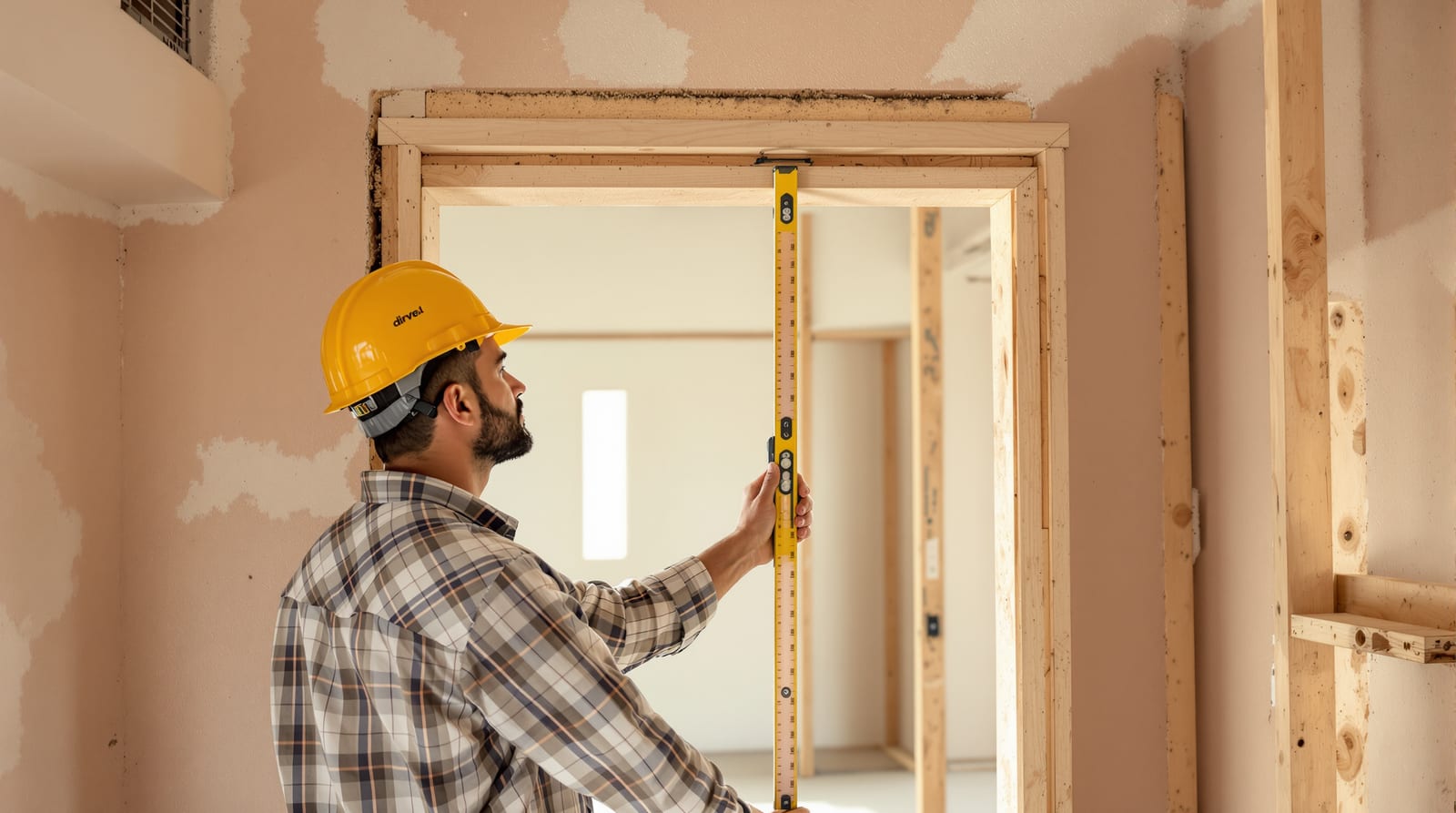
Door Frame Plumb, Level & Square: Setting It True (India 2026)
How to set a door frame plumb, level, square and out-of-wind on Indian sites — spirit level, plumb bob, diagonals, shimming and the 1-2mm tolerance that decides whether the leaf latches.
A door leaf is a heavy, hinged pendulum, and a pendulum only hangs still when its pivot line is dead vertical. That single fact is why getting the door frame plumb and level is the most important ten minutes of any door fit. Set the hinge jamb even one or two millimetres out of vertical and the leaf will quietly swing open or fall shut on its own; let the head sag and the gap goes wedge-shaped and the latch misses the strike. None of this shows when the carpenter is holding the frame — it shows three weeks later when the homeowner calls to say the bathroom door won't stay where it's left. This guide is the fitter's and site engineer's reference for setting a chowkhat truly plumb, level, square and out-of-wind, the four conditions that, together, decide whether a door behaves, in line with IS 4021 (timber door frames) and IS 4351 (steel frames).
The four conditions a frame must satisfy
People say "plumb and level" as shorthand, but a frame that latches and stays put actually has to pass four separate checks. Miss any one and you get a distinct, recognisable fault.
| Condition | What it means | How it fails | Symptom if wrong |
|---|---|---|---|
| Plumb | Both jambs dead vertical, front-to-back and side-to-side | Hinge jamb leans | Leaf self-swings open or shut; won't stay put |
| Level | Head (and sill, if any) truly horizontal | One jamb set higher | Wedge-shaped gaps; latch misses the strike |
| Square | Corners at 90 degrees; diagonals equal | Frame racked in opening | Reveal tapers; leaf binds one corner |
| Out of wind | Frame in one flat plane, not twisted | Two jambs in different planes | Leaf touches rebate top-near, bottom-far; rattles or sticks diagonally |
The one people forget is out of wind (also called "in winding" or untwisted). A frame can be perfectly plumb on each jamb and perfectly square in elevation yet still be twisted like a propeller, so the two jambs sit in different vertical planes. The leaf then meets the rebate at the top on one side and the bottom on the other — it sticks diagonally and no amount of planing fixes it. The cure is to sight across the frame (or use winding sticks) before fixing, and twist it flat.
Why a plumb jamb keeps the leaf still
The physics is worth stating plainly because it convinces sceptical site crews. Gravity always pulls the leaf's centre of mass to the lowest point it can reach. If the hinge axis is exactly vertical, every open position is the same height, so the leaf has no reason to move and stays wherever you leave it. Tilt the hinge jamb so the top leans towards the opening side, and the open leaf is now slightly raised — gravity swings it shut. Tilt it the other way and the leaf swings open. The effect is brutal: a lean of barely 2mm over a 2.1m jamb is enough to make a smooth-running leaf drift on its own. That is the whole reason the tolerance is so tight, and why "close enough" with a frame is never close enough.
Level does a related job. If the head is out of level, the margin (the gap between leaf and frame) is no longer parallel — it opens to a wedge — and the latch bolt no longer lines up with the strike plate at the right height, so the door rattles or refuses to catch. Square and out-of-wind keep the four-sided gap even all round so the leaf clears the rebate everywhere without binding.
Checking the frame — the tools and the order
You need very little: a good spirit level (a 1.2m / 4ft level reads a jamb far more honestly than a 600mm one), a plumb bob for a cross-check, a tape for the diagonals, and shims/packers (timber wedges, plastic horseshoe shims, or offcuts). A laser level helps but is not essential.
The checking order matters — do it the same way every time:
1. Stand the frame in the rough opening on packers, roughly centred, with the head a touch high so you can wedge down to height.
2. Plumb the hinge jamb first — hold the level on the jamb face, side-to-side and front-to-back, and shim behind it until the bubble centres on both. Cross-check with a plumb bob hung from the top of the jamb: the string should just kiss the jamb at top and bottom.
3. Level the head — bubble on the head member; if it dips, raise the low jamb on its packer until level.
4. Plumb the lock jamb and set the frame width so the rebate-to-rebate (or jamb-to-jamb) clear width is correct top, middle and bottom.
5. Check square with the diagonals — measure corner to corner both ways; equal diagonals = a square frame. Nudge a jamb to equalise.
6. Check out of wind — sight across the two jambs from one side, or rest winding sticks across head and sill; the front edges should line up. Twist the frame flat if they don't.
7. Re-confirm plumb after every adjustment — squaring or de-winding often disturbs it.
Shimming and adjusting to hold it true
A frame is only as true as the packing behind it. Set the shims at the hinge and lock points above all — that is where slam and weight loads concentrate, and an unpacked jamb there will bow inward over time and lose the latch. Use shims in opposing pairs (folded wedges) so you can fine-tune by sliding them, and pack solid behind every fixing so tightening the screw or holdfast does not suck the jamb out of plumb.
| Adjustment | What you reach for | Tolerance to hit |
|---|---|---|
| Bring a jamb plumb | Shims behind jamb at hinge / lock / mid | Within ~1-2mm over the 2.1m height |
| Level the head | Raise the low jamb on its base packer | Bubble centred; gaps parallel |
| Square the frame | Nudge a jamb until diagonals equal | Diagonals within ~2-3mm of each other |
| Take out twist | Push one jamb forward/back; re-pack | Jamb faces in one plane |
| Keep an even reveal | Even shim spacing; recheck after grout | ~3mm head and stiles, ~2-3mm hinge/lock edge |
Fix only once all four conditions pass at the same time, and recheck plumb and reveal one last time before the grout or foam sets — that is the final chance to correct. Use low-expansion PU foam on timber frames (high-expansion foam bows the jamb) and 1:3 cement mortar grout packed solid on steel frames. As a rule of thumb the tolerance to aim for is the frame plumb within 1-2mm over its height and an even reveal all round — tight enough that the leaf hangs still and latches cleanly, with no wedge-shaped gap betraying it.
India site realities
Floors and walls are rarely true. On many Indian sites the floor screed slopes and the masonry reveal is out of plumb, so you almost never just drop the frame in — you shim to a true line, not to the opening. Set the frame to plumb and level first; let the architrave and a little caulk absorb the wall's irregularity later.
Wet trades come after. If the frame goes in before flooring, allow for the finished floor level so the undercut and threshold land right, and protect the jamb foot — stand it on a DPC / stone or RCC base block, never on a floor that will be wet, and anti-termite treat a timber foot in ground contact.
It is a skilled job. Setting a frame dead plumb, square and out-of-wind, packed and held, is a carpenter-and-mason task, not a fix-it-later one. The commonest faults — hinge jamb out of plumb (leaf self-swings), head out of level (latch misses), and no packing behind hinges (jamb bows) — are exactly the ones in door installation mistakes. If an existing door drops or drifts, it usually traces back here: see fix a sagging door and, for a leaf catching the frame, door rubbing the frame.
Related guides and tools
This page sits in the frames-and-installation cluster. For the dimensions and margins behind these checks see door clearances and tolerances and measuring for a door; for the full fit-up sequence the frame slots into, door frame installation and how to fit a door. To set the opening before you ever stand the frame, run the door rough opening calculator, and check leaf-to-frame gaps with the door clearance checker. See the phase pillar door frames and the cluster pillar complete door guide.
Frequently asked questions
Why does my door swing open or shut by itself?
Almost always because the hinge jamb is not plumb. The leaf is a pendulum and gravity pulls it to the lowest open position, so a jamb leaning even 1-2mm over 2.1m makes the leaf drift on its own. Re-plumb and shim the hinge jamb true and the drift stops; the door will then stay wherever you leave it.
How plumb does a door frame need to be?
As a rule of thumb, within 1-2mm over the full height of the jamb, with both jambs vertical front-to-back and side-to-side. That is tight by everyday standards but necessary — the leaf's self-swing and the latch alignment both depend on it. Use a long (1.2m) spirit level and cross-check with a plumb bob.
What is the diagonal check and why does it matter?
Measure the frame corner to corner both ways; if the two diagonals are equal the frame is square. Unequal diagonals mean the frame is racked, the reveal will taper, and the leaf binds in one corner. Nudge a jamb until the diagonals match (within about 2-3mm) before fixing.
What does "out of wind" mean for a door frame?
It means the frame is not twisted — both jambs sit in the same flat plane rather than like a propeller. A twisted frame can be plumb and square yet still make the leaf touch the rebate top-near and bottom-far, so it sticks diagonally. Sight across the jambs or use winding sticks and twist the frame flat before fixing.
Where should I put the shims behind the frame?
Concentrate them at the hinge and lock points, plus mid-height — that is where slam and weight loads concentrate. Pack solid behind every fixing so tightening the holdfast or screw does not pull the jamb out of plumb, and use opposing wedge pairs so you can fine-tune. An unpacked jamb at the hinge will bow inward and lose the latch.
Can I correct a frame that is out after the grout has set?
Only marginally. Once steel-frame mortar or timber-frame foam has set, the frame's position is essentially fixed, so small errors get lived with or shimmed at the leaf. That is why you must confirm plumb, level, square and reveal before the grout cures — it is the last real chance to correct.
Export this guide
Related Guides — Deep-dive reading
Measuring for a Door: Opening Sizes & Checks (India 2026)
How to measure a door opening in India — three width and height points, diagonals, plumb and level — so the carpenter cuts it right the first time.
Home Doors & EntrancesDoor Frame Installation: Set a Chowkhat True (India 2026)
Step by step on setting a door frame into the opening — propping, bracing, plumb, level and square, fixing and grouting — so the leaf hangs perfectly.
Home Doors & EntrancesDoor Frame Anchoring to Masonry: Holdfasts (India 2026)
How to anchor timber, steel and WPC door frames into brick, concrete block, AAC and RCC walls — fixings, edge distance, loads and India site realities.
Home Doors & EntrancesRelated Tools — Try Free
Accessible Door Checker
Check a door against wheelchair-accessibility guidance — clear width, threshold, handle and closer force per RPwD 2021.
Compliance ToolDoor Rough Opening Calculator
Work out the frame outer size and rough/structural opening for any finished door, with the packing gap and lintel.
Opening CalculatorDoor Security Rating Calculator
Score your main door out of 100 across leaf, frame, lock and hardware — and see the top upgrades.
Security Tool