
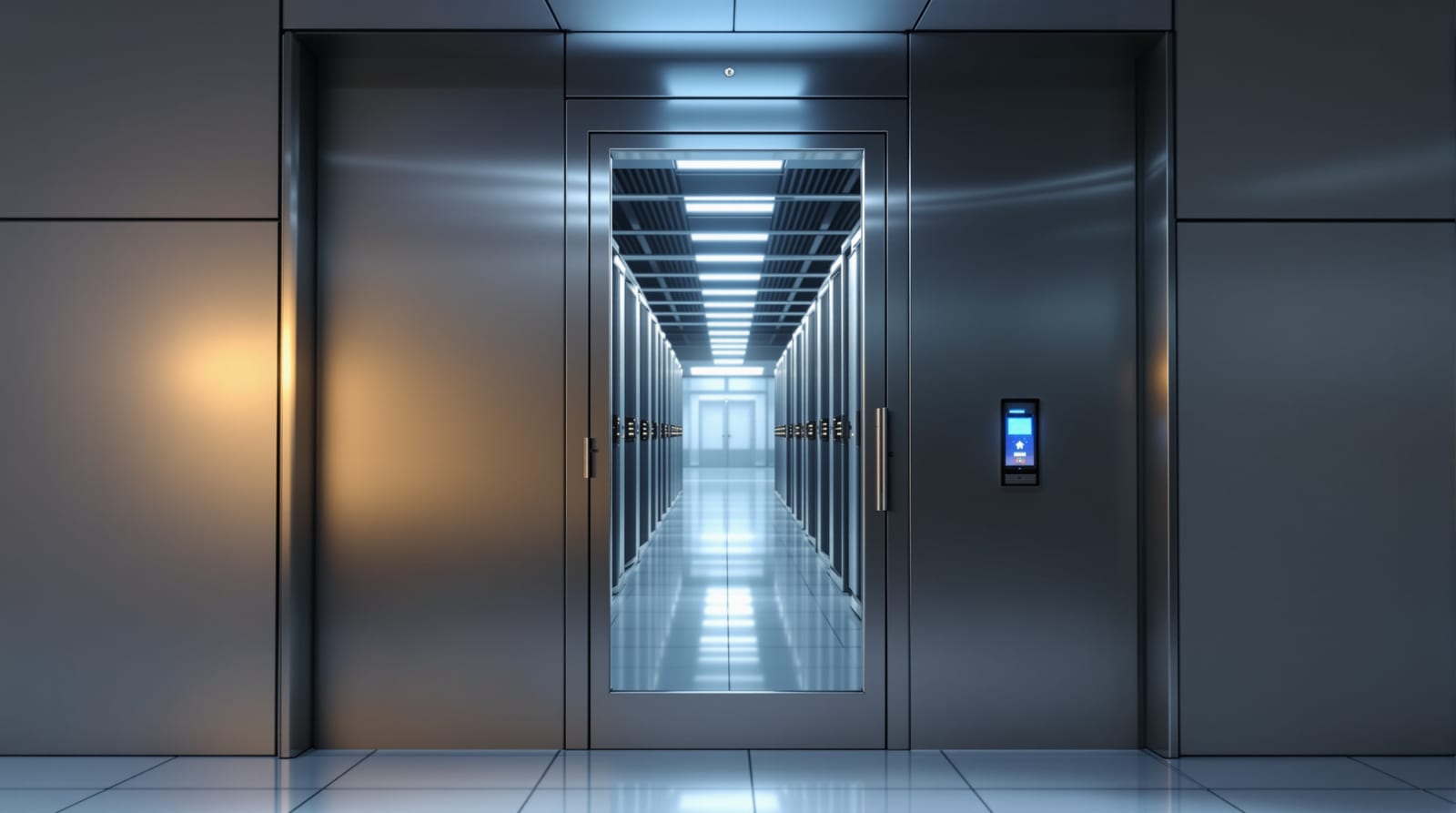
Data Centre Door in India: Mantraps, Fire-Rated White-Space and Airflow Containment (2026)
A layer-by-layer guide to data centre doors in India - perimeter mantraps with biometric anti-tailgating, fire-rated gas-tight white-space doors, hot/cold-aisle containment doors and electrical-room steel doors - with indicative rupee costs and codes.
A data centre is a building where the doors are part of the machine. In an office a door is joinery; in a data centre every door is simultaneously a security boundary, a fire compartment wall and a piece of the airflow plant. A single weak door can let an unauthorised person tailgate into the white space, let a corridor fire reach the racks, or let your clean-agent suppression gas leak away in seconds. As India's hyperscale, colocation and enterprise data centres multiply across Mumbai, Chennai, Hyderabad and the NCR, getting the door schedule right is no longer optional - it is audited under Uptime, SOC 2 and the operator's own security policy. This guide walks the door layers from the street to the rack, tells you exactly what to specify at each one, and gives indicative rupee costs.
The principle: defence in depth, layer by layer
A data centre door schedule is built on concentric security zones. Each zone is harder to enter than the last, and the door between zones enforces the step-up. The same doors must also hold the fire compartment line and protect airflow integrity. Think of three demands stacked on every door, with the priority shifting by layer:
1. Multi-layer access control + anti-tailgating - only named, vetted people pass, one at a time, with a full audit trail. The mantrap is the heart of this.
2. Fire rating + suppression airtightness - the white space and electrical rooms are fire compartments protected by clean-agent gas; the door must hold its rating and seal gas in.
3. Airflow containment integrity - inside the hall, aisle-containment doors keep hot and cold air separated so cooling actually works.
Aesthetics and Vastu do not feature here. Vision panels are usually omitted for security. Width is driven by racks, not people. Below, we take each layer in turn.
Layer 1 - perimeter and building entrance
The outer skin is about deterrence and the first identity check. Specify a robust steel or aluminium entrance with multipoint locking, access control and CCTV coverage, plus a fire-rated emergency exit that opens in the direction of escape with panic hardware. This layer is conventional secure-building practice - see door security in India and steel doors in India for the leaf and lock detail, and treat the fire exit per fire-exit doors in India. The interesting, data-centre-specific engineering starts at the next layer.
Layer 2 - the mantrap (the security core)
The mantrap, or interlock airlock, is the signature data centre door. It is two doors in series with a small vestibule between them, electronically interlocked so both can never be open at once. You authenticate at door one, step in, door one locks, you authenticate again (often a second factor) and only then door two releases. This is what defeats tailgating - one person cannot slip in behind an authorised pass-holder.
What to specify:
- Two leaves, interlocked. A controller ensures door two stays locked until door one is closed and latched, and vice versa. On a fire alarm both fail safe for egress.
- Anti-tailgating / single-occupancy detection. Floor-mounted weight sensors, overhead 3D people-counting sensors or an optical turnstile inside the vestibule confirm only one person is present before releasing the inner door.
- Two-factor authentication. Card plus biometric is standard for the inner door. Specify the reader via biometric door locks in India and wire the whole interlock through door access control in India.
- No vision panel, or a small armoured one only. Security first; if any glazing is used it is laminated/security glass.
- Fire-rated leaves where the mantrap sits on a compartment line, with self-closers and seals.
The mantrap is where security, fire and life safety must be reconciled - the interlock logic and the fail-safe-on-alarm behaviour have to be commissioned and tested together.
Inline plan: a data centre mantrap airlock
Layer 3 - white-space / server-hall doors
The door into the actual server hall (the white space) is the fire-and-gas door. The hall is a clean-agent-protected fire compartment - typically FM-200, Novec 1230 or inert gas (IG-541) - so the door must do everything the server room door in India does, but to a stricter, room-scale standard:
- Fire rating. A tested IS 3614 assembly, commonly 90-120 minutes for a hall, leaf plus frame plus hardware as one certified unit. See fire-rated doors in India.
- Gas-suppression airtightness. Intumescent and smoke seals in the rebate, full perimeter gasketing and an automatic drop-down threshold seal so the hall passes its door-fan enclosure-integrity test and the agent holds its concentration. The threshold is the commonest leak path.
- Self-closing and access-controlled. Mandatory closer, positive latch, card or biometric reader, request-to-exit and door-position sensor, fail-safe for egress on alarm.
- Wide double-leaf for racks. A standard hall door is a 1.5-leaf or double-leaf unit so the inactive leaf opens to move full racks, CRAC units and UPS modules. The everyday active leaf stays self-closing and locked.
- No vision panel. Security and seal integrity both argue against glazing; use cameras instead.
Layer 4 - hot/cold-aisle containment doors
Inside the hall, modern halls run hot-aisle or cold-aisle containment - the racks face each other across an aisle that is closed off with a roof and end doors so cooled air and exhaust heat never mix. These containment doors are an airflow product, not a fire or security one:
- Sliding or swing leaves at each aisle end, often part-glazed (toughened/polycarbonate) so staff can see into the aisle.
- Self-closing so the aisle reseals automatically and the cooling delta is preserved.
- Drop-away or fusible-link release is often specified so the containment door drops open on a fire-suppression discharge, letting the gas flood the whole hall.
- Light, fast and frequently operated - more like an interior partition door than a security door. The glass detailing follows frameless glass doors in India practice, scaled for the aisle.
The key point: containment doors protect the cooling investment, while the hall door protects the fire boundary - do not confuse their specs.
Layer 5 - electrical, UPS and battery rooms
Plant rooms - main electrical, UPS, battery (VRLA or Li-ion) and generator-control rooms - get fire-rated steel doors, 60-120 minutes per IS 3614, self-closing, no vision panel, with access control. Battery rooms add ventilation and, for Li-ion, an even more conservative fire stance. Steel is preferred over timber because it adds no fuel load and survives years of trolley impacts - the same logic as the server room door in India, applied to every plant room. Frames follow IS 4351.
Door schedule by layer: spec, why and cost
Indicative, per door, 2026, including frame, fire-rated hardware and seals where relevant; add about 18% GST. Access-control electronics and anti-tailgating sensors are usually separate security-contractor line items. Costs vary by size, rating, sensor choice and city - data centre doors sit at the high end of the range.
| Layer / location | Recommended door | Why | Indicative cost (₹ per door) |
|---|---|---|---|
| Perimeter / building entry | Steel or aluminium, multipoint lock, access control | First identity check, intrusion resistance | 30,000 - 90,000+ |
| Mantrap (security core) | Two interlocked fire-rated leaves + 2FA + anti-tailgating | Stops tailgating; one person, one entry, audited | 1,50,000 - 6,00,000+ (pair + sensors + controller) |
| White-space / server hall | 1.5/double-leaf steel fire door, gas-tight seals, access control | Fire compartment + gas integrity + rack clearance | 60,000 - 1,80,000+ |
| Hot/cold-aisle containment | Sliding or swing, self-closing, fusible-link release | Keeps cold and hot air separated; cooling efficiency | 25,000 - 1,20,000 per aisle end |
| Electrical / UPS / battery room | Steel fire door 60-120 min, no vision, access control | No added fuel load, fire compartment, secure plant | 22,000 - 50,000+ |
| Door-fan enclosure-integrity test | per room (commissioning) | Proves the gas-tight envelope works | 15,000 - 50,000 |
For a like-for-like steel baseline see steel doors in India; for the fire-door premium logic, fire-rated doors in India.
How a data centre door differs from a normal commercial door
| Requirement | Ordinary commercial door | Data centre door |
|---|---|---|
| Access control | Optional single lock | Multi-factor, anti-tailgating, mantrap, full audit |
| Fire rating | Sometimes | 90-120 min on halls and plant rooms (IS 3614) |
| Gas/air sealing | None | Full perimeter + drop threshold; door-fan tested |
| Airflow role | None | Aisle-containment doors manage cooling |
| Vision panel | Common | Avoided (security + seal integrity) |
| Width / leaves | Single 900 mm | 1.5 / double-leaf for racks and CRAC units |
| Material | Timber/laminate/glass | Steel for fire layers; glass only for aisles |
If you are scoping just one IT room rather than a whole facility, the focused companion is the server room door in India; for the building-wide which-door-where logic, see the doors by space guide for India. Where the project also has true cleanroom or lab zones (hermetic, ESD, interlocked), align with the cleanroom door in India.
Standards to quote in your schedule
- IS 3614 - fire-resistant door assemblies; cite 60/90/120 min for the leaf-plus-frame-plus-hardware assembly per layer.
- IS 4351 - pressed-steel door frames.
- NBC 2016 - fire compartmentation and means of egress; halls and plant rooms are compartment boundaries, and staff inside need a compliant exit that opens in the escape direction.
- RPwD 2021 / accessibility - where staff work routinely, keep clear width >=900 mm with a lever-operable, fail-safe exit; threshold seals must still drop below ~12-13 mm at the walking line.
- Clean-agent enclosure integrity (door-fan test) - design every hall and gas-protected room door to pass it from day one; a 120-minute door that leaks gas is a failed data centre door.
- Uptime / SOC 2 / operator security policy - audit the mantrap, anti-tailgating, audit trail and fail-safe behaviour; design the doors to satisfy the certification you are targeting.
Do and don't
Do treat the mantrap as the security core and commission its interlock, anti-tailgating and fire fail-safe together. Do specify the gas-tight seal system at the same time as the fire rating. Do size hall doors for the largest rack or CRAC unit that will ever pass. Do keep aisle-containment release logic coordinated with the suppression discharge.
Don't add vision panels to security or hall doors "to keep an eye on things" - use cameras and the BMS. Don't let any active leaf be wedged open; it defeats fire, gas and security at once. Don't confuse a containment door (cooling) with a hall door (fire) - they have different specs. Don't forget the threshold; the floor line is the commonest gas-leak and the easiest weak point an auditor will find.
Frequently asked questions
What is a mantrap door and does an Indian data centre need one?
A mantrap is an interlock airlock - two doors in series with a single-occupancy vestibule between them, electronically interlocked so both never open at once. You authenticate twice and pass one person at a time, which defeats tailgating. Any colocation or enterprise data centre targeting Uptime, SOC 2 or a serious internal security policy will require a mantrap at the white-space entry; it is standard practice across Indian hyperscale and colo sites.
Why do data centre doors have to be gas-tight?
Server halls and plant rooms are protected by clean-agent suppression (FM-200, Novec 1230, inert gas). The agent must hold its extinguishing concentration for several minutes. A leaky door lets the gas escape and the fire can reignite, so the door needs perimeter seals plus an automatic drop-down threshold seal and must pass a door-fan enclosure-integrity test. See the detail in the server room door in India and fire-rated doors in India.
What is the difference between an aisle-containment door and the hall door?
The hall door is the fire-and-security boundary into the white space - fire-rated, sealed, access-controlled, often double-leaf for racks. The aisle-containment door is inside the hall, at the end of a hot or cold aisle, and exists to keep cooled and exhaust air separated so cooling stays efficient. It is light, often part-glazed, self-closing, and frequently set to drop open on a suppression discharge. Different jobs, different specs.
How wide should a data centre server-hall door be?
Size it for the biggest thing that will ever pass - a fully loaded rack, a CRAC unit or a large UPS module. In practice that means a 1.5-leaf or double-leaf door: an everyday active leaf around 900-1000 mm that is self-closing and access-controlled, plus an inactive leaf opened on flush bolts for equipment moves. Confirm minimums against NBC 2016 egress and your equipment dimensions.
How does access control stay safe for staff during a fire?
Every secure door must fail safe for egress: people inside can always leave (request-to-exit releases the lock and, on a verified alarm, the access system releases per the egress plan), while the door still resists entry from outside. The mantrap interlock must also drop to allow exit. Specify this explicitly through door access control in India so security and life safety never conflict.
Export this guide
Related Guides — Deep-dive reading
Multi-Factor Access Control in India (2026): Two-Factor Doors, Anti-Passback and Mantraps Done Right
What multi-factor access control means, the three factor categories, common two-factor combinations, and which high-security doors truly need them versus where a second factor just slows honest people down.
SecurityAccess Control Maintenance in India (2026): Readers, Locks and Fail-Safe Egress
How to keep a card, keypad, fingerprint or face access-control system reading reliably and locking securely — and, above everything, how to test that its doors still release on a fire alarm and on power loss, so an access-controlled door never becomes a life-safety trap.
SecurityFire Rated Doors in India: IS 3614 Ratings, Cost & Where They're Required (2026)
What a fire-check door is, how the 30/60/90/120-minute ratings work to IS 3614, where the NBC makes them mandatory, and why the whole assembly must be certified.
Home Doors & EntrancesRelated Tools — Try Free
Emergency-Egress Checker
A life-safety self-check that access-controlled doors on escape routes still let people out in an emergency.
Egress CheckAccess-Control Schedule Generator
Build the time schedules that decide when each access group can enter — an editable list for your integrator.
Time SchedulesCross-Ventilation Analyzer
Estimate airflow and air changes per hour (ACH) from room size, window areas, layout, and local wind — with NBC 2016 Part 8 compliance check.
Ventilation Calculator