
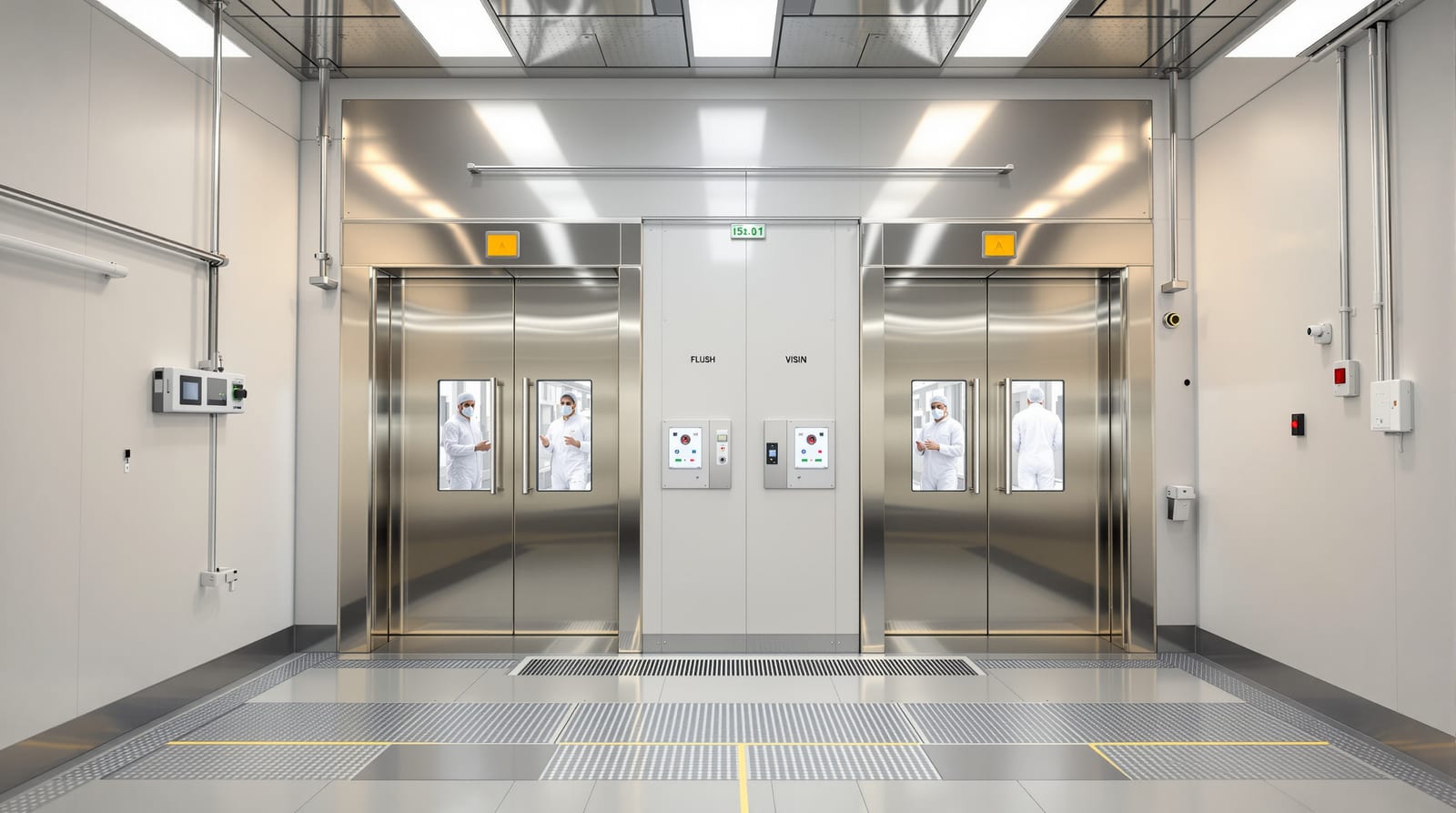
Cleanroom Door in India: Sealed, Interlocked Airlock Doors for Pharma, Semiconductor & Biotech (2026)
How to specify cleanroom doors in India - flush gasket-sealed leaves, interlocked airlock doors that hold the pressure cascade, hands-free operation, non-shedding cleanable surfaces, ESD and lead/RF variants - to ISO 14644 and GMP, with indicative rupee costs.
A cleanroom door is not joinery - it is a piece of contamination-control equipment that happens to swing or slide. In an Indian pharma fill-finish suite, a semiconductor fab, a biotech lab or a medical-device assembly hall, the door's whole job is to let people and materials cross a controlled boundary without dragging in particles, microbes or static, and without ever collapsing the pressure cascade that keeps the clean zone clean. Get the door wrong and you fail your environmental monitoring, your ISO 14644 particle count or your GMP audit - not because the room is dirty, but because the door leaked, shed, or let two airlock leaves open at once. This guide tells you exactly how to specify cleanroom doors in India: the seal, the interlock, the surface, the drive and the ESD or shielding options, with indicative rupee costs and the standards to write into your schedule.
What a cleanroom door actually has to do
Treat the cleanroom door as six overlapping demands, ranked by what protects product integrity most directly. As with the operation theatre, looks come last - this is pure performance.
1. Hold the pressure cascade with an airtight seal. A cleanroom suite is held at a stepped pressure difference - each cleaner room sits a few pascals above the dirtier room next to it, so air (and particles) always flows from clean to less-clean, never in. The door is part of that envelope: when shut it must be near-airtight via a continuous compression or inflatable gasket so the cascade and the air-change rate are not lost every time someone enters.
2. Interlock the airlock so both leaves never open together. People and materials enter through an airlock (a PAL - personnel airlock - or MAL - material airlock). Its two doors are electrically or pneumatically interlocked so that one cannot open until the other is shut and the airlock has re-pressurised. This is what stops a direct, unbroken air path between the dirty corridor and the clean core.
3. Stop shedding - a fully cleanable, non-porous surface. The face must not generate particles and must take repeated wipe-down with IPA, sporicides and disinfectants. Specify a flush, gap-free, non-shedding surface - stainless steel (SS 304), GI powder-coated steel or a high-pressure laminate (HPL) / compact panel - with rounded coved edges, no exposed fasteners, flush glazing and a flush threshold so there is nowhere for particles or bio-burden to lodge.
4. Open hands-free where contamination or gowning demands it. In aseptic and high-grade zones an operator in full gowning cannot touch a handle. Hands-free triggers - elbow plates, foot sensors, no-touch hand-wave sensors, proximity - keep gloves and gowns off the door and cut the particle burden.
5. Control static where the process needs it (ESD). Semiconductor fabs, electronics assembly and some pharma processes need ESD-safe / conductive doors, handles and vision glass so the door cannot hold or discharge static onto a wafer, device or operator.
6. Shield where the lab is special. Radioisotope or imaging labs need lead-lined leaves; sensitive RF or EMC labs need RF-shielded (Faraday) doors with conductive gaskets so the door does not become a leak in the shielded boundary.
Why a flush, interlocked, gasket-sealed door - not an ordinary door
For any classified space in India the right answer is a flush, gasket-sealed door interlocked as part of an airlock, never an ordinary panelled or hollow leaf. An ordinary door has recesses, raised mouldings, exposed fixings and a floor gap - every one of those is a particle trap or a leak path. A cleanroom leaf is flush both faces, coved at the edges, sealed all round and across the floor, and either swing or sliding depending on space and grade. Where airflow disturbance and hands-free entry matter most - aseptic cores, busy material routes - use a hermetic sliding leaf that glides flush to the wall and compresses onto its gasket; this is the same family covered in automatic sliding doors in India, and the medical cousin of this door is the operation theatre door in India. Where the grade allows and budget is tighter, a flush gasket-sealed swing door with a closer and an interlock does the job. Either way the interlock is what makes it an airlock rather than just a sealed door.
Requirement, specification and why - the cleanroom door schedule
This is the spec to write into a cleanroom door schedule. Tune it to the room's ISO class and GMP grade.
| Requirement | Specify this | Why it matters |
|---|---|---|
| Hold pressure cascade | Continuous perimeter compression / inflatable gasket + sealed bottom (drop seal / flush gasket); near-airtight when shut | Keeps the stepped pressure difference and air-change rate; a leaky door fails ISO 14644 / EM |
| No direct air path | Two-door airlock with electro-pneumatic interlock; both leaves can never open together | Maintains the cascade during entry; core of GMP airlock design |
| Non-shedding surface | Flush SS 304, GI powder-coated or HPL / compact face; coved rounded edges; no exposed fixings | Does not generate particles; survives IPA / sporicide wipe-down |
| Cleanable detail | Flush threshold (<=12 mm), flush double-glazed vision panel, concealed hinges / drive | Removes particle and bio-burden traps; supports validation |
| Hands-free (aseptic / high grade) | Hermetic auto-slider on sealed operator OR swing + foot / elbow / no-touch sensor; closer on swing | Keeps gloves and gowns off the door; cuts contamination |
| Static control (where needed) | ESD-safe / conductive leaf, handle and glazing; grounded | Protects wafers, devices and operators in fab / electronics |
| Special shielding | Lead-lined leaf (isotope / imaging lab) or RF-shielded leaf + conductive gasket (EMC / RF lab) | Keeps the shielded boundary unbroken |
| Egress & power-fail | Manual override / break-out; door open in escape direction on egress route; interlock fire-release | People must get out; fire alarm must release the interlock |
Width and leaf count. A clear opening of about 900-1000 mm for personnel airlocks; 1200 mm or more for material airlocks and equipment routes, where a single wide slider or a telescopic 1.5/2-leaf slider gives the opening without a long wall pocket. Flush-to-wall sliders also help laminar flow because they do not sweep an arc through the clean zone.
Inline plan: an interlocked cleanroom airlock
Cost: what cleanroom doors run in India
Indicative, per door, 2026, including the leaf, gasket seal, flush vision panel and basic interlock provision where noted; add about 18% GST. The airlock interlock controller, validation, ESD grounding and shielding are separate line items. Costs vary widely by ISO class, GMP grade, size, brand and city.
| Door / scope | Type | Indicative cost (₹ per door) | Why this price |
|---|---|---|---|
| Flush gasket-sealed swing door, GI powder-coated | Lower-grade / support cleanroom | 35,000 - 90,000 | Flush leaf + gasket + flush vision panel + closer; interlock-ready |
| Flush gasket-sealed swing door, SS 304 | Pharma / GMP cleanroom | 80,000 - 1,80,000 | Stainless face, coved edges, full seal, hands-free trigger option |
| Hermetic auto-slider, SS 304, single leaf | Aseptic core / busy material route | 2,50,000 - 5,50,000 | Sealed operator + full gasket + hands-free + wide opening |
| ESD / conductive cleanroom door | Semiconductor fab / electronics | 1,20,000 - 3,50,000 | Conductive leaf, handle, glazing + grounding; static control |
| Lead-lined or RF-shielded cleanroom door | Isotope / EMC / RF lab | 3,00,000 - 12,00,000+ | Pb-lined or Faraday leaf, conductive gasket, heavier drive, cert |
| Airlock interlock controller (per airlock) | n/a | 25,000 - 1,20,000 | Electro-pneumatic interlock logic, indicators, fire-release |
A cleanroom door is far costlier than any ordinary commercial door - the seal, the interlock, the medical-grade or conductive leaf and the validation are what you pay for. For the cleaner-than-cleanroom medical version see the operation theatre door in India; for the wider analytical lab, laboratory doors in India.
How it compares to nearby controlled-space doors
| Requirement | Cleanroom door | Lab door | Data centre door |
|---|---|---|---|
| Primary driver | Particle / pressure control | Containment + chemical resistance | Fire + access + gas-tight |
| Seal | Near-airtight gasket | Sealed for fume / spill control | Gas-tight for clean-agent suppression |
| Interlock | Always (airlock) | Sometimes (containment lab) | Mantrap on secure routes |
| Surface | Flush non-shedding SS / HPL | Chemical-resistant, washable | Fire-rated steel |
| Hands-free | Yes in aseptic grade | Foot-pull in some labs | Access-controlled, not hands-free |
| Static / shielding | ESD; lead / RF variants | Spark-safe in some labs | n/a |
For the analytical and containment-lab logic see laboratory doors in India; for the fire-rated, gas-tight, access-controlled server hall, data centre door in India; and for the building-wide which-door-where view, doors by space in India.
Standards and references to quote in your schedule
- ISO 14644 (cleanroom air-cleanliness classification) - sets the particle-count class (ISO 5 to ISO 8 typically) the room must hold; the closed door is part of the enclosure that maintains the class and the air-change rate. Treat door leakage as part of enclosure integrity in your qualification.
- GMP / Schedule M (Indian pharma) and EU/WHO GMP grades A-D - drive the airlock design, the cascade, the cleanable surface and the interlock; the door spec is part of your GMP audit and validation evidence. India's revised Schedule M tightens these requirements for pharma facilities.
- Pressure-cascade and HVAC design practice - the inter-room pressure differentials and air changes set how airtight the door gasket and the interlock must be; a leaky door fails the cascade and the environmental monitoring.
- ESD / IEC 61340 (electronics) - where static control is required (fabs, electronics assembly), the door, handle and glazing must be ESD-safe and grounded to the facility's ESD plan.
- AERB shielding (isotope labs) / RF-EMC shielding (RF labs) - the safety officer or EMC engineer sets the lead-equivalence or attenuation; the door and its vision glass must match the wall so the shielded boundary is unbroken.
- NBC 2016 + RPwD 2021 - the suite still needs a compliant fire and egress strategy and accessible clear widths (>=900 mm); the interlock must release on the fire alarm so a controlled boundary never traps people. For the suite's fire strategy see fire-rated doors in India.
Do and don't
Do specify the gasket seal, the interlock and the cleanable surface in the same line as the door - a sealed leaf with no interlock is not an airlock. Do match the leaf finish to the cleanroom wall panels so the boundary wipes as one surface. Do size the material-airlock opening for the largest equipment and pallet the room will ever take. Do wire the interlock to release on the fire alarm and provide a manual egress override. Do get the ESD, lead-equivalence or RF-attenuation requirement in writing from the responsible engineer before ordering a special leaf.
Don't use an ordinary panelled or hollow door in a classified space - the recesses, mouldings and floor gap are particle traps and leak paths that will fail your validation. Don't leave a floor gap; the threshold is the commonest leak in the pressure cascade. Don't fit a recessed vision pane that traps particles - use a flush sealed window. Don't let an airlock's two leaves open together; if the interlock fails, the cascade is gone. Don't order a lead-lined or RF leaf on a standard operator - the extra mass needs a sized drive.
For the bigger building picture this door sits inside, see doors by space in India. To shortlist the right door for a clinical or controlled space fast, use the hospital-door-selector tool at /utilities/hospital-door-selector.
Frequently asked questions
Why do cleanroom doors have to be gasket-sealed?
A cleanroom suite runs on a stepped pressure cascade - each cleaner room sits a few pascals above the next - so air, and the particles in it, always flows from clean to dirty, never in. The door is part of that sealed envelope. If it is not near-airtight when shut, the cascade and the air-change rate break down every time someone enters, dirty air leaks in, and the room can fail its ISO 14644 particle count or GMP environmental monitoring. A continuous compression or inflatable gasket all round the leaf, plus a sealed bottom, is what keeps the room sealed.
Why are cleanroom airlock doors interlocked?
So that the two doors of an airlock can never be open at the same time. If both leaves opened together you would create a direct, unbroken air path between the dirty corridor and the clean core, and the pressure cascade would collapse. The interlock - electrical or pneumatic - holds one door shut until the other is closed and the airlock has re-pressurised, so the boundary is never fully open. The interlock must release on the fire alarm so it can never trap people.
What surface should a cleanroom door have?
A flush, non-shedding, fully cleanable face - stainless steel (SS 304), GI powder-coated steel or a high-pressure laminate / compact panel - with coved rounded edges, no exposed fasteners, flush glazing and a flush threshold. It must survive repeated wipe-down with IPA, sporicides and disinfectants without generating particles. Match the finish to the cleanroom wall panels so the whole boundary cleans as one surface.
When does a cleanroom door need to be ESD or shielded?
ESD-safe / conductive doors are for semiconductor fabs, electronics assembly and any process where static could damage a wafer or device or harm an operator; the leaf, handle and glazing are conductive and grounded to the ESD plan. Lead-lined doors are for radioisotope or imaging labs, and RF-shielded (Faraday) doors with conductive gaskets are for EMC or RF labs - in each case the door and its vision glass must match the wall's shielding so the boundary has no gap.
How much does a cleanroom door cost in India?
It depends entirely on grade. A flush gasket-sealed GI swing door for a lower-grade room runs roughly ₹35,000-90,000; an SS 304 GMP swing door ₹80,000-1,80,000; a hermetic SS auto-slider for an aseptic core ₹2,50,000-5,50,000; and a lead-lined or RF-shielded leaf ₹3,00,000-12,00,000 or more - plus about 18% GST and a separate interlock controller, validation and (where needed) ESD or shielding certification. For the medical-grade cousin of this door see the operation theatre door in India.
Export this guide
Related Guides — Deep-dive reading
Data Centre Door in India: Mantraps, Fire-Rated White-Space and Airflow Containment (2026)
A layer-by-layer guide to data centre doors in India - perimeter mantraps with biometric anti-tailgating, fire-rated gas-tight white-space doors, hot/cold-aisle containment doors and electrical-room steel doors - with indicative rupee costs and codes.
Home Doors & EntrancesPharma Cleanroom Doors: GMP Flush Door Guide India 2026
Specifier's guide to flush GI/SS304 cleanroom doors, double vision panels, full gaskets, interlocked airlocks and Schedule M / ISO 14644 compliance.
Home Doors & EntrancesLaboratory Door in India: Chemical-Resistant, Fire-Rated, Sealed and Access-Controlled (2026)
How to specify the right laboratory door in India - matched to the hazard: chemical-resistant FRP, SS or epoxy-laminate for acids and solvents, fire-rated for flammable-solvent labs, ESD and access control for electronics, hermetic-sealed for biosafety and cleanrooms, and lead-lined for radioisotope work - with indicative rupee costs and code references.
Home Doors & EntrancesRelated Tools — Try Free
Accessible Door Checker
Check a door against wheelchair-accessibility guidance — clear width, threshold, handle and closer force per RPwD 2021.
Compliance ToolCross-Ventilation Analyzer
Estimate airflow and air changes per hour (ACH) from room size, window areas, layout, and local wind — with NBC 2016 Part 8 compliance check.
Ventilation CalculatorMaterial Schedule Generator
Generate a room-wise finish schedule — walls, floors, ceilings, trim, and joinery by location.
Material Schedule