
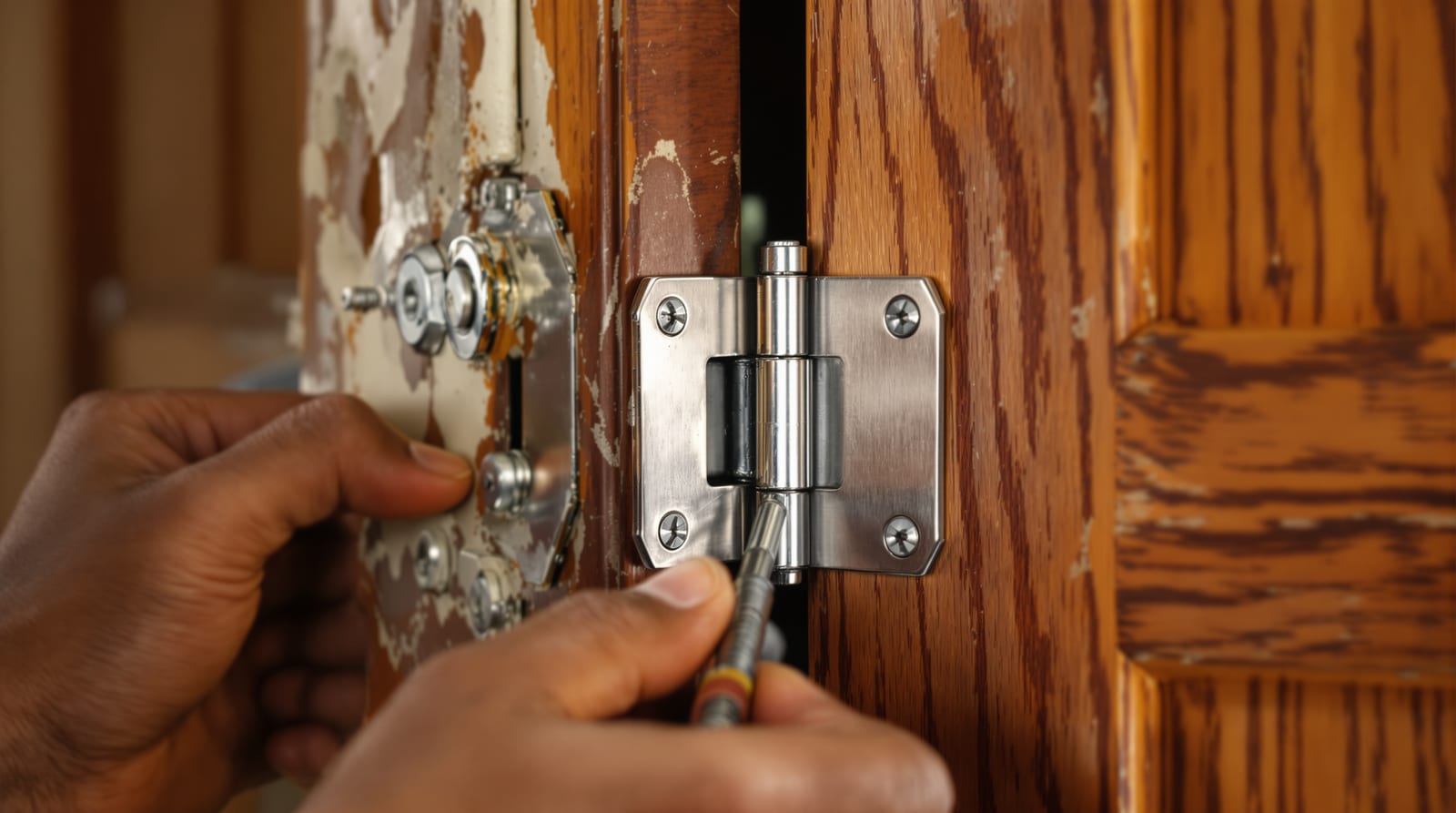
Door Hinge Replacement: DIY Step-by-Step Guide (India 2026)
Match the size, type and finish, then swap a worn or rusted hinge yourself without taking the whole door off its frame.
A worn, rusted or bent hinge is one of the most common reasons a door starts to sag, rub the frame or squeak — and the good news is that door hinge replacement is a genuinely doable DIY job for most homeowners. The trick is to match the new hinge exactly (size, type and finish), then remove and replace one hinge at a time while the door stays supported, so the leaf never drops out of alignment. Get those two things right and you avoid 90% of the trouble people run into. This guide walks you through choosing the correct hinge, working out how many your door needs, the step-by-step swap, and how to rescue a tired mortise or stripped screw hole.
Difficulty: easy to moderate. Time: 30-60 minutes per hinge for a first-timer. When to stop: if the door itself is warped, the frame is rotten or split, or the leaf has dropped because the frame has shifted, replacing a hinge won't fix it — see fix sagging door and door frame repair.
Why hinges fail (and when to replace vs tighten)
Not every hinge problem needs a new hinge. Before you buy anything, diagnose honestly:
| Symptom | Likely cause | Fix |
|---|---|---|
| Door squeaks but moves fine | Dry pivot | Lubricate — see lubricate door hinges |
| Door sags, hinge wobbles | Loose screws in soft wood | Tighten / re-anchor — fix loose door hinges |
| Hinge stiff, gritty, leaves orange dust | Corrosion / rust | Replace if pitted — rusted door hinges fix |
| Visible bend, knuckle play, pin won't sit | Worn or bent hinge | Replace the hinge |
| Screw spins, won't bite | Stripped hole | Plug & re-drill — stripped hinge screw fix |
Replace the hinge when the metal is bent, the knuckle has visible vertical play, the pin is loose or missing, or rust has pitted the leaf. A door that drags or rubs only when the hinge is intact is usually an alignment issue — check door rubbing frame first.
Step 1: Match the new hinge exactly
Never buy by guesswork. Take the old hinge to the shop, or measure it. Three things must match.
Size
Measure the hinge fully open: height (the long edge), width (across both leaves open flat), and the thickness/gauge of the metal. In India, common butt-hinge heights are 75 mm (3"), 100 mm (4") and 125 mm (5"). A 35 mm internal flush door usually takes 100 mm hinges; heavier teak or main doors take 125 mm. The new mortise must fit the existing recess, so the height and width are non-negotiable.
Type
- Plain butt hinge — fine for light internal doors.
- Ball-bearing butt hinge — has bearings between the knuckles; runs smoother, lasts far longer, and is the right choice for heavy doors, main doors and any door fitted with a door closer. Worth the small premium.
- Spring / self-closing hinge — only if the door must close itself; not a like-for-like swap for a plain hinge.
Finish & metal
This matters more in India than people expect:
| Metal / finish | Best for | Notes |
|---|---|---|
| Stainless steel (SS 304) | Humid, coastal, bathrooms, main doors | Won't rust; choose SS 304 for coastal Kerala/Goa/Mumbai |
| Mild steel (MS), powder-coated/brass-plated | Dry interiors, budget | Cheapest; coating chips, then rusts |
| Brass / antique brass | Decorative interior doors | Softer; fine for light doors |
| Aluminium | Light internal doors | Lightweight, won't rust, but bends easily |
For anywhere near the coast, in bathrooms, or for a hard-working main door, choose SS 304 — the extra ₹50-150 per hinge pays for itself the first monsoon. Match the visible finish (satin, chrome, antique brass) to your other hardware so the door looks consistent — see the door hardware guide.
Not sure of the size? Run your figures through the door hinge size calculator.
Step 2: How many hinges does your door need?
More weight and more height = more hinges. As a working rule for Indian doors:
| Door height | Door weight / type | Hinges |
|---|---|---|
| Up to 1.5 m | Light internal | 2 |
| Up to 2.1 m (7 ft) | Standard flush / hollow | 2-3 |
| 2.1-2.4 m | Solid wood, teak, heavy flush | 3 |
| Over 2.4 m or very heavy main door | Solid teak, double doors | 4 |
Three hinges is the safe default for most 7 ft Indian doors; the middle hinge stops the leaf bowing and shares the load. If your door currently has only two and it sags, adding a correctly mortised third hinge is often the real fix — but that is a fresh mortise, a step up in difficulty.
Tools & materials you'll need
| Item | Approx ₹ |
|---|---|
| New hinge(s), SS 304 ball-bearing | ₹150-700 each |
| Screwdriver set (Phillips + flat) | ₹150-400 |
| Cordless drill + bits (optional) | ₹1,500+ (or borrow) |
| Wood chisel (12-25 mm) + mallet | ₹250-600 |
| Wood filler / putty | ₹100-250 |
| Matchsticks/toothpicks + carpenter's glue (for screw holes) | ₹50-150 |
| Pencil, steel rule, wood wedges / shims | ₹100 |
| Touch-up marker or polish | ₹100-300 |
Total DIY outlay for a single-hinge swap: roughly ₹500-1,200 including the hinge. A carpenter visit for the same job runs ₹400-800 (half-day) — worth it if you're nervous or the door is heavy. GST 18% applies on the goods.
Step 3: Replace the hinge — one at a time
The golden rule: swap one hinge at a time, leave the others screwed in, and support the door. This keeps the door hanging in alignment so the new mortises line up perfectly.
1. Wedge the door. Open it about 90 degrees and push a wood wedge or folded cardboard under the outer (latch-side) bottom corner to take the door's weight off the hinges.
2. Work on one hinge. Start with the middle or bottom hinge. Unscrew the leaf from the door, then from the frame. Don't touch the other hinges.
3. Test-fit the new hinge in the existing mortise. It should sit flush — its face level with the surrounding wood. If it sits proud, the mortise is too shallow; if it sinks, it's too deep.
4. Deepen or realign the mortise if needed (see next section).
5. Fix the screw holes if any screw spins freely (see below) — do this before fitting.
6. Screw the new hinge in. Drive the centre screw of each leaf first to seat it, check it sits flush, then drive the rest. Snug, not over-tight — over-driving strips the hole.
7. Move to the next hinge and repeat. Only when one is fully done do you start the next.
8. Test the swing. The door should open and close without rubbing or springing back. Lubricate the new pin with silicone or graphite.
Doing all hinges at once, or taking the door fully off, almost guarantees misalignment — resist it.
Step 4: Mortise & screw-hole rescue
Deepen or realign the mortise
If the new hinge sits proud, lay it in the recess, score around it with a pencil, then pare the recess slightly deeper with a sharp chisel — bevel down, light taps, test often. If the old mortise is too deep (the door hangs loose toward the latch), pack the recess with a thin slip of veneer or a card shim before screwing the hinge back, so the leaf sits flush.
Fix stripped or spinning screw holes
A screw that spins won't hold a hinge no matter how new it is. Two reliable fixes:
- Matchstick/toothpick plug: snap matchsticks or toothpicks, coat with carpenter's glue, tap them into the hole, snap off flush, let it set 30 minutes, then re-drive the screw into solid wood.
- Larger screws: move up one screw size (e.g. from a No. 8 to a No. 10) if the hole is only slightly worn.
Costs at a glance
| Job | DIY (parts) | Carpenter |
|---|---|---|
| Replace one hinge, like-for-like | ₹150-700 | ₹400-800 visit |
| Replace all 3 hinges, SS 304 | ₹600-2,100 | ₹800-1,500 day |
| Add a third hinge (new mortise) | ₹250-700 + chisel | ₹600-1,200 |
| Stripped-hole repair | ₹50-150 | usually bundled |
DIY almost always wins on cost for a straight swap; pay a carpenter when a fresh mortise, a heavy main door, or a misaligned frame is involved. To compare across both, try the door repair cost estimator.
When to call a carpenter (or stop)
- The door is warped or the frame split/rotten — a hinge won't cure it; see warped door fix.
- A heavy solid-teak or double main door you can't safely support alone.
- The mortise is so damaged it needs filling and recutting from scratch.
- The door is glass or part of an automatic/sensor system — isolate power and call a pro; never improvise on toughened glass or auto-operators.
For the wider picture, see the complete door guide and the door troubleshooting pillar.
Frequently asked questions
Can I replace just one hinge, or do I have to do all of them?
You can replace just the faulty one — but always match the new hinge's size, type and finish to the others, and consider doing the full set if the rest are old or rusted. Mismatched hinges can throw the door out of line.
SS or MS hinges — does it really matter?
Yes, especially in India. Stainless steel (SS 304) won't rust and is essential near the coast, in bathrooms and on hard-working main doors. Mild steel is cheaper but its coating chips and then corrodes, often within a monsoon or two.
How many hinges should a 7-foot door have?
Most standard 7 ft (2.1 m) Indian doors are fine with three hinges. Light internal doors can manage two; heavy solid-teak or over-8 ft doors may need four. Three shares the load and stops the leaf bowing.
My new hinge sits higher than the wood surface — what now?
The mortise is too shallow. Score around the hinge and pare the recess slightly deeper with a sharp chisel, testing often, until the hinge sits flush with the surrounding timber.
The screws just spin and won't tighten. How do I fix it?
The hole is stripped. Glue-and-pack it with matchsticks or toothpicks, let it set, then re-drive into solid wood — or step up one screw size. For badly worn holes, plug with a glued hardwood dowel and re-drill.
Is hinge replacement a DIY job or should I call someone?
A like-for-like swap is an easy-to-moderate DIY job taking 30-60 minutes a hinge. Call a carpenter for heavy main doors, a fresh mortise, or if the door is warped, glass or automatic.
Export this guide
Related Guides — Deep-dive reading
Stripped Hinge Screw Fix: 5 Proven Methods (India 2026)
Your hinge screw spins without biting and the door has dropped? Here are five ranked fixes, from a longer screw to a glued dowel plug.
Home Doors & EntrancesFix Loose Door Hinges: Easy DIY Repair Guide India 2026
Tighten, re-anchor or replace sagging hinges with the matchstick trick and longer screws — the #1 cure for most door faults.
Home Doors & EntrancesDoor Hinges Guide for Indian Homes: Types, Sizes & Sag-Free Fitting
How to choose, size and count door hinges — from SS butt and ball-bearing to concealed soft-close — so your doors swing true for decades.
Home Doors & EntrancesRelated Tools — Try Free
Door Cost Calculator
Estimate the all-in cost of a door — leaf, frame, hardware, fitting and GST — by type, material and size.
Door CalculatorDoor Hardware Cost Estimator
Estimate the all-in hardware cost for a door — hinges, lock, handle, closer, bolts, stopper and fitting — with GST.
Door CalculatorDoor Hinge Selector
Get the right hinge type, size and count for a door by its height, weight and material — with a coastal SS-304 note.
Door Tool