
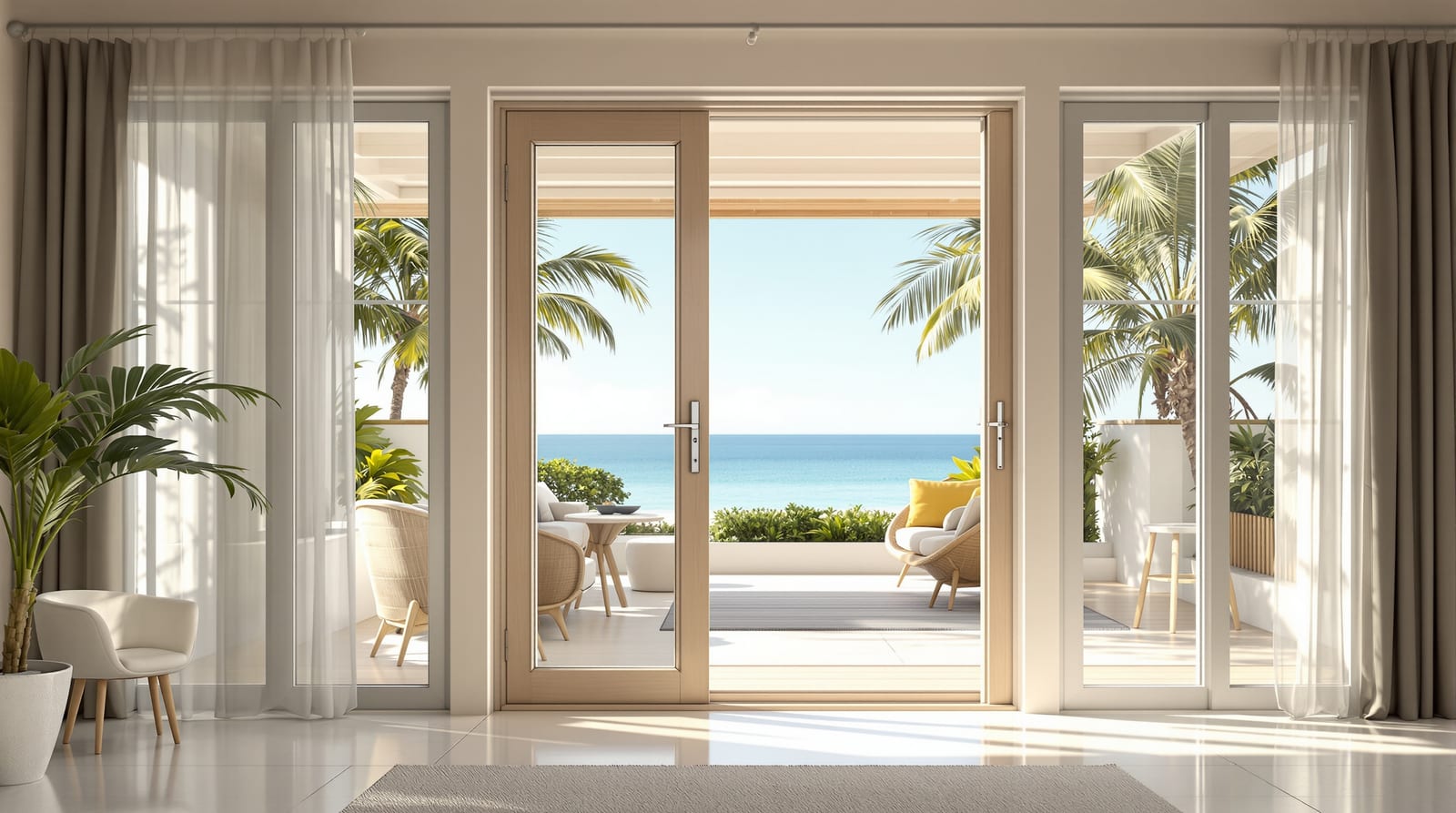
Coastal Region Door Buying in India 2026: Salt-Air Guide
Why cheap flush and MDF doors fail near the sea, and which water-resistant materials and corrosion-proof hardware actually last.
If you live within a few kilometres of the sea, coastal region door buying is a different game from buying doors anywhere else in India. The villain is not the monsoon downpour you can see — it is the invisible mix of airborne salt and relentless humidity that creeps into every joint, glue line and screw thread. In Mumbai, Goa, coastal Kerala, and the seaboards of Tamil Nadu, Andhra Pradesh, Odisha and West Bengal, a door that would last fifteen years inland can warp, delaminate or rust its hinges in two or three monsoons. This guide tells you which materials survive, which to avoid outright, what the coastal premium costs, and why the cheapest door is almost never the cheapest over its life.
Why salt air and humidity destroy ordinary doors
Three forces work together near the coast. First, relative humidity routinely sits at 75–90% for months, so wood and wood-composites never fully dry out — they stay swollen, soft and food for fungus. Second, airborne salt is hygroscopic: it pulls moisture onto every surface, keeps timber damp, and aggressively corrodes mild-steel hardware. Third, wet-dry swings between monsoon and summer make materials expand and contract, cracking glue lines.
This is why the doors builders fit by default fail first:
- Hollow-core flush doors — the thin face veneers absorb moisture, the internal honeycomb collapses, and the leaf goes soft and rattly.
- MDF and cheap moulded-skin doors — MDF is compressed wood fibre with glue; it drinks humidity like a sponge, swells at the bottom edge, and crumbles. Avoid MDF entirely on the coast.
- Untreated or under-treated flush doors — even "BWR" grade fails if the edges are unsealed, because water wicks in through the bottom rail.
- Mild-steel hinges, mortise locks and screws — these rust within a year or two, staining the door and seizing up.
The fix is to choose a core material that simply does not care about water, then pair it with hardware that does not corrode.
The materials that survive the coast
Here is how the realistic options compare. Prices are pan-India 2026 supply-only averages for one standard 7×3 ft leaf, before the coastal/city premium and before 18% GST.
| Material | Salt-air verdict | Supply price (₹) | Best use |
|---|---|---|---|
| WPC door | Excellent — 100% waterproof core | 4,500–7,500 | Bathrooms, balconies, all internal doors |
| uPVC door | Excellent — sealed, rustproof frame | 8,000–16,000 | External, sea-facing, balcony, utility |
| FRP / fibreglass door | Excellent — won't rot, warp or rust | 5,000–12,000 | External, service, terrace, bathroom |
| Marine-grade ply flush (IS 710) | Very good if edges sealed | 5,000–9,000 | Bedrooms, study, where you want a wood look |
| Seasoned teak panel | Good — naturally oily, but needs upkeep | 22,000–45,000+ | Main door, statement entry |
| PVC door (hollow) | Fair — fine for bathrooms only | 1,800–4,000 | Bathroom, low-traffic wet areas |
| Hollow-core / MDF flush | Avoid on the coast | 1,800–3,000 | Inland only |
WPC (Wood-Plastic Composite) is the workhorse of the coast: its core is polymer plus wood flour with no honeycomb to collapse, so it is genuinely waterproof and termite-proof. See the WPC doors guide and live WPC door prices.
uPVC doors and frames are the gold standard for external and sea-facing openings — fully sealed, salt-proof and weather-gasketed, though they cost more upfront. Read the uPVC doors guide.
FRP (fibreglass-reinforced polymer) is underrated: it never rots, warps or rusts, takes a wood-grain finish, and is popular for service and terrace doors in Kerala and coastal Tamil Nadu.
Marine-grade plywood (IS 710 BWP) lets you keep a real-wood flush look if you seal all edges and the bottom rail. Seasoned teak still works for a grand main door because its natural oils resist water — but it demands annual oiling near the sea. Compare all options in the door materials comparison and best door material guides.
Hardware: where coastal doors quietly fail
You can buy the perfect waterproof leaf and still lose the door to rusted hardware. Salt air attacks mild steel and even ordinary nickel-plated zinc. Near the sea, insist on:
- Stainless steel grade SS 316 (marine grade) for hinges, screws, tower bolts and door handles. SS 316 contains molybdenum and resists salt far better than the cheaper SS 304 most showrooms stock by default — ask specifically.
- PVD-coated or powder-coated locks and handles for an extra corrosion barrier.
- Brass for traditional main-door fittings — naturally corrosion-resistant, common in Goa and Kerala heritage homes.
- For smart locks, check the IP/weather rating and prefer models rated for humid exteriors; keep them under a porch, not in direct salt spray.
Budget more for hardware than you would inland. See the door hardware guide and, for entrances, door security and smart door locks.
What the coastal premium actually costs
There are two cost effects on the coast. First, you upgrade the material away from the cheapest flush door. Second, several coastal cities carry a city cost index above the national average — Mumbai 1.20, Bengaluru 1.15, Chennai 1.08, Pune 1.10, Kochi 1.05, Hyderabad 1.05 — driven by labour, real-estate and showroom costs. Both stack on the supply price before 18% GST.
| Choice | National supply (₹) | In Mumbai (×1.20) | + 18% GST |
|---|---|---|---|
| Hollow-core flush (avoid) | 2,400 | ~2,880 | ~3,398 |
| WPC internal door | 6,000 | ~7,200 | ~8,496 |
| uPVC external door | 12,000 | ~14,400 | ~16,992 |
| FRP service door | 8,000 | ~9,600 | ~11,328 |
| SS 316 hardware set (per door) | 2,500 | ~3,000 | ~3,540 |
Across a 3BHK of 10–14 doors, switching from cheap flush to a coastal-grade mix typically adds ₹40,000–₹1,20,000 to the door budget. That feels steep — until you run the maintenance economics below. Use the door cost by city calculator to localise these figures, and the door GST calculator to add tax cleanly. For the full national benchmark see the 2026 door cost guide, and for city-by-city numbers the door cost by city pillar.
Maintenance economics: cheap doors are the expensive ones
The coastal trap is buying down. A ₹2,400 hollow-core flush looks like a saving, but near the sea it commonly needs replacing within 3–5 years, and its mild-steel hinges may rust in year one or two. Over a 15-year horizon you might fit it three times plus repaint and rehinge it — easily ₹12,000–₹18,000 all-in, with months of swollen, sticking, mouldy door in between.
A ₹6,000 WPC door (₹7,200 in Mumbai) fitted once, with SS 316 hardware, runs roughly 15+ years with near-zero upkeep. The waterproof options pay for themselves on the coast purely by not failing. As a rule of thumb: spend the premium on the leaf and the hardware; save on nothing.
| Spec | 15-year true cost (indicative) | Hassle |
|---|---|---|
| Cheap flush, mild-steel fittings | Refit ×2–3 + rust = ₹12k–18k | High — recurring swelling, rust, mould |
| WPC leaf, SS 316 hardware | One fit + minimal upkeep = ₹8k–10k | Low |
| uPVC external, SS 316 | One fit, gasket check = ₹14k–18k | Very low |
Even where the durable door costs more upfront, it usually costs less per year of service. Plan the whole-home spend with the door budget planner.
Buying smart on the coast — a quick checklist
- Match material to exposure. Sea-facing and external openings → uPVC or FRP. Internal and bathrooms → WPC. Main door → treated teak or a designer FRP/WPC with a wood finish.
- Demand sealed edges on any ply-based door, including the bottom rail — that is where water wicks in.
- Specify SS 316 hardware by name; do not accept "stainless" without the grade.
- Read the warranty for water/termite cover and keep the invoice (see the door warranty guide). Confirm GST and HSN on the bill via the door GST and HSN guide.
- Get supply-only and installed quotes separately so you can compare like with like — the door quotation guide shows how.
- Check local dealer reach for after-sales — replacement gaskets and parts matter near the sea (see where to buy doors).
For the bigger picture on choosing across rooms and climates, start with how to choose doors and the home doors complete guide.
Frequently asked questions
Are WPC doors really waterproof enough for a sea-facing flat?
For internal doors, balconies and bathrooms, yes — a quality WPC door has no honeycomb core to collapse and does not absorb water, so it shrugs off coastal humidity. For the actual external sea-facing door taking direct spray and sun, uPVC or FRP is the safer, longer-lasting choice.
Can I still have a real teak main door near the sea?
Yes. Seasoned teak is naturally oily and water-resistant and remains a classic coastal main door, especially in Goa and Kerala. The catch is upkeep: budget for re-oiling or sealing once a year and use brass or SS 316 fittings, or the hardware will rust before the timber fails.
What hardware grade should I insist on?
Stainless steel grade SS 316 (marine grade) for hinges, screws, bolts and handles. Many showrooms default to the cheaper SS 304, which still corrodes faster in salt air. Ask for SS 316 by name, or use PVD-coated and powder-coated fittings as a backup barrier.
How much more do coastal-grade doors cost?
Expect to pay a premium on two counts: upgrading the material (a WPC door is ₹4,500–₹7,500 supply vs ₹1,800–₹3,000 for cheap flush) and, in cities like Mumbai or Bengaluru, a 15–20% city loading on top, plus 18% GST. Across a 3BHK that often adds ₹40,000–₹1,20,000 — usually repaid by avoiding repeat replacements.
Is MDF ever acceptable on the coast?
No. MDF and cheap moulded-skin doors absorb humidity, swell at the bottom edge and crumble within a few seasons near the sea. Skip them entirely and choose WPC, FRP, uPVC or properly sealed marine-grade ply instead.
Which doors should I avoid completely in a coastal home?
Hollow-core flush doors, MDF doors, and any door fitted with mild-steel hinges and screws. They are the cheapest at purchase and almost always the most expensive over fifteen years once you factor in warping, mould, rusted fittings and repeat replacements.
Export this guide
Related Guides — Deep-dive reading
South India Door Buying Guide: Prices & Brands India 2026
Where South Indians buy doors, what teak, WPC and uPVC cost across Bengaluru, Chennai, Hyderabad and Kochi, and how to spec for heat and monsoon.
Home Doors & EntrancesDoor Cost in Hyderabad: Prices, Markets, GST Guide 2026
What doors really cost in Hyderabad in 2026 — city index 1.05, worked examples with 18% GST, and the markets where people actually buy.
Home Doors & EntrancesDoor Cost in Jaipur (2026): Prices, Markets & Buying Guide
What doors really cost in Jaipur in 2026 — city index 0.95, worked examples with 18% GST, real timber markets and the carved-wood heritage premium.
Home Doors & EntrancesRelated Tools — Try Free
Door Material Comparison Tool
Compare 2–4 door materials on cost, durability, maintenance, security and moisture resistance.
Comparison ToolDoor Cost Calculator
Estimate the all-in cost of a door — leaf, frame, hardware, fitting and GST — by type, material and size.
Door CalculatorWindow Hardware Cost Calculator
Estimate window hardware cost — hinges, handles, locks, rollers and multipoint gears.
Window Calculator