
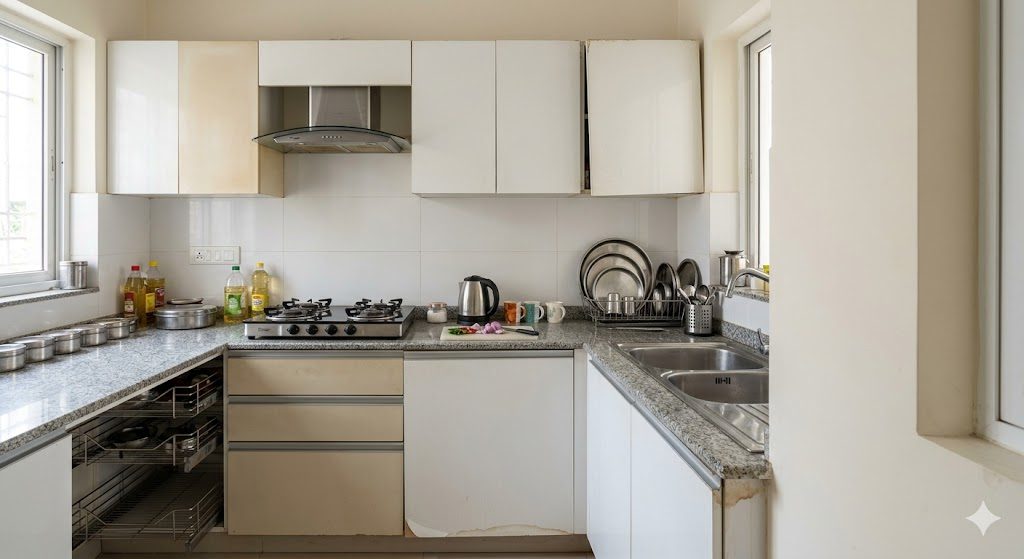
Why Most Indian Kitchens Fail After 5 Years
The six failure modes you can design out at planning stage — and the standard timeline they follow
A modular kitchen in an Indian home almost never fails because of how it was used. It fails because of how it was bought. The decision to save 600 rupees on a ply grade, drop the chimney from the BOQ, or skip edge banding — each one is invisible at handover and unforgivable at year five. The Indian kitchen ages on a remarkably consistent timeline, and that timeline tells you which planning-stage decisions cost the most.
This guide walks through that timeline year by year, names the six big failure modes, and pins each one to the decision that prevents it. Numbers come from IS 303 and IS 710 (ply grades) and the National Building Code's ventilation chapter. It is a deep-dive companion to our best modular kitchen layout for Indian cooking.
The 5-year failure timeline
The kitchen you bought from the catalogue is engineered for the showroom, not the next decade. Walk it forward year by year and the failure pattern is almost universal in Indian homes — same sequence, same months, same line items in the rework quote.
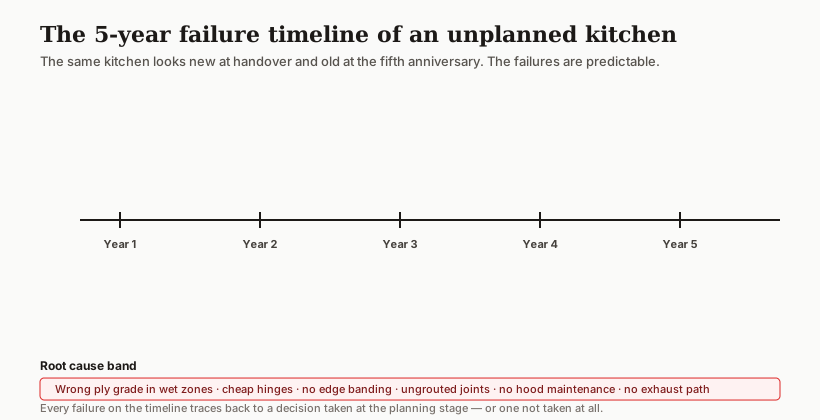
| Year | What you notice | What is actually happening |
|---|---|---|
| 1 | Looks new. Soft-close hisses, shutters align. | Hardware grease and tolerances are fresh. Latent failures already seeded. |
| 2 | One or two shutters drift a millimetre off-plumb. | Concealed hinges with sub-spec cup-and-spring fatigue under cooking-hour cycling. |
| 3 | Laminate edge lifts on the sink-front shutter. | The cut edge was never banded with PVC; daily splash has crept into the substrate. |
| 4 | The sink-base cabinet has a soft, swollen feel along the bottom rail. | Moisture-resistant (IS 303) ply has absorbed plumbing seepage. The fibre swells; it never recovers. |
| 5 | Drawer rails bind, the chimney is a brown grease haze, the kitchen "feels old". | Ball-bearing slides have lost lubrication, hood baffles were never washed, ambient damp has stained walls. |
Five years is not a long warranty for a kitchen that should outlast the loan that bought it. The reason most do not is that the six failures below were never designed out.
Failure mode 1 — Wet-zone carcase failure
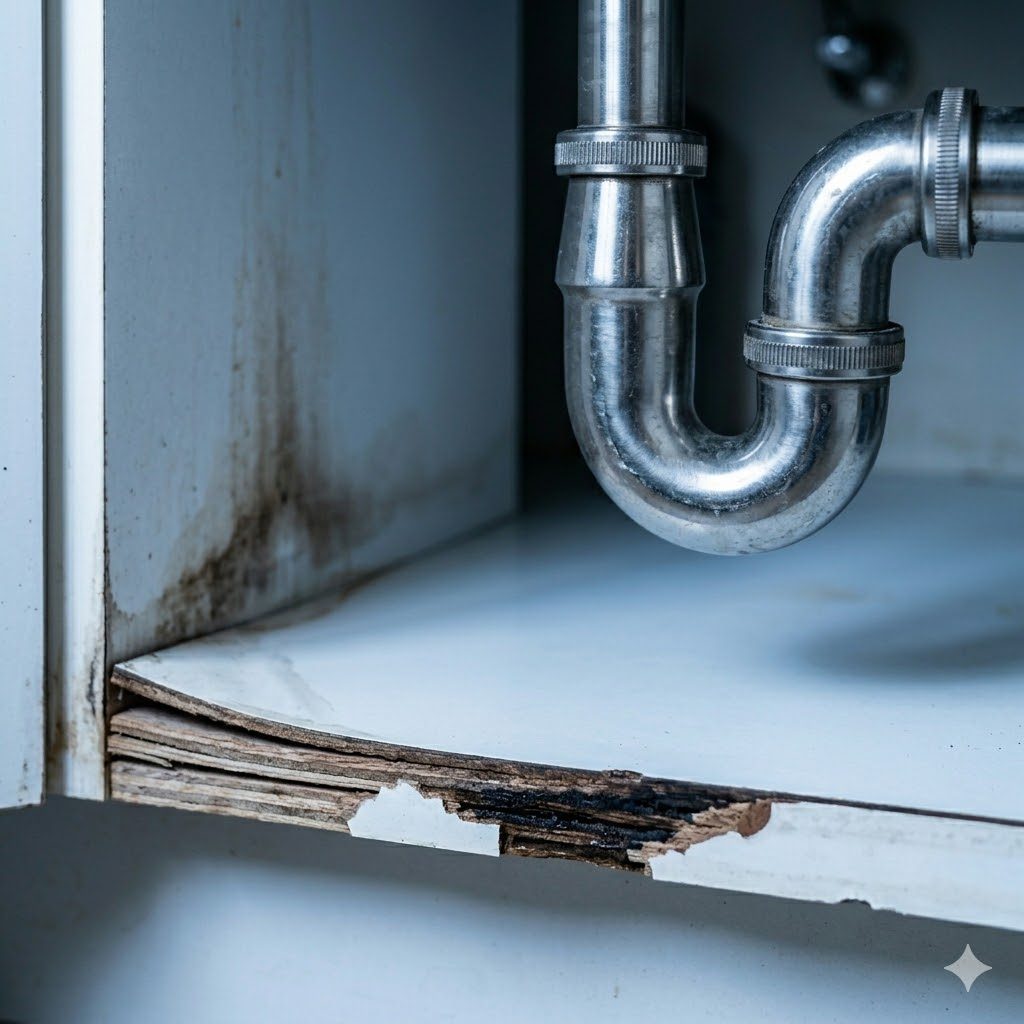
The single most expensive failure in an Indian kitchen is the sink-base cabinet rotting from below. It is also the most preventable.
Carcase boards in most catalogue kitchens are 18 mm moisture-resistant ply manufactured to IS 303 — fine for a wardrobe, wholly wrong for a cabinet under a sink. The correct specification for any wet zone is BWP ply to IS 710, graded for repeated boiling-water exposure and using phenol-formaldehyde resin. The cost difference per sink-base cabinet is 600 to 1,200 rupees. The cost of replacing it after failure is closer to 55,000 rupees, plus four to six days the kitchen is unusable.
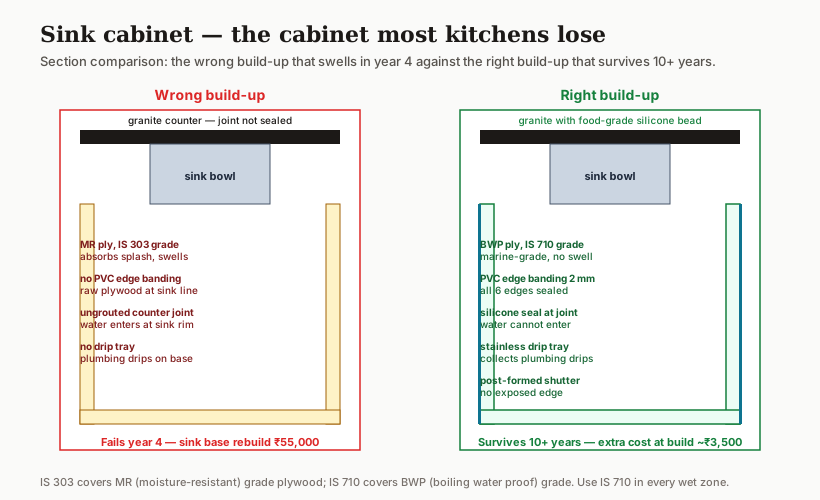
The build-up matters as much as the grade. The right detail is: IS 710 BWP ply on all six panels, 2 mm PVC edge banding on every exposed edge, a food-grade silicone bead between counter and sink rim, and a removable stainless drip tray inside the cabinet.
Failure mode 2 — Hardware fatigue
The cheapest hinge and the most expensive hinge look identical at handover. They are very different by month thirty. A budget hinge is rated for around 50,000 open-close cycles; a tier-1 European hinge (Hettich, Hafele, Blum) is rated for 80,000 to 200,000 cycles. An Indian shutter opens roughly twenty times a day on a busy run — 7,300 cycles a year. Five years takes the cheap hinge past its design life; the premium hinge is barely halfway through.
The same arithmetic applies to drawer slides. Standard roller slides bind and rattle inside three years on a daily-use atta drawer. Ball-bearing full-extension slides with a 35 kg dynamic rating outlast them by a factor of three. Soft-close mechanisms stop the carcase joints from being shocked apart, twenty times a day, for a decade.
Failure mode 3 — Finish delamination
A laminate shutter that has not been edge-banded is a failure waiting for a humid monsoon. Laminate is a paper-and-resin sheet glued to a substrate; the cut edge exposes raw substrate to any moisture the kitchen offers. Once water has crept a millimetre under the laminate, no amount of re-pressing will hold it.
The fix is simple and almost free at build time: 2 mm PVC edge banding, hot-melt applied, on all four edges of every shutter and on the exposed edges of every internal shelf. For high-wet zones, post-formed shutters (the laminate is wrapped around the edge in one piece, no joint) eliminate the failure entirely. Acrylic and PU shutters delaminate less but scratch and dull where laminate would simply have lifted — there is no maintenance-free finish, only honest trade-offs.
Failure mode 4 — Countertop joint failure
Granite is the default Indian counter material, and a granite counter installed correctly will outlast the building. Installed wrong, it fails at the joint. The two big mistakes are an unsealed joint between counter and dado (water enters at the rear edge and rots the carcase from behind) and an unsealed cut-out for the sink (water enters at the rim and rots from above).
Both are solved by a food-grade silicone bead applied during install — five minutes of work, lost when the installer is paid by the slab and not by the year. Quartz, which is engineered stone, removes one variable: it does not need annual sealing the way natural granite or marble do. Either material will last; neither will if the joints are open.
Failure mode 5 — Hood-grease ageing
Indian cooking puts more grease into the air per square metre than any other domestic cuisine. A wall-mount chimney captures it in a baffle or cassette filter that has to be removed and washed. Most Indian homes never wash theirs.
By year five the baffles are coated in a hard varnish of polymerised oil; airflow is a fraction of design. Cooking smells linger, the ceiling above the hob yellows, the upper cabinets nearest the hob develop a sticky film. The fix is two-part: a hood with dishwasher-safe baffles (every tier-1 brand meets this), and a monthly cleaning habit the kitchen plan actively supports — accessible filter clips, no cabinet door blocking baffle removal.
Failure mode 6 — Ventilation and damp-driven mould
The National Building Code (Part 8) requires every kitchen to have either openable windows giving a free area of at least one-tenth the floor area, or mechanical extraction. In practice, many flats have a single utility-side window kept closed against street noise. The hood evacuates cooking steam; nothing evacuates the residual humidity from washing, mopping, and the daily flame load.
The result is the brown-grey mould bloom on the back wall of cabinets, around the window reveal, and on the ceiling outside the kitchen door. It looks like a dirt problem; it is a ventilation problem. The planning-stage fix is an extract fan separate from the hood, ducted to outside, and a mineral or silicate paint that does not feed mould.
Every failure on the five-year timeline traces back to a decision taken at the planning stage — or one not taken at all.
The six failures, ranked by what they cost to fix
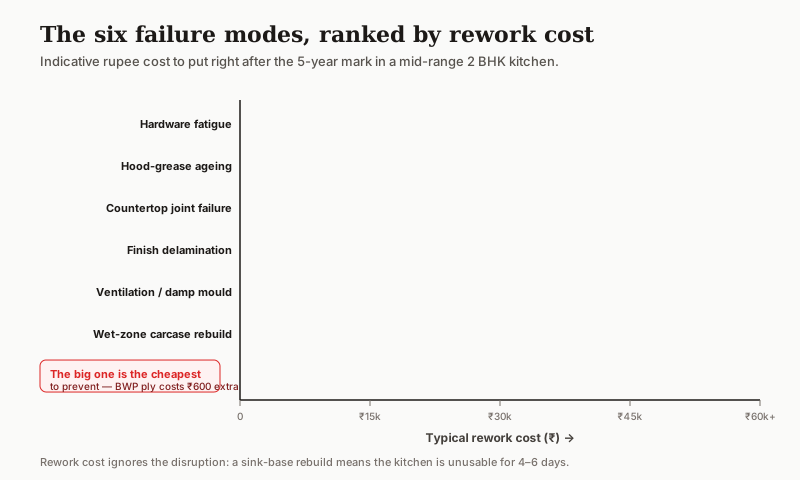
| Failure mode | Typical rework cost | Cost of prevention at build | Ratio |
|---|---|---|---|
| Hardware fatigue | ₹8,000 | ₹3,500 (hinge upgrade) | 2.3× |
| Hood-grease ageing | ₹12,000 | nil (habit + accessible filter) | — |
| Countertop joint failure | ₹18,000 | ₹400 (silicone bead) | 45× |
| Finish delamination | ₹22,000 | ₹2,000 (PVC edge banding) | 11× |
| Ventilation / damp mould | ₹32,000 | ₹6,000 (extract fan + ducting) | 5.3× |
| Wet-zone carcase rebuild | ₹55,000 | ₹3,500 (IS 710 + edge banding) | 16× |
Read the right-hand column. The cheapest-to-prevent failure is also the most expensive to repair — no other comparison in interior design has a return this extreme.
The fix, in order
1. Specify IS 710 BWP ply for every wet zone — sink base, dishwasher base, water-purifier cabinet — and IS 303 MR ply elsewhere is fine. Get the brand stamp on the BOQ; verify on site.
2. Tier-1 hinges and full-extension ball-bearing slides on every daily-use drawer. Budget at least 15–20 per cent of the kitchen line for hardware.
3. 2 mm PVC edge banding on every cut edge, no exceptions. Post-formed or membrane-pressed shutters for the wettest zones.
4. Silicone every joint — counter-to-dado, counter-to-sink-rim, counter-to-hob-cut-out — with food-grade silicone, not the cheaper construction kind.
5. Hood with dishwasher-safe baffles, plan the cabinet so the filter slides out without removing a shutter.
6. Extract fan separate from the hood, ducted to outside, sized to NBC's free-area rule.
Prevent it / Plan it: Verify your specifications and brand stamps with the material quality checklist and choose between MR, BWR and BWP grades with the material decision framework. For wider context, read common kitchen planning errors, the interior choices that age poorly, why cheap interiors are expensive later, and the pillar best modular kitchen layout for Indian cooking.
References
- Bureau of Indian Standards (1989, reaffirmed 2018) IS 303: Plywood for General Purposes — Specification. New Delhi: BIS.
- Bureau of Indian Standards (2010, reaffirmed 2020) IS 710: Marine Plywood — Specification. New Delhi: BIS.
- Bureau of Indian Standards (2016) National Building Code of India 2016, Part 8: Building Services, Section 1 — Lighting and Ventilation. New Delhi: BIS.
- Panero, J. and Zelnik, M. (1979) Human Dimension and Interior Space. New York: Whitney Library of Design.
- National Kitchen and Bath Association (2016) Kitchen and Bathroom Planning Guidelines with Access Standards. Hoboken, NJ: John Wiley & Sons.
Part of the Studio Matrx Kitchen Design series.
Export this guide
Related Guides — Deep-dive reading
How to Design a Low-Maintenance Kitchen
The finishes, joinery and hardware that survive Indian cooking with the least weekly attention
Kitchen DesignBudget vs Premium Interiors: What Actually Changes?
Where the extra money really goes — and where premium is just a markup
Cost & MoneySmart Storage Interiors — A 2026 Working Reference for Indian Homes
Inventory-driven · Floor-to-ceiling · Hardware-engineered · Zone-mapped
Room PlanningRelated Tools — Try Free
Cross-Ventilation Analyzer
Estimate airflow and air changes per hour (ACH) from room size, window areas, layout, and local wind — with NBC 2016 Part 8 compliance check.
Ventilation CalculatorMaterial Comparison Sheet
India's interior material cheatsheet — plywood, finishes, hardware, countertops, paints, waterproofing.
Reference GuideMaterial Compare — Side by Side
Compare materials side-by-side: granite vs quartz vs marble, laminate vs acrylic vs PU, and more.
Comparison