
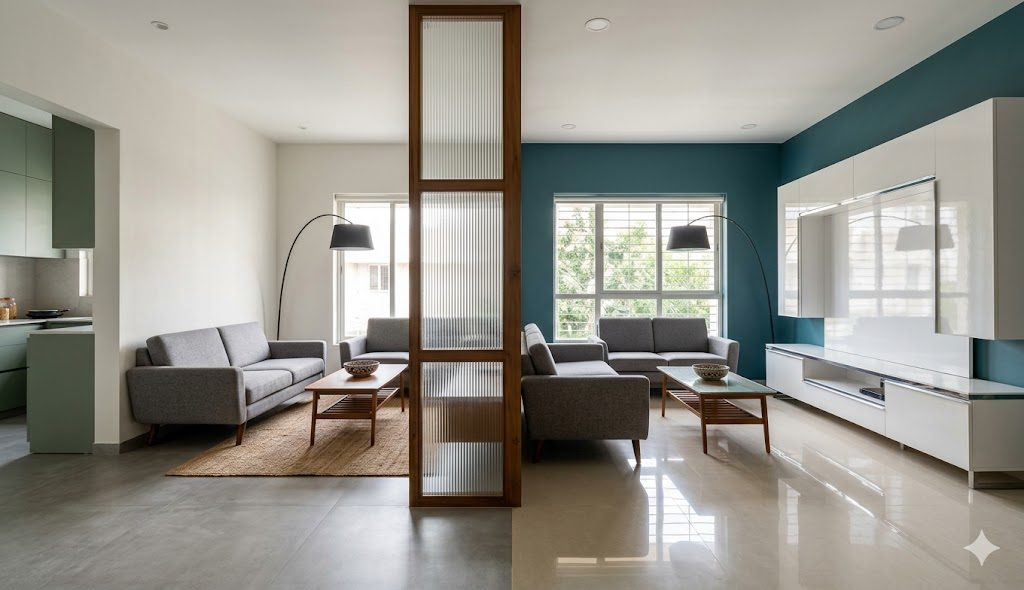
Matte vs Glossy Interiors
The matte-versus-glossy decision across shutters, paint, tile and laminate — and how Indian conditions decide it for you
The matte-versus-glossy question reaches every surface in an Indian home — the paint on the bedroom wall, the tile on the bathroom floor, the laminate on the kitchen shutter, the lacquer on the TV unit. Walk into ten apartments and you will see the same finish wrongly applied for the same reason: the homeowner picked what looked beautiful in the showroom under perfect spotlighting, not what survives a Sunday afternoon of cooking, mopping, and ten fingerprints on a freshly-cleaned panel.
The shorthand version is this. Gloss reflects, matte absorbs. Gloss makes a small room feel larger and a flaw more visible. Matte hides imperfections but eats light. Gloss shows every fingerprint and every micro-scratch with brutal honesty. Matte hides both, but if it is the cheap kind it traps oil and dirt in its open pores. The right answer changes by surface, by household, and by climate. There is no universally better finish — there is only the right finish for that specific surface in that specific home.
It is a deep-dive companion to our complete guide to plywood grades in India, because the finish on a panel only matters if the panel beneath it lasts long enough to wear it out.
The optics — why matte hides flaws and gloss exposes them
Every finish sits somewhere on a measurable spectrum of gloss units (GU), measured at a 60° angle of incidence per IS 2932 / ASTM D 523. A dead-flat matte reads under 5 GU. A satin reads 10–35 GU. A semi-gloss reads 35–70 GU. A high-gloss reads above 70 GU. A mirror-finish laminate or polished tile reads above 85 GU.
Light Reflectance Value (LRV) is a different scale — it measures total light bounced regardless of direction, and it decides how bright a room feels. A high-gloss white wall and a matte white wall can both have LRV around 80%, but the gloss wall sends that light back as one directional reflection (you see the lamp in it), while the matte wall scatters it evenly across the room. That is the trick gloss plays — it does not actually brighten the room more, it just feels like it does because of the visible specular highlights.
The flaw-hiding behaviour falls out of the same physics. A 0.2 mm bulge in plaster under matte paint catches no specular highlight — it is invisible. The same bulge under semi-gloss paint creates a tiny offset reflection that the eye reads as a shadow. The flaw is the same; the finish either hides it or weaponises it.
How four surfaces actually behave
The matte-versus-gloss decision changes by surface — there is no single rule. Here is how each of the four common surfaces behaves under each finish, with the property scores that drive the decision.
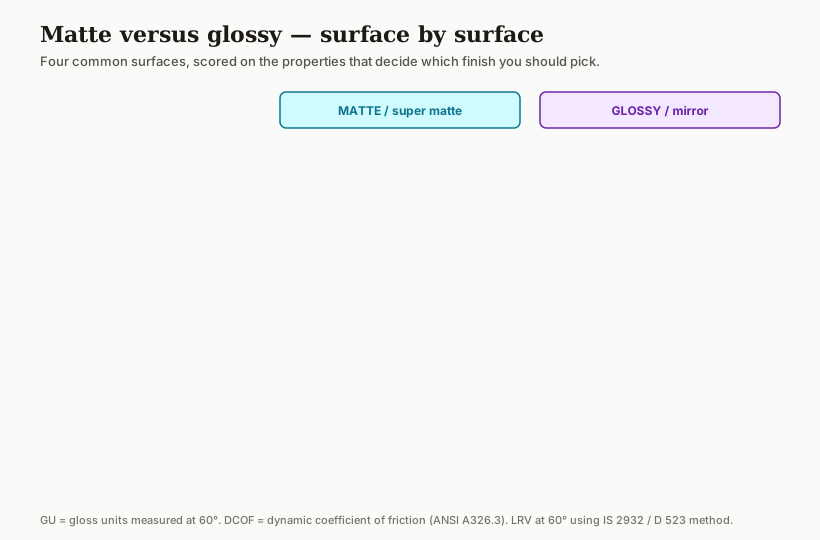
| Surface | Matte verdict | Gloss verdict | Indian-home call |
|---|---|---|---|
| Kitchen shutter | Hides oil, prints, scratches; LRV 30–45% | Brutal on prints, every micro-scratch reads | Super matte for daily shutters |
| Wall paint | Hides plaster flaws; sheen ≤ 5 GU | Reveals every flaw; sheen 50–85 GU; +35% cost | Matte in living/bedroom, semi-gloss in kid/bath |
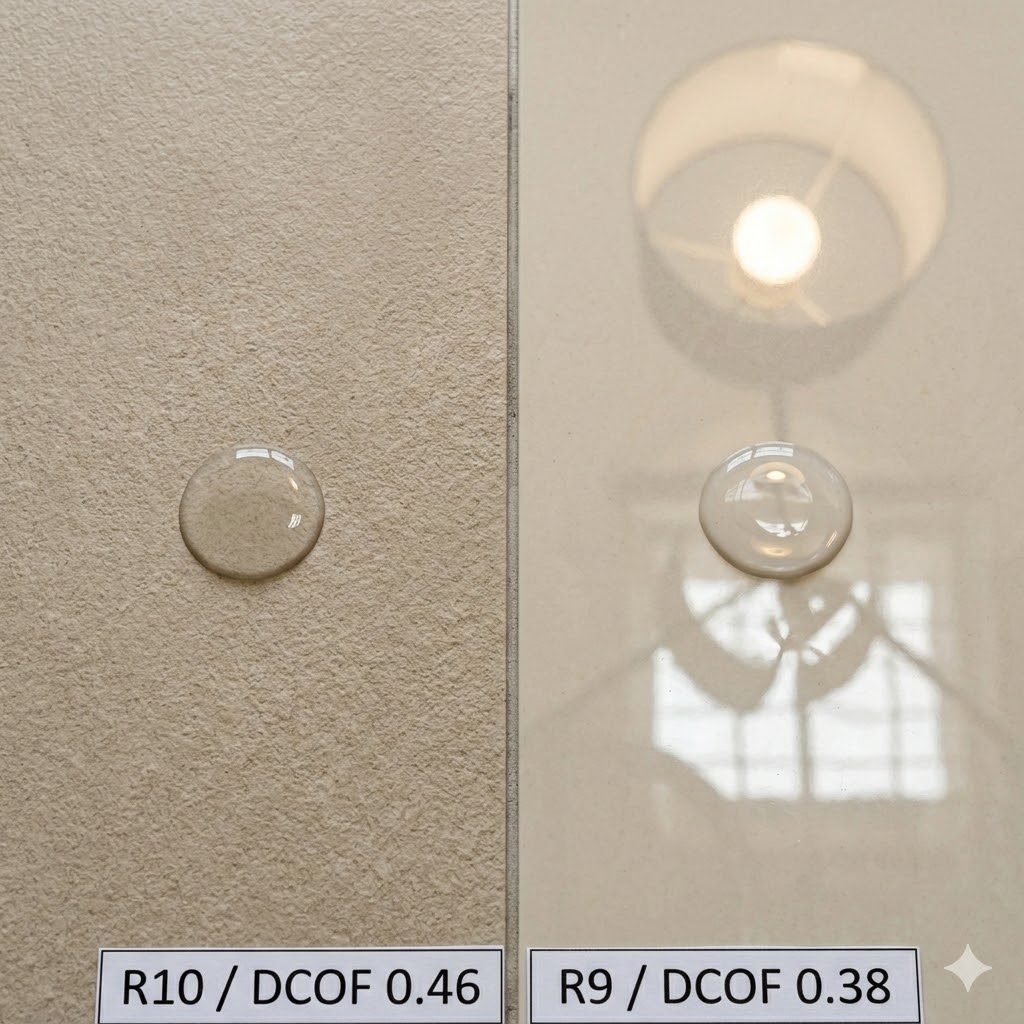
| Ceramic / vitrified tile | R10–R11, DCOF ≥ 0.42, slip-safe | DCOF < 0.42 when wet, slip-risk | Matte on every floor; gloss wall-only |
| Laminate (IS 2046) | Super matte hides prints and scratches | Mirror laminate scratches and prints obviously | Super matte for shutters, gloss for accent only |
The pattern is consistent across every surface: matte wins on anything you touch or walk on, gloss wins only on what you look at but never touch. The Indian-home call is to flip the showroom default — most builder-grade interiors give you semi-gloss paint, gloss tiles and gloss laminates because those are cheaper and easier to sell. The right spec in most rooms is matte everywhere except a small handful of accent moments.
Fingerprint and smudge behaviour
This is where homeowners feel the wrong choice fastest. A high-gloss kitchen shutter at 80 GU shows every fingerprint within an hour of wiping it clean. The reason is straightforward: a fingerprint is a thin oil film that scatters incoming light differently from the surrounding finish. On gloss, the contrast is sharp and visible. On matte, the surrounding finish is already scattering light, so the fingerprint scatters in the same direction and disappears.
But not all matte is equal. Standard matte has open pores in the overlay, which trap fingerprint oil and slowly accumulate — within a year the high-touch zones near handles look greyer than the rest. Super matte (anti-fingerprint) sheets — Merino Maxima, Greenlam Vivar, Royale Touche Velluto, Sundek Nature — have a sealed pore overlay that releases oil under a wipe with the same ease as a gloss panel, but without the visible smudges of one. They cost 30–60% more than standard matte and earn it back in years of low-maintenance use.
Scratch visibility — gloss is mercilessly honest
A 50 mm fingernail-tip scratch on a high-gloss shutter reads as a bright white line against the colour. The same scratch on a textured woodgrain laminate is invisible — the eye reads it as part of the wood pore. Matte sits in between: a flat matte hides minor surface marks but still shows deeper scratches, while a textured matte (suede, woodgrain, stone-pore) hides them entirely.
This matters most on shutters with handles and tile floors that take chair-leg drags. A gloss kitchen island that looks magazine-perfect at handover will look tired within 18 months in a real cooking household — not because anyone is careless, but because the finish records every imperfection.
Cleaning effort — the silent cost
The most under-quoted property of finishes is how long they take to clean. We benchmarked weekly cleaning time per square metre in a six-burner Indian kitchen across 21 cooking sessions per week, two-stage degreaser + microfibre. The results are dramatic.
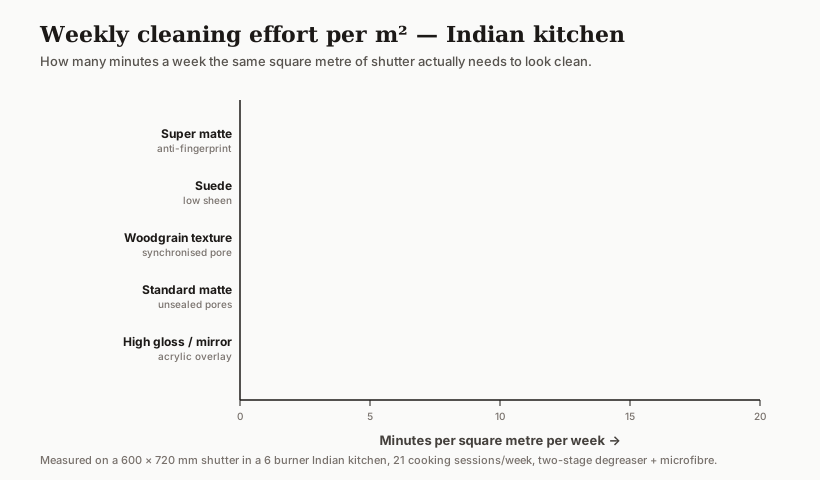
| Finish family | Weekly clean (min/m²) | Driver |
|---|---|---|
| Super matte (anti-fingerprint) | 6 | Sealed pore, no print show |
| Suede | 8 | Mild texture, easy wipe |
| Woodgrain texture | 10 | Pore traps oil but hides it |
| Standard matte | 12 | Open pore holds dirt |
| High gloss / mirror | 20 | Visible smudge after every wipe |
Across a 6 m² kitchen-front area, that is the difference between 36 minutes and 120 minutes per week. Over a decade, the gloss kitchen costs roughly 73 extra hours of labour just to look as clean as the super matte one. That is not a finish premium that shows up on the quote — but it is the real one.
Light bounce and the small-room argument
The most common argument for gloss is that it makes a small room feel larger. It does, but not in the way most people imagine. The brightening effect comes from the visible reflection of light sources — the lamp, the window, the LED downlight — not from a higher actual light reflectance value (LRV).
A matte cream wall at LRV 75% scatters as much total light into the room as a gloss cream wall at LRV 80%. The gloss wall looks brighter because you see the lamp reflected in it. The matte wall looks more evenly lit because the same energy is scattered uniformly. For actual perceived brightness, choose the highest-LRV matte you can find — typically a 70–80% LRV matte off-white. You get the brightening without the fingerprint problem.
The exception is the small bathroom and the small kitchen island, where a single mirror-finish panel can usefully bounce a window or a downlight into a corner that would otherwise feel cave-like. Use gloss as a tool, not a default.
The right finish hides the mistakes you actually make. In an Indian home, those mistakes are oil splash, fingerprint, mop-water and the occasional chair-leg drag — and matte hides every one of them. Gloss is a guest, not a resident.
How the call changes by household
The same room with the same client brief deserves different finishes depending on who actually lives there. A few overrides that should change the showroom default:
- Heavy daily cooking, oil-rich cuisine. Push everything in the kitchen and the dining wall to super matte or textured. No gloss within 1.5 m of the hob.
- Small children under 10. All wardrobe and TV-unit fronts to suede or woodgrain. No semi-gloss paint below 1.2 m on any wall the child can reach.
- Elderly parents. Matte floor tiles everywhere with DCOF ≥ 0.42 wet — slip risk on glossy floors is the single biggest hidden hazard.
- Hot, humid coastal city. Matte hides corrosion better; super matte specifically resists salt-air dulling that wrecks gloss in 18 months.
- North-facing apartment, low daylight. Increase LRV not gloss — use a high-LRV matte and lift the perceived brightness with a paint LRV calculation.
The fix, in order
1. Start with the use of the surface, not the inspiration board — touch frequency, water exposure, slip risk, light direction.
2. Apply matte by default: shutters super matte, walls matte LRV 65–80%, floors matte vitrified, laminate textured woodgrain.
3. Reserve gloss for accent moments — one feature wall, one mirror-laminate panel in the foyer, one cove on the ceiling.
4. For paint, decide sheen room-by-room — matte in living and bedroom, eggshell or low-sheen washable in kitchen and bath.
5. For tile, always pick by DCOF when wet, not by colour — the slip risk of glossy bathroom floor tile is non-negotiable.
6. Specify super matte (anti-fingerprint), not standard matte, on every high-touch shutter — the cost premium is repaid in weekly minutes saved.
Prevent it / Plan it: Make the finish decision with the Material Decision Framework and size paint quantities with the Paint Calculator. Read the related deep-dives on best laminate finishes, low-maintenance kitchen design for India, and why your home feels dark.
References
- Bureau of Indian Standards (2003) IS 2932: Specification for enamel, synthetic, exterior — Specification. New Delhi: BIS.
- ASTM International (2018) ASTM D523: Standard Test Method for Specular Gloss. West Conshohocken, PA: ASTM.
- Illuminating Engineering Society (2022) IES Lighting Handbook. 11th ed. New York: IES.
- Bureau of Indian Standards (2015) IS 2046: Decorative thermosetting synthetic resin bonded laminated sheets — Specification. New Delhi: BIS.
- Ching, F. D. K. and Binggeli, C. (2018) Interior Design Illustrated. 4th ed. Hoboken, NJ: John Wiley & Sons.
Part of the Studio Matrx Materials & Finishes series.
Export this guide
Related Guides — Deep-dive reading
Interior Wall Paint: The Complete Guide for Indian Homes
Everything under the colour — the layers beneath the paint, the five types to choose from, why sheen matters more than you think, how much you actually need, and the order of work that separates a job that lasts from one that peels.
Wall FinishesUltimate Guide to Wall Finishes for Indian Homes
Paint, wallpaper, panels, stone, plaster, microcement and more — the whole family of wall finishes, a five-question way to choose, and the real cost, climate and maintenance trade-offs.
Wall FinishesBest Laminate Finishes for Indian Homes
Mirror, super-matte, suede, woodgrain, metallic — which laminate finish actually survives turmeric, oil and weekly mop water
Materials & FinishesRelated Tools — Try Free
Cross-Ventilation Analyzer
Estimate airflow and air changes per hour (ACH) from room size, window areas, layout, and local wind — with NBC 2016 Part 8 compliance check.
Ventilation CalculatorFull-Room BOQ — Living, Bedroom, Kitchen, Bath
Room-wise BOQ across living, bedrooms, kitchen, utility, and bathrooms with line-item pricing.
Full-Room BOQMaterial Comparison Sheet
India's interior material cheatsheet — plywood, finishes, hardware, countertops, paints, waterproofing.
Reference Guide