
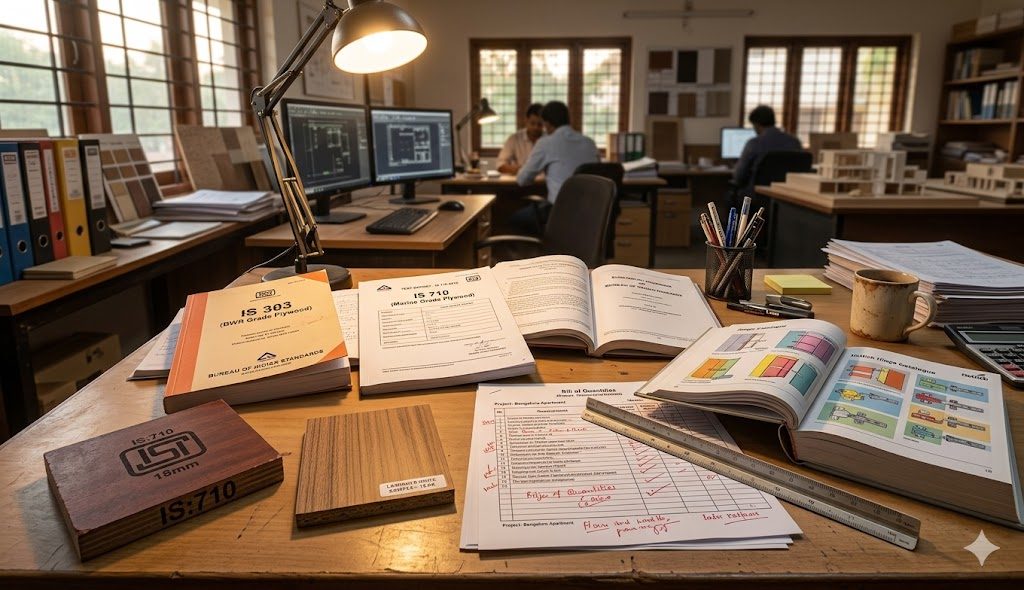
Understanding IS Codes in Interior Design
The BIS code family every BOQ should cite — and how to read an IS code
A line on an Indian interior BOQ that reads "19 mm plywood, 1 mm laminate, branded material" is not a specification. It is a wish. There is no enforceable standard, no test you can demand, no clause to invoke if the supply turns out to be the cheapest sheet on the lot. The same line written as "19 mm BWR plywood to IS 303 Type I, preservative-treated per IS 5539, 1 mm laminate to IS 2046 Type S, ISI mark on every sheet edge" is a contract — one that a Consumer Forum will read in your favour if the supply falls short.
The difference is the IS code. The Bureau of Indian Standards has been quietly publishing testable specifications for residential-interior materials for sixty years, and the codes that matter most to a homeowner are not obscure — they are short numbers, easy to learn, and every reputable Indian manufacturer already mark their products against them. The problem is that a homeowner reading a BOQ usually does not know which codes to look for, what the code numbers mean, or what an ISI mark proves.
This guide fixes that. It is a deep-dive companion to our complete guide to plywood grades in India. The pillar walked through MR / BWR / BWP / FR; this one steps back and shows the whole IS-code family for residential interiors — plywood, laminate, hardware, paint, tiles and timber — and how to weave them into a BOQ that is enforceable.
Why the BIS / IS-code system exists
The Bureau of Indian Standards is the country's national standards body, constituted under the BIS Act 2016. Its core job is to publish testable specifications — recipes, really — for how a material or product should perform, and to license manufacturers who can demonstrably make to that recipe. The system has three motives layered into it:
1. Consumer protection. A homeowner cannot send a sample of plywood to a laboratory before signing a quote. An IS code lets them rely instead on a stamp.
2. Contractual clarity. "BWR plywood" is rhetoric. "IS 303 Type I" is testable.
3. Trade fairness. A small manufacturer who builds correctly should not be undercut by a larger one who claims the same grade but supplies an inferior sheet.
The Act gives BIS the legal power to test marked products and revoke licenses; it gives Consumer Forums clear contractual ground when a marked product fails its standard. Without that legal backbone, every dispute would be a fight over what "premium quality" meant.
The residential-interior code family
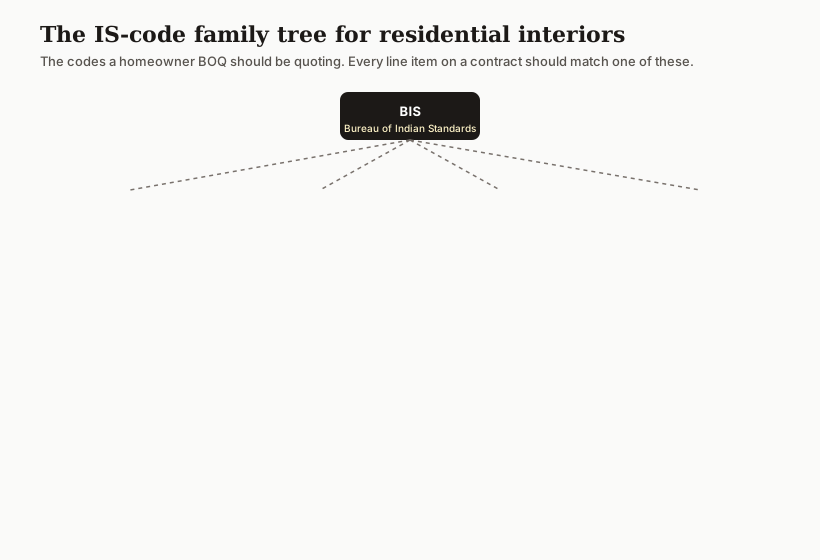
The codes a homeowner BOQ should usually cite, grouped by what they specify:
| Code | What it covers | Where it shows up |
|---|---|---|
| IS 303 | Plywood for general purposes (MR Type II, BWR Type I) | Living, bedroom, kitchen carcase |
| IS 710 | BWP marine plywood | Sink-base, vanity, utility |
| IS 1659 | Block-board (hardwood batten core) | Solid-feel shutters, doors |
| IS 5509 | Fire-retardant plywood | High-rise apartments (society rules) |
| IS 13745 | CFR — calibrated for laminate | Pre-laminated panel work |
| IS 5539 | Preservative-treated plywood | Termite-prone zones |
| IS 1141 | Timber seasoning | Solid-wood components |
| IS 2046 | Decorative laminate | Shutter faces, dado panels |
| IS 776 | Paint and varnish | Wall and woodwork finish |
| IS 3389 | Metallic builders' hardware | Hinges, handles, locks |
| IS 7196 | Hinges — general | Carcase hinges |
| IS 12817 | Stainless-steel butt hinges | Coastal-grade hardware |
| IS 15193 | Vitrified tiles | Floor and dry-area walls |
| IS 15622 | Ceramic tiles | Backsplash, wet walls |
| IS 13753 | Cement-based tile adhesive | Tile laying |
A residential project will typically cite eight to twelve of these. The BOQ does not need to cite every code in the country — only the ones that apply to its line items.
How to read an IS code
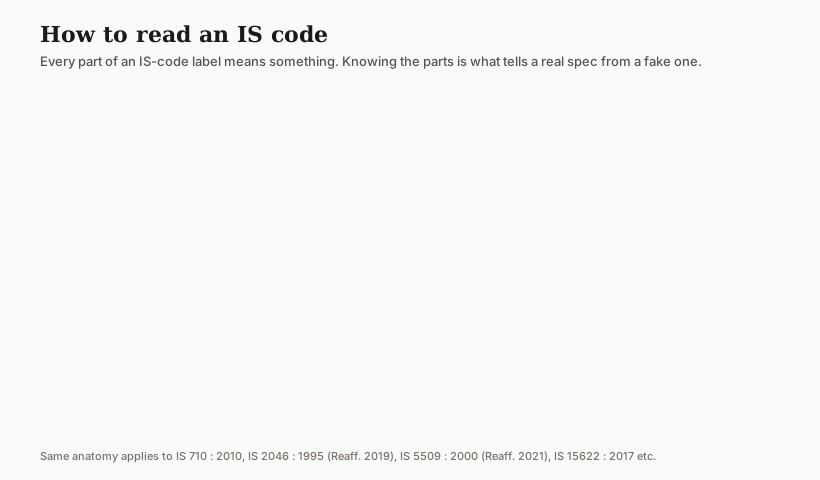
An IS code label looks complicated until you take it apart. Take the line "IS 303 : 1989 (Reaff. 2018)":
- IS is the prefix — Bureau of Indian Standards (the Indian Standard).
- 303 is the unique number BIS assigns to the standard. The numbers are not random, they are catalogued, and you can look any of them up at standards.bis.gov.in.
- : 1989 is the year of the current revision — the edition baseline.
- (Reaff. 2018) means BIS reviewed the code in 2018 and confirmed it is still valid in its current form. If you see no reaffirmation date for a code older than ten years, treat that as a red flag and check at the BIS portal — withdrawn or superseded codes still occasionally appear in stale BOQs and that is a contract that will not hold.
A code is updated either by a fresh revision (which changes the year) or a reaffirmation (which says the existing year still applies). Some codes also carry an "Amd. N" suffix — Amendment Number N, a minor change layered onto an existing revision.
The IS prefix means the spec is testable. The four-digit number tells you which product. The year tells you which edition. Without those three, you have a sentence, not a specification.
What the ISI mark proves — and what it does not
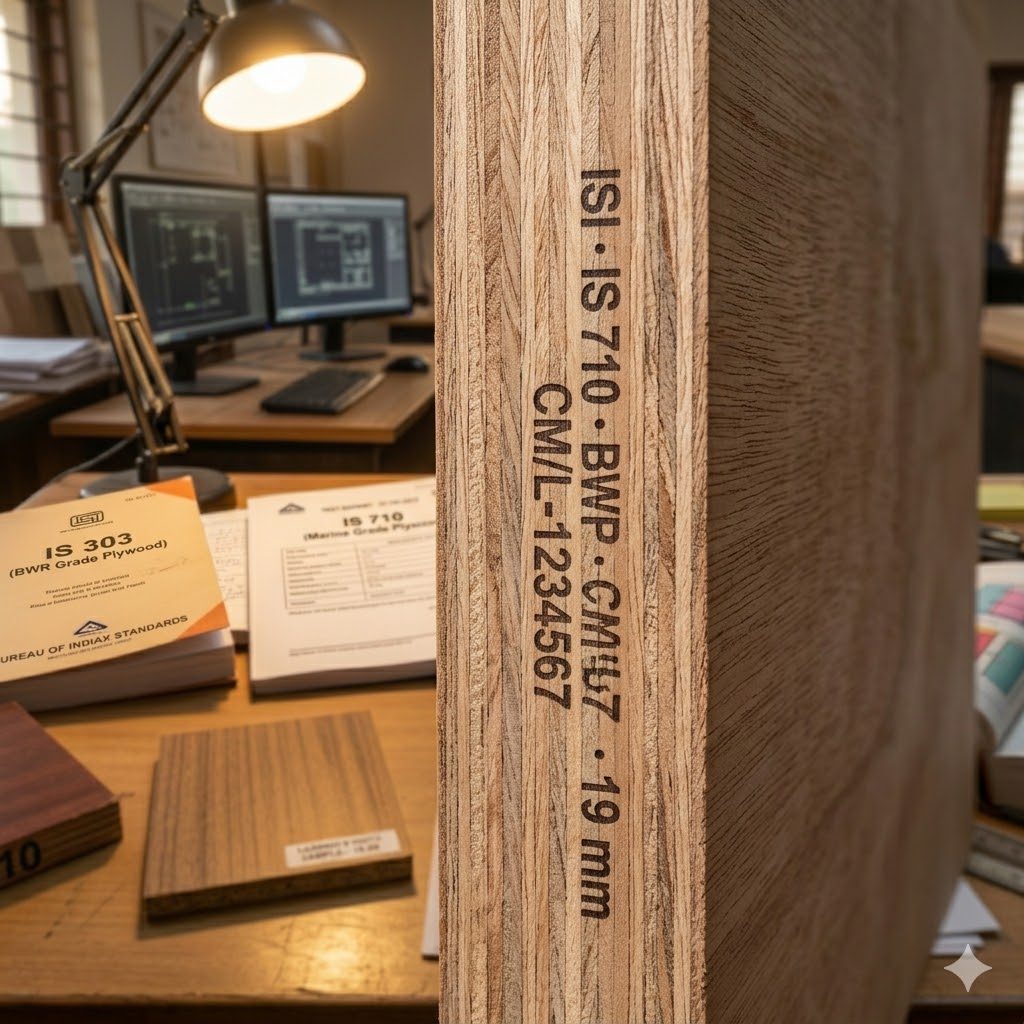
The ISI mark is the visible badge of a BIS license. To carry it, the manufacturer has been audited by BIS, the production process has been examined, and samples have been tested against the cited code. Every sheet of plywood stamped "ISI · IS 710 · BWP · CM/L-xxxxxxx" is saying: BIS has licensed this manufacturer to make to IS 710, and a randomly drawn sheet should pass IS 710 tests.
What the mark proves:
- The manufacturer holds a current BIS license against that specific code.
- A test sample, drawn from supply and run against the cited code, is the contractual proof of grade. If it fails, the supply is non-conforming.
- The license number (CM/L-…) can be verified online at standards.bis.gov.in — fake ISI marks are a known scam.
What the mark does not prove:
- It does not prove every sheet in the lot meets the standard; it proves the licensed manufacturer is approved to make to that standard.
- It does not prove the grade is right for your zone — a BWR sheet under a sink is still a wrong specification, even with a perfect ISI mark.
- It does not guarantee colour, face quality, or aesthetic — these are above and beyond the spec.
BIS hallmark vs CRS registration
Two related but separate BIS schemes show up in interior work and are often confused:
- The ISI mark (under the BIS Act 2016 §17) covers most physical goods — plywood, laminate, tiles, paints, hardware. It is the day-to-day mark on the edge of a sheet.
- The CRS registration (Compulsory Registration Scheme) covers electronic and electrical goods — switches, LED drivers, lighting. A BOQ for fittings should cite the CRS-registered model number; a BOQ for sheet materials cites the ISI mark.
- The BIS Hallmark covers gold and silver — irrelevant to interiors except where ornament is being commissioned.
For an interior project, the practical rule is: every sheet, every fitting, every adhesive should carry the appropriate BIS / ISI / CRS mark, and the BOQ should call for the mark to be visible at the point of delivery, not just claimed on paper.
Writing the BOQ line — vague vs cited
The single most useful skill a homeowner can learn is rewriting a vague BOQ line into a cited one. The structure is always the same:
Item · component · dimension · IS code · grade/type · brand options · proof requirement.
Worked example for a kitchen base cabinet:
- Vague: "Kitchen base cabinet, 19 mm plywood, 1 mm laminate, hinges + handles, branded material."
- Cited: "Kitchen base cabinet — 19 mm BWR plywood to IS 303 Type I, preservative-treated per IS 5539, sourced from Century / Greenply / Archidply tier-1, ISI mark visible on every sheet edge; 1 mm decorative laminate to IS 2046 Type S; soft-close stainless-steel butt hinges to IS 12817 (Hettich / Hafele / Ebco)."
The cited version is fifty words longer and an order of magnitude more enforceable.
Legal weight in a dispute
In a Consumer Forum case, the BOQ is the primary contract between homeowner and contractor. The Consumer Protection Act 2019 §35 defines deficient service to include supply that materially differs from specification. A vague BOQ line is interpreted against the party who drafted it (usually the contractor), but the homeowner still has to prove what was meant. A cited line removes the interpretation step: a test on an edge sample, run by a BIS-recognised laboratory, settles the matter.
Common substitution traps to watch for:
- MR substituted for BWR in kitchen carcases — saves about ₹650 per 8×4 sheet, fails within two years.
- Zinc-plated hardware substituted for stainless steel (IS 12817) in coastal kitchens — rusts in months.
- Domestic laminate substituted for IS 2046 Type S — abrasion-fails on heavily used worktops and shutter edges.
- "BIS-approved" language without an actual code — a deliberate ambiguity; insist on the code number.
The fix, in order
1. Get the list of IS codes that apply to your project (engineered wood, laminate, hardware, paint, tile).
2. Rewrite every BOQ line to follow item · IS code · grade · brand · proof.
3. Specify that ISI / CRS marks must be visible at delivery, not just claimed.
4. Verify each contractor's tier-1 brand claims at standards.bis.gov.in by license number.
5. Keep a lot sample of each material — your evidence if a dispute arises.
Prevent it / Plan it: Audit each BOQ line against the codes with the material quality checklist, pick substrates by zone with the material decision framework, and run multiple contractor quotes through the quote comparison tool. Pair with our complete guide to plywood grades, the material standards guide, the why Indian kitchens fail after 5 years deep-dive and the why cheap interiors are expensive later breakdown.
References
- Bureau of Indian Standards (2016) The Bureau of Indian Standards Act, 2016. Government of India.
- Bureau of Indian Standards (1989, Reaff. 2018) IS 303: Plywood for General Purposes — Specification. New Delhi: BIS.
- Bureau of Indian Standards (2010) IS 710: Marine Plywood — Specification. New Delhi: BIS.
- Bureau of Indian Standards (1995, Reaff. 2019) IS 2046: Decorative Thermosetting Synthetic Resin Bonded Laminate Sheets — Specification. New Delhi: BIS.
- Government of India (2019) Consumer Protection Act, 2019. Ministry of Consumer Affairs.
- Bureau of Indian Standards (2016) National Building Code of India 2016, Part 6 Structural Design, Part 8 Building Services. New Delhi: BIS.
Part of the Studio Matrx Materials & Finishes series.
Export this guide
Related Guides — Deep-dive reading
Complete Guide to Plywood Grades in India
MR, BWR, BWP, FR — the IS-code ladder, the right grade per zone, and how to verify it on site
Materials & FinishesComplete Guide to Interior Hardware
The 8–12% of the interior budget that decides whether everything else works
Materials & FinishesWhy Cheap Hardware Destroys Expensive Interiors
The catalogue trick where the carcase is premium and the hardware is invisible — and how to prevent it
Materials & FinishesRelated Tools — Try Free
Material Comparison Sheet
India's interior material cheatsheet — plywood, finishes, hardware, countertops, paints, waterproofing.
Reference GuideInterior Contract Clause Checklist
16 sections and 98 checkboxes covering scope, BOQ, milestones, penalties, warranty, and disputes.
Contract ChecklistFull-Room BOQ — Living, Bedroom, Kitchen, Bath
Room-wise BOQ across living, bedrooms, kitchen, utility, and bathrooms with line-item pricing.
Full-Room BOQ