
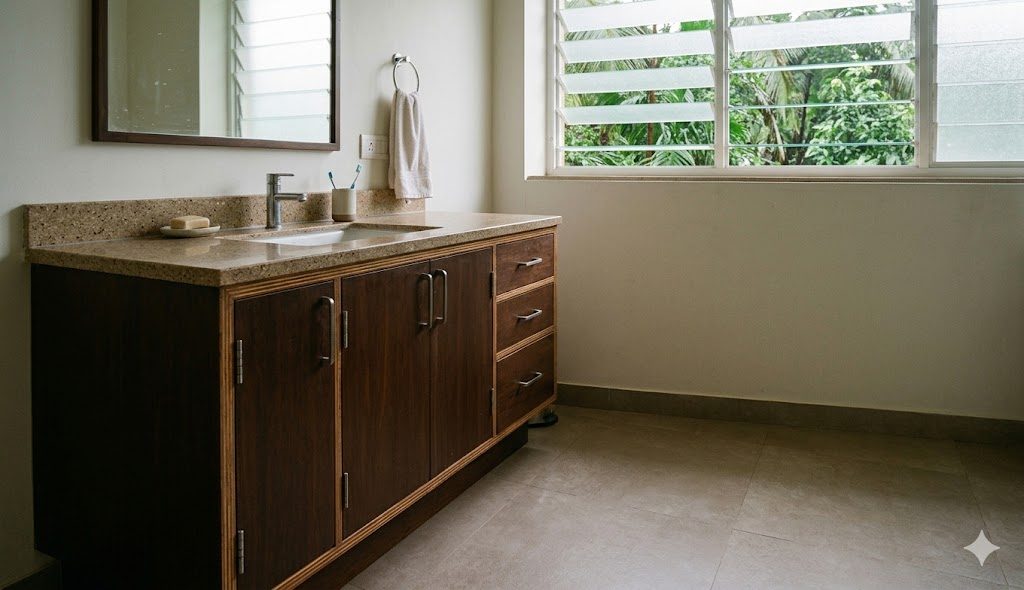
Best Materials for Moisture-Prone Homes
Coastal, monsoon and basement specifications that actually survive Indian humidity
Half of India lives in moisture. Not gentle hill-station humidity but the punishing, four-month, ninety-percent-RH kind — the Kerala and Konkan coast, Goa, Mumbai, Chennai, Mangalore, Visakhapatnam, the Bengaluru ground floor when the monsoon arrives, and the basement of every metro apartment regardless of geography. A home in any of these zones has to be specified differently from one in Delhi or Pune. The materials that work for a dry-air interior fail spectacularly here — not because they are bad, but because they were not chosen for this fight.
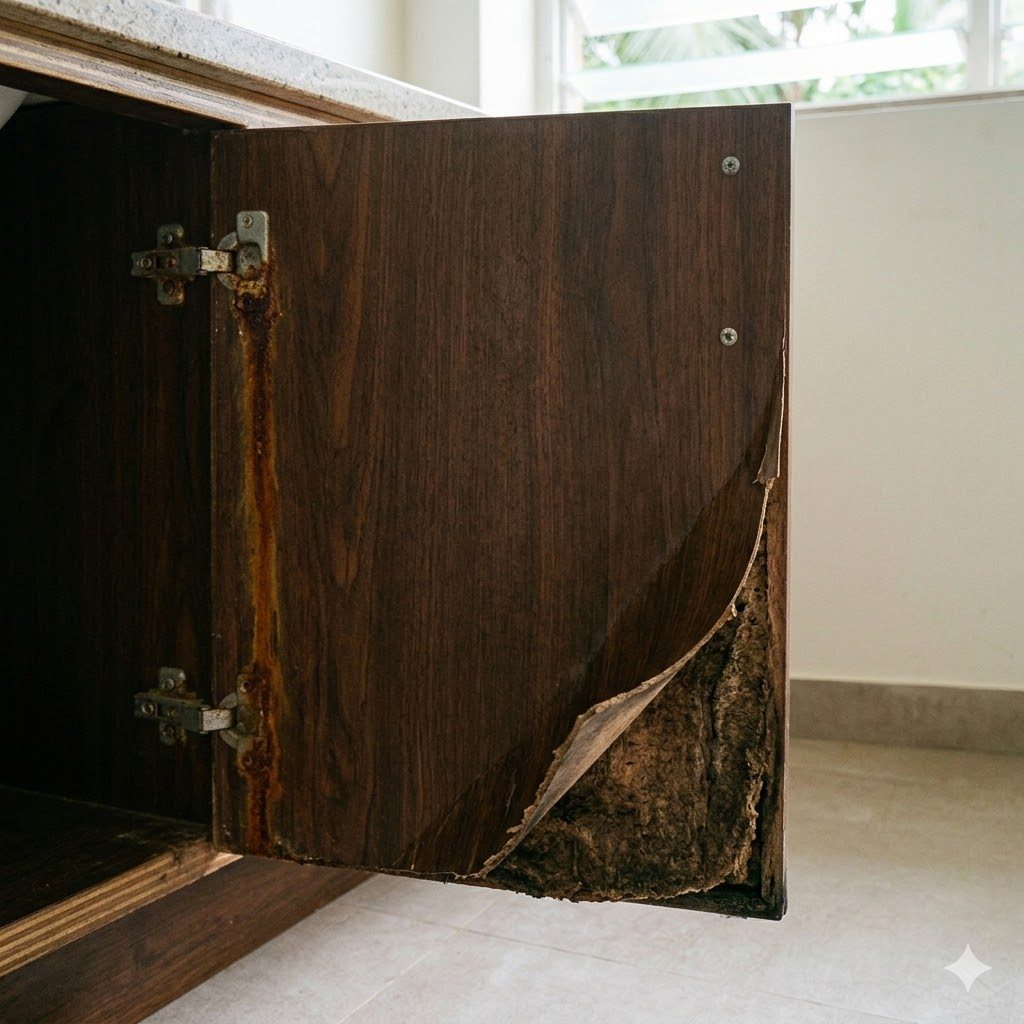
The failure is dramatic and quick. MR plywood under a sink in Mumbai swells in eighteen months. Zinc-plated hinges on a Chennai bathroom rust orange in nine. A laminated MDF wardrobe on a Bengaluru ground floor delaminates at the bottom edge by the second monsoon. None of this is exotic engineering — the substrates, hardware and sealants that survive moisture are widely available, and only marginally more expensive than the failing ones. The problem is almost always at specification stage, when the contractor offers the same standard package they use in Pune and the homeowner does not know enough to refuse it.
This guide is a deep-dive companion to our complete guide to plywood grades in India. The pillar lays out the IS-code grade ladder; this one stays narrowly focused on humidity — what to specify when the home is going to live with moisture every day of its design life.
Which Indian homes are moisture-prone
The shortlist, in declining order of severity:
| Zone | Driver | Months at risk |
|---|---|---|
| Kerala / Konkan / Goa coast | Sea spray + monsoon | 6–8 |
| Mumbai, Mangalore, Visakhapatnam | Coastal city + heavy monsoon | 4–6 |
| Chennai | Humidity + cyclone + tropical | 5–7 |
| Bengaluru ground floor | Monsoon + slab moisture | 3–4 |
| Basements (all metros) | Year-round | 12 |
| Hill stations (Munnar, Ooty, Shillong) | Persistent damp, cooler temps | 4–6 |
If your home appears in this list, the spec changes. The same kitchen, drawn the same way, has to be built differently.
The four moisture stresses
A moisture-prone home is fighting four different physical mechanisms at once, and each calls for a different fix:
1. Relative humidity. Coastal monsoon air sits at 85–95% RH for weeks. Wood-based panels in equilibrium with that air carry 16–20% moisture content (versus 8–10% inland). MR ply at that moisture content delaminates from the inside.
2. Capillary rise. A ground-floor RCC slab in monsoon Bengaluru wicks moisture upward into anything sitting on it — wardrobe carcases, skirting, plinths. Without a damp-proof course (DPC) and a raised plinth, the bottom 100 mm of every cabinet stays wet.
3. Direct splash. Sinks, basins, showers, washing-machine drains — water that hits the cabinet face or the back panel. Marine-grade sealants and BWP carcases handle this; the cheaper builds do not.
4. Condensation. Cool RCC walls behind cabinets in an air-conditioned room — the wall sweats overnight, the back of the cabinet gets damp, and without a ventilation gap the damp stays. This is the silent killer of urban-coastal wardrobes.
A spec that addresses only the first stress and ignores the other three is going to fail.
Materials that survive
The shortlist of materials that earn their place in a moisture-prone home:
| Component | Specify | Avoid |
|---|---|---|
| Cabinet carcase (wet zone) | BWP plywood, IS 710 | MR ply, MDF, particleboard |
| Cabinet carcase (damp zone) | BWR plywood, IS 303 Type I | MR ply on a ground floor |
| Edge banding | 2 mm anti-microbial PVC | Paper / 0.4 mm thin band |
| Shutter / drawer face | HDHMR or BWP-faced ply | MDF in any damp zone |
| Splashback / dado | Vitrified or porcelain tile | Glossy ceramic in heavy splash |
| Floor | Vitrified, anti-skid finish | Vinyl over damp slab |
| Hinges, slides, handles | PU-coated SS, IS 12817 (316-grade near sea) | Zinc-plated steel |
| Sink / countertop seal | Marine-grade silicone | Silicate caulk |
| External-wall paint (inside face) | Breathable, vapour-permeable | Vinyl emulsion on damp wall |
| Ceiling | PVC-coated, moisture-resistant gypsum | Standard gypsum in bathroom |
Two notes worth lingering on. Anti-microbial PVC edge banding (2 mm thick, EVA-bonded) is the single cheapest survival upgrade — it costs about ₹40 / running metre versus ₹15 for paper, and it doubles the life of a damp-zone shutter. 316-grade stainless steel (rather than the standard 304) becomes worth the cost within 5 km of the sea: 304 will pit and rust in sea air; 316 will not.
Materials that fail
Equally important is the never-list. The substrates and finishes that fail predictably in Indian moisture:
- MR plywood (IS 303 Type II) in any damp zone. UF resin is water-soluble; the glue line breaks.
- MDF anywhere damp. Swells 25–50% irreversibly. The cheapest failure mode in Indian interiors.
- Particleboard. Lower-density chip + UF — fails faster than MDF.
- Zinc-plated hardware. The zinc layer is microns thick; salt air or repeated washing rusts the steel underneath.
- Vinyl flooring over a damp slab. Without DPC, capillary moisture lifts the vinyl in a year.
- Untreated MDF skirting in a monsoon ground floor. The skirting wicks slab moisture upward.
- Silicate (acidic) caulks at the sink-counter junction. They crack within a year.
- Standard gypsum board in a bathroom ceiling. Sags as soon as RH crosses 80%.
The cost of doing it right at the spec stage is ₹6,000–10,000 across a full kitchen. The cost of doing it wrong is a rebuild within the warranty window.
Construction details that prevent failure
The substrate decision is only half the answer. The other half is the construction details that keep moisture from reaching the substrate in the first place:
- Continuous DPC at plinth. A bitumen or HDPE membrane laid below the wardrobe plinth blocks capillary rise from the slab.
- Raised plinth in utility zones. 100 mm SS-bolted plinth keeps the carcase off the wet floor.
- 15 mm ventilation gap behind cabinets placed against external or wet-wall faces. The gap lets condensation evaporate before it soaks the back panel.
- Sloped floors to drain. Bathroom and utility floors should fall 1:60 to 1:80 toward the drain, with no flat puddling zones.
- Breathable paint on the inside face of external walls. Vapour-permeable emulsions let the wall dry inward rather than trapping condensation.
- Marine-grade silicone at sink-counter junctions and around the entire skirting line in a wet utility.
- PVC-coated MR gypsum or fibre-cement for bathroom ceilings.
A spec without these details might use all the right materials and still fail because moisture finds a route around them.
City-by-city specifics
| City / zone | Carcase | Hardware | Sealant | Notable detail |
|---|---|---|---|---|
| Kerala / Konkan / Goa | BWP everywhere | PU-coated SS 316 | Marine silicone | Ventilation gap mandatory |
| Mumbai | BWP wet, BWR rest | SS 304 (316 if < 5 km sea) | Marine silicone | Breathable external-wall paint |
| Chennai | BWP wet, BWR rest | SS 316 | Marine silicone | Cyclone-rated balcony shutters |
| Bengaluru (upper floors) | BWR carcase, BWP wet | SS 304 | Standard neutral-cure silicone | Standard plinth |
| Bengaluru (ground floor) | BWP wet + carcase, BWR upper | SS 304 | Marine silicone | DPC mandatory |
| Basements (all metros) | BWP only | PU-coated SS | Marine silicone | Dehumidifier 50–60% RH |
| Hill stations | BWR (BWP if heavy roof leak risk) | SS 304 with PU coat | Marine silicone | Insulated back panel |
The 72-hour swell evidence
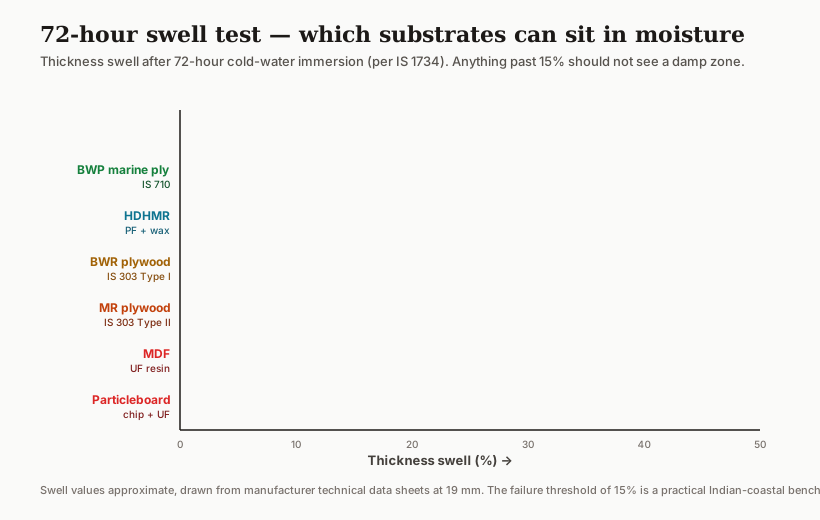
The numbers are the easiest way to justify the spec to a sceptical contractor. The IS 1734 72-hour cold-water immersion test gives a thickness-swell number that maps almost perfectly onto in-service moisture behaviour. Anything past 15% swell will fail in a real damp zone within a few monsoons — usually irreversibly.
| Substrate | 72-h swell | Damp-zone verdict |
|---|---|---|
| BWP marine ply | 5–10% | Survives wet zone |
| HDHMR | 8–12% | Survives damp, not splash |
| BWR plywood | 10–15% | Survives damp |
| MR plywood | 15–20% | Fails in damp zone |
| MDF | 25–50% | Fails everywhere damp |
| Particleboard | 35–55% | Fails fastest |
The fix, in order
1. Identify the moisture zones in the home (wet, damp, capillary-risk, condensation-risk).
2. Lock the carcase substrate by zone (BWP wet, BWR damp, MR ply only in dry conditioned rooms).
3. Upgrade to anti-microbial PVC edge banding and PU-coated SS hardware in every damp-zone cabinet.
4. Add the construction details — DPC, raised plinth, ventilation gap, sloped floors — at site stage.
5. Demand ISI marks and brand stamps at delivery; reject any sheet without a visible code.
Prevent it / Plan it: Pick substrates by zone with the material decision framework and verify every spec with the material quality checklist. Pair with our complete guide to plywood grades, the waterproofing guide, the cross-ventilation guide and the marine ply vs HDHMR vs MDF substrate deep-dive.
References
- Bureau of Indian Standards (2010) IS 710: Marine Plywood — Specification. New Delhi: BIS.
- Bureau of Indian Standards (1989, Reaff. 2018) IS 303: Plywood for General Purposes — Specification. New Delhi: BIS.
- Bureau of Indian Standards (2016) National Building Code of India 2016, Part 6 Structural Design — §3 Damp-Proof Course. New Delhi: BIS.
- Forest Products Laboratory (2010) Wood Handbook — Wood as an Engineering Material, Chapter 13: Drying and Control of Moisture Content. General Technical Report FPL-GTR-190. Madison, WI: USDA.
- Straube, J. and Burnett, E. (2005) Building Science for Building Enclosures. Westford, MA: Building Science Press.
- Bureau of Indian Standards (1983) IS 1734: Methods of Test for Plywood — Thickness Swelling. New Delhi: BIS.
Part of the Studio Matrx Materials & Finishes series.
Export this guide
Related Guides — Deep-dive reading
Moisture-Resistant Building Materials in India: The Right Material for Every Wet Zone (2026)
Moisture is the biggest enemy of Indian buildings - monsoon, rising damp, condensation, leaks and coastal humidity. This guide separates waterproofing (a system) from choosing inherently moisture-tolerant materials, then names the right material for bathrooms, exteriors, roofs, basements and finishes - with a zone-by-zone selector table. A specify-and-select guide.
Building MaterialsCoastal Flooring India: Best Floors for Salt Air, Humidity and Monsoon Damp in Mumbai, Goa, Chennai, Kochi and Vizag
What to choose and what to avoid for coastal and high-humidity Indian homes: why solid wood warps and carbon-steel fixings rust, why vitrified and porcelain tiles, anti-skid natural stone and SPC win, plus matte finishes for wet grip, moisture barriers, ventilation and mould-proof grout.
Flooring & SurfacesMarine Ply vs HDHMR vs MDF
When each engineered-wood substrate is the right answer for an Indian interior
Materials & FinishesRelated Tools — Try Free
Material Comparison Sheet
India's interior material cheatsheet — plywood, finishes, hardware, countertops, paints, waterproofing.
Reference GuideCross-Ventilation Analyzer
Estimate airflow and air changes per hour (ACH) from room size, window areas, layout, and local wind — with NBC 2016 Part 8 compliance check.
Ventilation CalculatorHome Building & Interior Cost Calculator — 20 Cities
Construction + interior costs for 20 Indian cities across kitchen, wardrobes, flooring, painting, ceiling.
Cost Calculator