
Compact Urban Living — The Day-to-Day Lifestyle for 350-650 sqft Indian Homes (2026)
Daily routines · Decluttering discipline · WFH in 1 BHK · Pet keeping · Hosting ethos · Move-out math
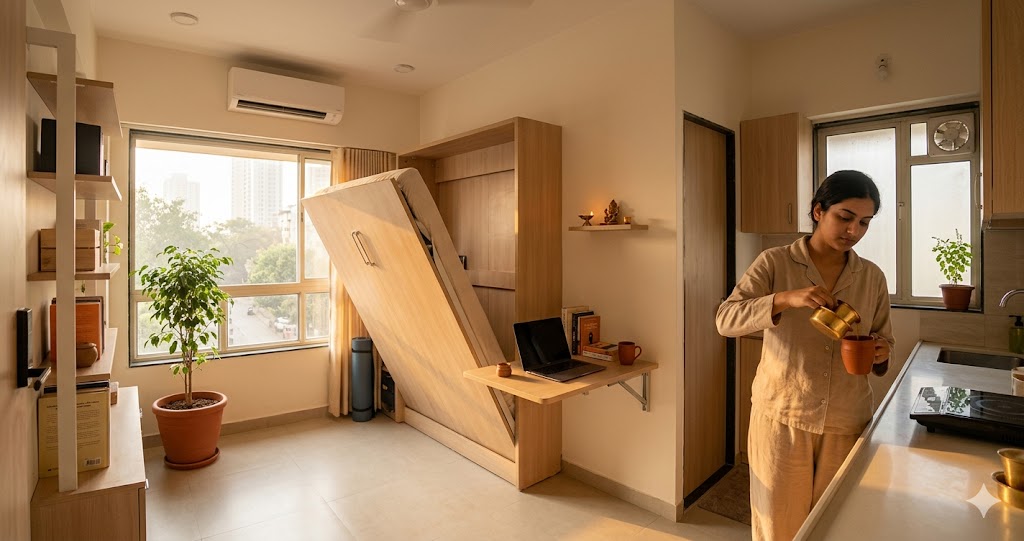
Compact urban living in 2026 India is not a floor plan — it is a daily practice. It is the 6:30 am ritual of folding the bedding so the bed becomes a sofa, of clearing the dining table because by 9:00 am it is a desk, of choosing between the air-fryer and the microwave because there is only counter for one. The 350-650 sqft Mumbai or Bengaluru apartment does not get smaller because it is small; it gets smaller because the people inside it have not yet learned the choreography. This guide is the choreography manual — the lifestyle, discipline, routine, and decision-making that turn a tight footprint into a calm life. It is the companion to the architectural lens; while compact urban home planning tells you how to draw the 12x14 bedroom, this guide tells you how to live in it on a Tuesday in July when the maid did not show up and your spouse has a 4 pm video call and the cat is in heat.
"The square footage you bought is fixed. The square footage you experience is a function of habits. Two families in the same 480 sqft Hiranandani flat can live in two completely different houses." — Anuradha Mathur, urban anthropologist, in conversation with the Studio Matrx editorial team, 2026.
For the structural and layout side of this conversation, pair this reading with compact urban home planning India, space-efficient homes, smart storage interiors, and urban home architecture India. For the aesthetic register most commonly associated with this lifestyle, see japandi apartment and compact luxury apartment.
This guide refreshes every 12 months. Last verified: May 2026 · Next verify: May 2027.
What Compact Urban Living Actually Means in 2026 India
Compact urban living, in the Indian metro context of 2026, refers to households of one to four people occupying carpet areas between roughly 280 sqft (studio) and 650 sqft (a generous 1 BHK or a tight 2 BHK) in tier-1 city cores — South and Central Mumbai, Koramangala and Indiranagar in Bengaluru, South Delhi colonies, central Pune, Chennai's T Nagar and Adyar, Hyderabad's Banjara and Jubilee Hills fringe. It is not merely a size category; it is a complete behavioural pattern in which time, possessions, noise, and even social life are negotiated against a fixed spatial budget.
The defining feature is temporal layering: a single 80 sqft room performs as bedroom (10 pm to 7 am), wardrobe (7 to 7:30 am), home office (9 am to 6 pm), gym (6 to 7 pm), and entertainment room (7 to 10 pm). The household runs on a schedule the way a school timetable does. When the schedule fails — a sick day, a guest, a power cut — the apartment briefly becomes unliveable until the schedule resumes. This fragility is the central truth that occupants must accept and design around.
Five things compact urban living is NOT:
1. It is not student-hostel living. Hostel life accepts impermanence and shared discomfort; compact urban living is a permanent or semi-permanent home for adults with careers, partners, and often children. The standard is much higher.
2. It is not slum housing or chawl housing. Chawls share toilets, kitchens, and corridors with up to 20 families; compact apartments are self-contained units with full plumbing, kitchen, and a private bathroom.
3. It is not "downsizing" in the Western retirement sense. Most Indian compact-urban dwellers have never lived large; this is their entry-level adult home, often their first marital home, sometimes the home in which they will raise a child to age six.
4. It is not van life or off-grid minimalism. The apartment is fully serviced, plugged into municipal power, water, fibre, and a building society with rules and a managing committee.
5. It is not just "minimalism." Minimalism is an aesthetic choice; compact urban living is a constraint that may be solved minimally or maximally (some compact apartments are crammed with brass, fabric, and family photographs — the lifestyle still works as long as the discipline holds).
The lifestyle is shaped less by what is in the apartment and more by the rules of engagement between the people, the objects, and the schedule. The maid arriving at 7:30 am means the floor must be clear by 7:25. The Amazon delivery means there must be a place to land a 60 cm box. The mother-in-law visiting for three nights means somebody is sleeping on the foldable mattress in the living area, and that mattress must already exist and have a known storage location.
Why Compact Urban Living Matters Now
The trend lines that make this guide necessary in 2026 are several and reinforcing.
First, price-per-sqft compression. According to Anarock's Q1 2026 residential report, average ticket sizes in Mumbai's central wards crossed ₹3.4 cr while developer-launched carpet areas in the same micro-markets shrank from an average of 720 sqft in 2018 to 510 sqft in 2026. Bengaluru's central east (Indiranagar, Koramangala) and Pune's Koregaon Park show parallel trajectories. JLL India's 2026 mid-year note frames it bluntly: the metro family in 2026 buys the same rupee budget that bought a 2 BHK in 2015 and receives a 1 BHK with study.
Second, the WFH-hybrid baseline. Post-pandemic, roughly 58 percent of metro knowledge workers operate on a two-to-three-day office, two-to-three-day home schedule (Knight Frank India Workplace Report 2026). The home must absorb this without growing. Compact urban living therefore had to invent the kitchen-table-becomes-desk routine, the bedroom-door-acoustic-treatment fix, and the video-call-backdrop-discipline almost overnight.
Third, delayed family formation and childlessness by choice. India's metro fertility rate dropped to 1.4 in NFHS-6 (2025-26 round), meaning the typical metro household is two adults plus maybe one child, not the four-person household interiors were historically designed around. A 480 sqft unit fits this household.
Fourth, the rise of the "investment-grade compact" segment. Developers like Lodha, Brigade Buzz, Godrej, and DLF have explicit micro-unit product lines (Lodha Crown, Godrej Splendour, Brigade Insignia studios). These are bought by young professionals as first homes and by parents as future endowments for their children. The Magicbricks 2026 PropIndex flags compact (under 600 sqft) as the fastest-growing search category, up 34 percent year-on-year.
Fifth, the cost of help. Domestic workers in metros now command ₹6,000-12,000 per month for daily two-hour visits. Households are doing more of their own cleaning, cooking, and maintenance, which means the apartment must support self-service routines: the dishwasher slot, the washing-machine-cum-dryer, the air-fryer that replaces three other appliances.
The cumulative effect: compact urban living is no longer a transitional state. For a growing minority of urban Indians, it is the destination.
The Eight Defining Characteristics
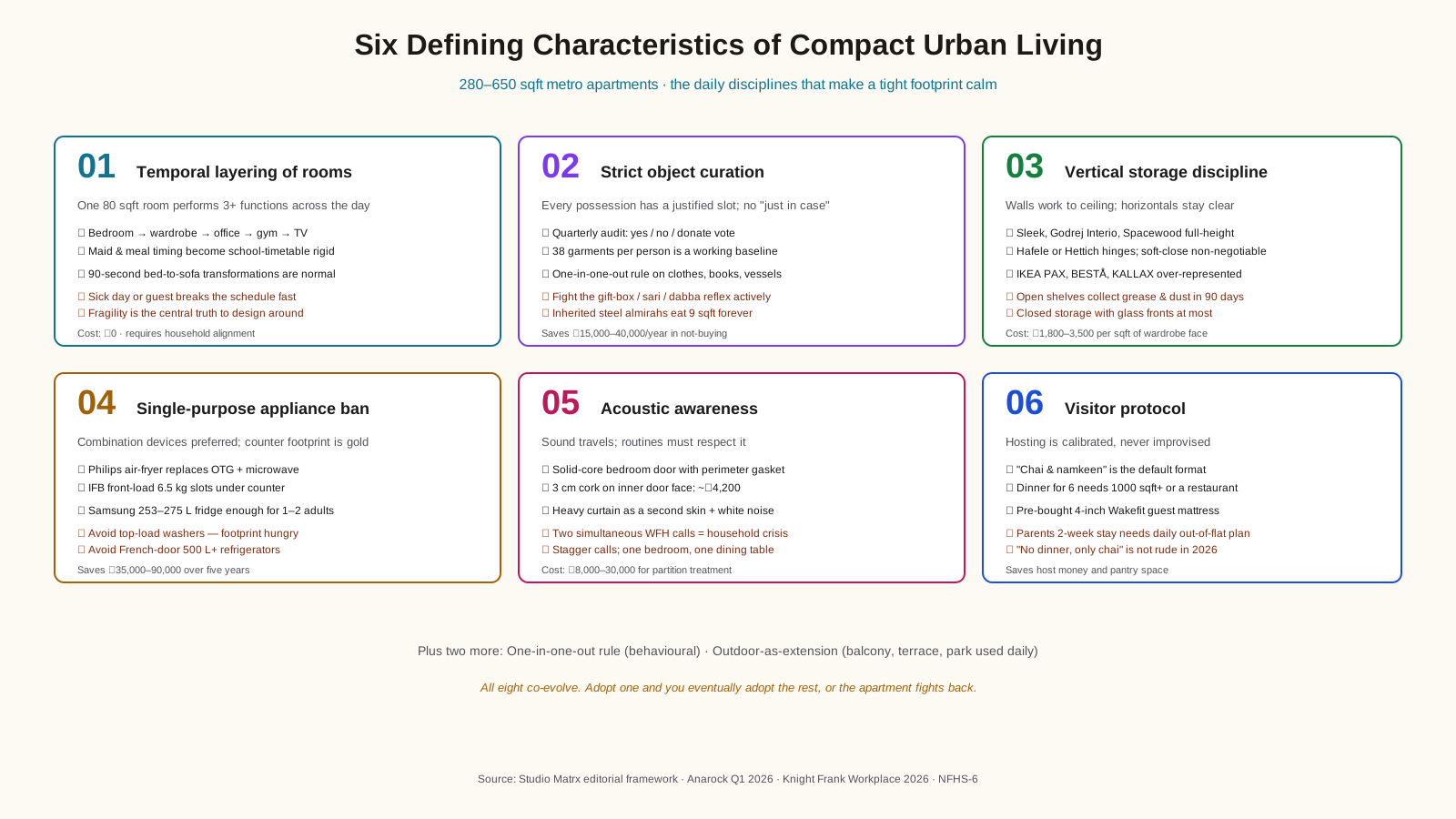
| Characteristic | What it means | India-specific note | Typical cost or constraint |
|---|---|---|---|
| Temporal layering of rooms | Each space performs 3+ functions across the day | Maid timing and meal timing become more rigid than in larger homes | Costs nothing; requires household alignment |
| Strict object curation | Every possession has a justified slot; nothing is "stored just in case" | The Indian tendency to keep gift boxes, plastic dabbas, and old saris must be actively fought | Saves ₹15,000-40,000/year in not-buying |
| Vertical storage discipline | Walls work to ceiling; horizontals stay clear | Modular full-height wardrobes by Sleek, Godrej Interio, Spacewood | ₹1,800-3,500 per sqft of wardrobe face |
| One-in-one-out rule | New purchase requires old item to leave | Hardest with clothing, books, kitchenware | Behavioural, not capital |
| Single-purpose appliance ban | Combination appliances preferred | Air-fryer + microwave + OTG combo; washer-dryer | ₹35,000-90,000 saved over five years |
| Acoustic awareness | Sound travels; routines respect it | Concrete and brick walls help, but doors and partitions matter for WFH | ₹8,000-30,000 for partition treatment |
| Outdoor-as-extension | Balcony, terrace, building common areas, nearby park used daily | Mumbai's heat and Bengaluru's rain shape balcony usability differently | Balcony build-out ₹40,000-2 lakh |
| Visitor protocol | Hosting is calibrated: chai only for short visits; meals require advance prep | "No dinner, only chai" is the social norm; not rude | Saves the host both money and pantry space |
These eight characteristics co-evolve. You cannot adopt one without eventually adopting the others. A household that masters object curation but neglects acoustic awareness ends up with a peaceful-looking apartment in which nobody can take a video call.
A Worked Example: A 465 sqft Bandra (W) 1 BHK, Two Adults Plus One Cat
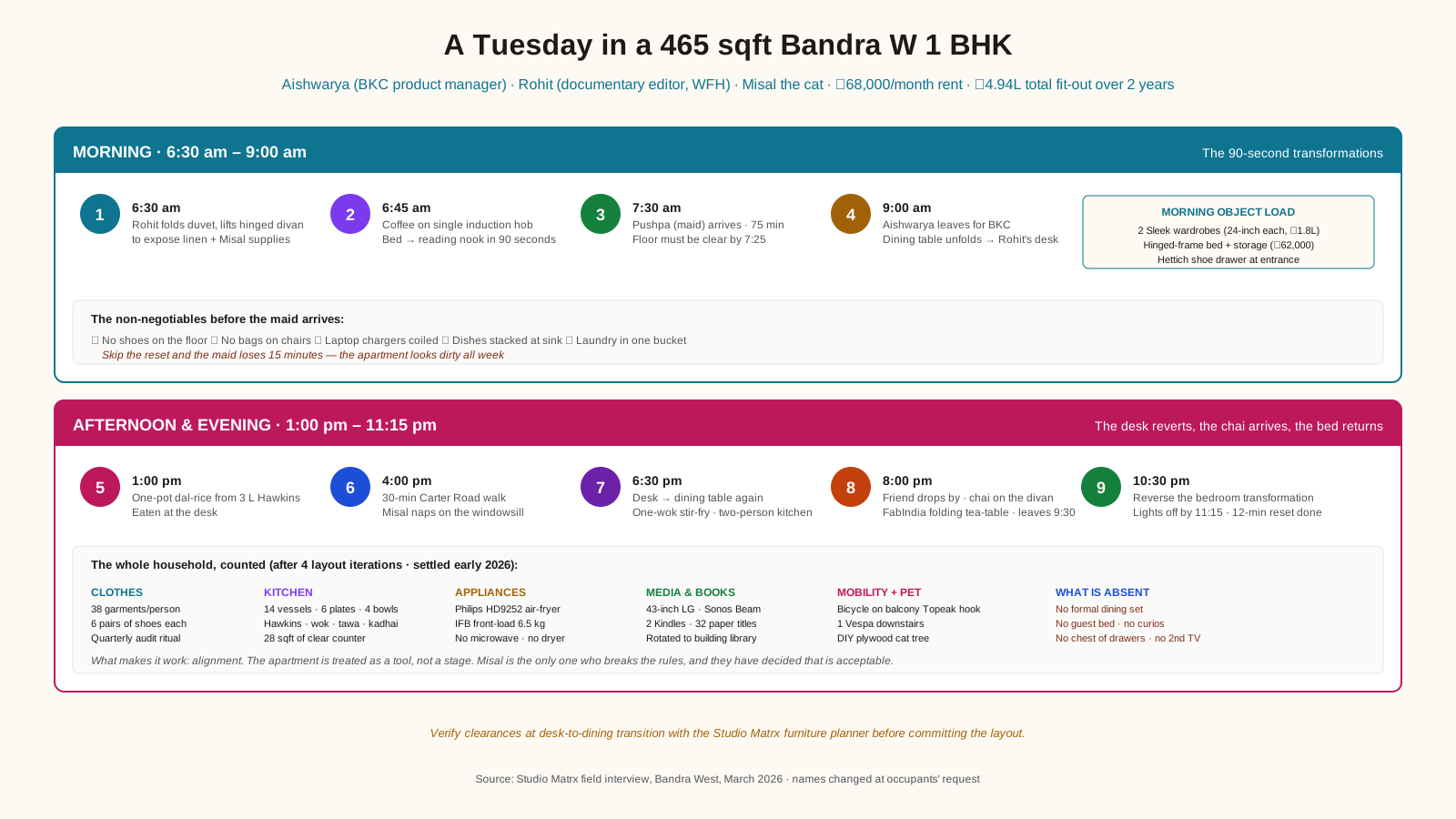
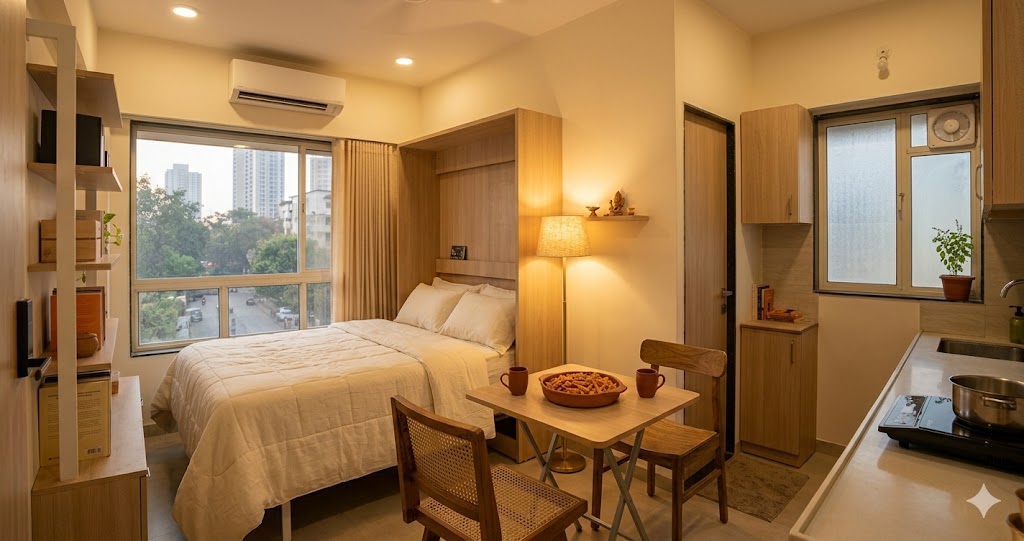
Aishwarya, 31, is a product manager at a fintech in BKC; Rohit, 33, is a documentary editor working primarily from home. They rent a 465 sqft (carpet) 1 BHK on the third floor of a 1990s building on Carter Road, Bandra West, for ₹68,000 per month plus ₹4,500 maintenance. Their cat, a Bombay-Persian mix called Misal, has the run of the apartment. They moved in two years ago and have iterated four times on the layout. The current arrangement, settled in early 2026, looks like this.
The daily schedule:
- 6:30 am: Rohit's alarm. He folds the duvet, lifts the divan mattress on its hinged frame to reveal the linen-and-Misal-supplies storage drawer below, and walks to the kitchen. Misal follows.
- 6:45 am: Coffee on a single induction hob. Aishwarya is up; she begins the 90-second bed-to-sofa transformation in the bedroom — the bed is a low platform with a removable backrest cushion stack that converts it into a daytime reading nook.
- 7:30 am: The maid (Pushpa) arrives. She has 75 minutes for sweeping, swabbing, dishes, and one load of laundry. The household clears the floor entirely; no shoes, no bags, no laptop chargers.
- 9:00 am: Aishwarya leaves for BKC. Rohit converts the four-seater Sleek dining table (folded along the wall when not in use) into a desk, sets up his external monitor on a swing arm, and starts editing.
- 1:00 pm: Lunch is a one-pot dal-rice prepared the previous evening in a 3 L Hawkins pressure cooker and stored in a stainless steel tiffin. He eats at the desk.
- 4:00 pm: A 30-minute walk along Carter Road. Misal naps on the windowsill.
- 6:30 pm: Aishwarya is back. The desk reverts to dining table. They cook together — a one-wok stir-fry or an instant-pot biryani. The kitchen has 28 sqft of clear counter; two people can work in it only if one stays at the sink and the other at the hob.
- 8:00 pm: A friend drops by for chai. They sit on the divan-sofa-bed and use a low folding wooden tea-table from FabIndia. The friend leaves by 9:30; nobody has cooked for her, and nobody is offended.
- 10:30 pm: Reverse the bedroom transformation. Lights off by 11:15.
The objects, counted:
- 38 garments per person (counted at last quarterly audit). One full-height Sleek wardrobe per person, 24 inches wide.
- 6 pairs of shoes per person, in a Hettich pull-out shoe drawer at the entrance.
- 14 kitchen vessels, 6 plates, 4 bowls, 8 glasses. One pressure cooker, one wok, one tawa, one saucepan, one kadhai.
- 1 air-fryer (Philips HD9252), 1 induction hob (Prestige), 1 mixer-grinder (Preethi Zodiac), 1 kettle. No microwave; the air-fryer reheats and cooks.
- 1 washing machine (IFB front-load, 6.5 kg, in the bathroom utility nook). No dryer; clothes go on a retractable ceiling-mounted Eurorack drying rack on the balcony.
- 1 television (43-inch LG, wall-mounted), 1 Sonos Beam, 2 Kindle e-readers, 1 paper bookshelf with 32 titles (rotated quarterly to the building's lending library).
- 1 bicycle (Rohit's, hung vertically on the balcony wall with a Topeak hook) and 1 Vespa parked downstairs.
- 1 cat tree (DIY plywood, attached to the wall, fits Misal and a basket).
The capital outlay (over two years of iteration):
- Sleek modular wardrobes (2 units, 24-inch each, full height): ₹1.8 lakh
- Hinged-frame bed with storage (custom by Bandra carpenter): ₹62,000
- Wall-mounted folding dining table (Sleek, walnut laminate): ₹38,000
- Hettich shoe drawer and entrance console: ₹46,000
- Balcony bike hook + retractable drying rack: ₹6,800
- Kitchen reorganisation (no civil work; carcass + Hafele soft-close drawers): ₹1.4 lakh
- Acoustic treatment of bedroom door (3 cm cork on inner face): ₹4,200
- Misal's wall-mounted cat tree (carpenter): ₹8,500
Total: ₹4.94 lakh, amortised over what they expect to be a five-year occupancy.
What does not exist in the apartment: no formal dining set, no second TV, no guest bed (the divan-sofa-bed in the living area is the guest bed), no coffee table (the folding tea-table doubles), no decorative consoles, no display shelves with curios, no second wardrobe in the bedroom, no chest of drawers, no shoe cabinet beyond the entrance drawer, no second mattress, no spare blankets beyond two, no air-conditioner in the kitchen.
What makes it work: alignment. Both occupants have agreed that the apartment is a tool, not a stage. They host but do not entertain in the lavish sense. They cook but do not stockpile. They own things but audit them quarterly. Misal is the only family member who breaks the rules, and they have decided that is acceptable.
For a household considering this trajectory, a session with the furniture planner to verify clearances at the desk-to-dining transition and around the bed is the cheapest insurance against a costly mistake.
Compact Urban Living vs Adjacent Lifestyle Categories
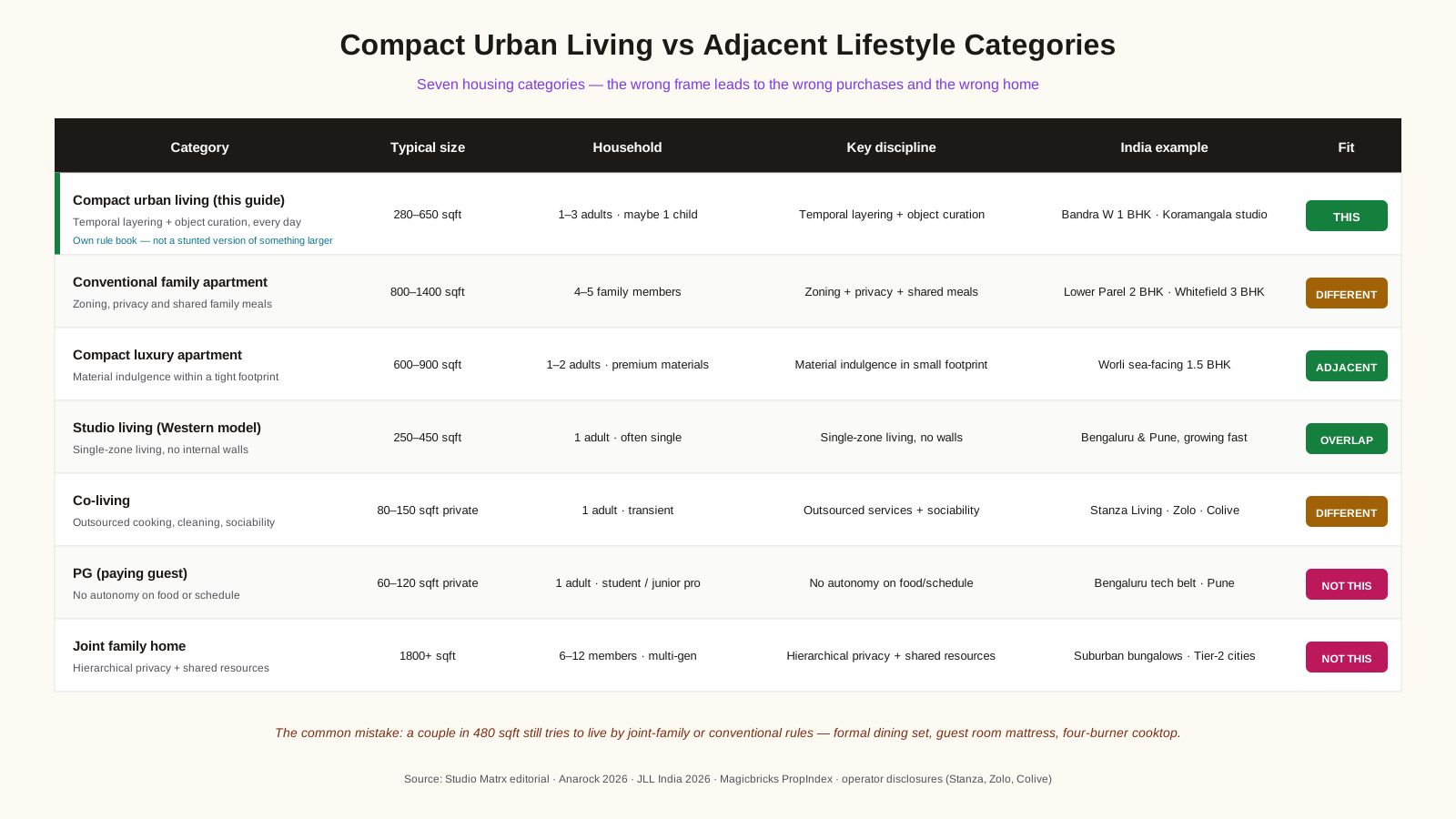
This category is often confused with related but distinct lifestyles. The differences matter because the wrong frame leads to the wrong purchases, the wrong expectations, and ultimately the wrong home.
| Category | Typical size | Household | Key discipline | India example |
|---|---|---|---|---|
| Compact urban living (this guide) | 280-650 sqft | 1-3 adults, maybe 1 child | Temporal layering, object curation | Bandra W 1 BHK, Koramangala studio |
| Conventional family apartment | 800-1400 sqft | 4-5 family members | Zoning, privacy, shared meals | Lower Parel 2 BHK, Whitefield 3 BHK |
| Compact luxury apartment | 600-900 sqft | 1-2 adults, premium materials | Material indulgence within tight footprint | Worli sea-facing 1.5 BHK |
| Studio living (Western model) | 250-450 sqft | 1 adult, often single | Single-zone living, no walls | Increasingly common in Bengaluru, Pune |
| Co-living | 80-150 sqft private + shared common | 1 adult, transient | Outsourced cooking, cleaning, sociability | Stanza Living, Zolo, Colive |
| PG (paying guest) | 60-120 sqft private | 1 adult, often student or junior pro | No autonomy on food or schedule | Bengaluru tech belt, Pune |
| Joint family home | 1800+ sqft | 6-12 members across generations | Hierarchical privacy, shared resources | Suburban bungalows, Tier-2 cities |
The mistake most often made: a household that is structurally compact-urban (a married couple in a 480 sqft flat) still tries to live by joint-family or conventional-family rules — keeps the formal dining set, the guest room mattress, the four-burner cooktop, the wardrobe-for-saris-she-has-not-worn-since-college. This produces clutter, daily friction, and a constant sense of inadequacy. The reframe is that compact urban living is its own category with its own rule book, not a stunted version of something larger.
Cross-reference: for the aesthetic-and-architectural reading of the same footprint band, see compact luxury apartment, space-efficient homes, and smart storage interiors.
Materials, Finishes and the Brand Landscape for Compact-Urban Households
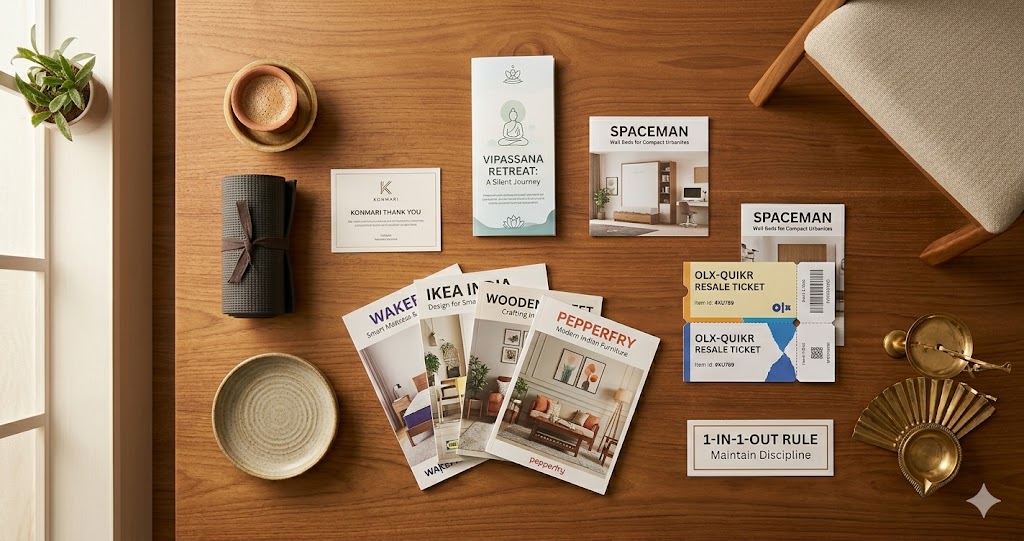
The compact-urban household has a particular shopping pattern: fewer items, higher unit quality, longer expected lifespan. The right brands are those that engineer for repeatability, modularity, and small footprints. The wrong brands are those whose product lines are built around large rooms and showroom display.
| Category | Best fit for compact-urban | Mid-range | Avoid for compact-urban | Notes |
|---|---|---|---|---|
| Modular wardrobes | Sleek (Asian Paints), Spacewood, Godrej Interio | HomeLane, Livspace | Custom carpenter without hardware spec | Insist on Hafele or Hettich hinges; soft-close non-negotiable |
| Modular kitchens | Sleek, Hacker (premium), IFB Modular | Livspace, HomeLane | Local kitchen-shop with MDF carcass | See also modular kitchen India |
| Hardware (drawers, hinges) | Hafele India, Hettich India, Blum | Ebco | Unbranded Chinese hardware | Reorder the same line for 10 years; brands matter for parts |
| Bedding | Wakefit, Sleepyhead, The Sleep Company | Urban Ladder, Pepperfry | Mattress-shop street purchases | Wakefit's 100-night trial is useful for compact bedrooms where size is hard to undo |
| Washing machine | IFB front-load 6-7 kg, Bosch | Samsung, LG | Top-load (footprint-hungry) | Front-loaders stack under counters; top-loaders cannot |
| Cooking appliances | Philips air-fryer, Wonderchef, Prestige induction | Borosil, Bajaj | Built-in microwave above hob | Counter-top air-fryer + induction replaces oven + microwave + gas |
| Refrigerator | Samsung Twin-Cooling 253-275 L | LG, Whirlpool 240-280 L | French-door 500 L+ | A 1-2 person household rarely needs above 275 L |
| Lighting | Wipro, Philips Hue (smart), Eglo | Crompton, Havells | Decorative chandeliers | Layered, dimmable, warm. See japandi apartment on lighting register |
| Sofa / divan | Wakefit space-saver, Urban Ladder modular | Pepperfry, Sleepyhead | 5-seater leather chesterfield | A 2-seater plus a foldable single-mattress beats a 3-seater every time |
| Window furnishing | Hunter Douglas / Vista (premium), D'Decor | IKEA India, FabIndia | Heavy traditional drapes | Blinds beat curtains for cleaning and width tolerance |
| Storage containers | Borosil glass, Cello Modustack | Tupperware India | Plastic dabbas inherited from parents | Modular stackability is the criterion, not nostalgia |
| Smart home | Mi (Xiaomi), Philips Hue, Atomberg fans | Syska, Wipro Garnet | Full-home automation suites | Start with three: lights, fan, doorbell |
The IKEA India footprint (Hyderabad, Mumbai Navi, Bengaluru, online-pan-India) is increasingly the default first stop for compact-urban households because IKEA explicitly designs for small European apartments — the dimensions translate well to Mumbai and Bengaluru carpets. The PAX wardrobe system, BESTÅ storage, and KALLAX cube units are over-represented in compact Indian apartments built after 2022.
A spending heuristic that holds well in 2026: spend 60 percent of your furniture budget on the 20 percent of items you use daily (mattress, kitchen storage, primary task chair), 30 percent on the items you use weekly (sofa, dining surface, lighting), and 10 percent on everything else. The compact-urban household that inverts this — splurging on decorative items and skimping on the mattress — is the one whose Saturday-morning back pain becomes a personality.
Eight Pitfalls Common in 2026 India
1. The "we'll grow into it" furniture purchase. Buying a 6-seater dining table because "one day we'll have guests" is the single most common compact-urban mistake. The table dominates the room for four years while you eat at the kitchen counter; eventually you sell it on OLX at a 70 percent loss. Mitigation: buy for the present use case + 18 months, not for a hypothetical future.
2. Inherited storage. The well-meaning Mumbai aunt who sends a steel almirah that has been in the family since 1978. Refusing it feels ungrateful; accepting it eats 9 sqft of floor area forever. Mitigation: have a pre-rehearsed line ("we don't have space and the building doesn't allow heavy items in the lift, but thank you so much"). Use the language of building rules, which Indian families respect more than personal preference.
3. Open-shelving aspirational decor. Pinterest and Instagram glorify open shelves with curated objects. In Indian metros — dust, monsoon, humidity, no daily dusting help — open shelves become grease-and-dust collectors within 90 days. Mitigation: closed storage with glass fronts at most. Save open shelves for one ceremonial spot, not every wall.
4. The dinner-party trap. Hosting dinner for six people requires either a 1000 sqft+ home or an external venue. Trying to do it in 480 sqft means the host spends 14 hours of the day cooking, the spouse spends 3 hours rearranging furniture, and the guests sit awkwardly on the bed. Mitigation: institutionalise the "chai-and-namkeen visit" as your hosting format. Save dinners for restaurants or for the rare three-times-a-year occasion when you order in extensively.
5. The hobby that outgrew the apartment. The pandemic-era pottery wheel, the home-gym bench, the violin amplifier, the 1200-piece Lego project that "just needs a flat surface for a week." Mitigation: hobbies that require permanent footprint above 6 sqft need a co-working studio, a community space, or a gym membership. Compact urban living and bulky hobbies are mutually exclusive.
6. Failing to negotiate the building society for bicycle and scooter parking. Many buildings have arbitrary rules: "no bicycles in flats", "scooters only in numbered slots", "no charging of EVs in common parking." Households accept these silently and lose mobility. Mitigation: read the bye-laws, propose written amendments at AGM, get one ally on the managing committee. Compact urban living without a bicycle or scooter is significantly worse.
7. The acoustic mismatch. One partner takes 15 video calls a day; the other naps in the afternoon. The bedroom door is hollow flush; the kitchen counter is 12 feet from the bed. By month four, one of them is sleeping at their mother's place every Tuesday. Mitigation: invest ₹15,000-30,000 in a solid-core door with a perimeter gasket, a heavy curtain across the doorway as a second skin, and a white-noise machine. See acoustic privacy visualizer for a quick assessment.
8. The "I'll declutter on the weekend" perpetual postponement. Clutter compounds. The Amazon box left in the corner for a week becomes the Amazon box-pile by month six. Mitigation: a non-negotiable 12-minute end-of-day reset, every day, before bed. Floor clear, surfaces clear, sink empty. The reset prevents the weekly two-hour ordeal.
India-Specific Considerations
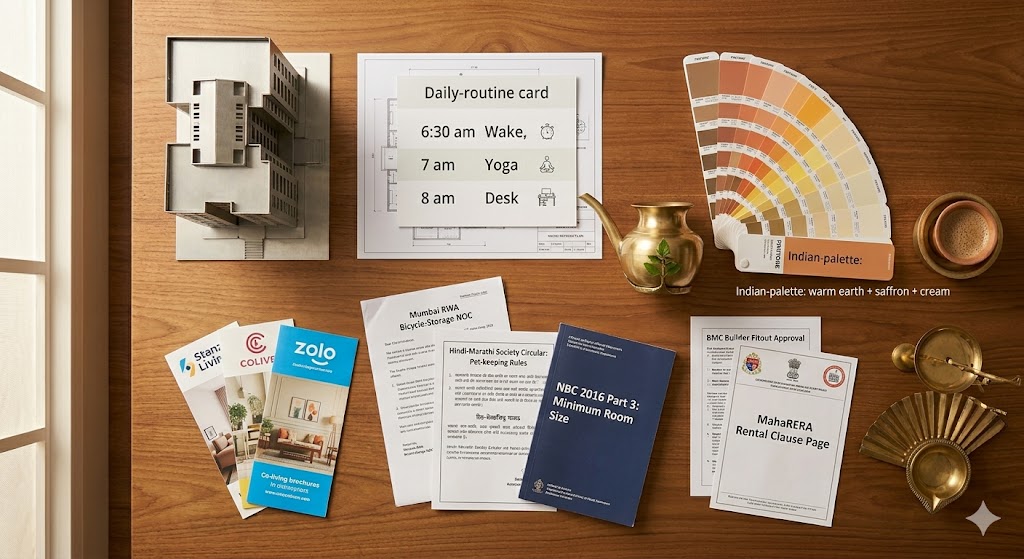
NBC 2016 and minimum dimensions. The National Building Code 2016 specifies minimum carpet area for habitable rooms (9.5 sqm / 102 sqft for the primary living-cum-bedroom), minimum clear width of corridors (0.9 m / 35 inches), and minimum kitchen area (5.5 sqm / 59 sqft). Most compact-urban units in 2026 are at or just above these floors. When evaluating a unit, demand the architect's stamped plan and verify against NBC — a 30 sqft "kitchen" claim is almost certainly a 22 sqft kitchenette with a 8 sqft passage counted in.
Society and RWA rules. Compact-urban living is unusually entangled with managing committees. Common contested items: bicycle storage in flats (most societies allow, some don't), pets (dogs increasingly restricted by lift-rules; cats almost universally permitted; the Animal Welfare Board of India 2014 circular protects residents' right to keep pets, but enforcement is uneven), washing-machine drainage (some societies object to balcony drains), drying-rack placement (Mumbai societies often have facade rules), Airbnb sub-letting (now restricted in most metro towers under post-2023 society resolutions).
Vastu and compact units. Vastu Shastra prescriptions assume a multi-room home with distinct zones for kitchen (south-east ideal), bedroom (south-west ideal), and pooja (north-east ideal). In a 350 sqft studio these zones overlap. The practical accommodation, drawn from a tradition of vastu pragmatism in Mumbai's small-flat culture: prioritise sleeping head-direction (south or east), keep the cooking flame in the south-east quadrant if at all possible, place any small pooja niche in the north-east corner of the unit even if it shares a wall with the kitchen. See vastu modern homes for the broader framework and vastu for kitchen for kitchen-specific rules.
Climate zones. A 480 sqft flat in Mumbai (warm-humid) and the same flat in Delhi (composite, with hot summers and cold winters) demand different lifestyles. Mumbai: balcony usable 10 months, drying clothes outside is normal, monsoon waterproofing critical, salt-air corrosion on hardware is real. Delhi: balcony usable 7-8 months, two-season wardrobe rotation essential, dust-storm sealing of windows, both heater and AC required. Bengaluru: balcony usable year-round, lightest load on AC and heating, ant-and-pest pressure higher than Mumbai. Chennai and Hyderabad: hottest summers; sun-shading critical; daytime balcony use limited March-June.
DPDP Act 2023 and home devices. Smart-home devices (cameras, speakers, locks) in shared compact apartments must comply with the Digital Personal Data Protection Act 2023 — meaningful when there are domestic workers, guests, or visiting family. Practical rules: no cameras in shared sleeping areas, label any audio-recording device, store no data on third-party clouds without considering jurisdictional issues. The compact apartment's tight footprint makes camera placement particularly delicate because there is no "private" room a worker can escape to.
Regional household-help dynamics. Mumbai household help expects daily 1.5-hour visits at ₹6,000-9,000/month for cleaning-and-dishes; Bengaluru typically ₹5,500-8,500; Delhi NCR ₹5,000-8,000 with more live-in options; Chennai ₹4,500-7,000. The compact apartment with daily help has a different cooking-and-storage rhythm than the compact apartment without — having someone do the dishes daily means you can own three plates instead of twelve.
Power reliability. Bengaluru averages 4-7 hours of cuts per month in 2026; Mumbai and Delhi NCR average 1-2 hours; Chennai and Hyderabad 6-12 hours. Compact apartments cannot accommodate inverter+battery setups easily (they need ventilation, space, and an electrician's love). Most rely on building-level diesel backup; this means refrigeration is fine but air-conditioning during outages is not guaranteed. Plan WFH around this.
The maid-mausi protocol. This is the most under-discussed India-specific factor. The domestic worker's routine — when she arrives, how long she stays, what she does — sets the apartment's metronome. Households should design the apartment around the maid's workflow, not the other way around: clear floor by her arrival time, dishes in one accessible spot, laundry in one bucket. The compact apartment with a chaotic maid-handoff is the apartment that always looks slightly dirty.
The Budget Bands for Compact Urban Living, 2026 India
Compact-urban budgets do not scale linearly with apartment size; they scale with discipline. A ₹4 lakh fit-out of a 480 sqft flat, done with rigour, often outperforms a ₹14 lakh fit-out done with the conventional-family playbook.
| Tier | Total fit-out | What it gets you | Typical vendor mix |
|---|---|---|---|
| Survival (₹1.5-3 lakh) | A liveable but iterating setup | IKEA + Pepperfry + one carpenter; existing mattress; rented appliances | DIY decisions, Amazon for hardware |
| Considered (₹3-7 lakh) | A coherent, comfortable, multi-year setup | Sleek wardrobes (₹1.8L) + IFB washer (₹38K) + Hafele kitchen hardware (₹1.4L) + Wakefit mattress (₹45K) + folding dining table (₹38K) + lighting refresh (₹60K) | One designer consult, balance executed by a trusted carpenter and modular-brand installer |
| Premium-compact (₹7-15 lakh) | A near-perfect calibration; minimal further iteration | Custom built-ins by a small studio (₹4-6L) + Hacker or Bulthaup kitchenette (₹3-5L) + premium appliances (Bosch, Miele compact, ₹1.5-2L) + designer lighting (Foscarini, ₹80K-1.5L) + acoustic treatment | Mid-tier design studio engagement; bespoke storage |
| Compact-luxury (₹15-35 lakh) | Material indulgence within tight footprint | Italian-imported wardrobe systems (Lema, Poliform, ₹6-12L), high-end appliances (Miele, Gaggenau, ₹3-5L), engineered timber flooring (₹2-4L), bespoke kitchen by Stosa/Hacker (₹5-8L), curated art and lighting (₹2-4L) | Boutique design firm; long lead times; imported materials |
Most metro households in 2026 land in the Considered band. Compact-luxury is the territory of compact luxury apartment, where a 720 sqft Worli sea-facing unit might absorb the same ₹30 lakh fit-out that a 3000 sqft villa would. The lesson: compact-urban living can be done in any of these bands, but the discipline (object curation, temporal layering, schedule alignment) is identical at every tier. The ₹2 lakh and the ₹25 lakh fit-outs both fail if the household does not learn the choreography.
For an honest first-cut on which tier matches your income and lifestyle, the budget allocation tool gives a useful starting frame.
"The most expensive mistake compact-urban families make is buying as if they were furnishing a 1200 sqft flat at a 480 sqft scale. The second is buying for the apartment they will own in seven years instead of the one they live in now." — Sundeep Khanna, design columnist, Architectural Digest India, 2026.
When Compact Urban Living Is NOT the Right Fit
This lifestyle is genuinely demanding and is not appropriate for every household.
Three-generation households. Compact urban living assumes one or two decision-makers, not five. Three generations under 600 sqft is feasible only with an iron schedule and tolerance for sustained intimacy. Most three-gen households are happier with a conventional 1100-1400 sqft 2.5-3 BHK in a slightly outlying micro-market.
Households with a non-negotiable hobby. Painters who need a studio, musicians with kits, cyclists with three road bikes, woodworkers, anyone who runs a YouTube channel from home with a large set. These hobbies eat compact apartments. Either rent a workshop or rent a larger home.
Households expecting a child within 24 months and planning to stay 5+ years. The compact apartment works fine for a baby (0-2). It begins to strain at toddler stage (2-4) and is genuinely difficult at school age (5+) because of homework setup, toy footprint, and friend hosting. Plan to move by year 4 of the child's life, or skip compact urban living entirely if your family-formation timeline is short.
Households with persistent chronic illness or mobility limitations. Compact apartments concentrate everything within a tight footprint, which sounds accessible but in practice means narrow corridors, smaller bathrooms (often 22-30 sqft), and bedrooms where a hospital-style adjustable bed will not fit. Universal design and compact urban living can be reconciled but require explicit attention and often disqualify off-the-shelf compact stock.
Households whose identity is hosting. If you are the friend whose Diwali dinner is the social event of the year, the cousin who hosts the engagement party, the colleague who hosts Friday drinks for 12 — compact urban living will make you unhappy. Buy or rent the larger apartment and accept the longer commute.
Households with rural-property obligations. If you are still maintaining a parental home in a Tier-2 city to which you send linens, kitchen vessels, books, and seasonal clothing, your compact apartment becomes an annexe to that home and accumulates redundant inventory. Resolve the parental home (close it, rent it, sell it, or give the contents away) before optimising the compact urban one.
The 5-Year Trajectory: 2030 Outlook
By 2030 the compact-urban Indian household will look meaningfully different from today's.
Smaller cooktops, bigger air-fryers. The induction-and-air-fryer combo will replace the four-burner gas hob in roughly 40-50 percent of new compact-urban kitchens, reflecting both the gas-pipeline build-out plateau and the cultural acceptance of one-pot and convection cooking. Wonderchef, Philips, and Borosil will compete on combination devices that do four jobs in one footprint.
Building-society-mediated services. Bicycle storage rooms, package lockers, electric scooter charging banks, co-working lounges, and pet-care concierges will be standard in new compact-urban developments — Lodha's, Brigade's, and Godrej's 2025-26 launches already include these. The compact apartment will offload more functions to the building, allowing the unit itself to stay smaller without quality of life suffering.
WFH-optimised stock. Developers will explicitly market "WFH 1 BHK" with a built-in 35-40 sqft work nook, an acoustically isolated bedroom door, and an in-unit fibre router cabinet. This may add ₹3-6 lakh to ticket prices in 2027-28 launches.
Sustainability mainstreaming. Compact apartments inherently consume less per capita (less power, less water, less material). The 2030 marketing of compact-urban will lean into this; buyers will increasingly choose a 520 sqft IGBC Gold unit over a 720 sqft non-rated one. See sustainable interiors India.
Pet-tech and pet-design integration. Bengaluru's cat-and-small-dog ownership in compact apartments is growing 18-22 percent year-on-year. Vertical cat infrastructure, automated litter management (PetSafe, Litter-Robot India launches), and wall-integrated feeders will be standard. Most building societies will formalise pet rules rather than ban-by-default.
The mid-career upgrade. A meaningful share of 2026's compact-urban households will move to 800-1100 sqft 2 BHKs around 2029-30, driven by child-rearing and remote-work permanence. The 2026 furniture they bought — modular, brand-supported, repeatable — will largely transfer because Sleek, Hafele, IKEA, and Wakefit all support modular reconfiguration. The carpenter-bespoke pieces will not transfer.
AI-assisted layout discipline. Tools like Studio Matrx's AI room planner will become standard in the renting-or-buying decision flow. The compact-urban shopper of 2030 will check three layouts virtually before signing a lease.
Frequently Asked Questions
1. We are a couple buying our first home in Mumbai with a ₹2.8 cr budget. Should we go for a 520 sqft 1 BHK in Bandra W or a 850 sqft 2 BHK in Mulund?
Both are defensible. The Bandra unit gives you better commute, social access, walkability, and rental yield; the Mulund gives you space for a child and a study. The deciding question is your 5-year plan: if you expect a child within four years and plan to stay through their primary-school years, Mulund. If you are likely to upgrade again in five years anyway, the Bandra micro-market will hold value better.
2. Can two adults work from home in a 1 BHK without driving each other mad?
Yes, with three rules. Rule one: one person works in the bedroom (door closed, acoustic treatment), the other at the dining table. Rule two: separate the video-call schedules where possible; back-to-back overlapping calls are the worst. Rule three: a 30-minute walking break out of the apartment, separately, every workday. The apartment is not designed for two simultaneous all-day occupants without a circuit-breaker.
3. How do we host my parents for two weeks without losing our minds?
Have a pre-bought, easy-to-deploy guest setup: a 4-inch foldable mattress (Wakefit), a single set of guest linen (stored vacuum-sealed), one extra towel set. Pre-agree the bathroom schedule. Plan one out-of-apartment activity every day so the apartment is empty for at least four daylight hours. Brief your parents honestly before they arrive: this is a small home, the routine is the routine, we love them.
4. Is buying a Murphy bed or wall bed worth it?
For a true studio (under 350 sqft), yes — it transforms the single room. For a 1 BHK with a separate bedroom, usually no — you already have a dedicated sleep zone; the Murphy bed in the living area is a solution to a problem you do not have. Murphy beds in India range ₹85,000-2.5 lakh (Spaceman, Resource Furniture, custom by Hettich-trained carpenters).
5. What about kids? Where do they sleep, study, play?
Up to age 2: they sleep with parents (this is the Indian norm anyway), play on a floor mat in the living area. Age 2-4: a toddler bed in the parents' bedroom or a partition curtain in the living area. Age 5+: this is where compact urban living begins to strain. Plan to either move up to a 2 BHK or accept that the child's "room" is a corner with a Hettich pull-down desk, a Spacewood wardrobe segment, and shared parents' room for sleeping. There is no perfect answer; many Indian families have done this successfully for decades.
6. Should we own a car?
In Mumbai SoBo and Bandra: usually no — Uber, Ola, autos, the local train, and a personal Vespa or e-scooter cover 95 percent of needs. In Bengaluru: a car is more useful given the city's transit gaps. In Delhi NCR: depends on the colony and metro proximity. Owning a car for a compact apartment imposes parking-slot rental costs (₹4,000-15,000/month) that can fund a Bluesmart subscription instead.
7. Cat, dog, or no pet?
Cats are nearly perfect for compact urban living: low spatial footprint, do not require walks, content with vertical territory, well-suited to apartment lighting and acoustics. Dogs are workable but harder: small breeds (Pug, Indie small mix, Shih Tzu) handle 480 sqft, large breeds do not. Daily walk discipline (45 minutes minimum) is non-negotiable for dogs and requires near-immediate access to a park. No pet is a perfectly valid choice for compact-urban; it should not feel like a failure.
8. How often should we declutter?
A 12-minute end-of-day reset (daily, non-negotiable), a 30-minute weekly sweep (Sunday morning), and a 2-hour quarterly audit (every clothing item, every kitchen vessel, every book gets a yes/no/donate vote). This cadence prevents the perpetual-decluttering trap.
9. Is renting better than buying for compact urban living?
Often yes, especially in Mumbai and Bengaluru core micro-markets where rental yields are 2.5-3.5 percent. The flexibility to upgrade in two-to-three years as life changes is worth more than the equity-build. Buy if you are certain of a 7+ year occupancy.
10. What is the single biggest mindset shift required?
Accepting that the home is a tool, not a stage. Indian aspirational culture has long treated the home as a display of arrival — the imposing dining set, the elaborate puja room, the formal living room. Compact urban living asks you to release that. The reward is calm; the cost is occasionally explaining to relatives why you don't have a sofa-cum-bed with embroidered upholstery.
References
1. National Building Code of India 2016, Bureau of Indian Standards, Part 3 (Development Control) and Part 4 (Fire and Life Safety). https://bis.gov.in
2. Anarock Property Consultants, Q1 2026 Residential Market Report (India). https://www.anarock.com/research
3. JLL India, Residential Market Update — Mid-Year 2026. https://www.jll.co.in/en/research
4. Knight Frank India, Workplace and Residential Convergence Report 2026. https://www.knightfrank.co.in/research
5. Magicbricks PropIndex Report 2026 (compact-segment trend data). https://www.magicbricks.com/Property-Rates-Trends/PropIndex
6. National Family Health Survey 6 (NFHS-6), 2025-26 round, Ministry of Health and Family Welfare. https://main.mohfw.gov.in
7. Digital Personal Data Protection Act 2023, Government of India. https://www.meity.gov.in/data-protection-framework
8. Animal Welfare Board of India, Circular on Pets in Housing Societies, 2014 and 2023 update. http://www.awbi.in
9. Indian Standard IS 10500:2012 (Drinking Water — relevant for compact-apartment plumbing). https://bis.gov.in
10. Houzz India 2026 Home Trends Study (compact-apartment renovation chapter). https://www.houzz.in/trends
11. IBEF (India Brand Equity Foundation), Real Estate Sector Report — Q1 2026. https://www.ibef.org/industry/real-estate-india
12. CBRE India, Live-Work-Play 2025 — Compact City Dweller Edition. https://www.cbre.co.in
13. Marie Kondo, "The Life-Changing Magic of Tidying Up" (2014, English translation), referenced as cultural antecedent to current decluttering discipline in Indian urban contexts.
14. S. N. Goenka, Vipassana Research Institute publications on minimal-possession lay practice, https://www.vridhamma.org
15. Sundeep Khanna, "The Vertical Mumbai: Living Small, Thinking Large," Architectural Digest India, March 2026.
Related Guides
- compact urban home planning India — the layout-and-architecture companion to this lifestyle guide
- space-efficient homes — broader principles for getting more from every sqft
- compact luxury apartment — the high-spend end of the compact-urban spectrum
- smart storage interiors — vertical and modular storage strategies in detail
- urban home architecture India — the wider architectural context of metro homes
- japandi apartment — the aesthetic register most aligned with compact-urban discipline
Export this guide
Related Guides — Deep-dive reading
Studio Apartment Design — The 1RK 250-450 sqft Indian Cornerstone (2026)
1RK studio · 5 zones in 350 sqft · Bed-as-sofa · Co-living adjacent · Mumbai BKC ₹35K rent
Design StylesSpace-Saving Furniture — The 12-Category Piece-by-Piece Indian Reference (2026)
Sofa-cum-beds · Murphy beds · Transformer dining · Modular wardrobes · IS 8888 · Indian brand+price tables
Design StylesSmart Storage Interiors — A 2026 Working Reference for Indian Homes
Inventory-driven · Floor-to-ceiling · Hardware-engineered · Zone-mapped
Room PlanningRelated Tools — Try Free
Cross-Ventilation Analyzer
Estimate airflow and air changes per hour (ACH) from room size, window areas, layout, and local wind — with NBC 2016 Part 8 compliance check.
Ventilation CalculatorAcoustic Privacy (STC) Visualizer
Indian healthcare acoustic visualizer — compare wall assemblies and noise sources, see received SPL after STC attenuation, and check FGI 2018 / IS 1950 / NABH speech-privacy compliance with live dual-canvas waveform.
Acoustic ToolMonsoon-Readiness Checklist
Pre-rain home audit across 9 categories — terrace, drains, waterproofing, electrical, HVAC, pest, vehicles, documents.
Seasonal Audit