
Community Facilities Planning
Planning the full set of community facilities — hall, clubhouse, worship, market, civic and care — as one coordinated social-infrastructure system, provisioned and distributed by population
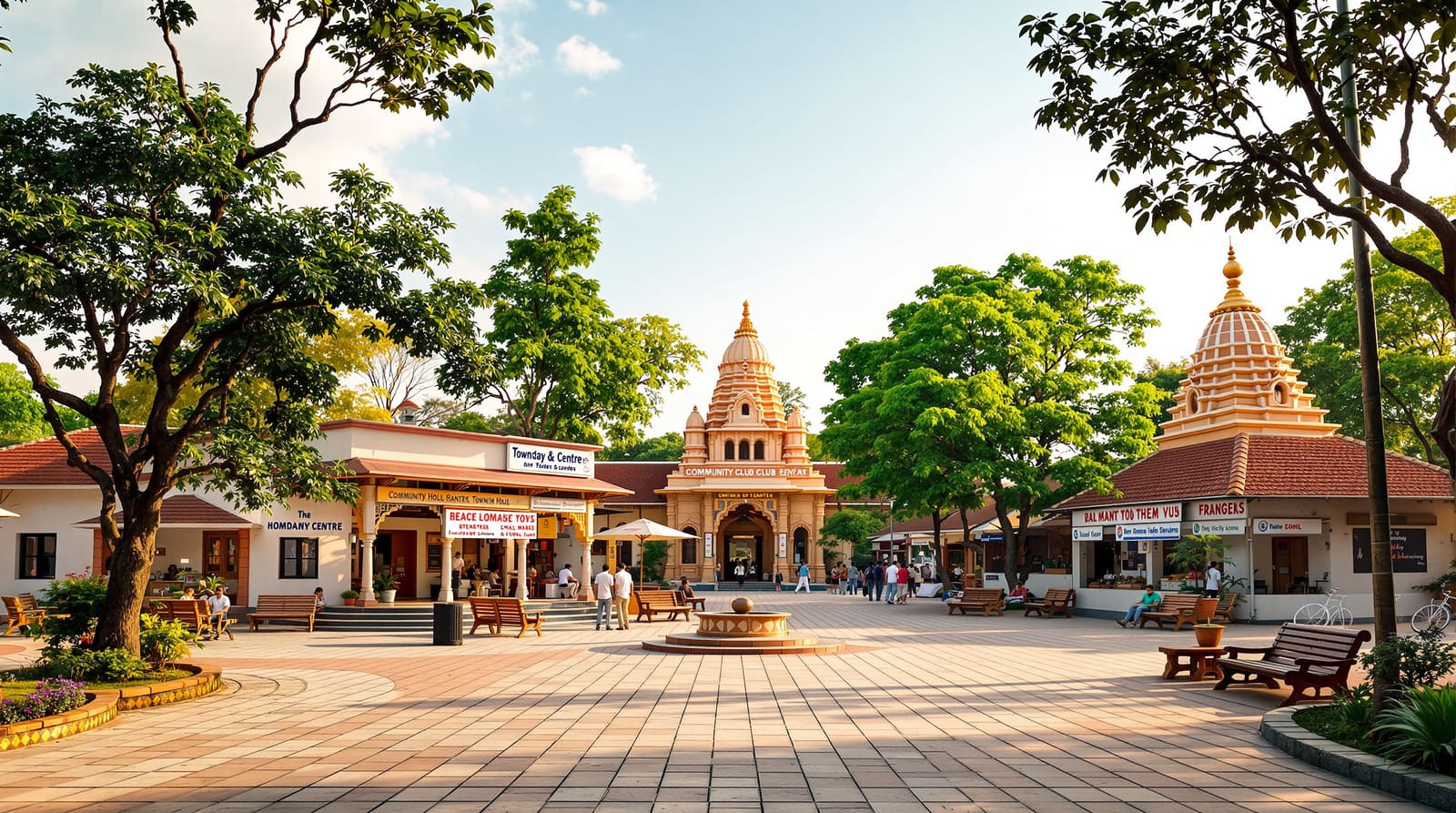
On a Sunday evening in a township on the edge of Pune, the town square is the busiest place for a kilometre in any direction. Children chase each other across a paved plaza while their grandparents claim the benches under the gulmohar trees. A wedding reception spills out of the community hall; next door, the clubhouse gym glows through plate glass, and a queue forms at the ATM beside the post office. The temple bell rings for the evening aarti, and across the square a small crowd drifts toward it. The kirana store, the chemist, the vegetable vendors and a coffee chain share a covered arcade, and every one of them is doing brisk trade. Nobody drove here. They walked, because everything they came for sits within a five-minute stroll of their front doors.
A kilometre away, in a township of identical buildings and identical setbacks, that same Sunday evening is silent. The developer built the homes, sold them, and left the "amenities" as a single under-used clubhouse behind a locked gate. There is no market, no place of worship, no library, no creche; residents drive ten minutes to the nearest town for milk and a haircut, and the township is a dormitory — a place people sleep, not a place they live. The difference between the two is not budget or architecture but amenity planning: the deliberate, coordinated provision and distribution of the full range of community facilities, sized to the population and clustered where people can reach them on foot.
Community facilities as one social-infrastructure system
At township scale — tens to hundreds of acres, thousands of homes across many neighbourhoods — community facilities are not a list of buildings to be ticked off. They are a single social-infrastructure system that has to be provisioned by population, distributed equitably, and clustered so that the parts reinforce each other. This is a discipline distinct from designing any one building, and it is the connective tissue that ties together the other big amenity domains: school planning, healthcare facilities in townships, and parks and recreation planning. Each of those has its own deep guide. This guide covers everything else — the hall, the clubhouse, places of worship, local retail and the town centre, civic services, the library, care centres, the gym, the cremation ground — and, crucially, the framework that knits all of them, schools and health included, into one coordinated plan.
The contrast with single-neighbourhood layout planning is the whole point. A neighbourhood layout might reserve a single convenience-shopping plot and a community room. A township has to provision a graduated hierarchy of facilities across its entire population and decide which go in every neighbourhood, which serve a cluster of neighbourhoods, and which serve the whole township from a central civic and retail heart. Get the system right and the township acquires social life of its own; get it wrong — under-provide, mis-distribute, or scatter the facilities so nothing is walkable — and no amount of good housing design will compensate.
The range — what the full set actually contains
Think of community facilities in five families. The gathering facilities are the community hall or multipurpose hall (weddings, functions, RWA meetings, festivals) and the clubhouse with its gym, indoor games, swimming pool and party rooms — the social engine of Indian gated-township life. The belief and ritual family is places of worship: India's social anchor, and at township scale a multi-faith provision question — a temple, but also reserved sites or shared space for a mosque, church or gurudwara, plus the often-forgotten burial and cremation ground that a self-contained township of thousands genuinely needs.
The everyday-retail family runs from the neighbourhood convenience cluster — the kirana, chemist, vegetables, milk booth, salon, laundry — up to the township market and the mixed-use town centre with its weekly bazaar, food and larger shops. The civic-services family is the chronically missing piece in Indian developer townships: the post office, bank or ATM, a police outpost or beat box, a fire-response point, and basic municipal/citizen-service access. The learning and care family includes the library or reading room, the day-care and creche, and the senior citizens' centre — small but disproportionately important facilities for the very young, the very old and the carers in between. Around all of these sit recreation grounds and parks, which connect this plan to a township's open-space network.
The hierarchy of provision
The organising principle, drawn from URDPFI-style amenity planning, is a three-tier hierarchy keyed to catchment and walking distance.
At the neighbourhood level (roughly 5,000–15,000 people, a 5-minute / 400–500 m walk) you provide the daily-need facilities: a convenience-shopping cluster, a community room or small hall, a creche or anganwadi, a small park and a place for informal worship. These must be plentiful and dispersed — one set per neighbourhood — because their whole value is that they are reachable on foot, the principle at the heart of walkable neighbourhood design.
At the sector level (a cluster of neighbourhoods, perhaps 25,000–50,000 people) you consolidate facilities that need a larger catchment to be viable: a full clubhouse, a sector market, a community hall sized for functions, a library, a clinic and a higher school. At the township level you place the things that serve everyone and work best as a single concentrated heart: the civic and retail town centre, the main place(s) of worship, the central library, the township-management office and the public-service cluster, and the cremation/burial ground (sited downwind and at the edge). The skill is matching each facility to the right tier — too low and it is unviable, too high and it is unreachable.
Provisioning by population — sizing the system
Provisioning means converting a population figure into floor area, plots and reservations using per-capita standards, then locating them. The URDPFI Guidelines 2014 give the working benchmarks, and they should be read as a floor to be calibrated to context, not as gospel — densities, household sizes and demand vary across Indian cities. The table below stays deliberately at the township provisioning level. Treat all numbers as indicative planning standards to be checked against the prevailing state township policy and local development control rules.
| Facility | Provision level | Indicative population served / standard |
|---|---|---|
| Convenience shopping / kirana cluster | Neighbourhood | 1 per 5,000 & within 400–500 m walk |
| Community room / multipurpose hall (small) | Neighbourhood | 1 per 5,000–15,000 |
| Anganwadi / creche & day-care | Neighbourhood | 1 per 5,000 (URDPFI anganwadi norm) |
| Clubhouse (gym, indoor games, pool) | Sector | 1 per 25,000–40,000 |
| Sector market / local shopping centre | Sector | 1 per 25,000–50,000 |
| Library / reading room | Sector | 1 per 25,000 (URDPFI library standard) |
| Place of worship (multi-faith reservation) | Sector & township | Sites reserved per community demand & mix |
| Senior citizens’ centre | Sector | 1 per 25,000–45,000 |
| Post office, bank / ATM, police outpost | Township | Civic cluster per township & per state norm |
| Town centre / district shopping & civic heart | Township | 1 per township (whole population) |
| Burial / cremation ground | Township | 1 per township, sited at the edge |
The township centre — the social heart
The single most important move in amenity planning is to concentrate the township-level facilities into one town centre built around a real public square. Co-location is not tidiness; it is what makes the whole greater than the parts. When the hall, the clubhouse, the market, the place of worship, the library and the civic services share a walkable plaza, each draws footfall that sustains the others — the temple visit becomes a market trip becomes a coffee becomes a chance encounter on a bench. That density of overlapping uses is what produces street life, and it is why the town square is the social and commercial heart of every township that feels alive. The principle scales down too: at neighbourhood level, cluster the convenience shops, the community room and the creche around a small green so that errands and child-minding and meeting neighbours happen in the same few hundred metres rather than scattered across the layout.
Co-location also disciplines distribution. The temptation in a phased, sold-as-you-go township is to put the clubhouse next to the first towers and forget the rest, or to bury facilities deep inside a premium pocket. Equitable distribution means every neighbourhood gets its daily-need tier within a 5-minute walk, every sector gets its consolidated tier, and the town centre is positioned — usually near the township's main internal junction on the township road hierarchy — so it is roughly equidistant and reachable on foot or by a short cycle from most homes, not captured by one enclave.
Make it real — phasing, provision, governance, and the Indian gaps
The hardest part of amenity planning in India is not the standards but the delivery. Four honest realities decide whether the plan survives contact with a balance sheet.
Phase facilities early, not last. The commercial instinct is to defer amenities until the homes are sold; the planning truth is the reverse. A township needs social life from its first occupied phase, or early residents endure years of dormitory living and the place gets a dead reputation it never shakes. Magarpatta in Pune is the standard cited example of a township where the work-live-play mix and early community provision created genuine self-containment; Aranya in Indore is remembered for incremental social infrastructure woven into an affordable fabric. The lesson is to front-load at least the neighbourhood-tier facilities and a starter town-centre in each major phase.
Public versus developer provision, and land reservation. Some facilities — post office, police outpost, fire response, a government dispensary — are properly public, but a private township cannot wait for the state to arrive; the realistic model is for the developer to reserve and build the shell under the state township policy and RERA-disclosed amenity commitments, then hand operations to the relevant agency or a service provider. Reserve the land for civic services explicitly in the master plan even when the operator is uncertain, because retrofitting a police post or a cremation ground into a fully sold township is nearly impossible. This is precisely where Indian developer townships most often fail: the missing-civic-services problem, where everything commercial gets built and everything public gets quietly dropped.
Maintenance and governance. A community facility is a recurring liability, not a one-time cost. Decide upfront who owns, who maintains and who pays — the RWA, an apportioned township-management company, a commercial operator for the clubhouse and market, or the local body for civic buildings. Indian clubhouse culture thrives where governance is clear and dies where maintenance funds and responsibility are vague. Respect the Indian texture of demand: the place of worship as the genuine social anchor, the kirana and the weekly market as the real retail backbone alongside any organised retail, and the clubhouse as the aspirational draw — plan for all three honestly rather than importing an amenity mix that does not match how people actually gather. Sized, distributed and phased this way, community facilities turn a collection of buildings into a township worth living in — the larger ambition set out in the pillar guide on designing a residential township, and a problem that planning tools like DesignAI can help model at the provisioning and distribution stage.
References
1. URDPFI Guidelines 2014, Ministry of Urban Development, Government of India — Volume I, social infrastructure and amenity provisioning standards.
2. National Building Code of India (NBC) 2016, Bureau of Indian Standards — assembly, mercantile and institutional occupancy requirements.
3. Relevant State Integrated Township Policy / Township Development Scheme (for example the Maharashtra, Haryana or Gujarat township policies) — amenity reservation and developer-obligation norms.
4. CPHEEO Manuals on Water Supply, Sewerage and Stormwater, Ministry of Housing and Urban Affairs — service provisioning for community buildings.
5. IGBC Green Townships Rating System, Indian Green Building Council — credits for social infrastructure, walkability and mixed use.
6. Real Estate (Regulation and Development) Act, 2016 (RERA) — disclosure and delivery of common areas and amenities.
7. The Urban Pattern: City Planning and Design, and standard town-planning texts on neighbourhood-unit theory and amenity hierarchy.
Read this alongside parks and recreation planning and the township planning checklist, and explore how DesignAI can help you provision and distribute community facilities across a township.
Export this guide
Related Guides — Deep-dive reading
Designing a Residential Township
Planning a township as a self-contained system — many neighbourhoods plus shared schools, healthcare, parks and community facilities, served by trunk roads, water, power and stormwater
Township PlanningSchool Planning Inside Townships
Schools as township amenities — how many of what type by population, the walk-to-school catchment, safe siting away from arterials, the school-park pairing and safe routes
Township PlanningDesigning Adaptable & Universal-Design Homes
Accessibility, Aging-in-Place, and the Multi-Stage Family — Code, Anthropometrics, and Plan-Stage Discipline for Indian Residential Architects
Room PlanningRelated Tools — Try Free
Rainwater Tank Sizer
How big should your rainwater tank be? Computes annual harvest, recommended tank capacity in litres, water-bill savings, and payback — for 10 Indian cities.
RWH CalculatorCross-Ventilation Analyzer
Estimate airflow and air changes per hour (ACH) from room size, window areas, layout, and local wind — with NBC 2016 Part 8 compliance check.
Ventilation CalculatorInterior Budget Allocation Map
How ₹5L / ₹10L / ₹20L budgets should be distributed across rooms with visual charts and tier breakdown.
Reference Guide