
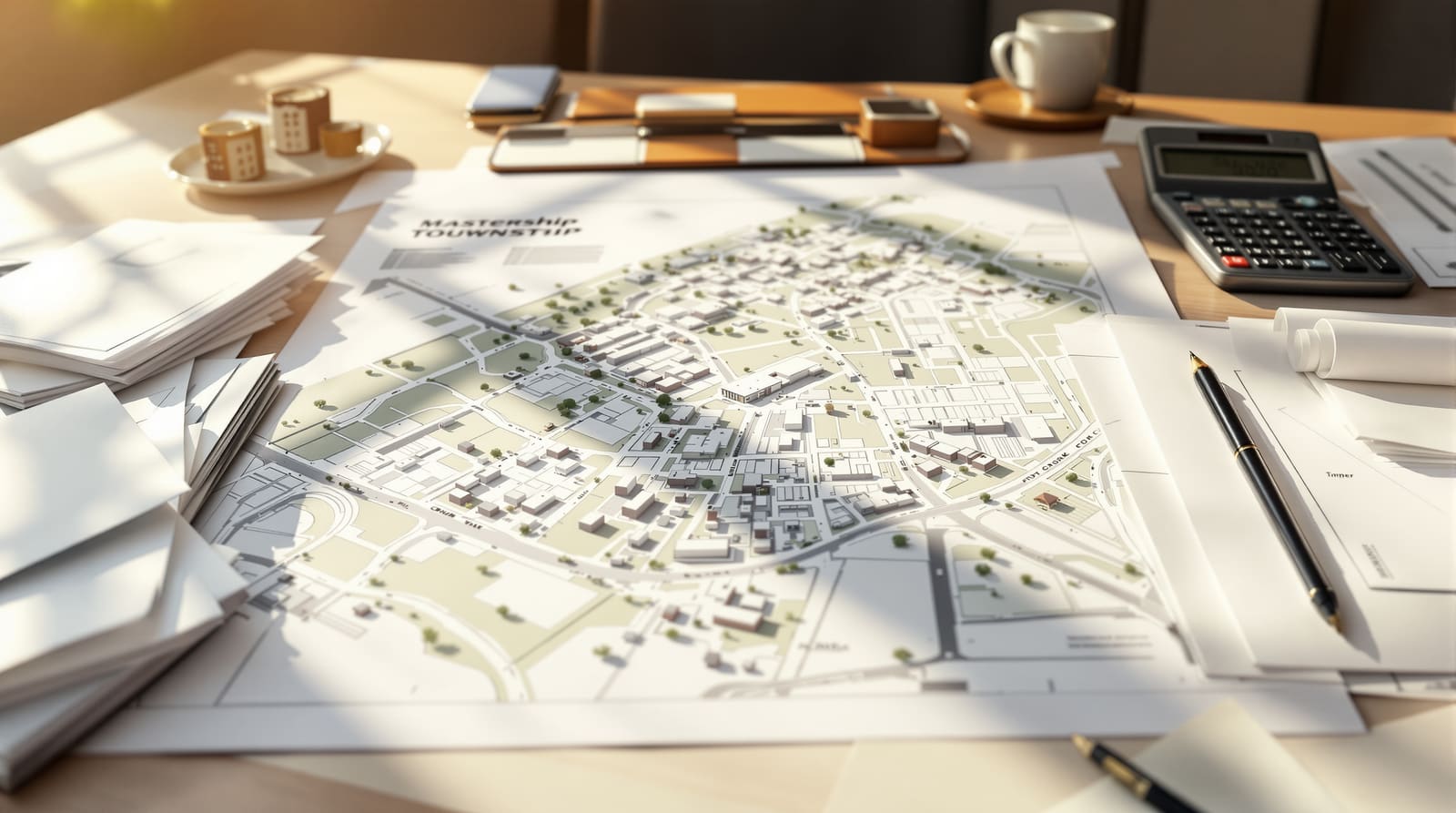
Township Planning Checklist
The complete township-to-handover checklist — feasibility, master plan, amenity provisioning, trunk infrastructure, sustainability and phased approvals, each linked to its deeper guide
The project review room in Pune is papered with drawings. On one wall, a 220-acre parcel off the ring road, stitched together from eleven survey numbers over three years. On another, a structure plan with a green spine running its length, three neighbourhood clusters hung off a single arterial loop, a school site marked in yellow, a 2-acre health node in red. A junior planner is asking the question that decides everything: in what order do we build, and what must be ready before the first family moves in? The development manager flips to a spreadsheet — sanctions pending, a water NOC stuck, a sewage treatment plant sized for Phase 1 but not Phase 3 — and the room goes quiet. The masterplan is beautiful. The sequence is where townships live or die.
A township is not a large layout. It is a small city that one developer must finance, sanction, build and eventually hand over — many neighbourhoods plus the schools, clinics, parks, trunk roads and treatment plants that serve all of them. Get the order wrong and you sell flats beside a road that floods, a school that opens in year nine, a sewage plant running at triple capacity. This is the township-scale checklist: a phase-by-phase action list that ties the whole cluster together — where each item tells you what to do, why it matters, and which deeper guide to open before you tick it off.
How to use this checklist
This is the capstone of the township cluster — an index you work through in sequence, not another essay. Each phase below is a table of actions; the "why" is one line; the link opens the guide that explains the item in full. Six phases run roughly in order, though approvals and phasing thread through all of them.
If you are working at the single-plot scale — one building on one site — this is the wrong checklist. Use the plot development checklist instead; it runs from setback and FSI to OC at the scale of a single property. This list operates two scales up: many neighbourhoods, trunk systems sized for the whole population, and per-population provisioning standards. The pillar that explains the design process behind these phases is designing a residential township.
Phase 1 — Feasibility & land
Before a single line is drawn, prove the land can legally and physically carry a township.
| Action | Why it matters | Deeper guide |
|---|---|---|
| Survey the site & contours | Slope, drainage lines & soil decide layout and cost | designing a residential township |
| Assemble & consolidate land | Townships need contiguous tens-to-hundreds of acres; fragmented title kills schemes | designing a residential township |
| Check master-plan & zoning conformity | Land use, FSI & reservations in the city master plan are binding | urban design concepts |
| Confirm township-policy eligibility | State integrated-township schemes set minimum area, amenity & open-space quotas | designing a residential township |
| Verify trunk-infrastructure access | Water source, power feeder & outfall must exist or be securable | township utility networks |
| Register the project under RERA | Mandatory before marketing; phase-wise registration is allowed | designing a residential township |
Phase 2 — Master plan
Fix the structure of the whole development before designing any one neighbourhood.
| Action | Why it matters | Deeper guide |
|---|---|---|
| Draw the structure plan | The arterial loop, neighbourhood clusters & centres are the township's skeleton | designing a residential township |
| Balance the land-use mix | URDPFI ranges for residential, commercial, public-semi-public & open space | designing a residential township |
| Set gross & net density | Density drives every downstream load — schools, water, roads, parking | residential density planning |
| Lay the green-blue network | A continuous park-and-drainage spine, fixed first, not the leftover scraps | open space planning |
| Locate amenity sites early | Reserve school, health & community plots in the plan, not after sales | parks & recreation planning |
Phase 3 — Amenity provisioning (by population)
Townships are judged on what serves the people, not the flats. Size every amenity to projected population using URDPFI 2014 thresholds — the per-thousand norms, not guesswork.
| Action | Why it matters | Deeper guide |
|---|---|---|
| Plan schools by catchment | Pre-primary to senior-secondary on URDPFI per-population norms & walking distance | school planning |
| Provision healthcare tiers | Dispensary → polyclinic → nursing home, scaled to township population | healthcare facilities |
| Allocate community facilities | Community halls, religious, socio-cultural & civic plots per the hierarchy | community facilities planning |
| Hit open-space & recreation quotas | Tot-lots → neighbourhood parks → district park; the URDPFI green hierarchy | parks & recreation planning |
| Distribute retail & convenience | Convenience shopping within walk distance plus a township-level centre | community facilities planning |
Phase 4 — Trunk infrastructure
The networks that carry water, waste, power and water-runoff for the whole township — designed as trunk-distribution-local hierarchies, sized for full build-out, staged for phasing.
| Action | Why it matters | Deeper guide |
|---|---|---|
| Set the road hierarchy | Arterial → collector → local, per IRC; widths fix everything beneath them | township road hierarchy |
| Size water supply & storage | CPHEEO per-capita demand, source, treatment, overhead & underground storage | township utility networks |
| Lay sewerage & treatment | Gravity sewers to an STP sized for the phase; reuse treated water | township utility networks |
| Plan power & distribution | Feeder, substations, distribution rings, plus solar & backup | township utility networks |
| Design the stormwater network | Drains in the road hierarchy, recharge & detention for the monsoon | township stormwater planning |
Phase 5 — Sustainability & smart
The difference between a township that ages well and one that becomes a maintenance liability. Build these in from the masterplan, not as a retrofit.
| Action | Why it matters | Deeper guide |
|---|---|---|
| Target a green-township rating | IGBC Green Townships / LEED-ND set water, energy & site benchmarks | sustainable neighborhood design |
| Engineer for resilience | Heat, flood & water-stress are India's recurring township failures | sustainable neighborhood design |
| Layer in smart systems | Metering, SCADA, sensors & data backbone, conduited during trunk works | future smart townships |
| Close the water loop | Rainwater harvesting, recycled-water reuse & recharge across the site | township stormwater planning |
Phase 6 — Approvals, phasing & governance
This phase threads through all the others, but it is where masterplans meet reality — and where most townships stumble.
| Action | Why it matters | Deeper guide |
|---|---|---|
| Secure sanctions & NOCs | Layout sanction, building plans, fire, environment (EIA), height, water & tree NOCs | designing a residential township |
| Sequence the phasing plan | Each phase must be self-sufficient — its own STP capacity, road access & amenities | designing a residential township |
| Gate amenities to occupancy | Tie school/park/clinic delivery to population milestones, not the final phase | parks & recreation planning |
| Obtain OC/CC per phase | Occupancy & completion certificates are the legal trigger for handover | designing a residential township |
| Plan the management handover | The township-management body or RWA, sinking fund & asset register from day one | community facilities planning |
Making it real in India
A checklist is only as honest as the phasing behind it. Magarpatta in Pune worked because farmers pooled land and the amenities — school, hospital, IT park — were built early, not promised for a final phase that never arrives. Aranya in Indore showed that a site-and-services frame can grow incrementally if the trunk infrastructure is laid first and the plots fill in over time. Lavasa is the cautionary tale: a masterplan unmatched by clearances and cash flow stalls, and stranded buyers inherit half a town.
The recurring Indian failure is the same one the Pune review room was staring at — selling flats faster than the trunk systems and amenities can follow. The fix is in Phase 6: make each phase genuinely self-sufficient, gate amenities to population milestones, and stand up the township-management body and its sinking fund before, not after, residents arrive. Governance is not the last item on the list; it is the thing that keeps everything above it working for thirty years. Run the masterplan options through DesignAI early, and the trade-offs between density, open space and phaseable infrastructure stop being a wall of drawings and become a decision you can defend.
References
1. URDPFI Guidelines 2014, Ministry of Urban Development, Government of India — social-infrastructure & amenity provisioning standards.
2. The relevant State Integrated Township Policy (e.g. Maharashtra, Haryana, Uttar Pradesh) — eligibility, minimum area & open-space norms.
3. National Building Code of India 2016 (NBC 2016), Bureau of Indian Standards.
4. CPHEEO Manuals on Water Supply, Sewerage & Stormwater Drainage, Ministry of Housing & Urban Affairs.
5. IGBC Green Townships Rating System, Indian Green Building Council.
6. IRC standards for urban road geometry & hierarchy, Indian Roads Congress.
7. Real Estate (Regulation & Development) Act, 2016 (RERA) — phase-wise project registration.
Work the full design process behind these phases in designing a residential township, size the loads with residential density planning, and pressure-test your masterplan with DesignAI.
Export this guide
Related Guides — Deep-dive reading
Designing a Residential Township
Planning a township as a self-contained system — many neighbourhoods plus shared schools, healthcare, parks and community facilities, served by trunk roads, water, power and stormwater
Township PlanningUtility Networks in Townships
The trunk utility backbone of a township — the water source and WTP, the sewerage network and STP with reuse, the power substation and HT ring, and the coordinated utility corridor
Township PlanningSTP for Housing Layouts & Plotted Developments: The Developer's Guide
Whether to mandate individual plot STPs or build one common plant, how to run the sewer network and lift stations, and how to phase treatment capacity as plots sell and homes come up over years — explained for developers and layout planners in India.
Sewage Treatment PlantsRelated Tools — Try Free
Rainwater Tank Sizer
How big should your rainwater tank be? Computes annual harvest, recommended tank capacity in litres, water-bill savings, and payback — for 10 Indian cities.
RWH CalculatorMonsoon-Readiness Checklist
Pre-rain home audit across 9 categories — terrace, drains, waterproofing, electrical, HVAC, pest, vehicles, documents.
Seasonal AuditConstruction Approval Checklist — 24-Stage Tracker
Track every approval, permit, and NOC from land title to occupancy certificate across 24 stages.
Approvals