
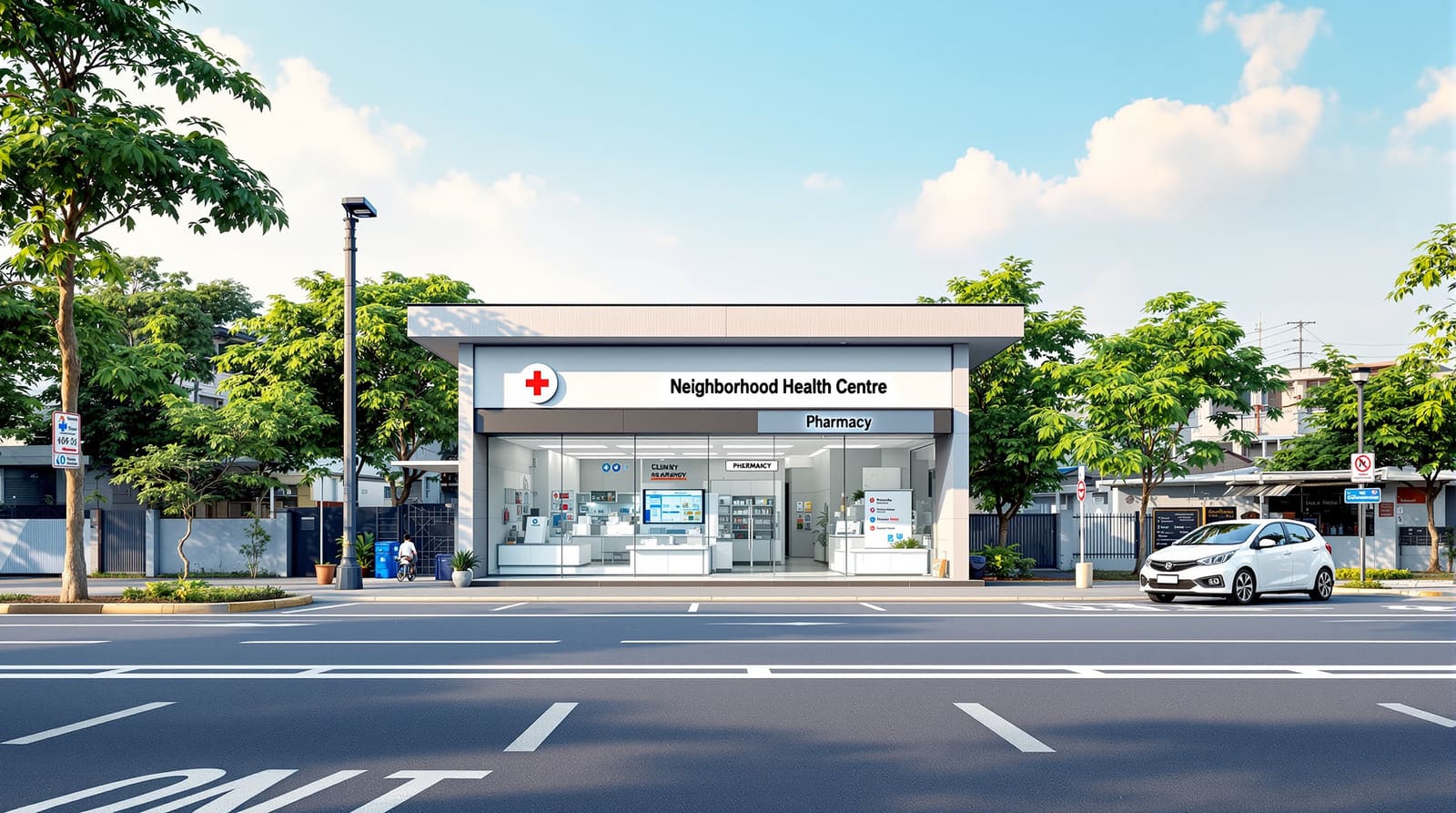
Healthcare Facilities in Townships
Healthcare as a township amenity — the tiers from walkable clinic to hospital, provisioning by population, the walk-to-everyday-care versus drive-to-acute-care principle, and siting for access
A young family moves into a glossy new township off the Pune ring road — six thousand homes promised over three phases, a clubhouse already open, a school under construction, and a brochure that shows a smiling doctor in a white coat under the words "integrated healthcare." Eighteen months in, the reality is a single chemist's shop in the retail strip and a part-time general physician who sits three evenings a week above the supermarket. When a resident's father has chest pain at two in the morning, the ambulance takes forty minutes to arrive because the gate guard cannot find the keys to the second boom barrier, and the nearest hospital with a cath lab is twenty-two kilometres away through a level crossing.
That gap — between the marketing render and the night a family actually needs care — is the real subject of healthcare planning at township scale. It is not a question of how a hospital ward is detailed or how a clinic meets fire code. It is a question of what level of care sits where, for how many people, and how fast you can reach it. A township earns the word "integrated" only when it provisions a tiered healthcare network — everyday care within a walk, acute care within an ambulance-reachable drive — and reserves the land for it from day one rather than leaving it to a chemist and a hope.
Healthcare as a township amenity, not a building
This guide works one scale up from the hospital architect's drawing board. The design and statutory compliance of the buildings themselves — the healthcare architecture regulatory landscape, the hospital design statutory compliance, and the clinic and polyclinic design compliance — are their own deep disciplines. What we plan here is the township-level amenity programme: how many health facilities of which tier, sized to the resident population, sited so they actually serve it, and phased so the first residents are not left without care. It belongs beside school planning and community facilities planning under the designing a residential township pillar.
The organising idea is the hierarchy of provision, borrowed from the URDPFI Guidelines 2014. Healthcare in a settlement is not one thing — it is a ladder of facilities, each matched to a catchment population and a level of acuity. At the bottom sits the everyday, high-frequency, low-acuity tier: the pharmacy and the clinic or dispensary, where most encounters happen — a fever, a prescription refill, a child's vaccination. In the middle sits the sector tier: a polyclinic with multiple specialists, a diagnostic laboratory and imaging, and a day-care or observation facility. At the top sits the acute tier: a multi-speciality hospital with inpatient beds, an emergency department and an operating theatre — a facility a single township often cannot fill alone and therefore shares regionally.
Provisioning by population — the URDPFI ladder, qualified
The URDPFI Guidelines give population thresholds per facility, and they are the right starting reference — but they must be read honestly. They are advisory norms calibrated to generic urban densities, they overlap awkwardly with the public-sector PHC/CHC system, and a private township's clientele behaves differently from the catchment a public dispensary assumes. Treat the numbers as a sizing discipline, not a guarantee of viability.
As a rough calibration: URDPFI suggests a dispensary or health centre serving on the order of 15,000 to 25,000 people, a polyclinic or larger health centre at roughly the 100,000 mark, and general-hospital beds provisioned at something like 1 to 1.5 beds per 1,000 population once the settlement is large enough to justify a hospital at all. The bed ratio is the one to scrutinise: India's overall availability is well below the WHO-referenced benchmark of around 3 beds per 1,000, and a township is not obliged to close the national gap single-handed — but it should plan to a defensible local ratio and reserve land accordingly. For a township of, say, 25,000 residents, the arithmetic points to one or two clinics, a single sector polyclinic, and a reservation for hospital land that may only be built out — or shared with a neighbouring catchment — at full occupancy.
This is also where the public-versus-private question bites. Some states' integrated-township policies and the URDPFI social-infrastructure norms assume public provision (PHCs, CHCs); a private township typically delivers care through a private operator or a public-private partnership (PPP), leasing a reserved plot to a hospital chain. Whichever route, the planning move is the same and non-negotiable: reserve the land in the master plan and lock it in the RERA-declared layout, so the hospital plot cannot quietly become another residential tower when the diagnostics tenant proves slow to sign.
| Facility tier | Indicative population served | Access mode & siting cue |
|---|---|---|
| Pharmacy & first-aid / day clinic | 5,000–10,000 (neighbourhood) | Walk — within local streets, near retail & community node |
| Dispensary / general clinic | 15,000–25,000 (one–two neighbourhoods) | Walk or short ride — on a distributor street, central to its catchment |
| Polyclinic + diagnostics & day-care | ~50,000–100,000 (sector) | Short drive / ambulance — on a collector road, signed & visible |
| Multi-speciality hospital (with ED) | Large township or shared regionally | Drive / ambulance — on a collector–arterial junction, dual emergency access |
| AYUSH / wellness & preventive centre | Township-wide | Walk to a park-linked location — paired with open space |
Walk to everyday care, drive to acute care
The single most useful design principle is the split between the access mode each tier demands. Everyday care is high-frequency and low-acuity, so it must be reachable on foot — a clinic and pharmacy within the 400-to-800-metre walking catchment that organises a good walkable neighbourhood. When the everyday clinic is a walk away, people actually use it: they refill a prescription, bring a feverish child, get a blood-pressure check on the way back from the park. Locking everyday care behind a car trip suppresses exactly the preventive, routine contact that keeps a population healthy.
Acute care is the opposite — low-frequency and high-acuity, and time-critical when it occurs. You do not walk to an emergency; you are driven, or an ambulance comes to you. So the hospital's siting logic inverts the clinic's. It belongs not buried in the residential fabric but on the township edge, at or near a collector-to-arterial junction, where an ambulance can reach it and leave it without threading through speed-bumped internal lanes. The hospital wants visibility, a hard road frontage, and — critically — two independent vehicular approaches so a single blocked gate or flooded underpass never severs emergency access.
Siting each tier — quiet enough, reachable enough
Siting is where good intentions are won or lost, and each tier has a distinct rule. The neighbourhood clinic wants to be central and quiet: walkable from the homes it serves, ideally clustered with the local retail and community node so a visit folds into daily errands, but set back from the noisiest spine so the waiting room is not deafened by traffic. The sector polyclinic, which draws from several neighbourhoods and receives some patients by vehicle, sits on a distributor or collector street with adequate parking and a clear drop-off — visible and signed, but still inside the calm of the township road hierarchy, not on its loudest carriageway.
The hospital is the demanding case. It needs the arterial-edge frontage and dual access already described, plus generous ambulance turning and a covered emergency entrance separate from the outpatient flow. It is a heavy water and power consumer with continuous demand, so it must sit where the trunk lines of the township utility networks can serve it with redundancy, and on ground that does not flood — coordinate it explicitly with stormwater planning so the one building that must never lose access is not the one marooned every monsoon. The honest tension to resolve: a hospital wants to be near the noisiest, most accessible road but never on it in a way that lets ambient noise and exhaust degrade recovery wards — the answer is an accessible edge plot with the noisy frontage given to the emergency and service side and the wards turned toward a buffer or green setback.
Wellness, elder care, and the ageing township
Healthcare provisioning that stops at treating illness is half a plan. The more powerful — and cheaper — lever is the environment that keeps people well: the walkability, the parks, the air and water quality that make a township a health asset in itself. Pairing a preventive-and-wellness centre with the open-space network of your parks and recreation plan lets blood-pressure camps, physiotherapy, yoga and geriatric day-programmes piggyback on places people already visit. In the Indian market this also meets real, growing demand: AYUSH services (Ayurveda, Yoga, Naturopathy, Unani, Siddha, Homoeopathy) and wellness offerings are sought by a large share of residents and are often a more saleable everyday amenity than a half-empty hospital floor.
Elder care deserves an explicit line item because a township ages. The cohort that buys in at forty is seventy in thirty years, and the demographic that disproportionately needs walk-to-everyday care, regular diagnostics and rapid emergency response is precisely the one a township accumulates over time. Planning for the ageing township means clinics genuinely walkable for someone with a stick, step-free routes from homes to the everyday tier, an emergency-response time the management can actually commit to, and reserved scope to add geriatric day-care and home-visit services as the median age climbs.
Make it real — phasing, governance, and the Indian ambulance problem
The recurring Indian failure is the timing one. A hospital is the last facility a township can fill, because it needs the full population to be viable — so it slips to the final phase or to "when a partner signs," and early residents are stranded. The discipline that fixes this is phase the everyday tier from day one. A pharmacy and a staffed day clinic should open with the first occupancy certificate, the sector polyclinic should track the second phase, and the hospital plot should be reserved and serviced from the start even if it is built or leased later — better still through a clear PPP or operator agreement struck before launch, not improvised after complaints begin. Magarpatta and Aranya in Indore are instructive precisely because they treated social infrastructure as foundational rather than residual; the cautionary tales are the developments that sold "integrated living" and delivered a chemist.
Then there is the ambulance reality, which no amount of bed-count solves. Gated-township security and the community facilities governed by an RWA or township-management company can become the very thing that delays acute care — boom barriers, missing keys, guards untrained in waving an ambulance through. Emergency access must be designed and drilled: pre-authorised ambulance entry at every gate, a posted internal route to the hospital and to the township boundary, addresses and block numbers legible to a driver who has never been inside, and a maintenance covenant that keeps those routes clear and unflooded. Capturing all of this in the master-plan reservations, the RERA layout and the management charter — not the brochure — is what turns the render's smiling doctor into a network a family can actually reach at two in the morning.
References
- URDPFI Guidelines 2014, Ministry of Urban Development, Government of India — Volume I, social infrastructure and healthcare provisioning norms.
- National Building Code of India (NBC) 2016, Bureau of Indian Standards — Part 4 (fire & life safety) and institutional occupancy provisions relevant to health facilities.
- Relevant State Integrated Township Policy (for example Maharashtra / Haryana / Uttar Pradesh) — amenity reservation and social-infrastructure requirements.
- CPHEEO Manuals on Water Supply, Sewerage and Stormwater Drainage, Ministry of Housing & Urban Affairs — trunk-utility sizing for institutional loads.
- IGBC Green Townships Rating System, Indian Green Building Council — community well-being, access and amenity credits.
- Ministry of AYUSH, Government of India — guidance on AYUSH and wellness service provision.
- Urban and Regional Planning practice texts on social-infrastructure hierarchy and catchment-based amenity planning.
Read this alongside the school planning and community facilities planning guides in the designing a residential township cluster — and when you are ready to test where a clinic, polyclinic and hospital should land in your own layout, bring the plan to DesignAI.
Export this guide
Related Guides — Deep-dive reading
Designing a Residential Township
Planning a township as a self-contained system — many neighbourhoods plus shared schools, healthcare, parks and community facilities, served by trunk roads, water, power and stormwater
Township PlanningSchool Planning Inside Townships
Schools as township amenities — how many of what type by population, the walk-to-school catchment, safe siting away from arterials, the school-park pairing and safe routes
Township PlanningSecurity for People Living Alone in India (2026): Calm, Practical Habits When There Is No Second Person to Notice
Living alone is an ordinary and growing part of Indian life - the student in a new city, the working single, the elder whose children are abroad, the person after a separation. It does not call for fear. It calls for a few deliberate habits, because there is no second person in the home to notice trouble, raise the alarm, or catch an accident. This is calm self-reliance, layer by layer.
SecurityRelated Tools — Try Free
Acoustic Privacy (STC) Visualizer
Indian healthcare acoustic visualizer — compare wall assemblies and noise sources, see received SPL after STC attenuation, and check FGI 2018 / IS 1950 / NABH speech-privacy compliance with live dual-canvas waveform.
Acoustic ToolHealing View Impact Calculator
Evidence-Based Design dashboard quantifying the recovery impact of nature view + daylight factor on analgesic use, length of stay, and HCAHPS patient-experience uplift. Calibrated against Ulrich 1984 (Science), Park & Mattson 2008, and the CHD EBD evidence base.
EBD CalculatorCircadian Light Meter
Patient-centric circadian lighting visualizer for Indian healthcare design — time-of-day × intensity → CCT, melanopic lux (EML / mEDI), melatonin suppression, and an alertness curve. Calibrated against WELL v2 L03 Circadian Lighting Design, CIE S 026:2018, Brainard 2001, and Lucas et al. 2014.
Circadian Tool