
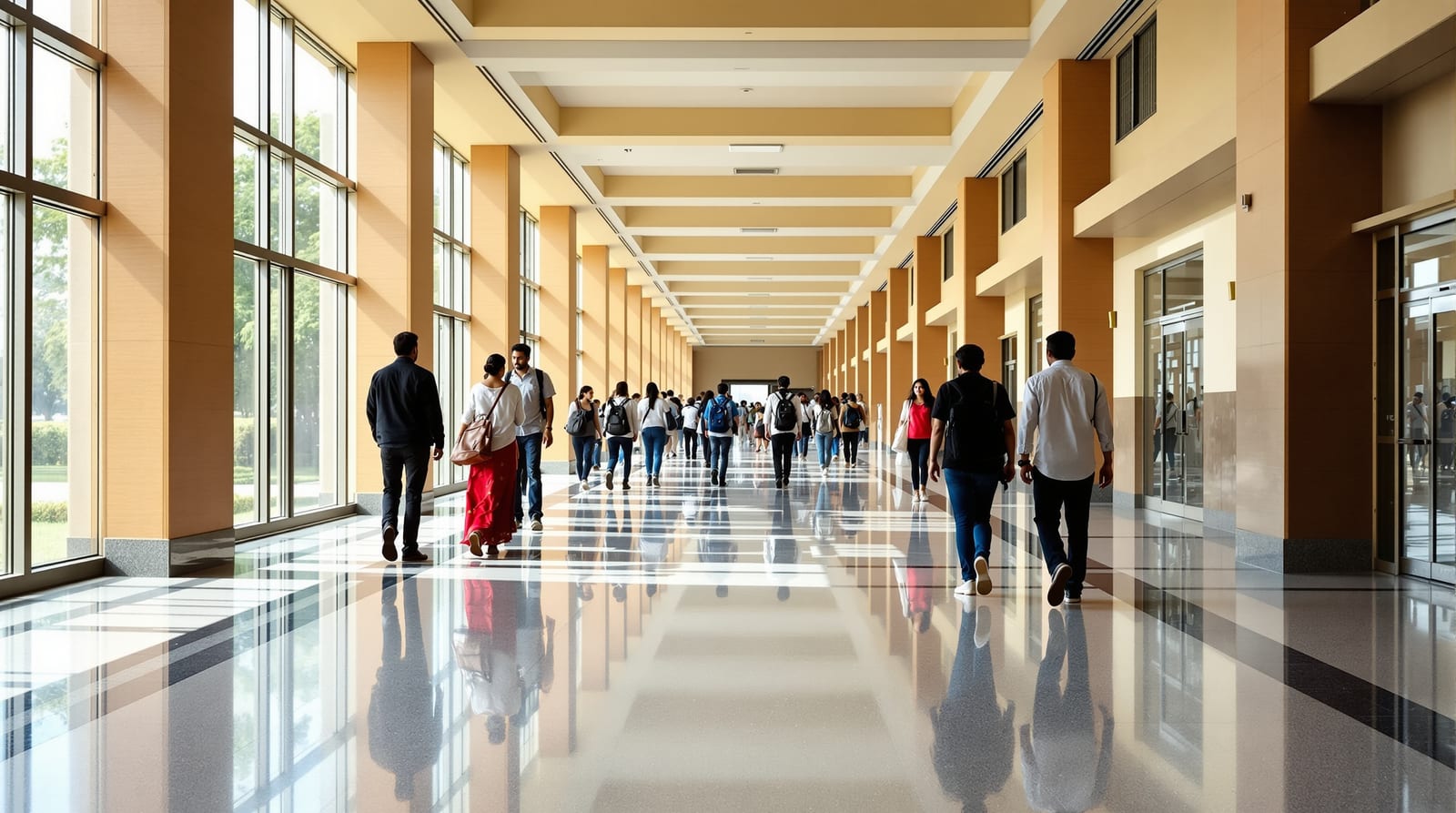
College Flooring in India: Facility-by-Facility Guide for Lecture Halls, Labs, Libraries, Hostels and Sports
How to specify the right floor for every part of a college or university campus — vitrified, epoxy, ESD, carpet tile, vinyl and sports systems — for heavy footfall, discipline-specific labs, institutional image and low maintenance over huge areas.
A college or university campus is not one building with one floor — it is a small city of very different rooms, each with its own punishment to endure. Thousands of students churn through corridors between classes, a chemistry bench spills acid, a physics lab needs static control, a library demands silence, a hostel bathroom must never be slippery, and the basketball court has to flex under a jump. Pick a single "campus tile" for all of it and you overspend in some places, fail safety in others, and create a maintenance bill that eats the institution's budget for a decade. This guide maps the floor to the facility — lecture halls, the full spread of discipline-specific labs, library, auditorium, hostels, sports, admin and canteen — with 2026 rates per sq ft, the codes that apply, and the maintenance logic that matters most when you are surfacing lakhs of square feet.
What a campus floor really has to survive
College flooring is an institutional problem, not a residential one. Five demands dominate every facility decision:
- Relentless footfall. Class-change surges send a packed crowd down every corridor and stair eight times a day, every working day, for the floor's whole life. Wear, scuffing and grout-line erosion are the slow killers. Specify abrasion-resistant, large-format surfaces that hide traffic and need minimal grout.
- Low maintenance over enormous areas. A campus has lakhs of square feet cleaned by a small housekeeping crew with mops and ride-on scrubbers. Every extra hour of polishing, sealing or grout-scrubbing per 1,000 sq ft multiplies into a crushing annual cost. The cheapest floor over 15 years is usually the one that cleans fastest, not the one with the lowest first price.
- Safety and code. Wet zones — hostel baths, canteens, lab washes, entrances in monsoon — must meet anti-slip ratings, and every public building must satisfy NBC 2016 and RPwD 2021 accessibility (ramps at 1:12, thresholds under 12mm, tactile paving for the visually impaired). Institutions carry real liability for slip injuries.
- Discipline-specific lab needs. This is where colleges differ from schools. A chemistry lab needs chemical-resistant seamless flooring; an electronics or instrumentation lab needs ESD (anti-static) control; a clean medical or microbiology lab needs hygienic seamless vinyl; a heavy mechanical or workshop lab needs an industrial-grade impact floor. One lab floor does not fit all departments.
- Institutional image. Reception, admin, the auditorium and the entrance lobby are what a prospective student and parent see on their campus visit. These need to look credible and durable — granite, large-format vitrified, terrazzo — without tipping into maintenance-heavy luxury.
For the broader institutional logic that schools and colleges share, the commercial flooring guide for India and the school flooring guide for India are useful companions — a college simply adds far more specialised labs and adult-scale sports and hostel blocks on top of the school template.
Facility-by-facility recommendations
Lecture halls, classrooms and tutorial rooms
The campus workhorse. Hundreds of chair-drags, bag-drops and shuffling feet per session, all dry. The right answer is anti-skid matte vitrified tile (GVT/PGVT) in large format (600x600mm or 800x800mm) — abrasion-resistant, near-zero maintenance, minimal grout to erode, and cheap to lay over vast areas. Double-charged vitrified is the value pick for very high traffic because its colour runs deep through 3-4mm of the tile and survives years of scuffing. Choose a matte or anti-skid finish, not gloss — gloss shows every scratch and turns lethal when wet feet track in during monsoon. For the material detail, see the vitrified tile flooring guide for India.
Laboratories — pick by discipline
Labs are where a generic spec fails. Match the floor to the chemistry of the room:
- Chemistry / chemical engineering / wet labs — acids, solvents and reagents will be spilt. Use a chemical-resistant seamless epoxy or PU resin floor, coved up the wall, so spills wipe off and nothing seeps into a grout line. See the epoxy flooring guide for India.
- Electronics, instrumentation, electrical and computer hardware labs — static discharge fries components. These need an ESD (anti-static / dissipative) floor — conductive epoxy or static-dissipative vinyl, earthed to a grounding grid. The anti-static ESD flooring guide for India covers the spec and earthing.
- Physics, optics and general science labs — moderate spills, sensitive instruments. A homogeneous seamless vinyl or matte epoxy floor is flat, anti-static-capable and easy to keep dust-free.
- Biology, microbiology, medical, pharmacy and pathology labs — hygiene and infection control rule. Use seamless homogeneous PVC sheet (coved, anti-bacterial) as in healthcare; it has no joints for bacteria and wipes down with disinfectant. See the PVC roll flooring guide for India.
- Mechanical, civil, workshop and heavy labs — dropped tools, machine loads, oil. These behave like an industrial shop floor: VDF concrete with a floor hardener, granolithic, or heavy epoxy. Treat them like the commercial flooring guide for India industrial section, not a classroom.
The common thread across all labs is seamless and coved wherever chemicals or hygiene are involved — joints and grout are the enemy.
Library and reading rooms
The library's brief is silence, dust-control and a calm image. Two valid routes: carpet tile in reading rooms and stacks (it deadens footstep and chair noise, and a modular tile lets you replace a stained square rather than re-carpet) — see the carpet tiles guide for India; or, where humidity and dust-mite worries rule carpet out (common in coastal and very humid campuses), acoustic-backed LVT or matte vitrified for an easy-clean, quiet-enough hard floor. Many Indian libraries run vitrified in the circulation and entry zone and carpet tile only in the quiet reading bays — the best of both.
Auditorium and seminar halls
The seating bowl wants acoustic carpet or carpet tile to control reverberation and footfall noise during talks and convocations; the stage gets engineered or solid wood (or a sprung sports-grade timber if it doubles for performances) for acoustics and looks; the aisles and ramps must be anti-slip and meet RPwD accessibility. The carpet flooring guide for India and the wooden flooring guide for India cover the two surfaces.
Hostels and residences
A residential block at institutional scale. Hostel rooms and common rooms take anti-skid matte vitrified — durable, cheap to clean, no carpet to harbour damp in monsoon. The decisive zone is bathrooms and shared wash areas, which must be R11 anti-slip (DIN 51130) on wet, soapy floors used by hundreds — this is the single highest slip-liability area on a campus. Corridors and stairs in the hostel block take durable vitrified or granite with anti-slip stair nosing. See the anti-slip flooring for wet areas guide for India.
Sports — indoor and outdoor
Match the floor to the sport. Indoor courts (basketball, badminton, volleyball) want a sprung sports timber or a multi-purpose PU/vinyl sports system for shock absorption and ball bounce; the gym/fitness room wants rubber rolls and tiles; yoga and aerobics want vinyl or cushioned sports vinyl. The full menu is in the sports flooring guide for India and, for weight rooms, the rubber flooring guide for India.
Administration, reception and faculty offices
The image-and-comfort zone. Reception and the entrance lobby carry the institution's first impression — granite or large-format vitrified, durable under footfall yet impressive. Faculty cabins and admin offices suit carpet tile or LVT for acoustics and a quieter, professional feel, with the vitrified tile flooring guide for India and carpet tiles guide for India covering the two finishes.
Canteen, mess and food courts
High-spill, grease, dropped-tray, mass-footfall territory. Use anti-slip matte vitrified or porcelain (R10-R11) in the dining area, and treat the commercial kitchen as its own problem — coved PU resin or anti-slip quarry tile at R11-R12 with IS hygiene requirements. Gloss tile plus spilt dal is a guaranteed fall; specify matte, textured, well-rated surfaces throughout.
Campus facility floor map
The single most useful planning step is to colour-code the campus by floor type so the same logic repeats across every block.
Facility, floor, why and cost — the master table
| Facility | Recommended floor | Why | ₹/sq ft (2026) |
|---|---|---|---|
| Lecture halls / classrooms | Anti-skid matte vitrified / double-charged | Heavy dry footfall, abrasion-resistant, low maintenance | 90-200 |
| Chemistry / wet labs | Chemical-resistant epoxy / PU resin, coved | Acid + solvent resistance, seamless, easy wipe | 150-500 |
| Electronics / instrumentation labs | ESD conductive epoxy / dissipative vinyl | Static control protects components | 200-450 |
| Biology / medical / pharmacy labs | Seamless PVC sheet, coved, anti-bacterial | Infection control, no joints | 150-350 |
| Mechanical / workshop labs | VDF concrete + hardener / heavy epoxy | Impact, machine load, oil resistance | 120-350 |
| Library / reading rooms | Carpet tile, or matte vitrified | Quiet, dust-control, modular replacement | 80-300 |
| Auditorium seating | Acoustic carpet / carpet tile | Reverberation + footfall control | 100-400 |
| Auditorium stage | Engineered / solid wood | Acoustics, performance image | 250-800 |
| Hostel rooms | Anti-skid matte vitrified | Durable, easy clean, no damp carpet | 90-200 |
| Hostel baths / wash areas | R11 anti-slip vitrified / ceramic | Wet-area slip safety (DIN 51130) | 90-180 |
| Indoor sports court | Sprung sports timber / PU sports | Shock absorption, ball bounce | 250-800 |
| Gym / fitness room | Rubber rolls / tiles | Impact, grip, slab protection | 120-450 |
| Admin / reception lobby | Granite / large-format vitrified | Image + durability | 130-350 |
| Faculty offices | Carpet tile / LVT | Acoustics, professional feel | 80-300 |
| Canteen dining | Anti-slip vitrified / porcelain (R10-R11) | Spill + grease + mass footfall | 90-220 |
| Commercial kitchen | PU resin / anti-slip quarry (R11-R12) | Hygiene + grease + slip code | 180-500 |
| Corridors / stairs | Durable vitrified / granite, anti-slip nosing | Heaviest footfall, continuity | 100-300 |
Rates are indicative supplied-and-laid figures for 2026 and move with city, quantity (campus-scale orders earn volume discounts) and grade. For a fuller breakdown, see the flooring cost per square foot guide for India, and size big institutional orders with the flooring cost calculator.
Codes and standards that apply on campus
- NBC 2016 + RPwD 2021 — every public-access route needs accessible ramps at 1:12 maximum slope, thresholds under 12mm, tactile/warning paving at hazards, and accessible toilets. Colleges are routinely audited on this.
- DIN 51130 R-ratings — R10 minimum for wet-prone dry areas, R11 for hostel baths and canteen dining, R11-R12 for commercial kitchens and lab wash zones.
- IS 15622 — the standard for ceramic and vitrified tiles; specify abrasion class (PEI/abrasion) suited to heavy traffic for corridors and halls.
- ESD / anti-static — earthed dissipative flooring for electronics and instrumentation labs, with measured resistance to ground.
- Lab hygiene — seamless, coved, chemical- or bacteria-resistant flooring for chemistry and medical/biology departments, mirroring healthcare practice.
Procurement and maintenance tips for institutions
- Standardise tile sizes and colours across the campus so a single inventory of spares covers any repair — buy 5-10% extra at first lay and store it.
- Specify by department, not by building. Issue the lab-floor spec per discipline (chemistry vs electronics vs biology) so the contractor cannot value-engineer a chemistry floor into a plain epoxy that fails.
- Plan for machine cleaning. Large-format, low-grout, matte hard floors suit ride-on scrubbers; minimise grout lines and avoid floors that need frequent resealing across lakhs of square feet. See the floor cleaning guide for India.
- Phase the work to the academic calendar. Lab and hostel floors are best laid in vacations; epoxy and PU need cure time before students return.
- Do not under-spec the wet zones. The hostel bath and canteen are where slip injuries — and liability — actually happen; the anti-slip rating is not the place to save money.
Do and don't
- Do match the lab floor to the department's chemistry and electronics, not a one-size campus epoxy.
- Do use matte, anti-skid finishes in every wet and high-traffic zone; reserve gloss for nowhere.
- Do cove and seal seamless floors in chemistry, medical and biology labs.
- Don't carpet humid coastal libraries or reading rooms wall-to-wall — damp and dust mites win; use modular tile or hard floor.
- Don't specify glossy vitrified in corridors and entrances — monsoon-tracked water turns them into a hazard.
- Don't ignore RPwD accessibility on ramps, thresholds and tactile paving; it is a legal requirement, not an extra.
Care and cleaning
Vitrified corridors, halls and hostels clean with a daily ride-on or walk-behind scrubber and a pH-neutral cleaner — their low grout and abrasion resistance is exactly why they suit campus scale. Seamless lab floors wipe down with the appropriate solvent or disinfectant for the department and need periodic recoat inspection. Carpet tiles in the library and auditorium are vacuumed and spot-cleaned, with stained tiles swapped out individually. Sports timber and rubber follow their own regimes — see the floor cleaning guide for India and the floor resealing guide for India for surface-specific schedules.
Frequently asked questions
What is the best flooring for college lecture halls and classrooms?
Anti-skid matte vitrified tile in large format (600x600mm or 800x800mm), or double-charged vitrified for the very highest traffic. It is abrasion-resistant, has minimal grout to erode, machine-cleans fast over big areas, and resists the constant chair-drag and class-change footfall of a campus. Avoid gloss finishes, which scratch visibly and turn slippery when wet feet track in.
Do different college labs need different flooring?
Yes — this is the key difference from a school. Chemistry and wet labs need chemical-resistant seamless epoxy or PU; electronics and instrumentation labs need ESD anti-static flooring earthed to ground; biology, medical and pharmacy labs need seamless anti-bacterial PVC sheet; and mechanical or workshop labs need industrial VDF concrete or heavy epoxy. Specify the floor per department, not per building.
What flooring should college hostel bathrooms use?
R11 anti-slip vitrified or ceramic tile, rated under DIN 51130 for wet, soapy floors. Hostel baths and shared wash areas are the single highest slip-liability zone on a campus because hundreds of students use them daily. Never use gloss tiles here; the anti-slip rating is not where to economise.
How much does campus flooring cost per square foot in India in 2026?
It varies hugely by facility: lecture halls and hostels run ₹90-200/sq ft, chemistry and ESD labs ₹150-500/sq ft, sports courts ₹250-800/sq ft, and admin granite ₹130-350/sq ft. Institutional volume earns discounts. Estimate a real campus with the flooring cost calculator and the flooring cost per square foot guide for India.
How do colleges keep maintenance low across such large floor areas?
By choosing large-format, low-grout, matte hard floors that suit ride-on scrubbers, standardising tile sizes and colours campus-wide so spares are interchangeable, avoiding floors that need frequent resealing over lakhs of square feet, and reserving carpet (the highest-maintenance surface) only for libraries and auditoria. The cheapest floor over fifteen years is usually the fastest to clean, not the lowest first price.
Export this guide
Related Guides — Deep-dive reading
School Flooring in India: Safe, Durable, Low-Maintenance Floors for Classrooms, Corridors, Labs and Play Areas
How to specify school flooring zone by zone — anti-skid vitrified for classrooms and corridors, rubber and vinyl for little ones, chemical-resistant epoxy for labs and impact-soft surfaces for play areas — for child safety, abuse-proof durability and tight budgets.
Flooring & SurfacesEpoxy Grout vs Cement Grout for Tiles in India: Which to Specify (2026)
A plain-English guide to tile grouts for Indian homes: what grout does, how cementitious grout compares with epoxy grout on cost, stain and water resistance, hygiene and durability, and exactly where each one belongs - kitchens, bathrooms, pools, dry rooms and more.
Building MaterialsAnti Slip Flooring for Bathroom and Wet Areas in India: R-Ratings, Finishes and Genuinely Safe Tile Choices
How to choose genuinely safe flooring for bathrooms, kitchens, balconies, pools, entrances and elderly- or child-friendly homes — the R-rating system, finishes that grip wet feet, anti-skid natural stone, slope to drains and the tiles to avoid.
Flooring & SurfacesRelated Tools — Try Free
Flooring Cost Calculator
Estimate the all-in cost of a floor — material, laying, wastage, skirting and GST — by area and material.
Flooring CalculatorElectrical Safety & Load Audit
Home electrical audit — 10 categories, 65+ checkpoints across earthing, RCCB, MCB, wiring, switchboards, appliance circuits, DG/inverter backup.
Safety AuditAcoustic Privacy (STC) Visualizer
Indian healthcare acoustic visualizer — compare wall assemblies and noise sources, see received SPL after STC attenuation, and check FGI 2018 / IS 1950 / NABH speech-privacy compliance with live dual-canvas waveform.
Acoustic Tool