
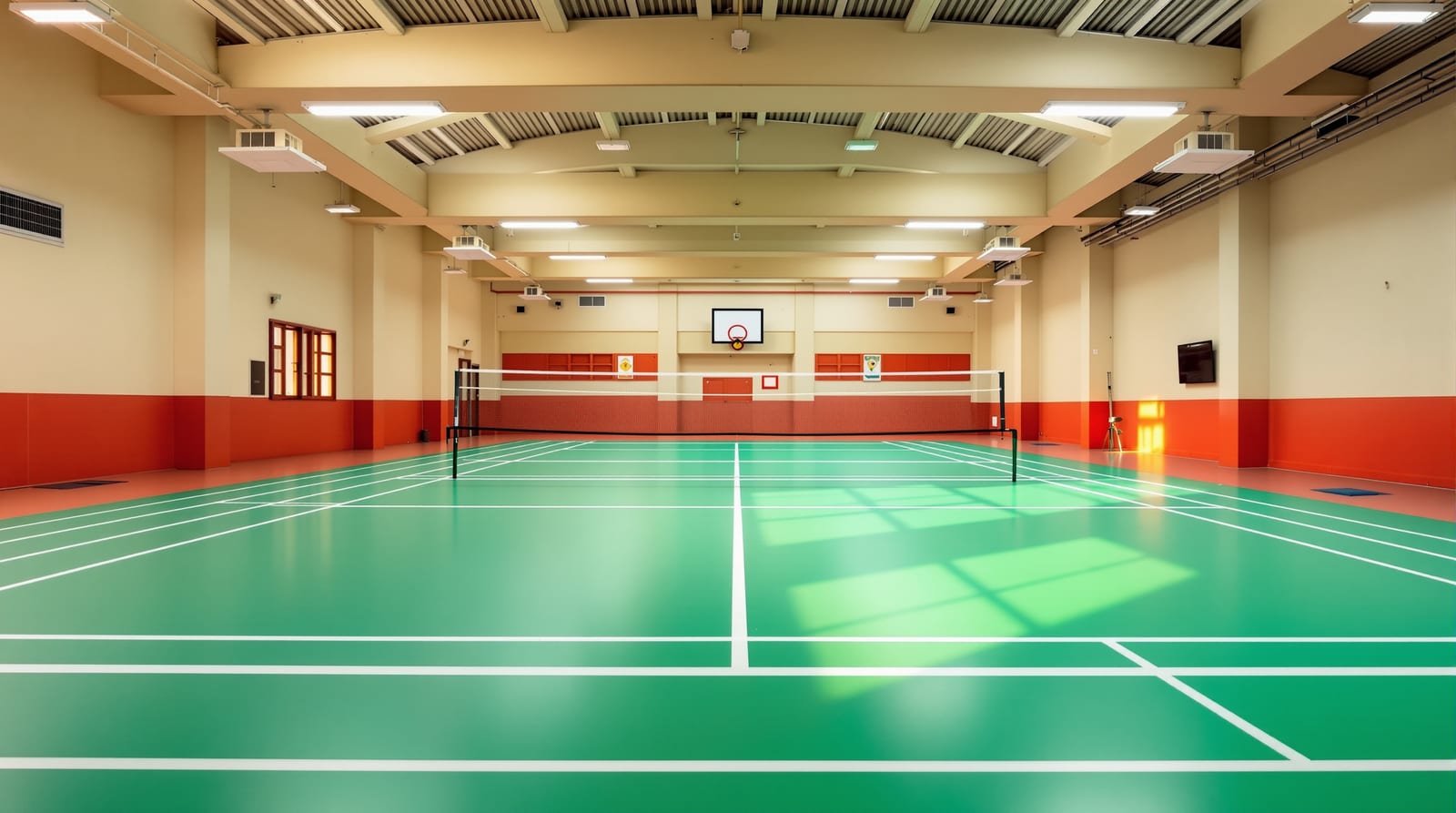
Sports Flooring in India: PU, Acrylic, Sprung Wood, Vinyl & Rubber Floors for Courts, Gyms & Halls — Types, Standards & Cost
Sports and gym flooring — PU synthetic, acrylic hard courts, sprung wooden, vinyl/PVC sports rolls, rubber and modular interlocking sport tiles — gives you the shock-absorbing, slip-controlled, ball-bounce-true surfaces that badminton, basketball, table-tennis, multipurpose and home-gym spaces need, at ₹150–800 per sq ft.
A sports floor is not a decorative floor that happens to be in a gym — it is a piece of safety and performance equipment. The right surface absorbs the shock that would otherwise travel up an athlete's knees, returns a true and consistent ball bounce, stays grippy without grabbing the foot, and survives years of pivoting, jumping and dropped dumbbells. The wrong surface ends careers and warranties alike. This guide maps the real sports-flooring options used in India — for courts, gyms, multipurpose halls, schools and home gyms — what each one costs, which sport each one suits, and the standards (EN 14904, BWF) that separate a genuine sports floor from a glorified vinyl roll.
What makes a sports floor different
Every sports floor is engineered around three measurable behaviours, and understanding them tells you instantly whether a product is suitable.
Shock absorption (force reduction) is how much impact energy the floor absorbs instead of returning it to the joints. A hard tile floor reduces almost no force; a sprung sports floor can reduce 30–60% or more. This is what protects knees, ankles and shins during repeated jumping and running.
Ball bounce (vertical ball behaviour) is how truly and consistently a ball rebounds. For basketball and table tennis this is critical — a dead spot or an inconsistent bounce makes a court unusable for competition. The standard expects a sports floor to return at least 90% of the bounce of a rigid concrete reference.
Slip and friction must sit in a controlled window: grippy enough that a player can plant and pivot safely, but not so grabby that a turning foot binds and the knee twists. Wet-area floors elsewhere chase maximum anti-slip; a sports floor chases the right slip.
The international benchmark that bundles these together is EN 14904, the European standard for indoor multi-sports surfaces. It classifies floors by their shock-absorption behaviour into four area-elasticity types, and tests force reduction, vertical deformation, ball bounce, slip and surface finish. For badminton specifically, the BWF (Badminton World Federation) runs its own approval programme and publishes a list of approved court mats. When a brand says "EN 14904 certified" or "BWF approved", it is telling you the floor has been laboratory-tested for exactly these athlete-protection numbers — and that matters far more than the colour or the brand name.
The four elasticity types (how the bounce is delivered)
Sports floors are grouped by where the springiness lives:
- Area-elastic — a sprung subframe (battens or pads under a wood or panel deck) flexes over a wide area. Classic sprung wooden basketball floors. Great consistent bounce, the cushioning is spread out.
- Point-elastic — the cushioning sits directly under the point of impact, usually a foam or rubber backing under a vinyl or PU top. The floor deflects locally where you land. Most PU and PVC sports rolls.
- Combi-elastic — a point-elastic top layer over an area-elastic subframe; combines local cushioning with broad spring. Premium multi-sport.
- Mixed-elastic — an area-elastic build with a reinforcing point-elastic layer.
For a home gym or school hall you rarely need to memorise these, but on a tender or a competition court the specified type is non-negotiable.
The sports-flooring families used in India
PU / polyurethane synthetic flooring
Seamless polyurethane poured or rolled over a cushioning base — the workhorse of Indian multipurpose halls, indoor courts, gyms and athletics tracks. It is jointless, durable, available in any colour, line-marked directly onto the surface, and made point-elastic by a rubber/foam underlayer. PU systems are sold both as in-situ poured floors (sandwich, comprehensive or cushioned PU systems built up wet on site) and as prefabricated PU/rubber rolls. It is closely related to, but distinct from, the seamless PU resin flooring used in factories — sports PU is tuned for elasticity and bounce, not chemical resistance.
Acrylic hard-court flooring
A water-based acrylic coating system (several layers of resurfacer, cushion and colour over an asphalt or concrete base), the standard for outdoor tennis and basketball courts and the surface you see on most Indian club and academy tennis courts. It is hard (a "hard court"), UV-stable, low-maintenance and weatherproof, with a controlled sand-textured grip. Cushioned acrylic systems add rubber layers for more give.
Sprung wooden flooring
The premium, area-elastic floor: a hardwood (commonly maple, beech or engineered hardwood) deck laid over a sprung subframe of battens, cradles or elastomer pads. This is the genuine basketball and badminton competition floor — the one professionals expect underfoot. It delivers a lively, consistent bounce and excellent shock absorption, and it can be sanded and re-coated for decades. It is the most expensive and the most demanding to install and maintain (it hates moisture). It draws on the same craft as solid hardwood flooring and wooden flooring, engineered for sport.
Vinyl / PVC sports rolls
Heterogeneous PVC rolls with a wear layer on top and a foam/rubber backing for point elasticity — the practical, cost-effective indoor sports floor for schools, multipurpose halls, badminton and general fitness. Heat-welded seams make it near-seamless and hygienic. It is the sports-tuned cousin of the PVC roll flooring used in hospitals and the vinyl flooring family generally — here engineered with a calibrated shock pad and a non-glare, grippy sports surface.
Rubber gym flooring
Recycled SBR or virgin EPDM rubber, in rolls, tiles or interlocking mats, is the default strength-and-conditioning floor: weights areas, CrossFit boxes, garages and home gyms. It is tough, slip-resistant, sound-deadening and shrugs off dropped plates. It is not a court floor — the bounce and roll are wrong for ball sports — but it is unbeatable under a squat rack. See the full rubber flooring guide for thicknesses and grades.
Modular interlocking sport tiles
Rigid polypropylene (PP) tiles that click together over any sound base, with a slightly flexing grid that gives modest point elasticity and rapid drainage. They suit outdoor multi-sport courts, futsal, basketball half-courts and roller areas, install dry with no adhesive, and lift and relocate easily. Lower shock absorption than PU or sprung wood, but fast, weatherproof and DIY-friendly.
Foam interlocking mats and artificial turf
EVA foam interlocking tiles are the budget cushioned floor for kids' play, yoga and light home gyms — soft, warm and DIY, but too soft for heavy lifting (plates dent them) and not for ball sports; see foam interlocking tiles. Artificial turf (short-pile sport turf, often with a sand/rubber infill) suits sled tracks, functional-training lanes, mini five-a-side and putting greens.
Sport to recommended floor to cost
This is the table to specify from. Costs are material-plus-system ₹ per sq ft, indicative and varying by city, brand and thickness; +18% GST; subframe, screed and line-marking can add materially on sprung and in-situ systems.
| Sport / use | Recommended floor | Why | Indicative ₹/sq ft |
|---|---|---|---|
| Badminton (competition) | PU synthetic or BWF-approved PVC sports roll over wood | True bounce, foot grip, BWF-rated cushioning | ₹250–600 |
| Badminton (club / school) | PVC sports roll (point-elastic) | Cost-effective, near-seamless, good grip | ₹150–350 |
| Basketball (indoor competition) | Sprung wooden floor (area-elastic) | Lively consistent bounce, best shock absorption | ₹450–800 |
| Basketball (school / outdoor) | Acrylic hard court or modular sport tiles | Weatherproof, durable, line-marked | ₹150–400 |
| Tennis (outdoor) | Acrylic hard court (cushioned optional) | UV-stable, controlled grip, all-weather | ₹150–350 |
| Table tennis | PU synthetic or quality PVC sports roll | Consistent, non-glare, true bounce | ₹200–450 |
| Volleyball / multipurpose hall | PU synthetic or PVC sports roll | One floor, many sports, easy line-marking | ₹200–500 |
| Strength / CrossFit gym | Rubber rolls or tiles (8–15 mm+) | Protects slab, deadens drops, slip-resistant | ₹80–400 |
| Cardio / functional zone | Rubber or vinyl sports roll | Cushioned, easy-clean, sound-absorbing | ₹100–350 |
| Yoga / pilates / low-impact | Foam interlocking or thin PU | Soft, warm, cushioned underfoot | ₹30–250 |
| Home gym | Rubber tiles or interlocking mats | DIY, removable, drop-tolerant | ₹80–300 |
| Outdoor multi-court / futsal | Modular interlocking sport tiles | Drains, weatherproof, relocatable | ₹150–400 |
How a sprung sports floor is built up
A genuine area-elastic wooden sports floor is a deliberate sandwich, not just planks on a slab. Each layer has a job: a vapour barrier keeps the slab's moisture out of the timber, resilient pads or battens deliver the spring, a plywood/OSB sub-deck spreads the load, and the hardwood wear layer takes the play and the line marking. The diagram below shows a typical pad-and-batten build-up.
A point-elastic PU or PVC floor is simpler — a cushioned foam/rubber backing bonded directly to a smooth screed, topped by the wear layer — but it follows the same logic: a sound, level, dry base; a resilient layer; a tough, grippy, line-marked top.
Installation, base preparation and line marking
The base decides the floor. Almost every sports system needs a flat, dense, dry, crack-free screed or slab — most specifications demand flatness within about 3 mm under a 3 m straightedge and a tested moisture content before any moisture-sensitive PU, PVC or wood goes down. Skipping the moisture check is the single most common cause of failed sports floors in India: a slab that looks dry can still gas off enough moisture to debond a vinyl backing or warp a wooden deck. A screed and mortar bed done right under any floor is covered in floor screed and mortar bed; for sports it must be even more disciplined.
PU in-situ floors are squeegeed and rolled wet over a primed base in successive coats and cure over days. PVC and prefabricated PU rolls are bonded with the manufacturer's adhesive and the seams heat-welded with a colour-matched cord for a hygienic, near-seamless finish. Sprung wood is built up dry as the layered subframe above, then sanded and sealed. Modular and interlocking tiles simply click together dry — the only true DIY option.
Line marking is its own craft. On PU and acrylic it is painted with court paint and stencils to the exact governing dimensions (badminton, basketball, volleyball lines can overlay on a multipurpose hall in different colours). On PVC it is either pre-printed, inlaid (cut-in welded strips, the most durable) or painted. Always mark to the official court dimensions for the sport, and on a shared hall agree the colour code before painting so players can read their sport's lines.
Choosing a brand and grade in India
The Indian sports-flooring market mixes global specialists and strong domestic suppliers:
- Gerflor (France) — Taraflex is the reference indoor PVC sports floor, widely used for badminton, volleyball and multipurpose halls; many ranges are EN 14904 classed and several are BWF or federation approved.
- Duroflex / Duro and Responsive (Pacecourt and similar) — established Indian sports-surface suppliers for PU, acrylic hard courts and synthetic court systems, common on academy and institutional projects.
- Pacecourt — Indian acrylic and PU court systems for tennis, basketball and multipurpose courts.
- Plus international court-system brands (acrylic and modular tile makers) and numerous Indian rubber-gym suppliers for the strength-floor end.
When you specify, ask three questions and get them in writing: What is the EN 14904 classification (or BWF approval) and the tested force reduction? What total thickness and wear-layer thickness? What is the warranty, and does it cover a tested base? A "sports vinyl" with no force-reduction number is just a vinyl roll. Cross-check costs against the live flooring cost per square foot benchmarks and price the job through the flooring cost calculator; for a strength gym, size the rubber with the rubber flooring calculator.
Home-gym options without over-spending
You do not need a competition floor for a home gym. The honest hierarchy:
- Free-weights / lifting corner — 15–25 mm recycled rubber tiles or rolls over the slab. They protect the floor, deaden the drop and the noise, and never dent. This is the right answer for a serious home gym.
- Cardio and functional zone — 8–12 mm rubber or a vinyl sports roll: cushioned enough, easy to wipe down.
- Yoga, stretching, kids — EVA foam interlocking mats are cheap, warm and DIY — just keep heavy weights off them.
- Mixed home gym — zone it: a rubber lifting platform inside a larger foam or vinyl area. You spend on rubber only where the iron lands.
For an Indian home, also mind humidity and ventilation — rubber and foam in a closed, unaired room can hold odour and condensation; keep the space ventilated and lift mats periodically to dry the slab.
Care and longevity
Sports floors are low-maintenance but not no-maintenance. Dust-mop or vacuum daily — grit is the enemy of any wear layer, and it dulls grip and scratches PU and wood. Damp-mop with the manufacturer's neutral pH cleaner; never use waxy or oily household cleaners that leave a slip film (the classic cause of "the new floor is slippery"). Wooden floors must be kept dry — no flood mopping, attend to leaks immediately, and re-coat the sealer when the sheen and grip start to fade (every few years under heavy play). PU and acrylic can be patched and re-coated; PVC seams can be re-welded if they lift. Rubber gym floors wipe clean and outlast almost everything. Use floor protectors under fixed equipment and lay mats under treadmills to spare the wear layer. Resealing technique generally is covered in the floor resealing guide, and routine cleaning in the floor cleaning guide.
For a wider view of where these floors sit among all the alternative and technical surfaces, see the specialty flooring guide.
Frequently asked questions
Which flooring is best for a badminton court in India?
For competition, a BWF-approved PVC sports mat (such as Gerflor Taraflex) or a quality PU synthetic floor over a sound base — both give the controlled grip, true shuttle-and-foot behaviour and shock absorption players expect, at roughly ₹250–600 per sq ft. For a club or school court, a good point-elastic PVC sports roll at ₹150–350 per sq ft is the cost-effective choice. Avoid plain tiles or ordinary vinyl: they have no force reduction and the bounce and grip are wrong.
What is EN 14904, and do I need it?
EN 14904 is the European standard for indoor multi-sports surfaces. It tests and classifies a floor's shock absorption (force reduction), vertical deformation, ball bounce, slip and finish, and sorts floors into area-, point-, combi- and mixed-elastic types. For a serious court, gym or institutional hall, insisting on an EN 14904 classification (and a stated force-reduction number) is how you confirm you are buying a genuine athlete-protecting sports floor rather than a relabelled commercial vinyl.
How much does sports flooring cost in India?
Indicatively, ₹150–800 per sq ft for the surface and its system, before laying extras and 18% GST. PVC sports rolls run about ₹150–350, PU synthetic ₹200–600, acrylic hard courts ₹150–350, and sprung wooden competition floors ₹450–800. Rubber gym floors are ₹80–400 and foam mats as low as ₹30. Sprung wood and in-situ PU add meaningful subframe, screed and line-marking costs on top.
Can I use rubber gym flooring for a badminton or basketball court?
No. Rubber gym flooring is built to absorb dropped weights and deaden sound, so its ball bounce and roll are wrong and a shuttle or ball behaves unpredictably on it. Use rubber for the weights and conditioning zones, and a PU synthetic, PVC sports roll or sprung wooden floor for the court itself. In a single multipurpose space, zone the rubber gym area separately from the marked court surface.
What flooring is best for a home gym?
For a serious home gym, 15–25 mm recycled rubber tiles or rolls over the slab — they protect the floor, absorb dropped plates and cut noise. For cardio and functional zones, 8–12 mm rubber or a vinyl sports roll is enough; for yoga and kids, EVA foam interlocking mats are cheap, warm and DIY. The smart move is to zone it: rubber where the iron lands, lighter cushioning everywhere else, and keep the room ventilated to manage India's humidity.
Export this guide
Related Guides — Deep-dive reading
Gym Flooring India: Commercial Fitness-Centre Floors by Zone, with Thickness and Costs
How to floor a commercial gym in India zone by zone — heavy rubber for free-weights and drop zones, vinyl or rubber rolls for cardio, artificial turf for the functional lane, sprung wood or cushioned vinyl for the studio, cork or foam for yoga, and anti-slip vitrified or LVT for reception and lockers — with thickness, impact, noise, grip, hygiene and ₹/sq ft for each.
Flooring & SurfacesEngineered Wood Flooring in India: Layers, Wear Layer, Install & Cost (2026)
Engineered wood is a real-wood top veneer bonded over a cross-laminated plywood or HDF core, which makes it far more dimensionally stable than solid wood in Indian humidity — the practical way to get a genuine timber floor here. This guide covers the layer build-up, wear-layer thickness, click vs glue-down install, where it suits, ₹/sq ft, brands and maintenance.
Flooring & SurfacesRubber Flooring in India: Rolls, Tiles & Interlocking Mats for Gyms, Play Areas, Clinics & Garages — Types, Cost & Care
Rubber flooring — supplied as rolls, tiles or interlocking mats in recycled SBR or virgin EPDM — is the tough, slip-resistant, cushioned and sound-absorbing floor for gyms, play areas, hospitals, clinics, garages, balconies and utility zones. Here are the types, thickness by use, costs of ₹80–400 per sq ft, install methods, pros, cons and care.
Flooring & SurfacesRelated Tools — Try Free
Flooring Cost Calculator
Estimate the all-in cost of a floor — material, laying, wastage, skirting and GST — by area and material.
Flooring CalculatorRubber Flooring Calculator
Estimate rubber flooring rolls, tiles or interlocking mats and cost for a gym, play area or utility space.
Flooring CalculatorWindow Cleaning Cost Calculator
Estimate professional window cleaning cost per visit and per year by access and frequency.
Window Calculator