
School Flooring in India: Safe, Durable, Low-Maintenance Floors for Classrooms, Corridors, Labs and Play Areas
How to specify school flooring zone by zone — anti-skid vitrified for classrooms and corridors, rubber and vinyl for little ones, chemical-resistant epoxy for labs and impact-soft surfaces for play areas — for child safety, abuse-proof durability and tight budgets.
A school floor takes a beating no home floor ever will. Thousands of small feet drag across it every day, dropped tiffin boxes and chairs scrape it, spilt water and monsoon mud arrive at every door, and a slip that an adult shrugs off can hurt a six-year-old. Yet the same floor has to be cleaned in minutes by a small housekeeping team, survive a decade on a tight grant budget, and never poison the children breathing the air above it. That is a harder brief than most luxury homes.
This guide specifies school flooring zone by zone — classrooms, corridors and stairs, science labs, play and sports areas, toilets, and assembly halls — ranking the floors that actually suit each Indian school space against the priorities that matter: child safety, abuse-proof durability, low maintenance and cost. It gives indicative 2026 rates per sq ft and the slip and hygiene codes a designer should cite. For the broader picture, start with our commercial flooring guide for India, and for higher-education campuses see the college flooring guide.
What a school floor really has to do
A school is not one space — it is a dozen spaces with different demands sharing one budget. But four drivers cut across all of them, and they are the lens for every choice below.
- Child safety first. Children run, slip and fall more than adults, and they fall from a shorter height onto a harder relative impact. Floors must be anti-slip (especially where water travels — entrances, corridors, toilets, stairs), and ideally soft enough underfoot for the youngest grades. They must also be non-toxic: a school floor off-gasses into a room full of developing lungs, so low-VOC and phthalate-free matters more here than anywhere.
- Abuse-proof durability. Dragged furniture, dropped weights, monsoon grit, and constant heavy foot traffic destroy ordinary floors. School floors must take years of deliberate and accidental abuse without cracking, denting or wearing through.
- Low maintenance and cost. Schools cover huge areas on lean budgets and clean with small teams. The floor must be cheap to lay over thousands of square feet, fast to mop, and cheap to keep — total cost over ten years matters more than the day-one price.
- Hygiene and acoustics. Floors must wipe clean of spills and not harbour germs in a crowded building. And a hard-floored classroom of forty children is loud — resilient floors that absorb noise make teaching audible.
No single floor wins on all four everywhere, which is why the right answer is zone by zone. The map below shows how the priorities shift across a typical school block.
Classrooms: the workhorse floor
The classroom is where the budget battle is won or lost — it is the single largest area in any school, repeated dozens of times.
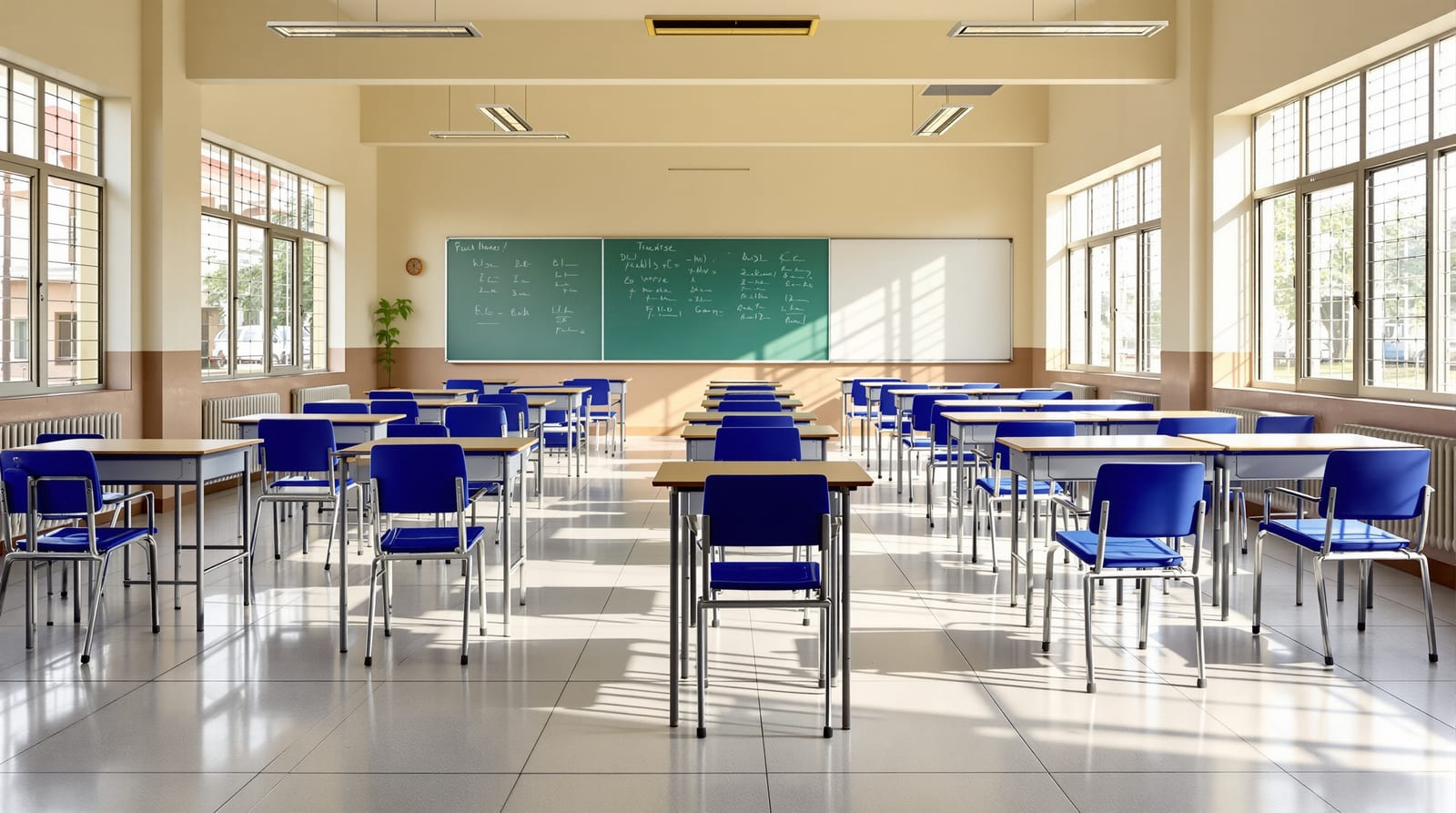
For most grades, vitrified tile with an anti-skid (matt) finish is the default and the right one. It is cheap per square foot over large runs, almost indestructible against dragged chairs and dropped objects, wipes clean in seconds, and lasts decades with near-zero upkeep. Specify a matt or anti-skid surface rather than glossy — gloss is slippery when wet and glares under tubelights. A double-charged body gives the deepest wear resistance for the heaviest-traffic rooms.
For the lower grades — pre-primary, kindergarten and primary, where children sit on the floor, crawl, and fall often, a resilient floor is worth the premium. Vinyl flooring (sheet or LVT) and rubber flooring are both warmer underfoot, quieter (a vinyl classroom is dramatically less echoey than a tiled one), and softer in a fall. Vinyl adds cheerful colours and patterns children respond to; rubber adds the most cushioning and the best slip resistance. Both must be specified low-VOC and phthalate-free for a room of small children — this is non-negotiable, not a luxury.
The honest trade-off: tile is the budget and durability champion, resilient floors are the safety and acoustics champion. Many Indian schools use tile from grade 4 upward and vinyl or rubber for the youngest, which is exactly the right split.
Corridors and stairs: high-traffic, high-risk
Corridors carry the entire school at break and dispersal — a river of running children, often with wet feet in the monsoon. They need maximum durability and reliable grip. Anti-slip vitrified tile or granite are the workhorses: granite for the most punishing traffic and a premium look, anti-skid vitrified for value. Insist on a matt or textured finish rated for wet traffic — a glossy corridor is an injury claim waiting to happen.
Stairs are the single highest-risk surface in a school. Use a hard, durable tread (granite, marble or vitrified) but never leave it slippery: every tread needs an anti-slip nosing — a contrast-coloured grooved or carborundum strip at the front edge that both grips wet feet and visually marks the step edge for a child looking down. This is a child-safety must, and it aligns with NBC 2016 and RPwD 2021 accessibility guidance on slip resistance and step legibility. Tactile warning strips at the top and bottom of flights help younger and visually impaired children.
Science labs: chemical-resistant and seamless
A school science lab sees spilt acids, alkalis, stains and the occasional dropped beaker. Ordinary tile grout stains and absorbs; a porous floor is unhygienic and ugly within a term. Specify a chemical-resistant epoxy coating or a homogeneous vinyl sheet, both laid seamless so spills cannot seep into joints. Epoxy gives the toughest chemical resistance and a wipe-clean monolithic surface; welded vinyl sheet adds a little resilience underfoot and is faster to install. Both should be anti-slip rated, because lab floors get wet. Cove the floor up the wall a few inches in a wet-prone lab so washdown water has nowhere to lodge.
Play areas and sports: soft and safe
This is where impact safety, not durability, leads. For kindergarten play areas and indoor play zones, rubber flooring rolls or tiles and interlocking EVA foam mats cushion the constant falls of small children and provide excellent grip. Rubber is the more durable and hygienic long-term choice; EVA foam is cheaper and easy to reconfigure but wears faster.
For multipurpose courts, indoor sports halls and outdoor play surfaces, move to purpose-made sports flooring — cushioned PU or rubber sports systems sized to the game, with the shock absorption and ball response a court needs. For outdoor play and ramps, anti-slip surfaces are essential; never use a polished or smooth floor anywhere children run.
Toilets: the slip-critical zone
School toilets are wet, busy and the most common site of slip injuries. The floor must be aggressively anti-slip — aim for a DIN 51130 rating of R11 or higher, the same standard as a wet commercial area. Anti-skid vitrified or matt ceramic with a textured surface, laid to fall toward the drain, is standard and affordable. For the full specification of wet-area grip, see our anti-slip flooring for wet areas guide. Small tiles with more grout lines actually help grip here. Keep colours light so cleanliness is visible and the space feels hygienic.
Assembly and multipurpose halls
The assembly hall doubles as exam hall, event venue and indoor games space, so it needs durability and a presentable look across a very large floor. Large-format anti-skid vitrified tile is the economical all-rounder; where the hall hosts indoor sport, a sports flooring system or a resilient vinyl is worth the premium for shock absorption and acoustics. Whatever the choice, anti-slip and easy-clean stay the priorities — this is a child-occupied space first and a venue second.
Comparison: school floors by zone
The table below pairs each school zone with its recommended floor, the reason, and an indicative installed 2026 rate. Ratings are relative to a school setting.
| Zone | Recommended floor | Why | Indicative rate (₹/sq ft, installed) |
|---|---|---|---|
| Classrooms (grade 4+) | Anti-skid vitrified | Cheap over large areas, abuse-proof, wipe-clean, decades of life | 80-220 |
| Classrooms (pre-primary/KG) | Vinyl or rubber | Warm, quiet, soft in a fall, low-VOC, colourful | 90-450 |
| Corridors | Anti-slip vitrified / granite | Heavy running traffic, wet feet, grip + durability | 80-350 |
| Stairs | Granite / vitrified + anti-slip nosing | Highest-risk surface; grip and step legibility | 130-350 |
| Science labs | Chemical-resistant epoxy / vinyl | Spill-proof, seamless, hygienic, anti-slip | 120-400 |
| Play / KG play | Rubber / EVA foam | Impact-soft, grippy, safe for falls | 120-450 |
| Sports / multipurpose | Sports PU / rubber | Shock absorption, ball response, durable | 120-450 |
| Toilets | Anti-slip vitrified / ceramic (R11) | Wet, slip-critical; graded to drain | 50-150 |
| Assembly hall | Large-format vitrified / sports | Durable, presentable, easy-clean over large area | 80-220 |
Rates are indicative all-India 2026 figures including basic installation; imported rubber, premium sports systems and resin labs run higher. Price your exact areas with the flooring cost calculator, and compare specific products with the flooring material selector.
Standards and codes for school floors
A designer specifying a school should cite the right benchmarks rather than rely on instinct:
- Slip resistance (DIN 51130): R10 minimum for general wet-prone floors; R11-R12 for toilets, washdown labs and wet entrances. Glossy floors fail children in the monsoon.
- NBC 2016 and RPwD 2021: anti-slip surfaces, contrast-marked and tactile stair edges, accessible ramps at 1:12, thresholds no higher than 12 mm, and tactile guidance for visually impaired students. See our accessible flooring standards guide.
- IS 15622 governs ceramic and vitrified tile quality and abrasion class — specify a high abrasion (PEI/wear) class for corridors and classrooms.
- Low-VOC / non-toxic: for any resilient floor in a children's room, specify phthalate-free, low-VOC vinyl or rubber with recognised emissions certification.
Do and don't
- Do specify anti-skid (matt) finishes everywhere children walk — glossy tile is a slip hazard in a monsoon-prone building.
- Do put anti-slip nosing on every stair tread and contrast-mark step edges.
- Do choose resilient, low-VOC vinyl or rubber for pre-primary rooms where children sit and fall on the floor.
- Don't use porous, easily-stained tile or grout in a science lab — specify seamless epoxy or welded vinyl.
- Don't value-engineer the toilet and stair floors down to a slippery surface to save a few rupees per square foot; that is where injuries happen.
- Do think in ten-year total cost: a tougher floor that needs no upkeep beats a cheap floor that needs replacing.
Care and maintenance
School floors are designed to be cleaned fast by small teams. Vitrified, ceramic and granite need only daily sweeping and damp mopping with a mild detergent — their dense surfaces resist staining and grit. Vinyl and rubber want a neutral-pH cleaner and no harsh abrasives that dull the surface; rubber play floors should be checked for lifting tiles. Epoxy lab floors wipe clean of chemical spills and should be inspected yearly for coating wear and re-coated before bare patches appear. Anti-slip surfaces lose grip if they are over-polished or coated with wax — never wax an anti-slip school floor. Re-grout and reseal tile joints in wet areas when they discolour; see our floor cleaning guide and floor resealing guide.
For higher-education campuses with labs, hostels and large halls, continue to the college flooring guide.
Frequently asked questions
What is the best flooring for a school in India?
There is no single best floor — it is zone by zone. Anti-skid vitrified tile is the right workhorse for classrooms (grade 4 up), corridors and assembly halls: cheap over large areas, abuse-proof and easy to clean. Use resilient vinyl or rubber for pre-primary rooms and play areas (warm, soft, quiet), chemical-resistant epoxy for labs, and aggressively anti-slip floors for toilets and stairs.
What flooring is safest for young children at school?
For pre-primary and kindergarten, choose resilient, cushioned, low-VOC floors: vinyl sheet or rubber in classrooms, and rubber or EVA foam in play areas. They are warmer underfoot, quieter, grippier and soft enough to absorb the constant falls of small children. Always specify phthalate-free, low-VOC products certified for emissions, because a children's room floor off-gasses into developing lungs.
How do I make school floors slip-safe?
Specify anti-skid (matt or textured) finishes everywhere children walk, with a DIN 51130 rating of R10 or higher for general areas and R11-R12 for toilets and wet entrances. Put contrast-coloured anti-slip nosing on every stair tread, grade wet-area floors to the drain, and never wax or polish an anti-slip surface. See our anti-slip flooring for wet areas guide.
Which flooring is best for a school science lab?
A seamless, chemical-resistant floor: epoxy coating or welded homogeneous vinyl, both anti-slip rated and coved up the wall in wet-prone labs. They resist acid and alkali spills, wipe clean, leave no porous grout to stain, and stay hygienic. Avoid ordinary tile with cement grout, which absorbs chemicals and stains within a term.
How much does school flooring cost per square foot in India?
Indicative installed 2026 rates run roughly ₹50-150 per sq ft for anti-slip toilet ceramic, ₹80-220 for classroom and corridor vitrified, ₹130-350 for granite stairs, ₹120-400 for lab epoxy or vinyl, and ₹120-450 for rubber or sports play floors. Because classrooms dominate the area, the vitrified rate drives most of the budget; price your exact zones with the flooring cost calculator.
Export this guide
Related Guides — Deep-dive reading
Anti Slip Flooring for Bathroom and Wet Areas in India: R-Ratings, Finishes and Genuinely Safe Tile Choices
How to choose genuinely safe flooring for bathrooms, kitchens, balconies, pools, entrances and elderly- or child-friendly homes — the R-rating system, finishes that grip wet feet, anti-skid natural stone, slope to drains and the tiles to avoid.
Flooring & SurfacesCollege Flooring in India: Facility-by-Facility Guide for Lecture Halls, Labs, Libraries, Hostels and Sports
How to specify the right floor for every part of a college or university campus — vitrified, epoxy, ESD, carpet tile, vinyl and sports systems — for heavy footfall, discipline-specific labs, institutional image and low maintenance over huge areas.
Flooring & SurfacesBathroom Flooring Guide India: Anti-Skid Tiles, Stone, Vinyl & Epoxy Compared
Every bathroom floor material for Indian homes in one place — anti-skid ceramic and vitrified tiles, natural stone, mosaic, vinyl (SPC/LVT) and epoxy — with a full comparison table, slip ratings, ₹/sq ft costs and the safety and slope rules that keep a wet floor from becoming a hazard.
BathroomsRelated Tools — Try Free
Flooring Cost Calculator
Estimate the all-in cost of a floor — material, laying, wastage, skirting and GST — by area and material.
Flooring CalculatorAcoustic Privacy (STC) Visualizer
Indian healthcare acoustic visualizer — compare wall assemblies and noise sources, see received SPL after STC attenuation, and check FGI 2018 / IS 1950 / NABH speech-privacy compliance with live dual-canvas waveform.
Acoustic ToolFlooring Material Selector
Get the best flooring material for your room, budget and climate, with anti-slip checks for wet areas.
Flooring Tool