
How to Choose a Bathtub in India: Size, Material, Fit & Budget (2026 Buyer's Guide)
A buyer's decision guide to picking a bathtub for an Indian home — the first checks on bathroom size, floor load and geyser capacity, freestanding vs built-in vs corner by space, acrylic vs cast iron vs FRP, whether a whirlpool is worth it, good/better/best rupee tiers, delivery and install, warranty, and how to spot thin flexing acrylic.
A bathtub is one of the few bathroom purchases you cannot quietly swap later. A tap can be changed in an afternoon; a tub is heavy, plumbed-in, sometimes walled-in, and — if you get the size or the material wrong — a mistake you look at every day. Yet most tubs in Indian homes are bought the way people buy a sofa: by sitting in the prettiest one on the showroom floor. This guide is the opposite. It is a buyer's decision framework: the checks that actually decide whether a tub belongs in your home, the trade-offs between shapes and materials, honest rupee tiers, and the traps that cost people money.
It is deliberately a buying guide, not a spec sheet. For the deep technical detail — construction, standards, exact dimensions — lean on the bathtub guide for India and the material-specific acrylic bathtub guide. This is the wider bathroom shopping guide applied to one hard-to-return product.
The single most expensive bathtub mistake in India is not buying a cheap tub — it is buying a good tub your bathroom, floor or geyser was never sized to carry. Do the fit checks before you fall in love with a shape.
First, three checks before you shop at all
Skip these and nothing else matters. A tub that fails any one of them is the wrong tub however good it looks.
- Bathroom size. A usable tub needs roughly 1500 x 700 mm of clear floor plus room to step in and dry off beside it. In a compact Indian bathroom under about 35 sq ft, a full tub usually eats the space a shower and movement need. Measure the clear floor after the door swing, WC and basin are placed, not the whole room.
- Floor load. A filled tub is heavy. A modest 250-litre soak plus an 80 kg bather is over 330 kg concentrated on a small footprint, and cast iron adds 100–150 kg of tub before you fill it. On a ground floor slab this is a non-issue; on an upper floor of an old building, or a cantilevered balcony bathroom, a heavy tub needs a structural nod, not a guess. When in doubt, lighter materials de-risk the decision.
- Hot water. A tub is only enjoyable full of warm water. A 15-litre geyser fills a shower happily and a tub barely to the ankles. A comfortable soak wants 50–70% of the tub volume as hot water, so a 200-litre tub effectively needs a 100-litre-plus storage geyser or an instant/gas heater sized to keep up. Buying the tub before checking the geyser is how people end up with a very expensive cold-water ornament.
Choose the shape by your space
Shape is a space decision, not a taste decision. Pick the family that fits, then choose the pretty one within it.
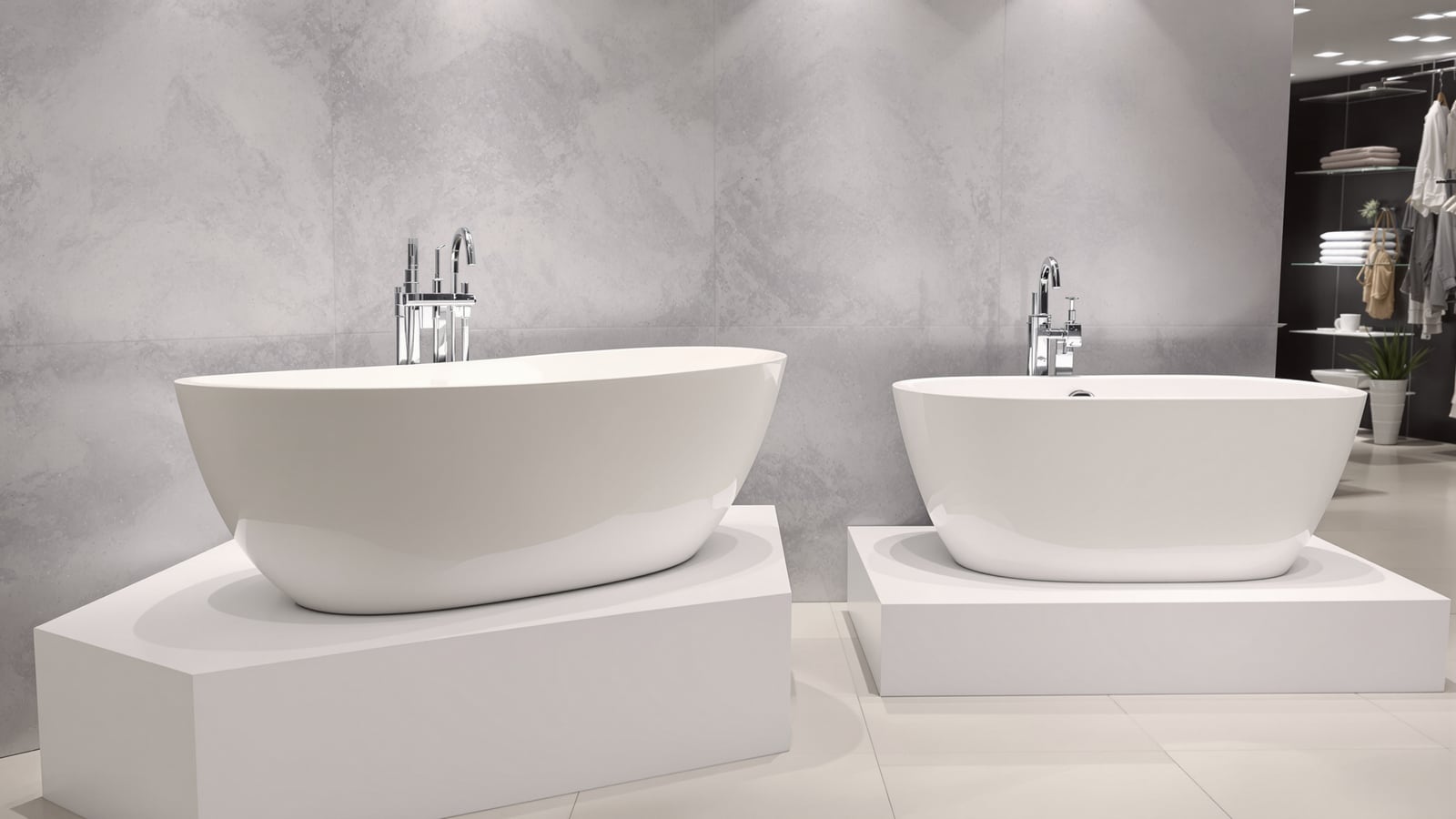
- Freestanding tubs sit clear of the walls and are the show-piece choice. They need generous floor and clearance on most sides, floor-fed or freestanding taps, and a wide-open bathroom — think master or luxury bathrooms of 60+ sq ft. Beautiful, but the least space-efficient. See the freestanding bathtub guide.
- Built-in (drop-in / alcove) tubs are set into a tiled deck or slotted between three walls. They are the most space-efficient and the most common in Indian apartments, hide their plumbing, and give you a tiled ledge for bottles. If space is finite, this is usually the answer.
- Corner tubs tuck the tub into a right angle, freeing the middle of the room. They read as space-saving but a corner tub is often wider overall than an alcove tub — good in an oddly shaped or medium bathroom, wasteful in a small square one.
| Shape | Best for | Space it needs | Watch out for |
|---|---|---|---|
| Freestanding | Large master baths, statement look | High — clearance most sides | Cold floor around it; heavy if stone/iron |
| Built-in / alcove | Apartments, efficient layouts | Low — uses walls | Access panel needed for the trap |
| Corner | Medium/odd-shaped rooms | Medium — big footprint | Often bigger than it looks |
Match the material to how you live
Material sets weight, warmth, durability and price all at once. In India the real contest is between three.
- Acrylic is the default for good reason: light (two people carry it up a stair), warm to sit in, holds heat, and scratches polish out. A good sanitary-grade acrylic with proper fibreglass backing lasts decades; a thin one is where the trouble starts (see the red flags below). Best all-round choice for most homes.
- Cast iron (with a fired enamel surface) is the heirloom option — immensely durable, dead-solid, and gorgeous, but very heavy, cold to first touch, and a load and installation headache on upper floors. Choose it for a ground-floor forever-home, not an apartment retrofit.
- FRP (fibreglass) is the budget tub — cheapest and light, but the gel-coat surface dulls, stains and crazes faster than good acrylic. Fine for a guest bath or a rental; not where you will bathe daily for fifteen years.
| Material | Weight | Warmth & heat retention | Durability | Typical role |
|---|---|---|---|---|
| Acrylic | Light | Warm, holds heat well | High if thick & well-backed | The sensible default |
| Cast iron | Very heavy | Cold at first, holds heat | Very high, decades | Ground-floor luxury |
| FRP / fibreglass | Light | Warm but thin-feeling | Low–medium, dulls | Budget / guest bath |
Size, depth and the whirlpool question
Beyond the shape, two comfort numbers matter. Length decides who fits — 1500 mm suits shorter bathers, 1700 mm is the comfortable standard, 1800 mm+ is roomy. Water depth decides the soak: a shallow 300 mm tub wets you; a proper soaking tub with a 400–450 mm water depth lets you sit submerged. Deeper tubs need more hot water, which loops straight back to your geyser check.
On whirlpool / jetted tubs: they add real cost, real hardware, and a real maintenance burden. The pump and pipework need regular flushing or biofilm builds up inside lines you cannot see, and in India's hard water that maintenance is not optional. A whirlpool is worth it if you genuinely want hydro-massage and will run cleaning cycles; for most buyers a plain deep soaking tub delivers 90% of the pleasure with none of the plumbing to babysit. If you do want jets, the bathtub guide covers air vs water systems.
Good, better, best — what it costs
Prices are indicative 2026 rupee ranges for the tub alone. Add ₹6,000–₹25,000+ for a mixer/filler, plumbing, tiling of the deck, and — importantly — delivery and installation of a heavy, awkward item up your stairs.
| Tier | Budget (₹) | What you get | Typical pick |
|---|---|---|---|
| Good | 18,000 – 45,000 | Standard acrylic or FRP alcove tub, basic warranty | Guest bath, first tub, rental |
| Better | 45,000 – 1,10,000 | Thick sanitary-grade acrylic, freestanding options, longer warranty | Most family master baths |
| Best | 1,10,000 – 3,50,000+ | Cast iron, stone/solid-surface or premium freestanding, well-engineered whirlpool | Luxury / forever homes |
Delivery, installation and warranty
A tub is a two-person, stair-unfriendly object. Confirm before paying who delivers it, whether they carry it to the bathroom or leave it at the gate, and who plumbs and sets it. Built-in tubs need an access panel left in the tiling for the trap; freestanding tubs need the floor waste positioned to the millimetre before tiling. Getting the plumber and the tiler to talk to each other beforehand saves a broken tiled deck later.
On warranty, read what each number covers. A "10-year warranty" often means 10 years on the acrylic surface but only 1–2 years on a whirlpool motor or pump — the part most likely to fail. Ask who performs service, whether it is on-site, and get it in writing. Brands with a real service network (Jaquar, Kohler, Hindware, Cera among others, cited here only as familiar examples) are worth a premium precisely for the after-sales, since a leaking or cracked tub is not a DIY fix.
Red flags: how to spot a thin, flexing acrylic tub
The showroom trick is that a bad acrylic tub and a good one look identical empty. Use your hands, not your eyes.
- Press the base and the side walls. A well-backed tub is dead solid. If it flexes, bows or makes an "oil-can" popping sound, the fibreglass reinforcement is skimped — it will creak, stress-craze and eventually crack in use.
- Ask for the acrylic thickness and whether it is sanitary-grade cast acrylic or cheap extruded. Vague answers are an answer.
- Look under the rim. A thin, patchy, uneven fibreglass layer under the tub is a warning; a thick, even build-up is what you want.
- Distrust the "imported, so it must be good" pitch and suspiciously cheap "freestanding designer" tubs online with no thickness spec and no service address — a heavy item you cannot inspect and cannot easily return is exactly the wrong thing to buy blind.
- A gel-coat FRP tub sold as "acrylic" is a common mis-sell. True acrylic scratches polish out; gel-coat FRP dulls and yellows. If the price looks too good for acrylic, it usually is.
Get the three first checks right, pick the shape your room allows, insist on a thick well-backed material, and pin down delivery, install and warranty in writing — do that and the tub becomes the twenty-year pleasure it should be, not the regret bolted to your floor.
References
- National Building Code of India (NBC) 2016 — bathroom space, drainage and loading provisions.
- IS 2556 (Bureau of Indian Standards) — vitreous and non-metallic sanitary appliances, referenced for tub quality benchmarks.
- Bureau of Indian Standards (BIS) — ISI marking and product certification guidance for sanitaryware and fittings.
- Studio Matrx — bathtub guide for India and acrylic bathtub guide for detailed material and installation specifications.
Export this guide
Related Guides — Deep-dive reading
Cast Iron Bathtub India: The Heirloom Tub, Weight & Slab Load, Enamel Care & Cost (2026)
Why an enamelled cast-iron bathtub is the heirloom tub — unbeatable heat retention, a quiet soak and a vitreous-enamel surface that shrugs off scratches and stains for decades — set against the one thing India buyers must plan for: the sheer weight on the slab, the crew it takes to carry it up, chip repair, the cost premium, and an honest verdict versus acrylic.
BathroomsFreestanding Bathtub India: Materials, Floor Load, Concealed Plumbing & Cost (2026)
The statement centrepiece tub that stands free of every wall — how acrylic, stone-resin and cast-iron differ, the floor load a filled tub imposes, the concealed rough-in you must set out before the flooring goes down, the clear space it needs all around, drainage, and honest 2026 rupee costs.
BathroomsSoaking Tub India: Deep Japanese-Style Ofuro Baths, Geyser Sizing, Load & Real Costs (2026)
Why a deep soaking tub gives a full-immersion soak from a small footprint — ofuro ergonomics, the extra-deep water line, how much hot water and geyser capacity you actually need, heat-retention materials, the structural load of a filled tub, and honest rupee ranges for an Indian home.
BathroomsRelated Tools — Try Free
Apartment Furniture Size Chart
Standard furniture dimensions for Indian apartments — sofas, beds, tables, dining, storage.
Reference ChartMaterial Decision Framework (M-Score)
Score 30+ Indian construction materials across cost, durability, climate fit, maintenance, and sustainability.
MaterialsMaterial Quality Evaluation Checklist
20-point checklist to evaluate interior materials before signing off at delivery.
Quality Checklist