
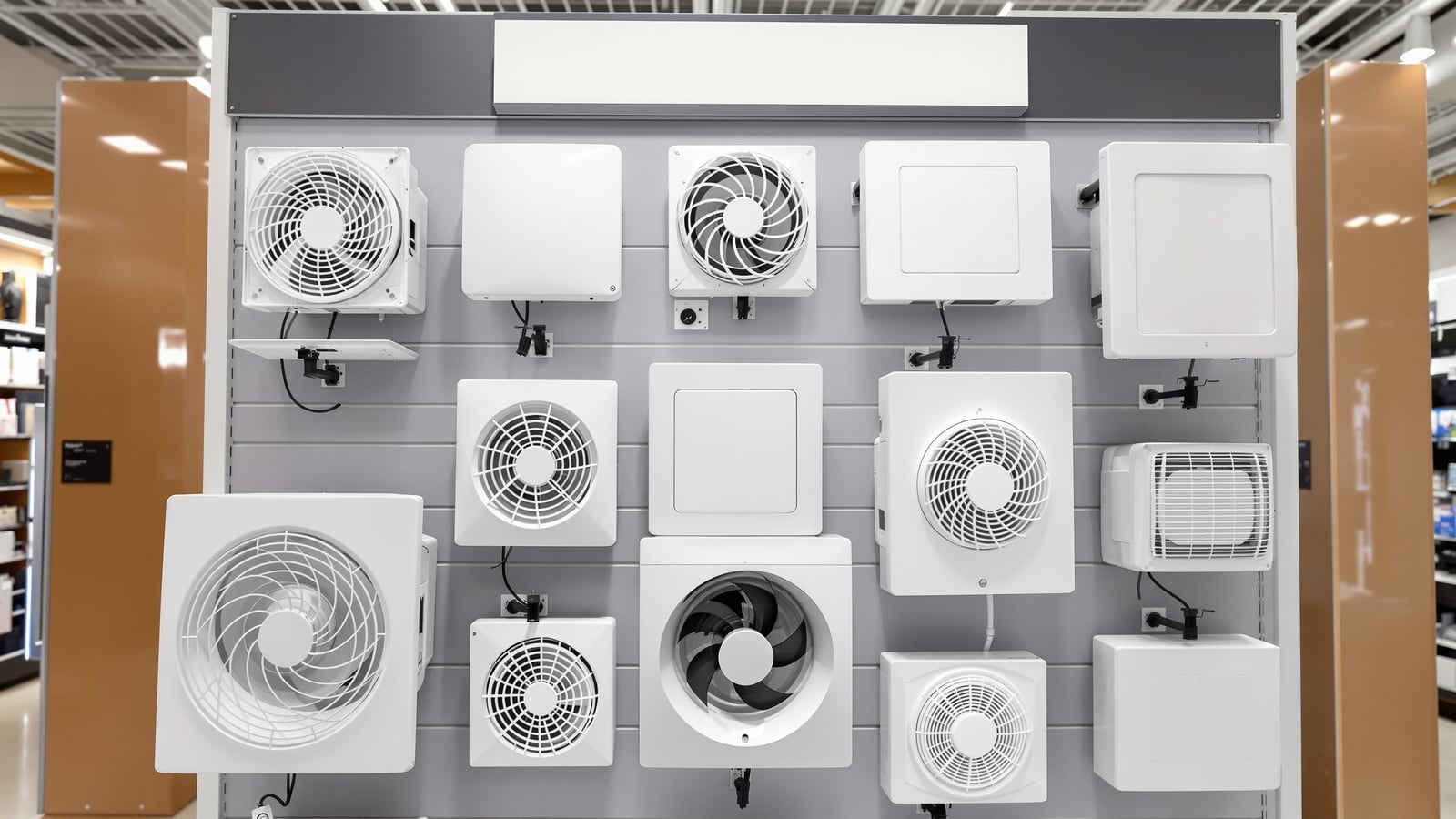
How to Choose an Exhaust Fan in India: CFM Sizing, Noise, Features & Budget Tiers
A buyer's guide to picking the right bathroom exhaust fan for your room — calculate the CFM you actually need, match wall vs ceiling vs inline to your layout, judge noise in sones, decide which extras earn their price, and spot the underpowered cheap fans that never clear the steam.
Walk into any hardware shop in India and you can buy a bathroom exhaust fan for ₹600. It will spin, it will make noise, and in a real bathroom with a real shower it will do almost nothing. The gap between that fan and one that actually keeps the mirror clear and the grout mould-free is not luck — it is a handful of specifications you can decide before you pay. This guide is about how to choose an exhaust fan in India: the numbers that decide the purchase, the features worth the extra rupees, and the cheap traps that look identical on the shelf.
If you want the full engineering of ducting, air changes and installation, read the companion bathroom exhaust fan guide and the broader bathroom ventilation guide for India. This is the buyer's version — it sits under the bathroom shopping guide and focuses on the decision, not the theory.
The single most expensive mistake is buying an exhaust fan by its price tag instead of by your room's cubic feet. A ₹600 window fan strangling a proper shower is money wasted; a correctly sized fan is the cheapest insurance a bathroom ever gets.
Start with CFM — calculate it, don't guess it
Every exhaust fan is rated in CFM (cubic feet of air per minute). This is the one number that decides whether the fan clears your room, and you calculate it from your own bathroom — you never take the salesperson's word for "this one's fine for any bathroom."
The arithmetic takes ten seconds:
- Room volume = length × width × ceiling height, all in feet.
- Required CFM = (volume × air changes per hour) ÷ 60. For a bathroom, target 8 to 10 air changes per hour so a burst of shower steam is swept out fast.
A standard 7 ft × 5 ft bathroom with a 10 ft ceiling holds 350 cubic feet. At 8 air changes that is 350 × 8 ÷ 60 ≈ 47 CFM, so you buy a 50–60 CFM fan. A quick sanity check — 1 CFM per square foot of floor, minimum 50 CFM — lands in the same place for ordinary ceilings, but always use the volume method when ceilings are high or the room is large.
| Your bathroom (approx.) | Volume | CFM you need | Fan to buy |
|---|---|---|---|
| Small / powder (5 × 4 ft) | ~200 cu ft | ~27 CFM | 50 CFM (sensible minimum) |
| Standard (7 × 5 ft) | ~350 cu ft | ~47 CFM | 50–60 CFM |
| Large (9 × 6 ft) | ~540 cu ft | ~72 CFM | 80 CFM |
| Master with tub / enclosed shower | ~700+ cu ft | ~95 CFM | 100+ CFM, or two fans |
Measure your room, do the sum, then buy the next practical size up — never below 50 CFM even for a tiny bathroom, and add a margin if the duct run is long or has bends, because every bend steals CFM.
Match the type to your layout
The CFM tells you how strong; your bathroom's walls and ceiling tell you which type to buy. Choose by where the moist air can actually exit.
| Type | Buy it when | The catch |
|---|---|---|
| Wall / window fan | You have an external wall or an existing ventilator opening | Only works on an outside wall; must have a backdraft shutter or it lets in insects, dust and shaft smells |
| Ceiling fan | You have a false ceiling and can run a duct to outside | Useless if it just blows into the ceiling void — it needs a real duct to the outside |
| Inline / duct fan | Internal bathroom, long duct run, or two grilles on one fan | Costs more and needs a service hatch, but the strongest option for windowless rooms |
The dividing question is simple: is there an external wall near the bathroom? If yes, a wall or short-ducted ceiling fan is cheapest. If the bathroom is internal — extremely common in Indian flats — budget for a ceiling or inline fan ducted through a chase to the outside. Whatever you choose, the fan has to discharge to genuine outside air; a fan venting into a sealed false-ceiling void is not ventilating anything.
Noise: read the sones, not the marketing
A fan you can hear is a fan you switch off, and a fan that is off does no good. Noise is rated in sones — lower is quieter.
- ≤1.0 sone — genuinely quiet, barely noticeable; worth it for a bedroom ensuite.
- ≤1.5 sones — the sensible target for any fan you will leave running after a shower.
- 3–4 sones — typical cheap window fans; they roar, so people turn them off, so the steam stays.
If a fan lists no sone rating at all, assume it is loud. A quiet fan with a run-on timer is the combination that actually gets used.
Which extras are worth paying for
The base job of a fan is easy; the value is in clearing the moisture that lingers after you leave. In rough order of what earns its price:
- Timer / run-on model — keeps running 5–20 minutes after the switch is off, clearing residual steam. If you buy one upgrade, buy this.
- Humidity sensor (hygrostat) — switches on automatically when humidity climbs and runs until the room dries. Ideal for a monsoon bathroom or a shared one where nobody remembers the switch.
- Backdraft damper — a gravity or spring shutter that blocks insects, dust and shaft odours when the fan is off. Non-negotiable on external walls; cheap to add.
- IP rating — a fan near the shower sits in a wet zone and should be at least IP44/IP45. Confirm it is printed on the box, not just claimed.
- Sweep / blade type — axial fans move a lot of air against low resistance (good for short ducts and wall mounts); centrifugal / mixed-flow blades hold their CFM against the back-pressure of long ducts, so favour them for inline and long-run installs.
Extras that sound good but rarely matter: coloured LED lights, "designer" grilles that block airflow, and app connectivity you will use once. Spend on the timer and the correct CFM first.
Budget tiers and what to check before you pay
Prices below are the fan alone. Budget separately for ducting, a wall louvre and the electrician — that is the part that actually makes any fan work, and it is where cheap installs fail.
| Tier | Price (₹, fan only) | What you get | Buy it if |
|---|---|---|---|
| Good | ₹1,200 – 2,000 | 50 CFM, stated sones, backdraft shutter, 1-yr warranty | Small bathroom on an external wall |
| Better | ₹2,500 – 4,500 | 50–80 CFM ceiling fan, run-on timer, IP44, 2-yr warranty | Most flats — the sensible default |
| Best | ₹5,000 – 9,000+ | Humidity sensor, inline/high CFM, ≤1.0 sone, IP45 | Internal, master or monsoon-heavy bathrooms |
| Avoid | Below ₹800 | Sub-30 CFM, no sones, no warranty | Never — it cannot clear a shower |
Before you hand over money, run this checklist:
- CFM printed on the box and matched to your room's calculation — not just "suitable for bathrooms."
- Sone rating stated — no rating means it is probably loud.
- IP rating appropriate to the fan's position (IP44+ near the shower).
- Genuine safety marking — household electrical fans should conform to IS 302; look for the marking, not a sticker.
- Warranty in writing — 1 to 2 years is normal; get the card stamped and keep the bill.
- What's in the box — grille, backdraft shutter and mounting hardware included, or are they extra?
- Installation — is the electrician's fitting quoted, and does it respect bathroom wiring zones under IS 732?
Spotting an underpowered or mis-sold fan
The cheap fan and the good fan look almost identical on the shelf, so learn the tells:
- A tiny 6-inch fan sold for a full bathroom. Sub-30 CFM units are for a cupboard or a toilet closet, not a room with a shower.
- No CFM figure anywhere. If the seller cannot tell you the CFM, they are selling you a fan by its diameter, which tells you nothing about airflow.
- "Powerful" with no number to back it. Marketing adjectives are not specifications. Ask for CFM and sones.
- Missing backdraft shutter on a wall fan — you will get insects, dust and shaft odours blowing back in.
- No warranty card, unbranded packaging, or a price that undercuts everything else — common signs of grey-market or counterfeit stock. Buy from a dealer who will honour the warranty.
Ask the showroom three questions: what is the CFM and sone rating, is the backdraft damper included, and what does the warranty actually cover. A vendor who answers all three with numbers is selling you a real fan. One who answers with "don't worry, it's very powerful" is selling you the ₹600 trap in nicer packaging.
References
- NBC 2016 (National Building Code of India), Part 8 & Part 11 — ventilation requirements for bathroom and sanitary spaces, including mechanical exhaust where natural ventilation is inadequate.
- IS 302 (Part 1 & Part 2/80) — Safety of household and similar electrical appliances; general and fan-specific requirements to verify when buying.
- IS 732 — Code of practice for electrical wiring installations; earthing, circuit protection and bathroom zoning relevant to fan installation.
- BIS (Bureau of Indian Standards) — reference for genuine product marking and how to distinguish conforming from counterfeit electrical goods.
- IGBC / GRIHA — green-building guidance on indoor air quality and effective mechanical ventilation of wet areas.
Export this guide
Related Guides — Deep-dive reading
Bathroom Exhaust Fan India: CFM Sizing, Wall vs Ceiling vs Inline, Ducting, Sones & Cost
How to specify a bathroom exhaust fan that actually clears steam in an Indian home — sizing by CFM from room volume and air changes, choosing wall, ceiling or inline, ducting it to outside air (never into a false-ceiling void), and picking backdraft-damper, humidity-sensor and timer models at the right noise and IP rating.
BathroomsHow to Choose a Wash Basin in India: Mount Type, Size, Tap Holes & Budget (2026 Buyer's Guide)
A buyer's decision guide to picking the right wash basin — matching the mount type to your vanity and space, sizing it to the room, getting the tap-hole config right for your faucet, judging material and durability, checking what's in the box, good/better/best rupee tiers, the IS 2556 vitreous-china mark, and how to spot seconds, hairline cracks and warranty traps.
BathroomsHow to Choose a Toilet in India: A Buyer's Guide to WCs, Traps, Flush & Budget (2026)
The make-or-break trap and rough-in check, floor-mounted vs wall-hung, one-piece vs two-piece, flush type and water use, seat and rimless upgrades, good/better/best rupee tiers, what's actually in the box, and how to spot a fake before you pay.
BathroomsRelated Tools — Try Free
Cross-Ventilation Analyzer
Estimate airflow and air changes per hour (ACH) from room size, window areas, layout, and local wind — with NBC 2016 Part 8 compliance check.
Ventilation CalculatorElectrical Safety & Load Audit
Home electrical audit — 10 categories, 65+ checkpoints across earthing, RCCB, MCB, wiring, switchboards, appliance circuits, DG/inverter backup.
Safety AuditBathroom Exhaust Fan Calculator
Size a bathroom exhaust fan from room volume and air changes per hour — output in CFM and CMH with a recommended fan rating and diameter.
Bathroom Calculator