
CCTV Signage in India (2026): Notice That Deters and Keeps You Compliant
A CCTV notice does two jobs at once — it deters, and it discharges a transparency duty under the DPDP Act, 2023. What a good sign should say, where to place it, why it must be bilingual, and why signage is never a licence to over-record.
A CCTV signage board is the small, easily-missed sign at a gate, shop door or society entrance that says, in effect, "this area is monitored." It looks trivial next to the cameras themselves, but it quietly does two important jobs at the same time. It deters — an opportunist who reads the sign at the boundary often decides not to proceed at all. And it is a transparency notice — a plain-language way of telling people that recording is happening before they are recorded, which is exactly the kind of openness the Digital Personal Data Protection Act, 2023 (DPDP Act) expects of anyone who collects personal data.
This guide, part of Studio Matrx's CCTV hub, covers what a good notice should say, where to place it so it works, why it should be bilingual in most Indian settings, and — the part people forget — that a sign is not a permission slip to over-record. It sits alongside the installation planning guide, which walks the property survey and the whole plan.
Not legal advice. This is an educational overview to help you plan good, ethical signage. It is not legal advice. For a shop, office, factory, clinic or a residential society covering shared and public-facing areas, consult a qualified professional on your specific obligations under the DPDP Act, 2023 and any local rules.
Why a sign matters — two jobs, one board
Most people think of a CCTV notice as a scare tactic. It is more than that.
- It deters at the boundary. Deterrence is cheapest when it happens before anyone acts. A visible notice at the gate — reinforced by an obvious bullet camera — tells the casual trespasser that this spot is watched and recorded, and most simply move on. The sign and the camera work as a pair.
- It is a transparency duty. When you record people — visitors, delivery staff, passers-by along your frontage — you are collecting their personal data. A basic principle running through the DPDP Act, 2023 is that people should not be recorded in secret without knowing it is happening and why. A clear notice, placed before the camera's view begins, is the simplest way to be open about it. Think of it as informed presence, not a hidden watch.
For a home covering only its own gate and porch the bar is light; for a shop, a society covering common areas, or any premises with staff and the public, the transparency side becomes far more important — see the security and privacy assessment guide for how to weigh purpose against intrusion.
What a good CCTV notice should say
A useful notice is short, readable from a few steps away, and answers three questions: is recording happening, roughly why, and who do I contact? You do not need dense legal text on a gate board — you need clarity.
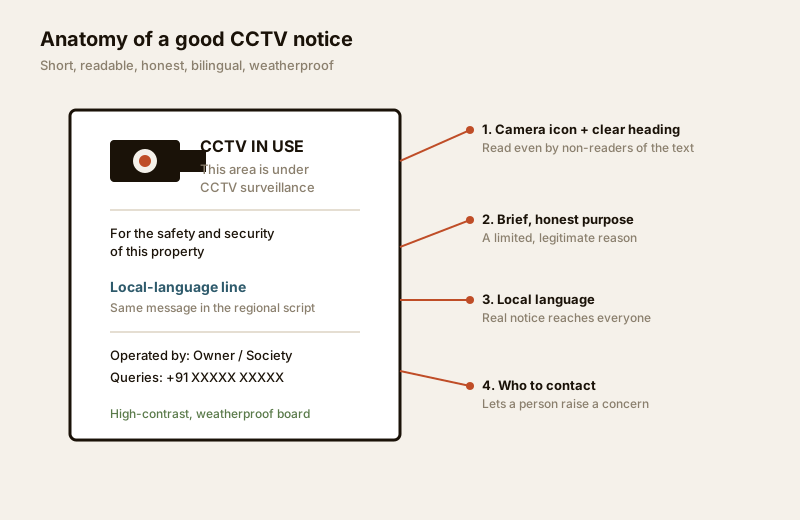
The core elements of a good sign:
| Element | What it should carry | Why it matters |
|---|---|---|
| Clear heading | A plain line such as "CCTV in use" or "This area is under CCTV surveillance" | The instant, readable deterrent and notice |
| A camera symbol | A simple camera icon | Understood even by someone who cannot read the text |
| Purpose (brief) | A short line — e.g. "for the safety and security of this property" | Signals the recording has a legitimate, limited reason |
| Who operates / contact | Owner, shop, society or a contact number/email for questions | Lets a person ask what is recorded or raise a concern |
| Local language | The same wording in the regional language, not only English | Real notice reaches everyone who passes |
| Legible, durable board | High contrast, weatherproof, sensible size for viewing distance | A faded, tiny or hidden sign gives neither deterrence nor notice |
Keep purpose lines honest and narrow. "For the safety and security of this property" is fine; vague claims that imply you record far more than you actually do — or need to — are not. For shops and offices, a slightly fuller notice near the entrance can add who to contact with a privacy query; for a plain home gate, the heading, icon and a contact number are usually enough.
Avoid these mistakes:
- A sign so small or high that no one reads it before entering.
- English only, in a neighbourhood where many read only the local language.
- A board bleached illegible by two summers of sun — treat it as a maintenance item.
- Threatening or misleading wording, or claiming powers you do not have.
- Placing the sign but aiming cameras well beyond what the sign implies (covered below).
Where to place the sign
Placement is what makes a notice actually work. The rule is simple: the sign must be visible before a person enters the camera's view — at the boundary, not deep inside where they have already been recorded for a while.
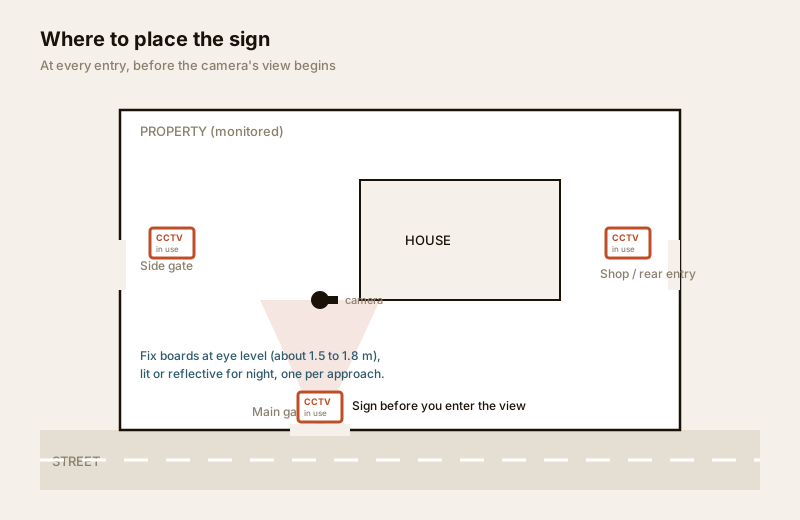
Practical placement points:
- At every entry. Main gate, pedestrian side gate, the shop door, the society's vehicle and foot entrances — anywhere someone crosses into a monitored area needs a sign at that threshold.
- Before the camera's view, not after. Position the board at or before the line where recording starts, so a person is informed first. A sign fixed behind the camera, facing into the property, misses its purpose.
- At readable height. Roughly eye level (about 1.5–1.8 m), where an approaching adult naturally reads it — not up near the eave with the camera.
- Well lit or reflective. A sign that vanishes after dark deters no one at night; use a spot that catches your security lighting or a reflective board.
- One per approach. A large plot or a society with several entries needs a sign at each; one board at the main gate does not cover a compound with three ways in. This maps directly onto the entry points you listed during the installation planning survey.
For societies and gated communities, signage at the community entrance and at shared facilities is part of a wider, documented approach — the gated-community security guide covers how an RWA should notify residents and visitors and keep the arrangement transparent.
Bilingual and local-language signage
In most of India a purely English notice does not reach everyone who passes your gate — delivery staff, domestic help, tradespeople, neighbours. For a notice to do its transparency job it has to be understood, so a good sign carries the same short message in English and the local/regional language (and Hindi where relevant), or leans on the universal camera icon plus minimal text.
- Keep both language lines equally legible — do not shrink the regional line to a footnote.
- The icon carries meaning to anyone regardless of script; make it prominent.
- In mixed neighbourhoods, three lines (English, Hindi, regional) on a slightly larger board is reasonable.
Signage is not a licence to over-record
This is the part that matters most, and it is where signage is easily misused. Putting up a board does not create a right to record whatever you like. A sign discloses recording; it does not justify it. The recording itself must still be lawful, proportionate and privacy-respecting — the sign and the restraint go together.
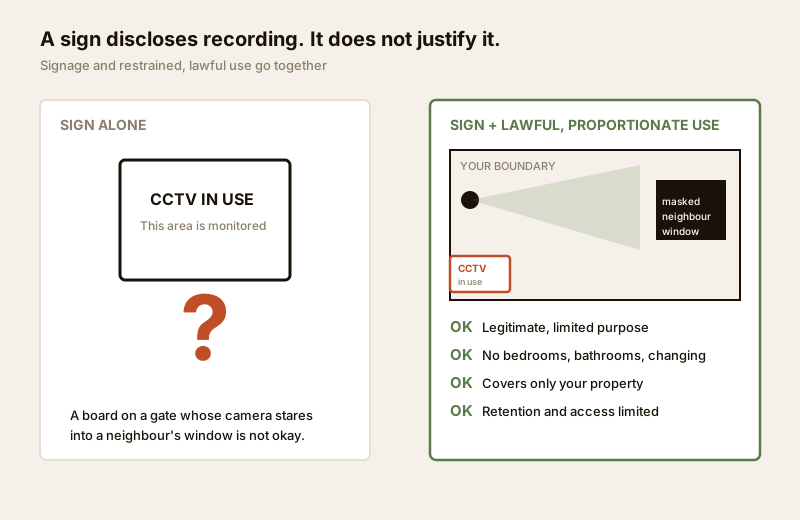
What "lawful and proportionate use" looks like alongside your sign:
| Do | Avoid |
|---|---|
| Cover only your own property and shared areas | Aiming cameras into a neighbour's home, windows or private yard |
| Keep a clear, limited purpose (safety, security) | Recording far more than the stated purpose needs |
| Use privacy masking to black out areas you should not see | Capturing the street or neighbours beyond your legitimate boundary |
| Never cover bathrooms, bedrooms or changing areas | Any camera in an inherently private space |
| Retain footage only as long as reasonably needed | Hoarding recordings indefinitely with no purpose |
| Restrict who can view the footage | Sharing recordings casually or publicly |
| Respond to a genuine query via the contact on the sign | Ignoring a reasonable request from someone recorded |
A notice board on a gate whose camera stares into the neighbour's bedroom window is not "compliant because there is a sign" — it is intrusive despite the sign. The sign earns its value only when the system behind it is restrained. Where a camera's field of view unavoidably catches an area you have no business recording, privacy masking blacks it out; where a boundary is tight, the security and privacy assessment helps you decide what is proportionate.
A quick signage checklist
Use this before you fix any boards.
| Check | Aim |
|---|---|
| Sign at every entry point | One board per approach, from the survey |
| Placed before the camera's view begins | People informed before being recorded |
| Readable height and size | Eye level, legible from a few steps |
| Heading + camera icon + purpose + contact | The four core elements present |
| Bilingual / local language | Understood by everyone who passes |
| Legible after dark | Lit or reflective board |
| Weatherproof and maintained | Survives sun, dust and monsoon; replace when faded |
| Cameras match what the sign implies | No over-reach beyond the stated purpose |
| Neighbours' private spaces masked | Privacy respected, not just disclosed |
When to bring in a professional
The signage itself is a job you can plan and place yourself. Two things around it are not:
- Fixing boards at height or drilling into structure. If a board must go high on a pillar or wall, or the mounting involves working at height, hand that to a professional — the same one mounting your cameras. Any board near an electrical fitting, and all mains-electrical work, belongs to a licensed electrician; see the electrical hub.
- Your specific legal obligations. For a shop, office, factory, clinic, rental property, or a society covering shared and public-facing areas, the exact wording and duties under the DPDP Act, 2023 can be more involved than a home gate. Consult a qualified professional on what your premises specifically requires. This guide is educational, not legal advice.
And, as always, security hardware and its signage must never block a doorway, window, staircase or fire-egress route.
Key takeaways
- A CCTV notice does two jobs: it deters at the boundary and it discharges a transparency duty under the DPDP Act, 2023 by telling people recording is happening before they are recorded.
- A good sign is short and readable: a clear heading, a camera icon, a brief honest purpose, and a contact — in English and the local language.
- Place a sign at every entry, before the camera's view begins, at readable height, legible day and night — one per approach, matched to the entry points from your installation plan.
- Signage is not a licence to over-record. The recording must still be lawful and proportionate: cover only your property, use privacy masking, never bathrooms or bedrooms, and respect neighbours.
- For shops, offices and societies, get advice on your specific duties — this is educational, not legal advice — and route at-height or electrical work to a licensed professional.
References
- Digital Personal Data Protection Act, 2023 — the framework behind transparency and proportionality when CCTV records people; consult a qualified professional for obligations specific to your premises. Verify the current text via official government sources.
- National Building Code of India (SP 7), Bureau of Indian Standards, and local municipal bye-laws for any structural, electrical or life-safety aspect of mounting signage or cameras; verify the current edition via the BIS catalogue: https://www.services.bis.gov.in/
This is an educational overview, not legal advice. Rules and their current status change — verify the DPDP Act, 2023 position with a qualified professional and any standard via the BIS catalogue before relying on it.
Export this guide
Related Guides — Deep-dive reading
Where Not to Install CCTV in India (2026): The No-Go Zones
A camera is a powerful thing, and pointing it at the wrong place can turn a security measure into a serious intrusion. This is the plain, humane list of places a camera must never point, plus the borderline spots to think twice about.
SecuritySecurity Privacy Assessment for Indian Homes
Getting the privacy side of home security right: camera placement ethics and limits, notice and consent, the extra caution audio demands, and treating footage as personal data you store, retain and delete responsibly under India's DPDP Act 2023 direction.
SecurityThe Complete Guide to Parking and Garage Security in India (2026): Access, CCTV, Lighting, People-Safety & Vehicle Protection
The pillar overview of parking and garage security for Indian apartments, offices and homes — how to control who enters, watch every corner, light and de-isolate the space, and protect the vehicles, without ever blocking the escape route or the fire tender.
SecurityRelated Tools — Try Free
CCTV Placement Compliance Checker
A quick DPDP-grounded privacy and safety self-check for where a camera is pointed — flags the items to fix.
ComplianceStructural Modification Approval Checklist
41 items across structural assessment, society approval, municipal compliance, and safety.
Approval ChecklistMonsoon-Readiness Checklist
Pre-rain home audit across 9 categories — terrace, drains, waterproofing, electrical, HVAC, pest, vehicles, documents.
Seasonal Audit