
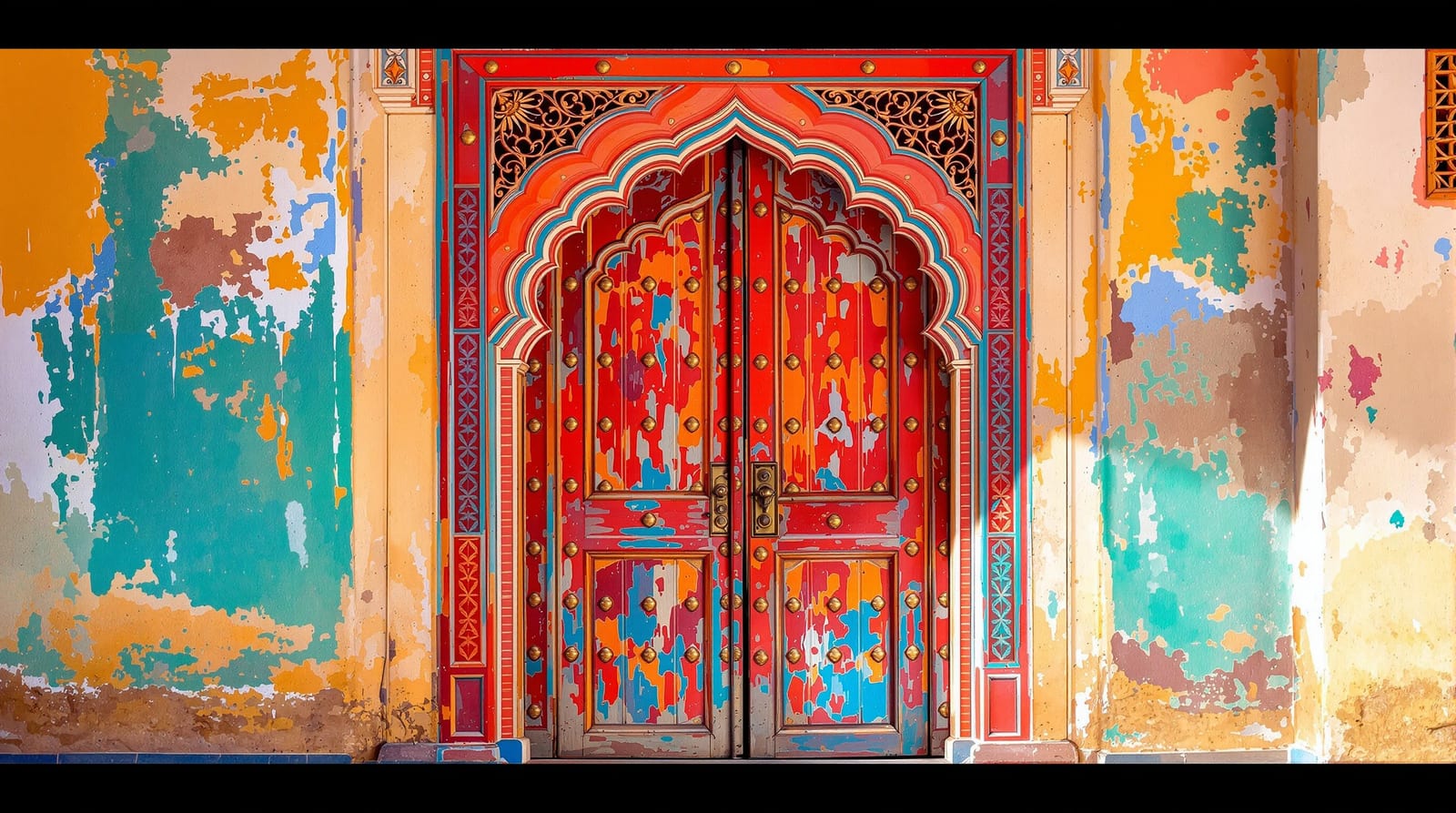
Rajasthani Carved Doors in India: Haveli Doors, Brass Studs and Jharokha Detailing
Deeply carved sheesham and teak haveli doors with brass studs, iron knockers, arched tops and bright distressed colour — and how to source reclaimed Rajasthani doors or honest reproductions today.
Stand in the lanes of old Jaipur, Jodhpur or a Shekhawati town and the doors stop you. Set deep inside carved stone gateways, hung with rows of brass studs and a heavy iron knocker, painted in fading indigo and ochre and crowned with a shallow arch, the Rajasthani haveli door is one of the most recognisable thresholds in Indian architecture. This guide goes deep on that single tradition — the carving, the colour, the deorhi and jharokha context — and the practical reality of putting a reclaimed haveli door, or an honest reproduction, into a home today.
This is a regional, heritage-specific companion to our broader traditional Indian doors overview and the cross-regional carved door designs piece. Where those map the whole spectrum, this one stays in Rajasthan.
Where Rajasthani carved doors come from
The haveli — a courtyard mansion built by merchant, banking and noble families — is the parent building. From the 18th to early 20th century, the trading communities of Marwar and Shekhawati (the Marwari and Maheshwari merchants who later funded much of India's industry) built ornate courtyard homes across Jaipur, Jodhpur, Bikaner, Jaisalmer, Nawalgarh, Mandawa, Fatehpur and the painted towns of Shekhawati. In a dry, hot, stone-and-lime architecture, the woodwork — doors, jharokhas, columns and brackets — carried the most concentrated craftsmanship in the building.
The entrance was never a single leaf in a flat wall. You approached through the deorhi — a carved gateway and transitional vestibule that mediated between the public street and the private courtyards (chowk) within. Above and beside ran the jharokha, the projecting carved-stone or wooden oriel window with its own miniature columns and brackets. The great timber door sat at the back of the deorhi, framed by carved stone jambs, often topped by a shallow ogee or multi-foil arch. That sequence — street, deorhi, threshold, courtyard — is the logic the door was built to crown, and it is why a genuine Rajasthani door reads as architecture, not joinery.
What makes a door unmistakably Rajasthani
No single feature defines the type; it is the combination — the carving, the colour and the studded hardware — that does.
| Rajasthani door element | The detail to look for |
|---|---|
| Sheesham, teak or mango leaves | Dense hardwood — Indian rosewood (sheesham/shisham), teak in grander homes, mango and country woods in humbler ones; heavy, wide-plank construction |
| Brass / iron studs (mekh) | Rows of domed brass or wrought-iron studs across the leaves — part decorative, part clinching the planks and bracing against forced entry |
| Deep relief carving | Floral vines, lotus, peacocks, elephants, parrots, kalash (pot) and geometric jaali fretwork chiselled into rails, stiles and panels |
| Arched or multi-foil top | Shallow ogee, semicircular or cusped (multi-foil) arch echoing Rajput-Mughal stone arches; sometimes a carved transom panel above |
| Iron knocker and pull rings | Hand-forged knockers (kundi), large pull rings and lion- or elephant-faced fittings made by the village lohar (blacksmith) |
| Bright / distressed colour | Original indigo blue, ochre, deep green or vermilion paint, now weathered and distressed — a defining modern aesthetic |
| Raised panels and turned spindles | Framed raised panels, applied turned kharad spindles, and pierced fretwork in upper panels or transoms |
| Carved stone deorhi surround | Sandstone jambs and lintel with carved brackets, often part of a salvaged set |
| Jharokha context | Projecting oriel windows flanking or above the entrance, sometimes salvaged alongside the door |
| Threshold and auspicious marks | A raised dehleez (threshold), toran of beads or mango leaves, kumkum and a Ganesh niche or motif near the entrance |
A note on colour: while the Chettinad tradition prized the bare oiled teak, the Rajasthani idiom embraced paint. The distressed indigo-and-ochre or weathered green finish that decorators love today is genuinely traditional — Rajasthan painted its woodwork — and it is the single biggest reason these doors became a global decor staple.
A diagram of the studded arched haveli door
The drawing shows the typical proportions and elements of a Rajasthani carved haveli door. Note the portrait proportion and the arched top — these doors are tall and set deep in a carved surround.
The fittings: brass studs, kundi knockers and iron locks
The hardware is half the character. On a genuine old haveli door almost everything was hand-made. Domed brass studs (meekh / meKh) — and on humbler doors, iron studs — run in bands across the leaves; they clinch the wide planks, brace the door against being forced, and catch the light. The knocker (kundi), large pull rings and corner brackets were forged by the village lohar, often as lion or elephant faces. Locking was typically a heavy sliding iron bolt (aglee / chitkani) and a sankal (chain-and-staple) from inside, sometimes backed by a deshi lever lock or, in later homes, an imported brass mortise lock.
If you are restoring a reclaimed door for a modern home, this is where the most thought goes. The original sliding bolt is charming but offers little security against today's threats. The usual compromise: keep the original studs, knocker and visible brasswork, retain the old bolt as a decorative interior latch, and discreetly add a modern mortise or multi-point lock behind the heritage ironwork — see our door hardware guide, and our brass-fitted traditional doors piece for how brass studs and modern fittings live together. Clean the brass and iron, do not strip them — the patina is part of the value.
The revival: statement doors and decor today
From the late 20th century, as many havelis were sub-divided, abandoned or demolished, their doors, jharokhas, columns and brackets entered the architectural-salvage market — first feeding Rajasthan's tourist and decor trade, then export. Today you will find Rajasthani carved doors in three forms:
- Genuine reclaimed antiques — original leaves and frames lifted from a demolished or renovated haveli. The most authentic and most expensive; condition, paint and provenance vary enormously.
- Restored / re-hung antiques — original carved leaves cleaned, repaired and fitted to a new frame, sometimes resized. The practical middle path for most homeowners.
- New "haveli-style" reproductions — freshly carved sheesham, mango or reclaimed-timber doors made to the same idiom by carpenters in Jodhpur, Jaipur, Saharanpur, Channapatna and elsewhere, often distressed to look aged. Honest reproductions are excellent value; they are not antiques, and a reputable dealer will say so.
Designers reach for them as a single dramatic gesture: a distressed blue carved door as the entrance to a contemporary home, a pair of carved leaves repurposed as a sliding feature partition, a salvaged jharokha as a wall sculpture, or a carved door panel mounted as a headboard or coffee-table top. They pair naturally with other antique doors for a collected, heritage look, and the arched-top examples sit comfortably alongside other arched doors in the home.
Sourcing a reclaimed haveli door
Reclaimed doors come from architectural-salvage yards (Jodhpur and Jaipur are the great hubs; also Udaipur, Saharanpur, Delhi, Mumbai, Bengaluru and Goa), heritage-demolition lots, auctions and a growing number of online antique platforms. A few cautions:
- Verify the timber and the age. "Antique" and "rosewood/teak" are claimed far more often than they are true. Genuine old sheesham and teak are dense and close-grained; ask, and where the price is high, ask for the dealer's provenance.
- Read the paint honestly. Much of the "distressed indigo" on the market is freshly applied to new doors. That is fine if you want the look — but it is not antique patina, and the price should reflect that.
- Check for termite and borer. Mango and country-wood components especially can be infested. Look for fine bore-dust, soft patches and tunnels. Budget for fumigation and termite proofing.
- Measure realistically. Antique doors are tall, with arched tops, and rarely match a modern NBC opening (main door ~1000-1200 x 2100 mm per NBC 2016). You will usually build the opening to the door, or have it trimmed and re-hung — see how to measure a door.
- Account for weight and the arch. A solid carved double leaf is heavy, and an arched top needs a matching arched frame or a squared infill. Plan hinges, frame and wall fixings accordingly.
- Insist on a clear bill with GST. Reputable dealers issue proper invoices; salvaged timber and reproductions attract GST, and clear paperwork protects you.
Indicative costs in India
Prices vary widely with provenance, size, carving, paint and condition. Treat the table below as indicative and confirm with the vendor.
| Item | Indicative cost (₹) | Notes |
|---|---|---|
| New hand-carved sheesham / mango haveli-style door (single leaf) | 12,000 - 60,000+ | Carpentry and carving hours dominate; distressing extra |
| New "haveli-style" carved double door, arched top | 40,000 - 2,00,000+ | Made-to-order; heavy carving and teak push it sharply higher |
| Reclaimed haveli antique door (leaves only) | 20,000 - 1,50,000+ | Provenance, paint, size and carving drive it; exceptional pieces far higher |
| Reclaimed antique with original carved frame / deorhi set | 60,000 - 4,00,000+ | A complete carved gateway set commands a premium |
| Salvaged jharokha (carved oriel) for decor | 15,000 - 1,00,000+ | Sold as a wall feature; size and carving dependent |
| Restoration / re-hanging of a reclaimed door | 8,000 - 40,000+ | Carpentry, new frame, fumigation, hardware |
| Fumigation / borer treatment | 2,000 - 8,000 | Essential for any salvaged timber |
Figures are indicative for 2026 and vary by city, vendor, size and condition; +18% GST may apply. Plan a contingency — antiques rarely fit on the first attempt. Our door cost calculator and door size calculator help you sanity-check the opening and budget before you commit.
Restoring and living with a Rajasthani door
A salvaged door usually arrives dry, stiff and either grey or carrying weathered paint. Sympathetic restoration means: dry-clean and gently consolidate loose carving (never aggressively sand — you can erase the very detail you bought), treat for borer, and decide on a finish. If you want the bare-wood look, feed the timber with oil or a wax/oil finish rather than thick glossy polyurethane; if you want the distressed colour, conserve the original paint where possible and touch in rather than repaint wholesale. Clean the brass studs and knocker without over-polishing. Re-hang on robust new hinges sized for the weight, and add a discreet modern lock behind the original ironwork.
In India's climate the choice of timber matters. Rajasthan's dry heat treated this woodwork gently; move the same door to coastal Mumbai, Goa or Kerala and you must reckon with monsoon swelling, salt air and faster borer activity. Keep an exposed entrance under a small overhang or porch, oil it annually (more often near the coast), and watch the arched top and threshold where water collects. For full method, see our door polishing and refinishing and door maintenance guides.
A note on tradition: the haveli threshold carried meaning. The dehleez was kept auspicious — a daily rangoli, a beaded or mango-leaf toran, kumkum at the jambs, a Ganesh motif over the lintel. Many homeowners reviving these doors also honour the older orientation customs (the main door as the largest and most ornate, the threshold respected, the door opening inward), which overlap with broader main-door Vastu and entrance Vastu ideas — best read as living tradition and prudent practice rather than rigid rule.
Frequently asked questions
What wood are Rajasthani carved doors made of?
Grander haveli doors used teak and Indian rosewood (sheesham); many doors, and most modern reproductions, are sheesham or mango, with country woods in humbler and interior doors. Today a large share of "Rajasthani" doors on the decor market are new sheesham or mango carved to the haveli idiom, so always verify the species and whether a piece is antique or new.
Is the distressed blue-and-ochre paint original or added?
Both exist. Rajasthan genuinely painted its woodwork — indigo, ochre, green and vermilion — so weathered colour can be authentic. But a great deal of the distressed paint on the market is freshly applied to new doors for the look. If antique patina matters to you, ask the dealer directly and judge the wear; if you simply love the aesthetic, a well-distressed new door is honest value.
Will a reclaimed haveli door fit a modern doorway?
Rarely without work. These doors are tall, often arch-topped, and were built to non-standard openings, while a modern main door is around 1000-1200 x 2100 mm (NBC 2016). You usually build the opening to suit the door, or have a carpenter trim and re-hang it — and an arched top needs a matching frame. Measure carefully first with how to measure a door.
How do I keep a Rajasthani door secure?
Keep the original sliding bolt or sankal as a decorative interior latch, and behind the visible heritage brass and iron fit a modern mortise or multi-point lock, reinforcing the new frame and hinges for the door's weight. See the door hardware guide for compatible modern fittings.
What do Rajasthani carved doors cost?
Anywhere from around ₹12,000 for a modest new carved single leaf to several lakh for a complete antique set with a carved deorhi frame, plus restoration, hardware and fitting. Reclaimed antique leaves typically start around ₹20,000 and rise sharply with carving, size and provenance. All figures are indicative for 2026 and vary by city and vendor.
Export this guide
Related Guides — Deep-dive reading
Kerala Traditional Doors: The Nalukettu Padippura & Carved Main Door Explained (2026)
The heritage door style of the Kerala tharavadu, from the padippura gateway to the carved teak and aanjili main door, its motifs, brass studs and panel proportions, and how it is revived in modern Kerala homes.
Home Doors & EntrancesCarved Door Designs in India (2026): Motifs, Regional Styles, Hand vs CNC & Costs
A design-led guide to ornamental carved wooden doors for Indian homes — regional traditions, motifs, hand-carving vs machine carving, wood choice, where they belong and what they cost.
Home Doors & EntrancesTraditional Indian Door Designs: Kerala, Chettinad, Rajasthani & Temple-Style Heritage Doors
A heritage tour of India's great door traditions - Kerala nalukettu teak, Chettinad mansions, Rajasthani haveli carving, South-Indian temple doors, brass cladding and nakshi work, thresholds and toranas - and how to bring reclaimed and revival traditional doors into a modern home.
Home Doors & EntrancesRelated Tools — Try Free
Cross-Ventilation Analyzer
Estimate airflow and air changes per hour (ACH) from room size, window areas, layout, and local wind — with NBC 2016 Part 8 compliance check.
Ventilation CalculatorWindow Hardware Cost Calculator
Estimate window hardware cost — hinges, handles, locks, rollers and multipoint gears.
Window CalculatorDoor Cost Calculator
Estimate the all-in cost of a door — leaf, frame, hardware, fitting and GST — by type, material and size.
Door Calculator