
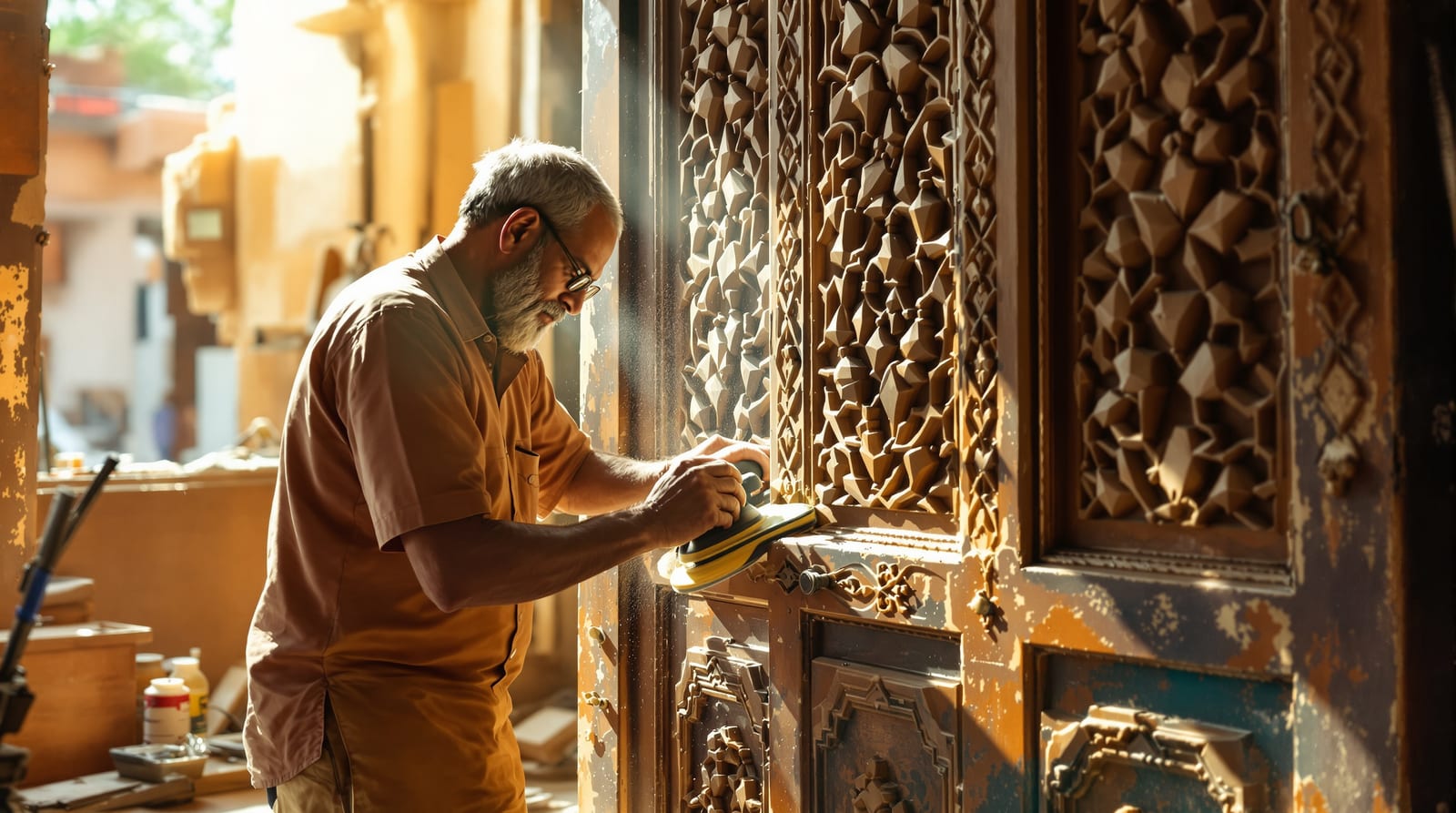
Heritage Door Restoration in India: How to Restore an Old Wooden Door
A step-by-step method for assessing, repairing, treating and refinishing old teak and rosewood doors without destroying their patina.
An old teak or rosewood door is almost always worth saving. The timber in a 50- or 100-year-old door is denser, slower-grown and more stable than anything you can buy new today, and the carving, the patina and the proportions are part of a home's memory. Restoration is patient, methodical work rather than anything magical: you assess honestly, treat the timber, repair the joints, re-hang it true, and finish it in a way that keeps its age rather than erasing it. This guide walks the full sequence for an Indian home, with realistic costs and the moment to admit a door is beyond saving.
This is a hands-on how-to companion to our antique doors buying guide and our broader door repair guide. Where those cover sourcing and everyday fixes, this one is specifically about bringing a tired old leaf back to life.
Step 1: Assess honestly before you touch it
Restoration decisions are made standing in front of the door with a torch, a thin screwdriver and a spray bottle of water. Work through five failure modes, because the repair and the cost depend entirely on which ones you find.
- Rot and decay. Press a screwdriver into the bottom rail, the threshold edge and any spot that stays damp. Sound timber resists; rotten timber crumbles or stays spongy. Wet rot is common at the foot of doors exposed to monsoon splash; dry rot is rarer but more serious because it spreads.
- Borer and termite. Look for fine, flour-like frass (bore dust) below the door, neat round exit holes the size of a pinhead (powder-post borer) or mud tubes and hollow-sounding patches (subterranean termite). Tap along the stiles — a healthy section rings, an eaten one thuds. Old Burma teak is famously resistant, but the softer country-wood components, beading and frame are fair game.
- Splits and checks. Long shrinkage splits along the grain are normal in old timber and usually cosmetic. A split that runs through a joint or a tenon, or one you can rock open, is structural.
- Loose joints. Grab the leaf at the corners and try to rack it into a parallelogram. Movement means the mortise-and-tenon or dowel joints have dried and let go — the single most common reason an old door sags and binds.
- Hardware and frame. Note seized hinges, a worn or out-of-square frame, missing beading, painted-over brass and broken locks. Half of a "ruined" door is actually a sound leaf hung on a failed frame.
Write down what you find. A leaf that only needs cleaning and re-gluing is a weekend's work; one with rotten rails, active termite and a sprung frame is a workshop job for a carpenter or restorer.
Step 2: Strip the old paint or polish
Most old doors carry decades of layered finish — French polish (shellac), oil, melamine, or coats of enamel paint hiding the grain. Strip back to bare timber so you can see the real condition and so the new finish keys properly.
- Chemical paint stripper (dichloromethane-free gels are now common) is the gentlest on carving — brush on, let it lift the film, scrape softly with a plastic or brass spatula, and pick detail out of mouldings with a toothbrush and a blunt awl. Best for carved heritage leaves where you must not lose crisp detail.
- Heat gun lifts thick enamel fast on flat panels but scorches teak and can crack glass or loosen veneer if you are careless — keep it moving, low setting.
- Sanding is for finishing, not stripping. Aggressive belt-sanding rounds off arrises, eats carving and removes the very patina you are trying to keep. Start no coarser than 120-150 grit and only after the bulk of the finish is off.
A French-polished door can often be revived rather than stripped — shellac re-dissolves in methylated spirit, so a "spirit-and-rubber" re-amalgamation can melt and re-spread the existing polish without removing it. For a deep dive on finishes, see our door polishing and refinishing guide.
Heritage caution: never sandblast or wire-wheel a carved antique. It destroys hand-tool marks and detail that give the door its value. Patience with gel stripper and a brush wins.
Step 3: Treat for termite and borer
Treat before you repair — there is no point gluing patches into infested timber. Even if you see no active infestation, a heritage door entering a new home is worth treating prophylactically.
- Surface and injection treatment. A licensed pest-control operator drills tiny holes along stiles and rails and injects a wood preservative / anti-termite emulsion (chlorpyrifos- or imidacloprid-based, or boron-based for a low-toxicity option), then plugs the holes. Indicative ₹1,500-6,000 for a single door, more if frame and surrounds are included.
- Fumigation. For a salvaged door with active powder-post borer, a sealed-bag or chamber fumigation is the surest kill. Many architectural-salvage dealers offer it; budget ₹2,000-8,000.
- Borer oil / boron paste, DIY. For light infestation, boron-based wood-preserver paste or borer-killing oil brushed and injected into exit holes works well and is far less toxic. Re-treat after a fortnight.
Whatever the method, treat the frame and the wall pocket too — re-infestation usually comes from the surroundings, not the leaf. Our termite-proofing doors guide covers prevention in full.
Step 4: Repair — the heart of the job
With clean, treated timber you can now make good. The right repair depends on the defect, summarised in the table below.
| Defect found | Restoration step | Material / method | Indicative cost (₹) |
|---|---|---|---|
| Hairline splits & checks | Fill and stabilise | Coloured wood filler or epoxy + sawdust slurry; clamp while curing | 100 - 600 per door |
| Small rot / lost corner | Cut out and patch | Dutchman patch — let in a matching teak/rosewood block, glue, plane flush | 500 - 3,000 per patch |
| Rotten bottom rail | Splice in new timber | Scarf or half-lap a new seasoned section in matching wood; re-glue | 2,000 - 8,000 |
| Loose mortise-tenon / dowel joints | Re-glue and clamp | Dismantle if possible; clean old glue; PVA/epoxy; sash clamps + draw-pegging | 800 - 4,000 |
| Missing or broken beading / moulding | Replace beading | Run new matching profile (or salvaged), pin and glue | 200 - 1,500 |
| Worn / sloppy hinge mortices | Re-cut or pack | Glue-in plug and re-mortise, or fit larger hinges | 300 - 1,500 |
| Deep gouges, holes | Fill / inlay | Two-part wood epoxy, then colour-match; or inlay a sliver | 200 - 1,000 |
| Seized / broken old lock | Service or discreet new lock | Free up, or fit modern mortise behind heritage face | 600 - 6,000 |
Costs are indicative for 2026, labour-and-material, and vary by city, vendor and the door's condition; +18% GST may apply where a firm bills you. A whole-door restoration commonly lands between ₹5,000 and ₹40,000 depending on how many of the rows above apply.
A few craft notes. Dutchman patches are the restorer's signature move: rather than slathering filler into a rotten corner, you chisel out a clean geometric recess and let in a tight-fitting block of matching old timber, glued and planed flush — invisible once finished, and far stronger than filler. Re-gluing joints ideally means knocking the leaf apart, cleaning the old hide-glue or PVA off the tenons, re-gluing and clamping square; where a full dismantle is impossible, drilling and injecting epoxy into the joint and adding a hidden draw-peg pulls it tight. Always clamp across the diagonals and check the door is square before the glue sets.
A diagram of the restoration sequence
The drawing shows the five repair zones on a typical panelled heritage leaf and the order of work.
Step 5: Re-square and re-hang
A restored leaf is only as good as the frame it hangs on and the way it swings. Many old doors bind, drag or refuse to latch not because the leaf is wrong but because the frame has racked or the hinges have worn.
- Check the frame for square with a long spirit level and by measuring both diagonals — equal diagonals mean square. An old timber frame that has dropped can sometimes be packed, re-plumbed and re-fixed; a badly rotted frame should be replaced (IS 4021 covers timber door frames) while keeping the original leaf.
- Hinges. Old doors are heavy; use three (or four for tall double leaves) good steel butt hinges (IS 1341). If the original hinge mortices are worn, plug and re-cut them. Match hinge throw to the door's swing — see our fix sagging door guide for the geometry of a drooping leaf.
- Easing the fit. Plane the leading (lock) edge, not the hinge edge, for clearance, and aim for an even 2-3 mm gap all round. A heritage door should clear a raised threshold (dehleez) cleanly — many old homes keep the threshold for both practical and Vastu reasons.
- Silence and seal. A drop of oil cures a squeaky door; a brush or gasket seal at the foot keeps monsoon water and dust out without compromising the look.
Measure twice before any trimming — our how to measure a door guide and the door size calculator help you confirm the opening before you cut anything off an irreplaceable leaf.
Step 6: Refinish — keep the patina, don't bury it
The finish is where restorations are won or lost. The cardinal rule for a heritage door is to enhance the age, not paint over it. Choose the finish to match the door's character and its exposure.
| Finish | Look & feel | Durability in Indian climate | Best for |
|---|---|---|---|
| Teak / Danish oil, traditional wax | Matte, natural, "feeds" the grain; patina shows | Lower — re-oil every 6-12 months, especially coastal | Carved antiques, interior heritage doors, anywhere you prize authenticity |
| French polish (shellac) | Warm, lustrous, classic; repairable | Moderate; not for wet/exterior use | Drawing-room and pooja-room heritage doors |
| Melamine | Satin to gloss, harder than polish, lets grain show | Good interior durability | Everyday interior heritage doors needing more protection |
| Polyurethane (PU) | Tough, water-resistant, can look "plasticky" if heavy | High — best for exposed main doors | Exterior/main doors facing monsoon and sun |
| Enamel paint | Opaque colour, hides the grain entirely | High, but erases heritage character | Only when the timber is too patched to show, or for a deliberate painted look |
For most heritage leaves the honest choice is oil or wax to keep the soul of the door, or melamine where it needs more protection but you still want the grain. Reserve heavy PU for an exposed main door that takes monsoon and sun, and treat opaque enamel as a last resort for badly patched timber — at which point see our door painting guide. Always finish all six faces (including top and bottom edges) so the door takes up moisture evenly and stays stable through the monsoon. Full method and product choices are in door polishing and refinishing.
Step 7: Restore or replace the brass hardware
The brass studs, pull rings, knockers, hinges and lock plates are half the personality of a heritage door — clean them, do not strip them.
- Painted-over brass comes back to life soaked in paint stripper or simmered (loose pieces) in water with a little washing soda, then loosened with a brass brush.
- Tarnished brass responds to a paste of lemon and salt, tamarind, or a proprietary brass cleaner — but stop short of a mirror shine on antique pieces; a soft aged glow is more honest than chrome-bright brass.
- Lacquer the cleaned brass if you want to slow re-tarnishing, or leave it raw and let it patinate again — a matter of taste.
- Locks. A seized old mortise or lever lock can often be freed, cleaned and re-pinned by a locksmith. Where security matters, keep the original lock face as decoration and fit a discreet modern mortise or multi-point lock behind it — see the door hardware guide. Reproduction brass studs and rings (Aldrops, knockers from Dorset, Europa and local foundries) fill gaps where originals are lost.
DIY versus a carpenter or restorer
Cleaning, re-oiling, brass polishing, filling minor splits and silencing a hinge are well within a confident DIYer's reach over a weekend, with hand tools and a chemical stripper. The line is crossed when the door needs dismantling and re-gluing of joints, dutchman patches, a spliced rail, frame replacement or hinge re-mortising — that is a skilled carpenter's work, and a carved antique deserves a restorer rather than a general carpenter. Expect a good carpenter to charge ₹800-2,500 a day plus materials in most Indian cities; a specialist heritage restorer charges more but is worth it for a museum-grade leaf. Get the door treated for borer first whoever does the rest.
When a door is beyond saving
Honesty saves money. Walk away from restoration when:
- The structural timber — stiles, rails, tenons — is extensively rotten or termite-hollowed rather than locally damaged. Past a point, patches are holding hands with each other, not the door.
- Active termite has been into the core repeatedly and the frame and wall are infested too.
- The leaf is delaminated veneer or a hollow flush door rather than solid timber — these were never built to be restored.
- The cost of restoration approaches the cost of a good new solid door and the door has no heritage or sentimental value.
Even then, a "dead" door is rarely waste: sound sections of old teak make superb dutchman stock, table tops, headboards or shelves, and the brass and carved panels are collectible. If you do replace, our door replacement guide and door cost calculator help you choose and budget; a new solid-teak door can be matched to the home's character.
Frequently asked questions
Is it worth restoring an old wooden door or should I just buy new?
If the door is solid timber — especially teak, rosewood (sheesham) or other old-growth hardwood — and the damage is local rather than throughout the structure, restoration almost always wins: the timber is denser and more stable than anything new, and you keep the character. A whole-door restoration of ₹5,000-40,000 buys a door you could not replicate new. Only replace when the structural timber is extensively rotten or eaten, or it is hollow/veneered.
How do I restore an old teak door without losing its patina?
Strip gently with gel stripper and a brush rather than sandblasting or coarse sanding, treat for borer, make repairs with dutchman patches and matching timber rather than heavy filler, clean the brass without over-polishing, and finish with oil, wax or at most melamine instead of opaque enamel. The aim is to enhance the age, not erase it.
Will an old door survive the Indian monsoon once restored?
Yes, if you treat and seal it properly. Treat for borer and termite, finish all six faces (including the top and bottom edges) so it takes up moisture evenly, use a tougher finish like PU on an exposed main door, fit a bottom seal, and ideally give the entrance a small overhang. Re-oil oiled doors every 6-12 months, sooner in coastal salt air.
What does heritage door restoration cost in India?
Indicatively ₹5,000-40,000 for a whole-door restoration in 2026, depending on how much rot, joint failure and patching is involved; simple clean-and-refinish jobs are far less, complex carved-antique restorations more. Borer treatment runs ₹1,500-8,000 and a carpenter ₹800-2,500 a day. Figures vary by city and vendor; +18% GST may apply on billed work.
Can I keep the original lock but still have a secure door?
Yes. A seized old lever or mortise lock can usually be freed and serviced by a locksmith and kept as a decorative face, while a modern mortise or multi-point lock is fitted discreetly behind it for real security. See our door hardware guide for compatible modern fittings.
Export this guide
Related Guides — Deep-dive reading
Door Repair Guide India: Fix Holes, Dents, Swelling, Hinges & Locks (2026)
A fix-it reference for Indian homes: every common door problem with a quick fix, a proper repair, a replace verdict, the materials needed, and indicative rupee costs.
Home Doors & EntrancesRepair a Cracked Wooden Door: DIY Guide (India 2026)
Hairline crack, deep split or panel separation? Match the right glue, clamp and filler method to the fault and refinish like new.
Home Doors & EntrancesDoor Polishing & Refinishing in India: Melamine, PU, Duco & Oil Finishes Compared
What melamine, PU, Duco and traditional oil-wax finishes look like, how long they last, and how to strip, sand and re-polish a tired wooden or veneer door — plus indicative ₹ per door.
Home Doors & EntrancesRelated Tools — Try Free
Door Cost Calculator
Estimate the all-in cost of a door — leaf, frame, hardware, fitting and GST — by type, material and size.
Door CalculatorWindow Hardware Cost Calculator
Estimate window hardware cost — hinges, handles, locks, rollers and multipoint gears.
Window CalculatorDoor Hardware Cost Estimator
Estimate the all-in hardware cost for a door — hinges, lock, handle, closer, bolts, stopper and fitting — with GST.
Door Calculator