
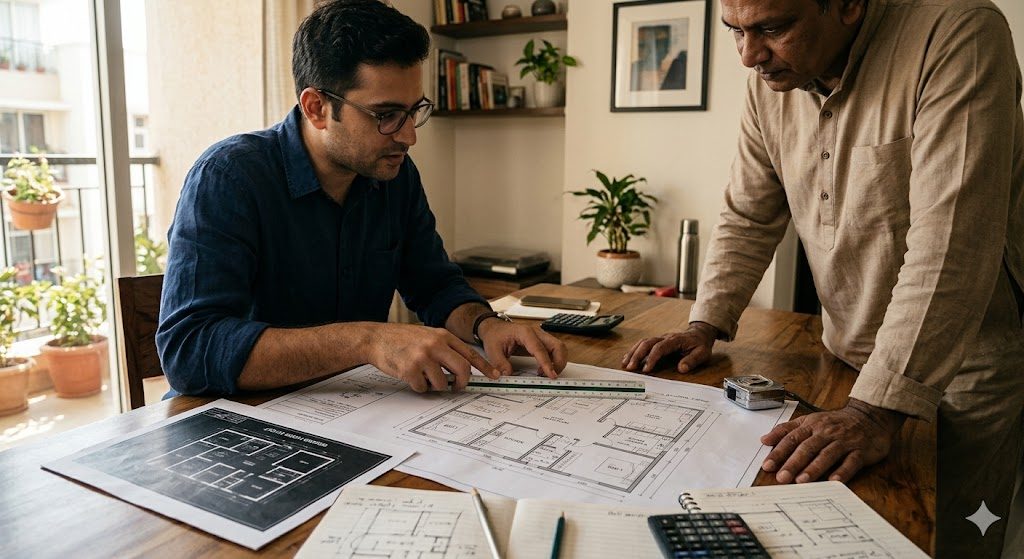
Beginner's Guide to Reading Floor Plans
Decode any floor plan like a pro — symbols, scale, dimensions, circulation and red flags
When Rajesh and Sunitha booked a 2BHK in a half-built Whitefield project, they spent an entire evening with the developer's floor plan spread across their dining table. They counted the bedrooms, found the balcony, and signed. Eighteen months later they moved in and discovered the truth the drawing had quietly told them all along: the second bedroom shared a wall with the bathroom soil pipe, the kitchen had a single high window that faced a blank lift shaft, and the "spacious" living room shrank to a usable nine feet once the sofa cleared the front-door swing. None of this was hidden. It was all printed on the plan. They simply could not read it.
This guide teaches you to read it. We will go from the absolute basics — what a floor plan actually is, how to read its scale and dimensions, what the strange marks mean — through to the harder skill of judging whether a room is genuinely usable, whether air and light can move through the home, and how to spot the red flags that turn into regrets after the concrete has set. It sits inside our larger walkthrough on how to plan your dream home before you meet an architect, and it pairs naturally with our deeper piece on space-planning principles.
The single idea to carry through this guide: a floor plan is a contract you sign with your future life, and if you approve a drawing you cannot read, you are agreeing to mistakes you will only discover after construction — when they are ten times more expensive to fix.
Why every homeowner must be able to read a plan
You will be shown floor plans at three moments that shape your money and your daily life: when a developer sells you an apartment, when an architect presents a design, and when a contractor builds from a working drawing. At every one of those moments, you are expected to approve. Most homeowners nod because the drawing looks professional and the alternative — admitting you cannot read it — feels embarrassing.
But the people drawing the plan are not living in it. You are. The architect will not be the one squeezing past a wardrobe that opens into a doorway every morning for twenty years. The builder will not be the one running an air-conditioner at noon in a bedroom that gets no breeze. The plan is the one chance to catch these things while they are still lines on paper and cost nothing to move. After construction, a misplaced wall is a demolition, a re-route of plumbing, a fortnight of dust, and a bill that can run into lakhs.
A wall you move on paper costs a pencil. The same wall, moved after construction, costs a demolition crew, a plumber, two weeks, and your patience.
Reading a plan is not an architect's secret skill. It is a small, learnable literacy — like reading a train timetable or a nutrition label. An hour with this guide will let you walk into any plan presentation and ask the questions that separate a home you will love from one you will quietly tolerate.
The basics: what a floor plan actually is
A floor plan looks like a top-down view, but it is something more precise: it is a horizontal slice through the building, taken at roughly 1.2 metres above the floor, with everything above the cut removed and you looking straight down at what is left. That cut height is chosen deliberately — it passes through doors and windows, so they show up, but sits below the tops of most full-height cupboards and below the ceiling. This is why a plan shows door openings and window sills but not the ceiling fan or the loft.
Understanding the slice explains a lot. Walls appear as thick solid bands because you are looking at the cut faces of the brick or block. A window appears as a gap in the wall with thin lines, because the cut passes through the glass. A door appears as a gap with a quarter-circle arc, because the cut passes through the open doorway and the arc shows where the leaf swings.
Before you read a single room, orient yourself with four things printed on every competent plan.
| Element | Where it sits | Why you read it first |
|---|---|---|
| North arrow | Usually a corner, often top-right | Tells you which walls get morning sun, harsh west heat, and prevailing breeze |
| Scale | Near the title, written as 1:50 or 1:100 | Lets you trust the dimensions and judge proportion |
| Title block | Bottom or right-hand strip | Names the drawing, the date, the revision number, the project |
| Level marks | Small triangles or "+0.00" notes | Show steps, sunken areas, and finished floor levels |
The North arrow is the most under-used mark on any plan. In India it decides comfort more than almost anything else: a west-facing bedroom wall bakes through summer afternoons, while a north light is soft and steady all day. Many homeowners stare at room sizes and never glance at the arrow. Look at it first, every time. If you are evaluating direction seriously, our note on the east-facing house plan explains why orientation changes daily life.
The scale tells you how much real building each line represents. At 1:100, one centimetre on the page equals one metre on the ground; at 1:50, one centimetre equals half a metre, so the drawing is twice as detailed. Residential layouts are usually presented at 1:100 for the whole flat and 1:50 for bathrooms and kitchens where the detail matters. A useful habit: always prefer a printed scale bar over a written ratio, because a scale bar shrinks and grows with the page if it is photocopied or resized, while the ratio quietly becomes a lie.
The title block is the drawing's identity card. Its single most important field is the revision number. If you are looking at "Rev B" and the contractor is building from "Rev D", you are reviewing a home that no longer exists. Always confirm you are holding the latest revision before you spend an hour analysing it.
How to read dimensions: the millimetre convention
Indian construction drawings are almost universally dimensioned in millimetres, with no unit written. So a bedroom labelled "3600 x 3300" is 3.6 metres by 3.3 metres — about 11 feet 10 inches by 10 feet 10 inches. The unwritten rule is that a four-digit number on a residential plan is millimetres. Once you internalise this, the numbers stop being intimidating: drop the last three digits and read it as metres. 3600 becomes 3.6, 4500 becomes 4.5, 900 (a door) becomes 0.9.
A few conversions worth keeping in your head, because Indian homeowners think in feet but plans speak in millimetres.
| On the plan (mm) | In metres | In feet | What it usually is |
|---|---|---|---|
| 900 | 0.9 | 3 ft | A main door leaf width |
| 750 | 0.75 | 2.5 ft | A bathroom door |
| 1200 | 1.2 | 4 ft | A comfortable corridor |
| 3000 | 3.0 | 9 ft 10 in | A small bedroom side |
| 3600 | 3.6 | 11 ft 10 in | A decent bedroom or living side |
| 4500 | 4.5 | 14 ft 9 in | A generous living-room side |
Dimensions are written along dimension lines — thin lines running parallel to the wall, capped with small ticks or arrows at each end, with the measurement floating above. The crucial detail: a good plan tells you whether a dimension is the clear internal size (inside face of wall to inside face of wall — the space you actually live in) or a centre-to-centre size (measured through the middle of the walls, which the builder uses but which overstates your usable room). When in doubt, ask which one is shown, and insist that room sizes be quoted clear internal. To measure your own existing rooms against a plan, our room measurement tool gives you a clean method.
The symbols: a legend you can memorise in ten minutes

Every discipline has a shorthand, and floor plans are no different. The good news is that residential plans use perhaps a dozen symbols, and once you know them the drawing reads like a sentence. Here is the legend, drawn the way you will see it.

| Symbol | How it is drawn | What it tells you |
|---|---|---|
| Load-bearing wall | Thick solid band, often 230 mm | Structural — cannot be moved without an engineer |
| Partition wall | Thinner band, often 115 mm | Non-structural — can sometimes be moved or removed |
| Door + swing | Gap in wall with a quarter-circle arc | Width of opening and which way the leaf opens |
| Window | Gap in wall with thin parallel lines | Where light and air enter |
| French door / sliding | Gap with double lines or a sliding track symbol | A larger opening, usually to a balcony |
| Staircase | A run of parallel lines with an UP or DN arrow | Direction of climb; the arrow points the way up |
| WC (toilet) | A rounded oval with a tank rectangle | A water closet — a wet point |
| Washbasin | A rounded oval or D-shape against a wall | A wet point needing a drain |
| Shower / floor trap | A square with a corner trap mark | A wet zone; floor slopes to the trap |
| Kitchen sink | A double or single rectangle in the counter run | A wet point — anchors the kitchen plumbing |
| Electrical point | Small circle, arc, or letter symbol | Switches, sockets, light points (often on a separate layer) |
| Furniture | Light grey outlines of beds, sofas, tables | Indicative only — confirms the room can hold real furniture |
| Level change | A triangle, an arrow, or "+150" | A step up or down of that many millimetres |
Three of these deserve a closer look because they cause the most after-the-fact regret.
Walls. The thickness is not decoration. A thick wall is usually load-bearing and structural; a thin one is usually a partition. This matters because the moment you think "we will just knock this wall through later," the wall's thickness tells you whether that is a weekend job or a structural intervention needing a consultant. Never assume a wall can move because it is inconvenient.
Door swings. The arc is the single most ignored symbol and the source of countless daily irritations. The arc shows the floor area the door sweeps, and nothing — no wardrobe, no fridge, no second door — can occupy it. Trace every arc with your finger and watch for two doors whose arcs overlap, a door that swings into a light switch, or a door that opens to hide a useful corner of a room. These clashes are free to fix on paper and maddening to live with.
Stairs. The arrow is not arbitrary: it points in the direction you climb, and the line where it starts is the bottom step. In a duplex or villa plan, the same staircase appears on two floors — going UP on the lower plan and DN on the upper — so confirm the arrows agree. Our guide to duplex house plans goes deeper on reading split-level homes.
Reading room sizes — and whether they are actually usable
This is where most homeowners are quietly cheated, not by dishonesty but by vocabulary. In India three different "areas" describe the same flat, and they can differ by a third or more. Knowing which one a number refers to is the difference between a 2BHK that feels generous and one that feels like a corridor with rooms attached.
| Term | What it includes | Why it matters to you |
|---|---|---|
| Carpet area | The actual usable floor inside your walls — where you could literally lay a carpet | This is what you live in. The only honest number. RERA now mandates it. |
| Built-up area | Carpet area + the thickness of your walls + your own balcony | Always larger than carpet; a fair internal figure but not your living space |
| Super built-up area | Built-up + your share of lobbies, lift, stairs, common areas (the "loading") | The number developers love to advertise — it can be 25 to 35 percent more than carpet |
A flat sold as "1,250 sq ft super built-up" may give you only 850 to 950 sq ft of carpet. Since the Real Estate (Regulation and Development) Act, 2016 (RERA), developers must disclose carpet area, so always read room sizes against the carpet figure, not the marketing one. Our RERA guide explains your rights here in full, and if you are weighing a ready unit, our walkthrough on how to evaluate a builder floor before buying shows how to test these claims on site.
Beyond the area label, judge each room by its clear internal dimensions and a simple test: can it hold the furniture you actually own, with room to move around it? A master bedroom needs roughly 3.3 metres in its shorter side to fit a queen bed with side tables and a walking gap; below 3.0 metres it starts to feel tight. A living room narrower than 3.3 metres struggles to seat a sofa and a walkway. These are not rules, but useful floors. The fastest way to test a room is to mentally place a 6-foot bed (about 1.8 m), a 2-foot side table, and a 2-foot walkway and see if they fit inside the clear dimension. Our layout planner lets you drop real furniture into a room and find this out without guesswork.

Reading circulation and flow
Circulation is the space you move through rather than live in — entries, corridors, the path from the front door to the kitchen, the route from a bedroom to its bathroom. It is invisible to most buyers because it has no name on the plan, yet it can swallow ten percent of a flat's area and shape whether the home feels open or cramped.
Trace the routes with your finger. Walk from the front door to the kitchen carrying imaginary grocery bags: how many turns, how many doors, does the path cut through the living room where guests sit? Walk from each bedroom to its bathroom at 2 a.m.: is it direct, or does it cross a hall? A good plan has short, generous circulation that doubles as living space; a poor one has long thin corridors that you pay for but only walk.
Watch specifically for these flow faults:
- Dead space — a pocket of floor too small or awkward to furnish, often left by a jutting column or an odd wall. You are paying for it and it does nothing.
- Door clashes — two door swings overlapping, or a door swinging into a switch, a cupboard, or another door. Trace every arc.
- Through-rooms — a bedroom you can only reach by walking through another bedroom, or a kitchen that is the only path to a balcony. These destroy privacy.
- Pinch points — a corridor under 1.0 metre, or a gap between a wall and furniture under 600 mm, where two people cannot pass.
Our deeper guide on space-planning mistakes that make homes feel smaller catalogues these in detail and shows the fixes.
Checking light and ventilation
A room without daylight is a room with the lights on all day; a room without cross-ventilation is a room that needs an air-conditioner to be bearable. Both are visible on the plan, and both are governed by minimums in the National Building Code of India, 2016 (NBC 2016) and your local building bye-laws.
To read light, find every habitable room — bedrooms, living, dining, kitchen — and check that each touches an external wall with a window in it. A room buried in the core of the flat, opening only onto a corridor, will be dark forever. As a rough guide, NBC 2016 and most municipal bye-laws expect the openable window area of a habitable room to be a meaningful fraction of its floor area (commonly cited around one-tenth for light and a further share for ventilation, with local variations). You do not need to compute this precisely; you need to confirm that every room people occupy has a real window onto open air, not onto a lift shaft, a duct, or a neighbour's wall a metre away.
To read ventilation, look for cross-ventilation: an opening on one side of a room and another opening roughly opposite, so a breeze can pass through rather than stall. A room with a single window has poor air movement no matter how large that window is. The best plans place habitable rooms so that prevailing breeze (read the North arrow and your city's wind direction) enters one side and leaves the other. If you find your home feels stuffy or dim, our companion piece on why your home feels dark traces the causes back to the plan. For choosing a layout suited to your weather, our guide on which house plan fits your climate zone is the place to start.
Spotting red flags in a plan
Now combine everything. Below is a single plan carrying five of the most common faults, each marked in warning red. Train your eye on these and you will catch them in the wild.

Here is the full checklist to run on any plan before you approve it.
| Red flag | How to spot it on the plan | Why it hurts you later |
|---|---|---|
| Dark room | A habitable room with no window on an external wall | Lights and fans run all day; the room feels like a basement |
| No cross-ventilation | A single window with no opening opposite | Stuffy air; permanent reliance on the air-conditioner |
| Awkward toilet placement | A WC opening directly into the kitchen, dining, or facing the main door | Smell, hygiene, and a Vastu concern many buyers care about |
| Kitchen-toilet adjacency | A toilet sharing a wall (or stacked above) the kitchen or its sink | Damp on the shared wall, hygiene worry, and resale resistance |
| Wasted circulation | Long thin corridors connecting rooms | You buy and clean floor area you only walk across |
| Undersized rooms | A bedroom side under 3.0 m or living under 3.3 m clear | Furniture barely fits; the room feels mean despite a big "area" |
| Bad door swings | Overlapping arcs, or a door swinging onto a switch or cupboard | Daily friction you cannot unsee once you live there |
| No storage | No wardrobes drawn, no utility, no loft, no store | Possessions spill into living space; the home feels cluttered |
| Plumbing scattered | Bathrooms and kitchen spread to opposite corners | Longer wet runs, more leak points, higher plumbing cost |
| Bedroom off the living room | A bedroom whose only door opens into the main social space | Zero acoustic or visual privacy |
A plan need not be perfect — every home is a compromise. But each red flag you accept should be a conscious choice, not a surprise. The point of reading the plan is to convert surprises into decisions.
How to mark up a plan with questions for your architect
Reading a plan is only half the skill. The other half is communicating clearly back. Print the plan large — A3 if you can — and sit with a coloured pen. Do not try to redesign it; your job is to ask sharp questions and let the professional solve them.
A simple markup discipline that architects respect:
- Circle anything you do not understand and write a question mark beside it.
- Draw an arrow from a room to the margin and write the use you intend ("our study cum guest room — needs a sofa-bed").
- Hatch any area you think is dead or wasted and write "use?"
- Trace door swings in red and flag any clash you find.
- Write your furniture in each room — bed size, wardrobe length, dining seats — so the architect designs for your real life, not a generic one.
- Number your questions in the margin and keep a matching list, so nothing is lost between meetings.
This turns a vague "I am not sure about the bedroom" into "Bedroom 2 is 3.0 m clear on the short side — will our queen bed plus a wardrobe fit, and can we move this partition 300 mm?" That is a question an architect can answer in seconds, and it is the kind of question that comes only from someone who can read the drawing. When you are ready to brief a designer properly, our piece on moving from client brief to concept shows how these annotations become a real design conversation.
Get it right, in order
1. Confirm you hold the latest revision — check the title block before spending an hour on a plan that has been superseded.
2. Find North first — it decides sun, heat, and breeze for every room.
3. Trust the scale bar over the written ratio — and read all dimensions as millimetres, dropping three zeros to get metres.
4. Read room sizes against carpet area, not super built-up — and test each room with the furniture you actually own.
5. Trace every circulation route and every door swing — hunt for dead space, through-rooms, and clashes.
6. Check that every habitable room has a real window and a cross-breeze — no room buried against a duct or a single-window box.
7. Run the red-flags checklist — and accept each compromise consciously, never by accident.
8. Mark up the plan with numbered questions — and take them to your architect before, not after, construction begins.
Reading a plan well is the cheapest insurance you will ever buy on the most expensive thing you will ever own. An hour of careful reading on paper saves a year of regret in concrete.
If translating a plan into a brief feels daunting, DesignAI can help: describe your plot, your family, and how you want to live, and it drafts a starter layout, a written brief, and a rough bill of quantities you can take straight to an architect — turning a blank page into a plan you can actually read, question, and improve.
References
1. Bureau of Indian Standards, National Building Code of India, 2016 (NBC 2016) — Part 3 (Development Control and General Building Requirements) and Part 8 (Building Services), for lighting, ventilation and habitable-room requirements.
2. The Real Estate (Regulation and Development) Act, 2016 (RERA) — carpet area definition and mandatory disclosure (Section 2(k)).
3. Bureau of Indian Standards, IS 962: Code of Practice for Architectural and Building Drawings — conventions for symbols, dimensioning and scales.
4. Francis D. K. Ching, Architecture: Form, Space and Order and Architectural Graphics — the standard references on reading and drawing plans, scale, and circulation.
5. Council of Architecture (CoA), India — guidance on architectural drawings and the architect's scope in residential projects.
6. Ernst Neufert, Architects' Data — anthropometric and furniture-clearance dimensions for judging usable room sizes.
Keep going: pair this with our pillar on planning your dream home before the architect, the deeper space-planning principles, the 2BHK house plan guide, and our walkthrough on evaluating a builder floor before buying.
Export this guide
Related Guides — Deep-dive reading
Storage Planning Before Interior Design
Why storage must be planned first — audited, budgeted and given its floor area — before a single layout, colour or sofa is chosen. The homeowner's plan-it-first master guide for Indian homes.
StorageUnderstanding Sun Path Analysis for Your Home
How the sun actually moves over an Indian site through the day and the year — and why that single fact quietly decides where your kitchen, bedroom and living room should sit.
Site PlanningWhy Scale Matters: Keeping Rooms Comfortable for Humans
How sizing furniture, art and lighting to the human body — not the showroom — keeps small Indian flats from feeling crushed and large halls from feeling empty.
Design PrinciplesRelated Tools — Try Free
Cross-Ventilation Analyzer
Estimate airflow and air changes per hour (ACH) from room size, window areas, layout, and local wind — with NBC 2016 Part 8 compliance check.
Ventilation CalculatorApartment Interior Planning Checklist
51-item checklist across structural, ceiling, lighting, furniture, storage, electrical, kitchen, bathroom.
ChecklistVastu Window Planner
Vastu guidance for window placement and size by wall direction and room — rating and remedies.
Vastu