
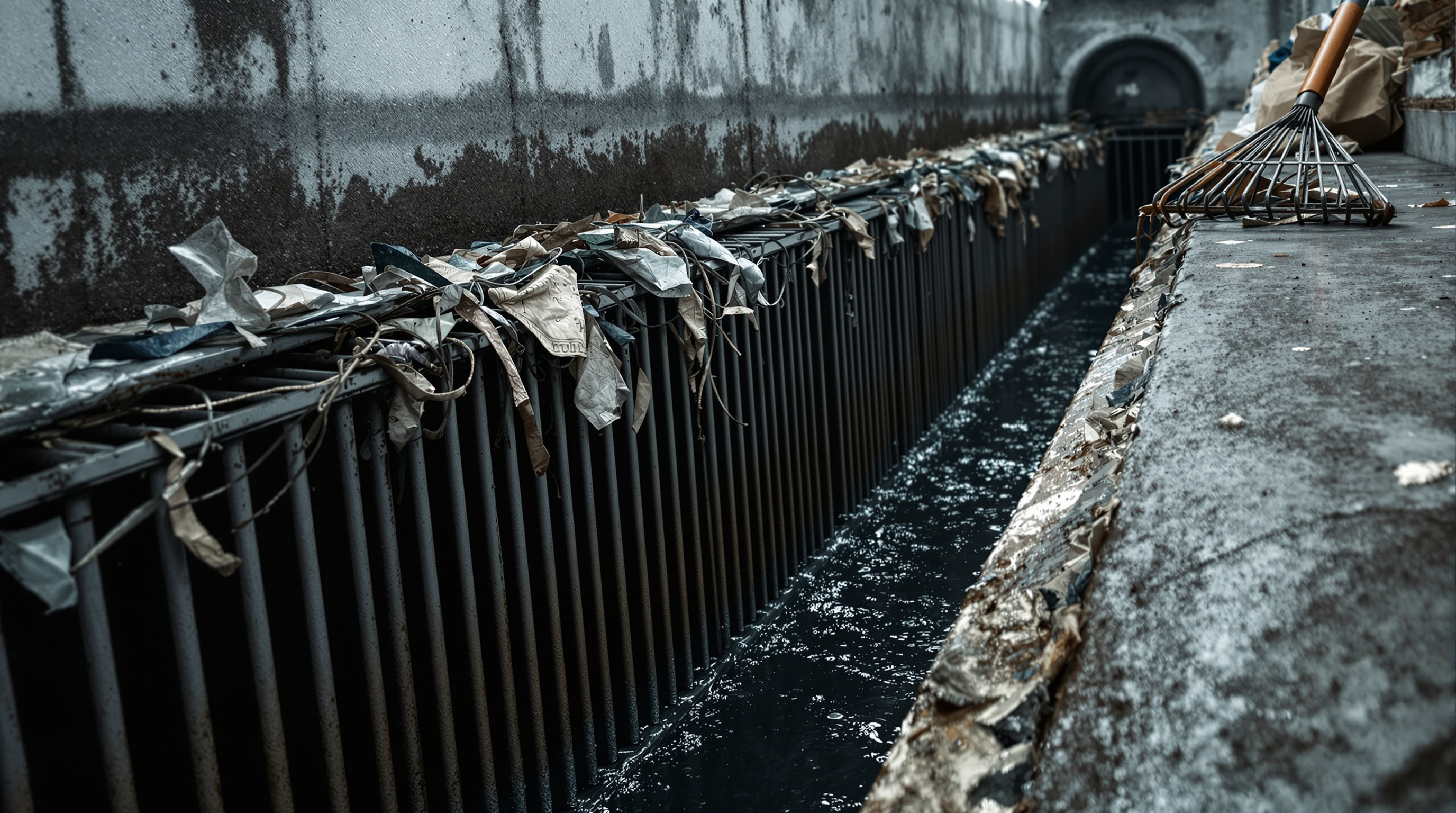
Bar Screen Chamber: The First Line of Defence in an STP
What a bar screen chamber is, why it sits right at the inlet of every sewage treatment plant, and how it protects your pumps and pipes by catching rags, plastics and coarse solids — with manual vs mechanical screens, bar spacing and cleaning explained plainly.
Walk up to any sewage treatment plant and follow the incoming pipe backwards, and the very first thing you will meet is not a fancy tank or a bank of blowers. It is a plain concrete channel with a set of steel bars standing across it like a comb. This is the bar screen chamber — the humblest-looking part of the whole plant, and the one that quietly saves you from your most expensive repairs.
Sewage arriving from a building is not just dirty water. Mixed into it are rags, sanitary waste, plastic wrappers, cloth, hair, bottle caps, twigs and the occasional lost mug. If that junk is allowed to travel deeper into the treatment process, it jams pumps, wraps around impellers, chokes pipes and clogs diffusers. The bar screen chamber exists to stop it at the door.
The bar screen is to an STP what a strainer is to a kitchen sink: it does no real "cleaning" of the water, but without it every machine downstream would choke within days. Catch the junk first, treat the water second.
What a bar screen chamber actually is
A bar screen chamber is the first unit of preliminary treatment — the stage that protects the plant before any biological work begins. Physically it is a rectangular channel, usually built in RCC (reinforced concrete) or sometimes fabricated in steel, through which all the raw sewage must flow. Set across that channel, at an angle, is the screen: a row of parallel steel bars (called a rack) with even gaps between them.
The water slips between the bars and carries on. Anything wider than the gap gets caught on the face of the screen and held back. Those trapped solids are called screenings, and they are raked off and thrown away — they are the first "waste" the plant separates out.
It sits right at the inlet, typically just after the incoming sewer line and before the collection tank or equalization tank. In many compact Indian STPs the screen channel and the raw sewage sump are built as one combined inlet structure. For the bigger picture of where every unit sits, see how an STP works.
Why it matters: protecting the pumps
The single most important job of the bar screen chamber is pump protection. Sewage pumps — and later the blowers, diffusers and filters — are the costly, moving, hard-to-replace heart of an STP. They are designed to move water and fine suspended solids, not to swallow a bedsheet.
Here is what a good screen prevents:
- Pump chokage and burnout — a rag wrapped around an impeller stalls the motor and can burn out the winding. This is the number-one cause of pump failure in poorly screened plants.
- Blocked pipes and valves — plastics and cloth lodge at bends and narrow points, throttling flow until the line jams.
- Damaged downstream equipment — grit and hard objects abrade impellers; fibres clog fine-bubble diffusers and mat onto media in MBBR or membrane systems.
- Foul, inaccessible blockages — clearing a choked submersible pump in a raw sewage sump is one of the worst jobs in plant operation. A Rs 5,000 screen prevents a Rs 50,000 pump strip-down.
In short, the screen trades a two-minute raking chore for a fleet of avoided breakdowns. It is the cheapest insurance in the whole plant.
Manual vs mechanical screens
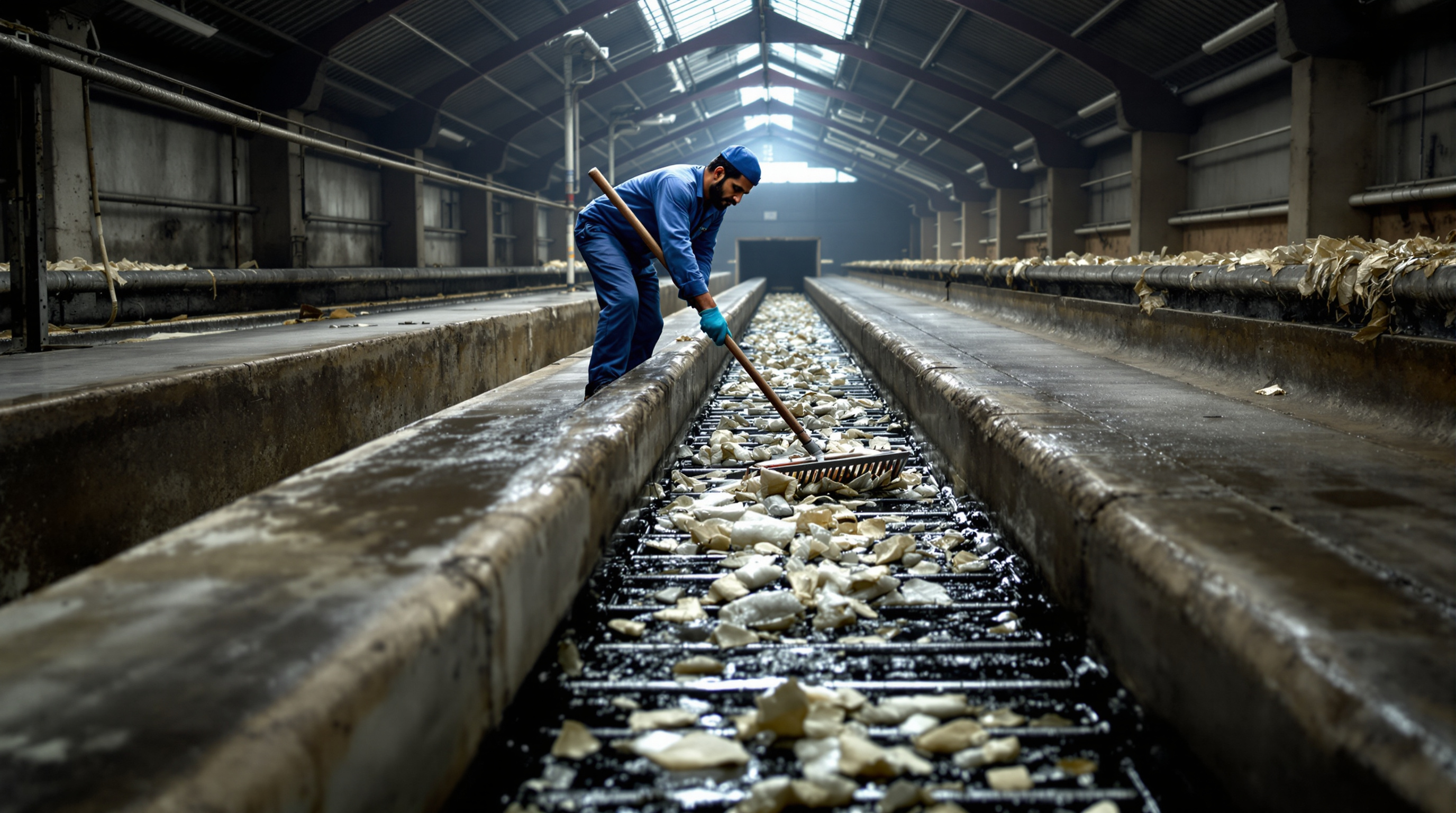
There are two ways to get the screenings off the bars: a person with a rake, or a machine that does it automatically. Which you choose depends mostly on the size of the plant and how much operator attention it can expect.
| Manual bar screen | Mechanical bar screen | |
|---|---|---|
| How it's cleaned | Operator rakes the bars by hand, several times a day | Motor-driven rake or chain cleans automatically on a timer or level trigger |
| Best for | Small to medium STPs (roughly up to a few hundred KLD) | Large STPs, and any plant with high or unpredictable solids load |
| Cost | Low capital, low tech | Higher capital, needs power and maintenance |
| Labour | Depends entirely on a diligent operator | Runs on its own; frees the operator |
| Risk | If raking is skipped, the screen blinds and overflows | Mechanical parts can jam or fail if neglected |
Most residential and commercial building STPs in India use a manual screen — it is simple, cheap and perfectly adequate if someone actually rakes it. That "if" is the whole catch: a manual screen is only as good as the operator's discipline. Larger developments, hospitals and townships, or any plant where the incoming sewage is heavy with solids, lean towards a mechanical screen so that cleaning never depends on someone remembering.
Many well-designed plants also run two screens in series — a coarse screen first, a finer one behind it — often with a bypass channel so one can be cleaned while the other stays in service.
Bar spacing: coarse and fine screens
The gap between the bars — the bar spacing or clear opening — decides what gets caught and what slips through. Screens are grouped by this spacing:
- Coarse screens — bar gaps of roughly 25 to 50 mm. These catch the big stuff: rags, bottles, cloth, plastic sheets. This is the workhorse screen at most building STPs.
- Fine screens — bar gaps of roughly 6 to 15 mm (some go finer). These catch smaller fibres and particles and are used where the downstream process is sensitive — for example ahead of a membrane bioreactor or fine-bubble aeration.
The bars themselves are usually flat or round steel, set at an incline of about 60 to 75 degrees from the horizontal in a manual screen — the slope lets the operator rake upward and lift screenings clear of the flow. The channel is sized so that sewage flows through the openings at a gentle velocity (broadly in the region of 0.6 to 1.0 m/s at peak flow): fast enough that solids don't settle and rot in the channel, slow enough that they don't get pushed straight through the bars.
These are directional figures, not a design code. Actual spacing, velocity and channel dimensions come from the plant's design flow and the engineer's judgement, in line with CPCB and NBC guidance. To get the design flow your own building would start from, the STP Capacity Calculator turns an occupancy count into a treatment capacity in KLD.
Common problems and O&M
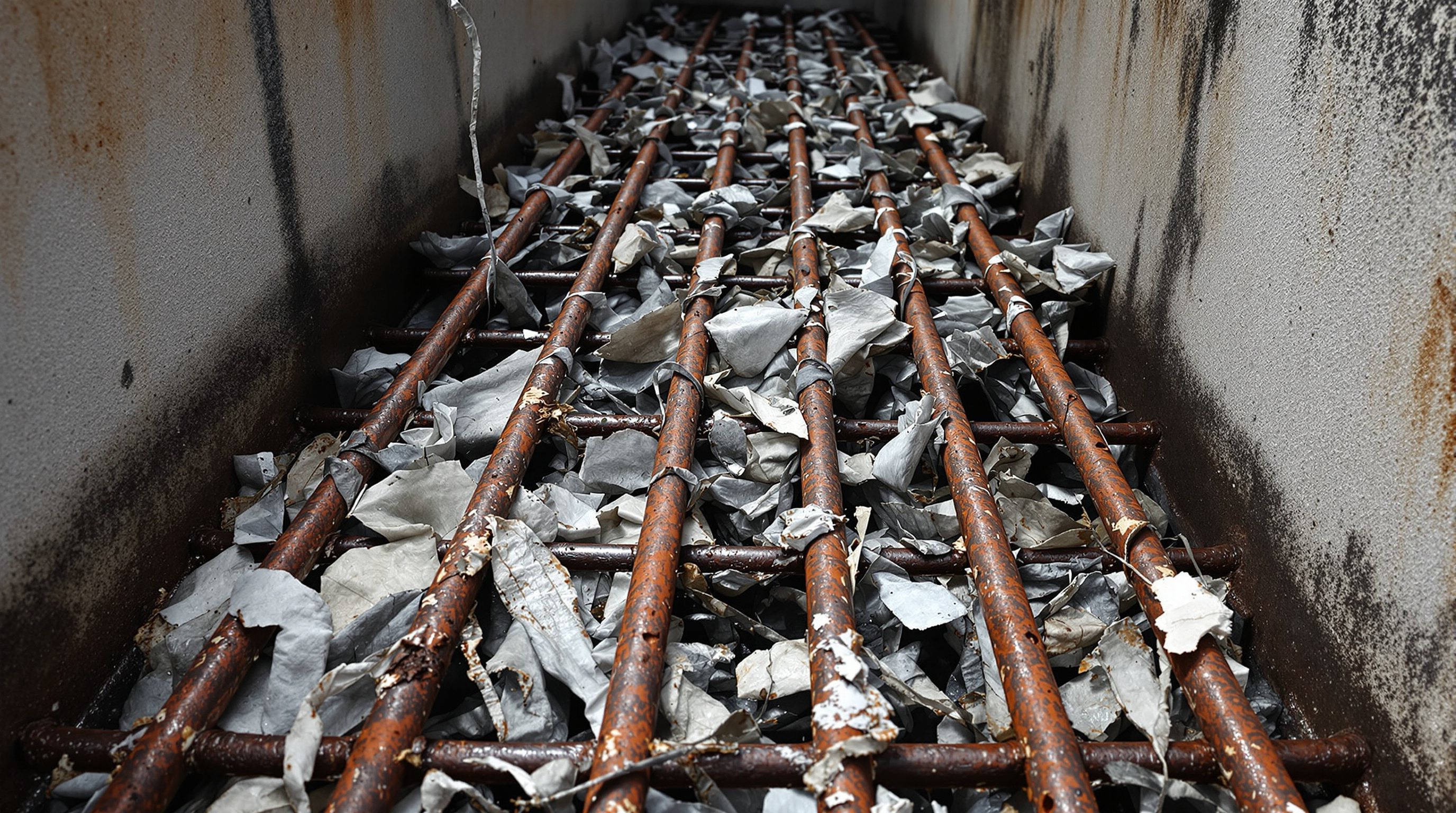
The bar screen chamber has no motor to burn out (in the manual case) and no chemistry to go wrong — yet it is the single most neglected unit in most STPs, precisely because it looks so simple. The problems are almost always about operation, not equipment:
- Blinding (screen overload). If screenings are not raked off, they build into a solid mat that water cannot pass. The chamber then backs up and can overflow — sending raw sewage where it should never go. The fix is discipline: rake on a fixed schedule, more often during peak hours.
- Screenings left beside the channel. Raked waste dumped on the platform rots, smells and breeds flies. It should be drained of water, bagged and sent out with solid waste promptly — never washed back into the channel.
- Corrosion. Sewage is corrosive and screens live in it constantly. Good plants specify stainless-steel or well-coated bars; ordinary mild steel pits and thins over the years and eventually needs replacement.
- Grit and settled solids in the channel. If flow velocity drops too low, grit settles in the channel bottom and turns septic. The channel needs periodic cleaning out.
- Mechanical rake jams (mechanical screens). The rake mechanism, limit switches and drive need routine inspection and lubrication, or the automation you paid for quietly stops working.
A sensible O&M routine is unglamorous but short: rake the screen several times a day, log how much you remove, dispose of screenings the same day, hose down the platform, and inspect the bars for corrosion and bent rods weekly. Ten minutes of attention here protects lakhs of rupees of equipment behind it.
Where it sits in the treatment flow
To place the bar screen chamber in context, it is the first stop in a sequence that gets the water progressively cleaner:
1. Bar screen chamber — removes rags, plastics and coarse solids (you are here).
2. Oil and grease trap — skims floating fats, especially from kitchens (see the oil and grease trap guide).
3. Collection / equalization tank — buffers and evens out the flow.
4. Biological treatment — the aeration tank and clarifier, where microbes do the real cleaning.
5. Tertiary polishing and disinfection — filters and UV or chlorine before reuse.
Everything after the screen assumes the junk is already gone. That is why this small concrete channel, easy to overlook and easier to neglect, genuinely earns its name: the first line of defence of the entire plant.
For the full journey from inlet to reuse, start with What is a Sewage Treatment Plant, or browse the complete STP guide library to explore every unit in depth.
Export this guide
Related Guides — Deep-dive reading
STP for Restaurants & Kitchens: Grease, Effluent Treatment & Compliance Guide
Restaurant wastewater is a different animal — thick with fats, oils and grease and a heavy organic load. This guide explains how to trap the grease, whether you need a full STP or just pretreatment before the sewer, and how a standalone eatery stays compliant in India.
Sewage Treatment PlantsOil & Grease Trap in an STP: Why It Matters (FOG Removal Explained)
The quiet chamber that skims fats, oils and grease out of kitchen-heavy sewage before it ever reaches the biology. What an oil and grease trap does, how its baffles work, how often it must be cleaned, and why skipping it wrecks an STP.
Sewage Treatment PlantsDaily STP Checklist: What Operators Must Check Every Day
The exact round an STP operator should walk every single day — dissolved oxygen, blowers, MLSS colour and smell, flow, chlorine residual, screens, pumps and the logbook — laid out as a practical checklist a facility manager can actually follow.
Sewage Treatment PlantsRelated Tools — Try Free
Apartment STP Planner
Plan an apartment complex sewage treatment plant from flats and occupancy — get population load, sewage flow, recommended STP capacity in KLD, treatment technology and approximate space.
PlannerSewage Generation Calculator
Estimate the daily sewage a building generates and its peak flow in KLD from occupancy, LPCD, sewage return factor and peak factor.
STP CalculatorCross-Ventilation Analyzer
Estimate airflow and air changes per hour (ACH) from room size, window areas, layout, and local wind — with NBC 2016 Part 8 compliance check.
Ventilation Calculator