
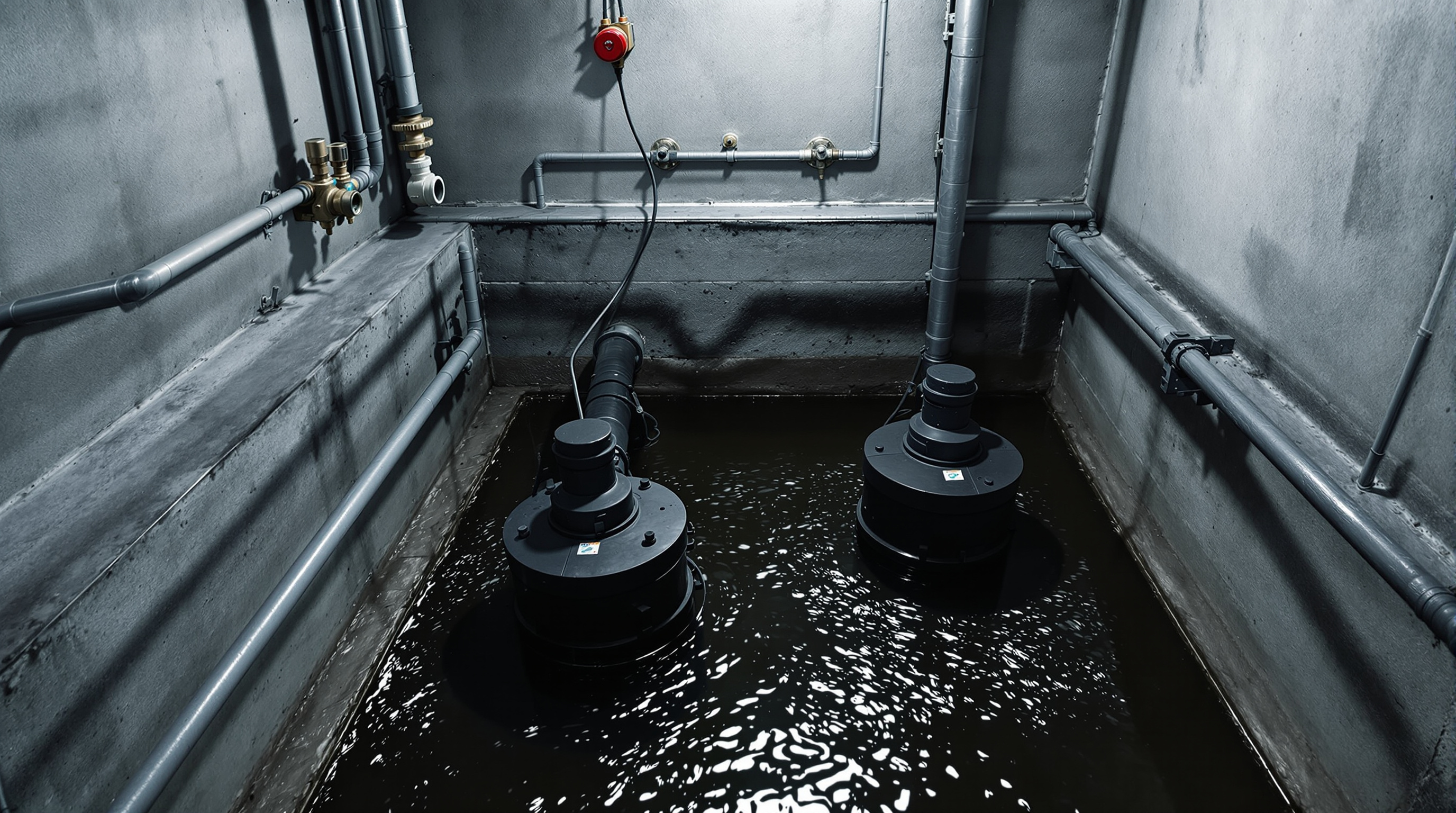
Collection Tank (Raw Sewage Sump) in an STP: The First Sump Explained
The raw sewage sump is where a building's drains empty and treatment begins. Here is what the collection tank does, how its float switches and submersible transfer pumps work, and why it is not the same thing as the equalisation tank.
Every drop of wastewater a building produces has to arrive somewhere before it can be cleaned. Toilets, kitchens, bathrooms and floor drains all feed into pipes that slope gently downward, and gravity carries everything to the lowest point on the plot — usually a pit in the basement or a corner of the STP yard. That pit is the collection tank, also called the raw sewage sump or wet well. It is the true starting line of the treatment process: the place where scattered building drains become one pooled stream, and where the plant's first pumps lift that stream up into the treatment train.
It is an unglamorous tank — no microbes, no filters, no clever chemistry. But get it wrong and the whole STP downstream starves or floods. This guide explains what the collection tank does, how its level controls and submersible pumps work, how it is sized, what goes wrong with it, and — the question that trips up most people — how it differs from the equalisation tank.
Think of the collection tank as the plant's loading dock. It does not treat anything. Its only job is to gather all the raw sewage in one place and hand it, at a controlled level, to the pumps that lift it into treatment.
What the collection tank actually does
The collection tank sits at the head of the plant, immediately after the drains and (usually) a bar screen chamber that catches rags and large solids. Its role is deliberately narrow:
- Collect. Gather the gravity-fed raw sewage from the entire building into a single sump.
- Buffer briefly. Hold a small working volume so incoming flow and pumped-out flow do not have to match second by second.
- Lift. House the transfer pumps that raise the sewage from the basement level up to the treatment tanks — which almost always sit higher so the rest of the plant can then flow by gravity.
That last point is the reason the tank exists at all. Sewage arrives at the lowest level of the site, but treatment happens above it. Something has to do the lifting, and it is the collection tank's submersible pumps. Everything after this — screening, oil removal, equalisation, aeration — is fed by them. If you want to see where this sits in the full sequence, our sewage treatment process flow guide maps the whole journey tank by tank, and the beginner's STP overview explains why the stages run in this order.
The submersible transfer pumps
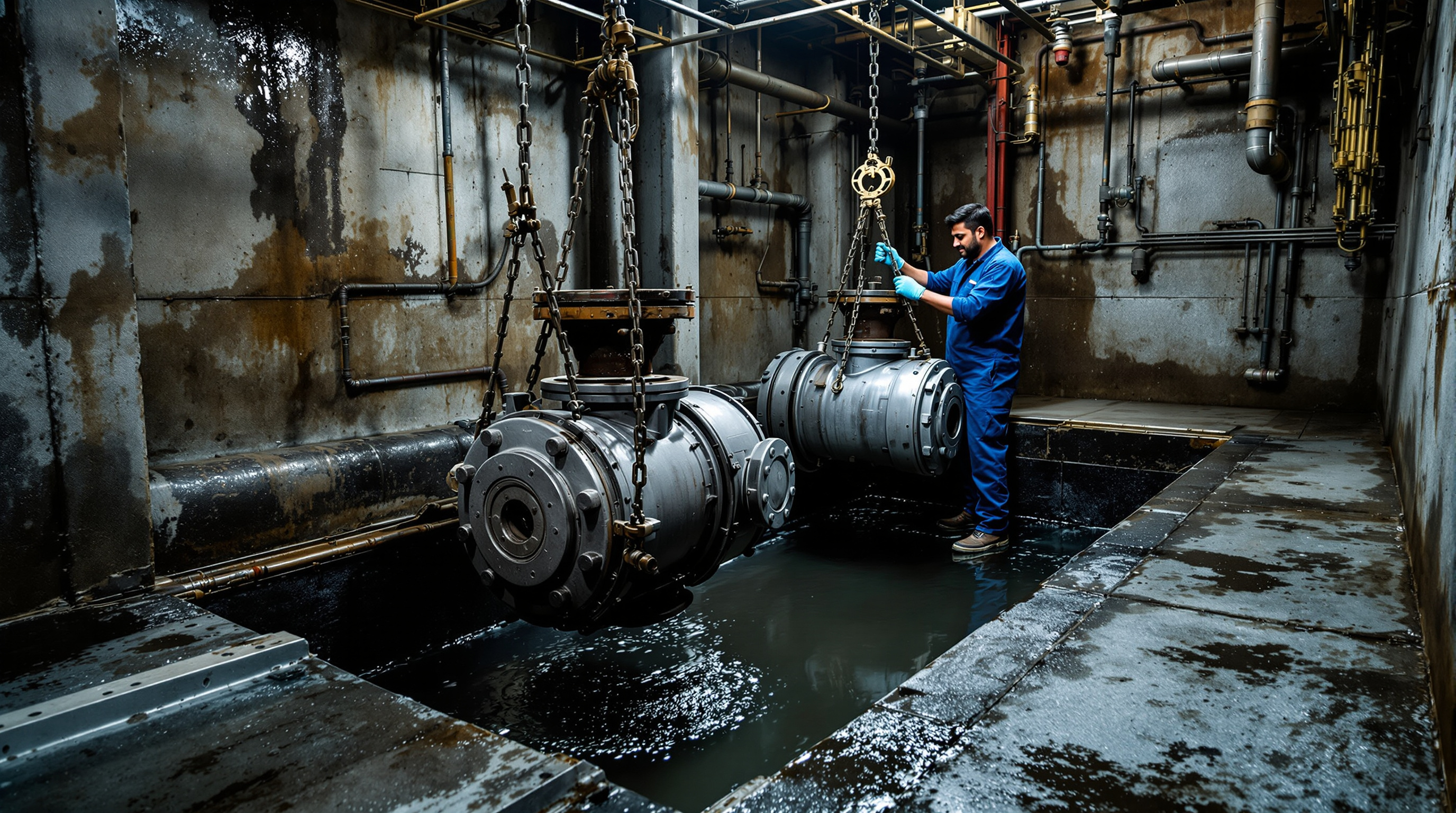
The workhorses of the collection tank are submersible sewage pumps — sealed motor-and-impeller units that sit fully underwater at the bottom of the sump. A few features matter:
- Non-clog / channel impellers. Raw sewage carries rags, sanitary waste, hair and grit. Collection-sump pumps use open or single-channel impellers designed to pass solids without jamming, not the closed impellers used for clean water.
- Duty and standby. A well-designed sump has at least two pumps — one running (duty), one resting (standby). They alternate automatically so wear is shared and there is always a spare if one fails. Larger plants run duty + assist + standby.
- Auto-coupling guide rails. Each pump drops onto a fixed base connection along a guide rail, so a clogged or failed pump can be hoisted straight up for cleaning without anyone entering the sump or draining it.
Because these pumps handle raw, septic sewage and abrasive grit, they are a genuine consumable — expect periodic seal and impeller wear. Pump selection, control panels and instrumentation are covered in more depth in the STP pumps and instrumentation guide.
Level controls: how the pumps know when to run
The collection tank runs itself automatically, and the brain behind it is a simple set of level controls. Float switches (or a level transmitter) sense how high the sewage has risen and switch pumps on and off accordingly. A typical arrangement:
| Level setpoint | What happens | Why it matters |
|---|---|---|
| Low / cut-off | All pumps stop | Keeps the pumps submerged; prevents dry-running and burnout |
| Start (lead) | Duty pump switches on | Begins lifting as the sump fills |
| High (lag) | Second pump switches on too | Handles peak inflow so the sump does not overflow |
| High-high | Alarm sounds | Warns of pump failure or blockage before sewage backs up |
This lead–lag logic does two useful things at once. It alternates the pumps so no single unit does all the work, and it matches pumping to inflow — one pump for normal flow, both when everyone showers at 7 a.m. The low-level cut-off is the most important safety line: submersible pumps are cooled by the sewage around them, and running one dry even briefly can destroy the seal and motor.
How big should a collection tank be?
The collection tank is small on purpose — it is not meant to store sewage, only to give the pumps a sensible working volume. Two limits set its size:
- Pump cycling. The tank must hold enough between the start and stop levels that the pumps do not switch on and off too frequently. Rapid cycling overheats motors and wears contactors, so designers usually cap it at roughly 10–15 starts per hour.
- Short retention. As a rough directional figure, a collection sump often provides only about 10–30 minutes of retention at peak flow. Much beyond that and the sewage begins to turn septic and smelly before it even reaches treatment.
Depth matters as much as volume: the sump must be deep enough to keep the pumps fully submerged at the low-level cut-off, with room for the guide-rail assembly below the inlet. The starting number for all of this — the building's daily sewage flow — comes from headcount. The sewage generation calculator and the STP capacity calculator turn occupancy into litres per day and a plant capacity, which is where sump sizing begins.
Collection tank vs equalisation tank — the key difference
This is the confusion worth clearing up, because on a drawing the two tanks sit side by side and both hold raw sewage. They do completely different jobs:
- The collection tank collects and lifts. It is small, holds sewage for minutes, and its pumps run on level control. Its goal is simply to get raw sewage up into the plant.
- The equalisation tank balances flow and load. It is much larger — often several hours of retention — and is continuously aerated or mixed to keep solids suspended and stop the sewage going septic. Its goal is to smooth the surges (the 7 a.m. peak, the midday lull) into a steady, even feed so the biological stage downstream is never shocked or starved.
In short: the collection tank answers "how do we get the sewage up here?"; the equalisation tank answers "how do we feed it into treatment at a calm, constant rate?" On small STPs the two are sometimes combined into a single raw sewage collection-cum-equalisation tank, but on any plant of size they are separate, and the collection sump always comes first.
Common problems and O&M
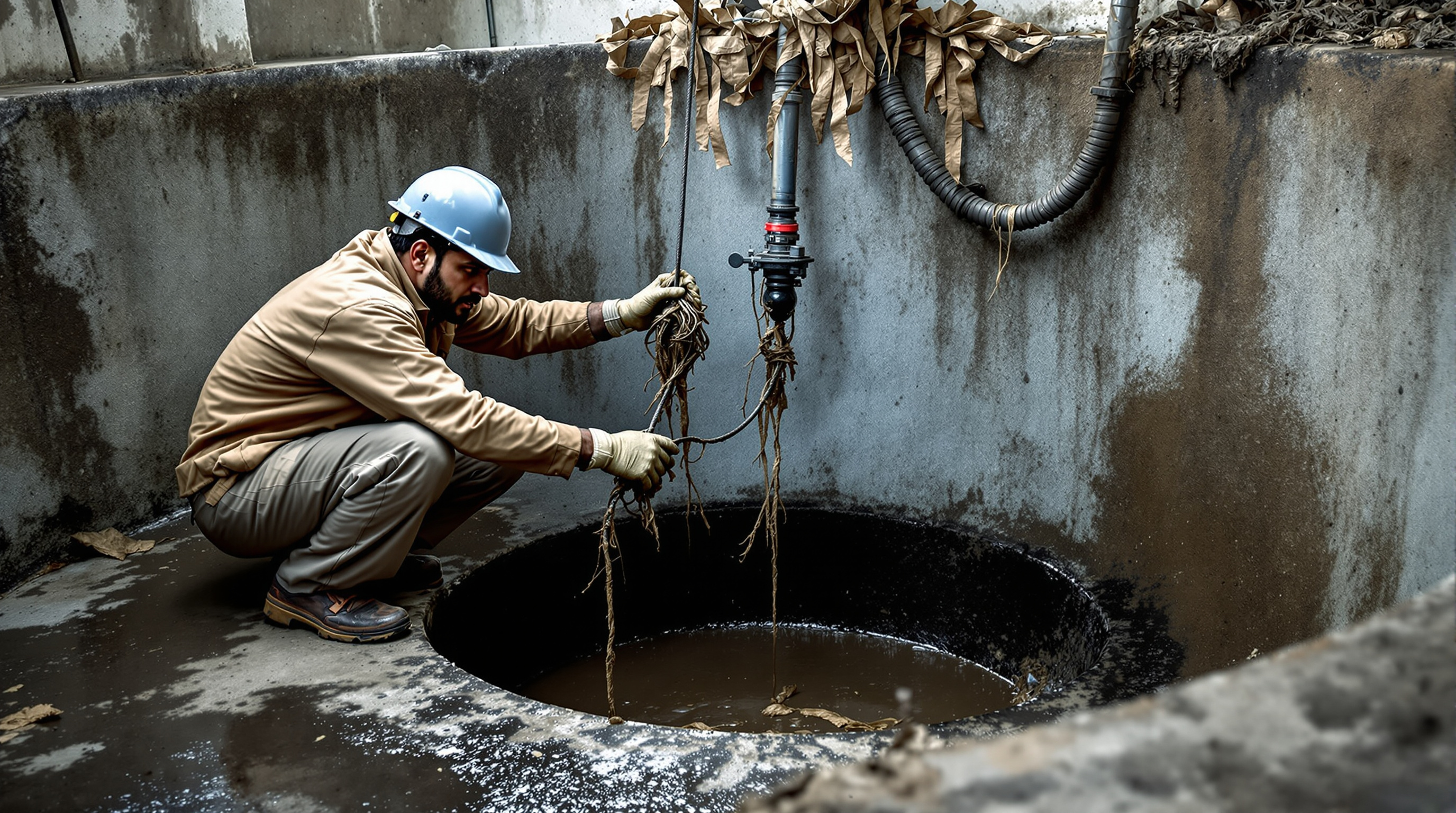
Because it handles the rawest, most solids-laden sewage in the plant, the collection tank is where a lot of everyday trouble shows up:
- Rag and grease clogging. Sanitary waste, cloth and congealed kitchen grease wrap around impellers and float switches. A working bar screen upstream is the best defence; regular pump lifting and cleaning is the cure.
- Grit and silt build-up. Sand and grit settle at the bottom and, over months, reduce the working volume and abrade the pumps. Sumps need periodic desilting.
- Septicity and odour. If sewage sits too long, bacteria turn it septic, releasing hydrogen sulphide (H₂S) — the rotten-egg smell — which is also corrosive to concrete and metal. Keeping retention short and, where fitted, a little coarse-bubble mixing helps.
- Float switch fouling. Grease-coated floats stop moving and give false levels, causing pumps to dry-run or the sump to overflow. Floats must be wiped clean on a routine.
- Dry-running and no-standby operation. A failed low-level cut-off, or a plant limping along on a single pump with the standby out of service, is how motors burn out. Checking pump alternation, non-return valves and the standby is basic monthly O&M.
A safety note: a raw sewage sump is a confined space that can accumulate toxic and oxygen-depleted gases. It should never be entered without proper confined-space precautions — which is exactly why guide-rail pumps that lift out from the top are worth the money.
Where it fits — and what comes next
The collection tank is the humble first link in the chain: drains → collection tank / raw sewage sump → bar screen and oil-and-grease removal → equalisation → biological treatment → filtration and disinfection → reuse. It treats nothing, but by gathering every drain into one place and lifting it reliably, it sets the pace for the entire plant.
From here, the natural next stops are the equalisation tank, which takes the sewage the collection sump lifts and turns it into a steady feed, and the full process-flow guide, which shows how all the tanks connect. For the complete picture, the Sewage Treatment Plants guide library walks through every component in turn.
Export this guide
Related Guides — Deep-dive reading
The Sewage Treatment Process Flow, Explained: Every Stage From Inlet to Reuse
Follow a drop of sewage through a typical STP — inlet, screening, aeration, clarifier, filtration, disinfection and reuse — as one connected flow, with a block diagram and a unit-by-unit table, in plain language.
Sewage Treatment PlantsSewage & Effluent Pumps in India: Lifting Foul Water Where Gravity Can't
The submersible sewage pumps, macerator/grinder units and basement lifting stations that move foul water uphill — from a basement WC below the sewer, from a wet well, or up to the STP. Solids-handling impellers, guide-rail auto-coupling, duty/standby control and alarms, sizing on head and flow, and indicative Indian pricing.
PlumbingBar Screen Chamber: The First Line of Defence in an STP
What a bar screen chamber is, why it sits right at the inlet of every sewage treatment plant, and how it protects your pumps and pipes by catching rags, plastics and coarse solids — with manual vs mechanical screens, bar spacing and cleaning explained plainly.
Sewage Treatment PlantsRelated Tools — Try Free
Sewage Generation Calculator
Estimate the daily sewage a building generates and its peak flow in KLD from occupancy, LPCD, sewage return factor and peak factor.
STP CalculatorPool Volume Calculator
Water volume in litres, US gallons and cubic metres, by pool shape and depth.
Pool CalculatorSTP Capacity Calculator
Size a sewage treatment plant in KLD from your building's occupancy — water demand, sewage generated and recommended STP capacity.
STP Calculator